NVIDIA, IBM, Fermilab Plan Quantum Platform; CUDA-Q QEC 13,000x Claim
NVIDIA, IBM and Fermilab plan to colocate DGX B200 systems with IBM Nighthawk quantum computers, and NVIDIA claims its decoder is up to 13,000x faster. No start date or cost is given.
2 min read
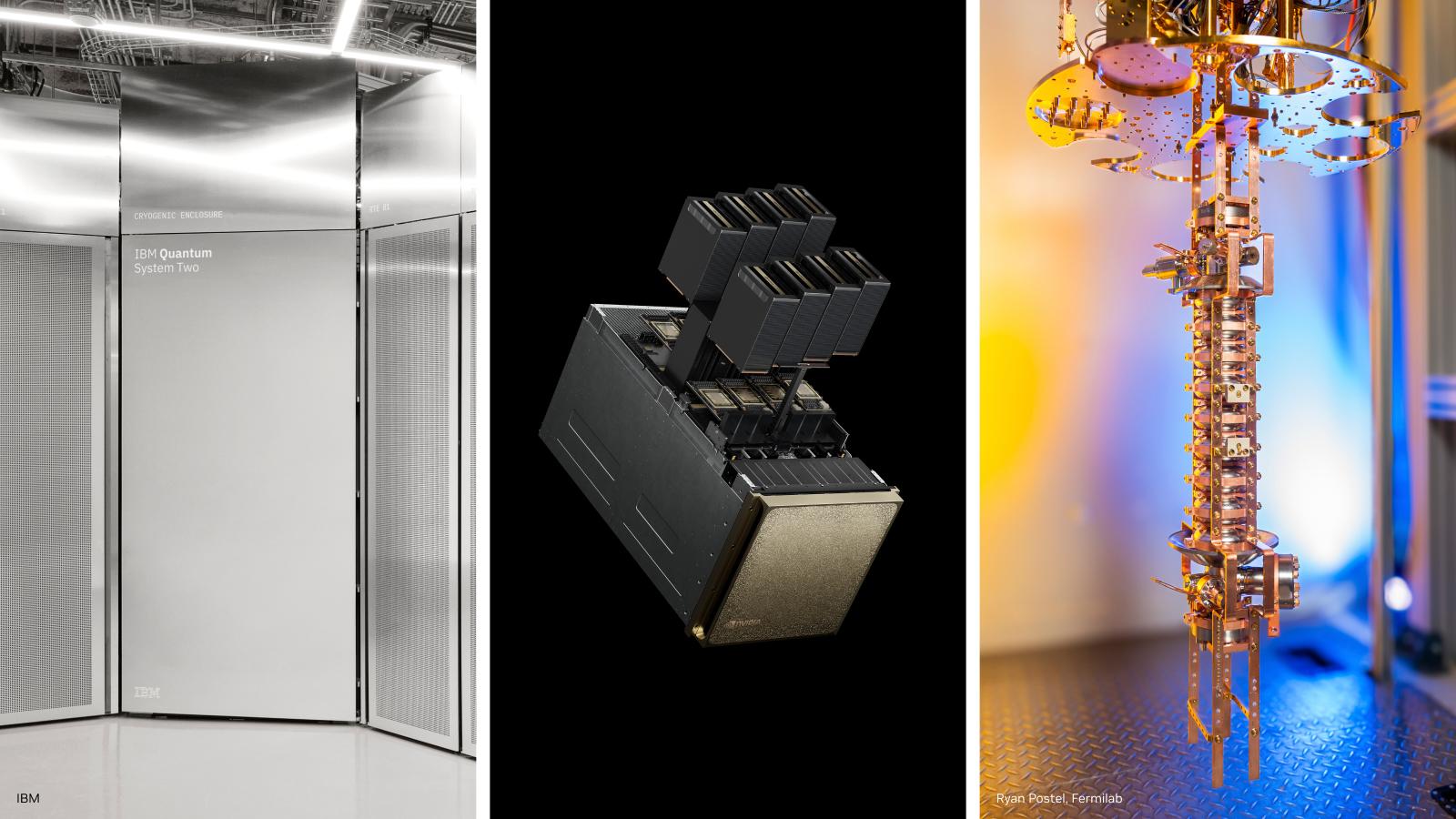
IBM, NVIDIA and Fermilab hardware shown with the platform plan; the NVIDIA panel is a GPU server, not labeled as a DGX B200 (IBM, NVIDIA, Ryan Postel/Fermilab).
Image: NVIDIA, IBM, Ryan Postel/Fermilab
Source · Press image from the NVIDIA newsroom, used for news reporting.
NVIDIA, IBM and the U.S. Department of Energy's Fermi National Accelerator Laboratory (Fermilab) said on Nov. 16 that they plan a modular quantum codesign platform that places NVIDIA DGX B200 GPU systems next to IBM quantum computers, and NVIDIA claims its new CUDA-Q QEC decoder is up to 13,000x faster.
According to NVIDIA's release, the DGX B200 systems will be colocated with IBM machines built on the Nighthawk processor, which NVIDIA calls the fastest quantum processor IBM has delivered. IBM's own release describes Nighthawk as running circuits of up to 7,500 two-qubit operations on 120 qubits. Researchers would use the platform to test error-correction codes, decoding algorithms and quantum-classical applications in high-energy and nuclear physics, and to study how classical computing can scale alongside several linked quantum processors.
The release wording differs by author. NVIDIA writes that the systems are being colocated, while IBM says it and NVIDIA "intend to launch" the platform, and Fermilab's Anna Grassellino called it a "proposed platform", as The Next Web reported. None of the three partners gave a start date or a cost.
Why Quantum Error Correction Matters for GPU Buyers
Quantum error correction spreads one unit of quantum information across many physical qubits, and a classical program called a decoder reads the measurements to find likely errors. That decoder work runs on conventional hardware, so each step toward fault-tolerant machines creates demand for GPU time in the same room as the quantum processor. For the supply chain, the news is a named DGX B200 pairing with IBM's quantum line. The releases give no power, rack-count or capacity figure.
CUDA-Q QEC Decoder and the 13,000x Claim
NVIDIA says its TCBP-JOBS decoder, available today in CUDA-Q QEC 0.9.0, speeds up the heavy parts of error-correction research by up to 13,000x against existing leading algorithms, and that research on new quantum computer designs drops from 12 weeks to 45 minutes. These are NVIDIA's figures. The company did not name the baseline algorithm, as The Next Web noted, and no independent test has been published.
The planned loop pairs IBM Nighthawk with a DGX B200 GPU decoder; the up-to-13,000x speedup is NVIDIA's claim and its baseline is unnamed.
Graphic: Voltgrid News
NVIDIA is also adding a quantum interface to Slurm, the open-source job scheduler used by many supercomputing centers, so quantum processors can be scheduled with the same commands as CPUs and GPUs. IBM contributes through its Quantum Resource Management Interface (QRMI). NVIDIA's blog says Slurm 26.11 will be available later this month and that nearly 30 supercomputing centers are deploying more than 50 quantum processors.
The pairing follows IBM's other quantum-error-correction partnership. As Voltgrid reported, IBM, AMD and Oak Ridge National Laboratory launched a platform around the 120-qubit Nighthawk with AMD hardware, so IBM is now working with both NVIDIA and AMD on error correction. IBM's roadmap is covered in our report on the Nighthawk r3 design, which targets 10,000 operations on 520 qubits with no ship date yet.
What is not confirmed yet
The platform has no announced site, start date or budget. The 13,000x and 12 weeks to 45 minutes figures come only from NVIDIA, and the baseline is unnamed. The Slurm release date rests on NVIDIA's blog.
Sources
- 01NVIDIA Announces Collaboration With IBM and Fermi National Accelerator Laboratory to Launch Quantum-Classical Codesign Platform, Plus Error-Correction Breakthrough to Advance Practical Quantum ComputingNVIDIA Newsroomnvidianews.nvidia.com
- 02IBM, Fermilab, and NVIDIA Announce Plans for New Co-Design Platform for Modular Quantum ComputersIBM Newsroomnewsroom.ibm.com
- 03Nvidia teams up with IBM and Fermilab on a quantum codesign platformThe Next Webthenextweb.com
- Published
- Sources
- 3 cited