IBM Nighthawk r3 Quantum Processor Targets 10,000 Operations, 520 Qubits
IBM's Nighthawk r3 quantum processor is a design for 10,000 operations on 520 programmable qubits, with no ship date yet; IBM plans to link two of the chips in 2027.
Chips & Power DeskEdited by Ege Erten
3 min readAI-assisted
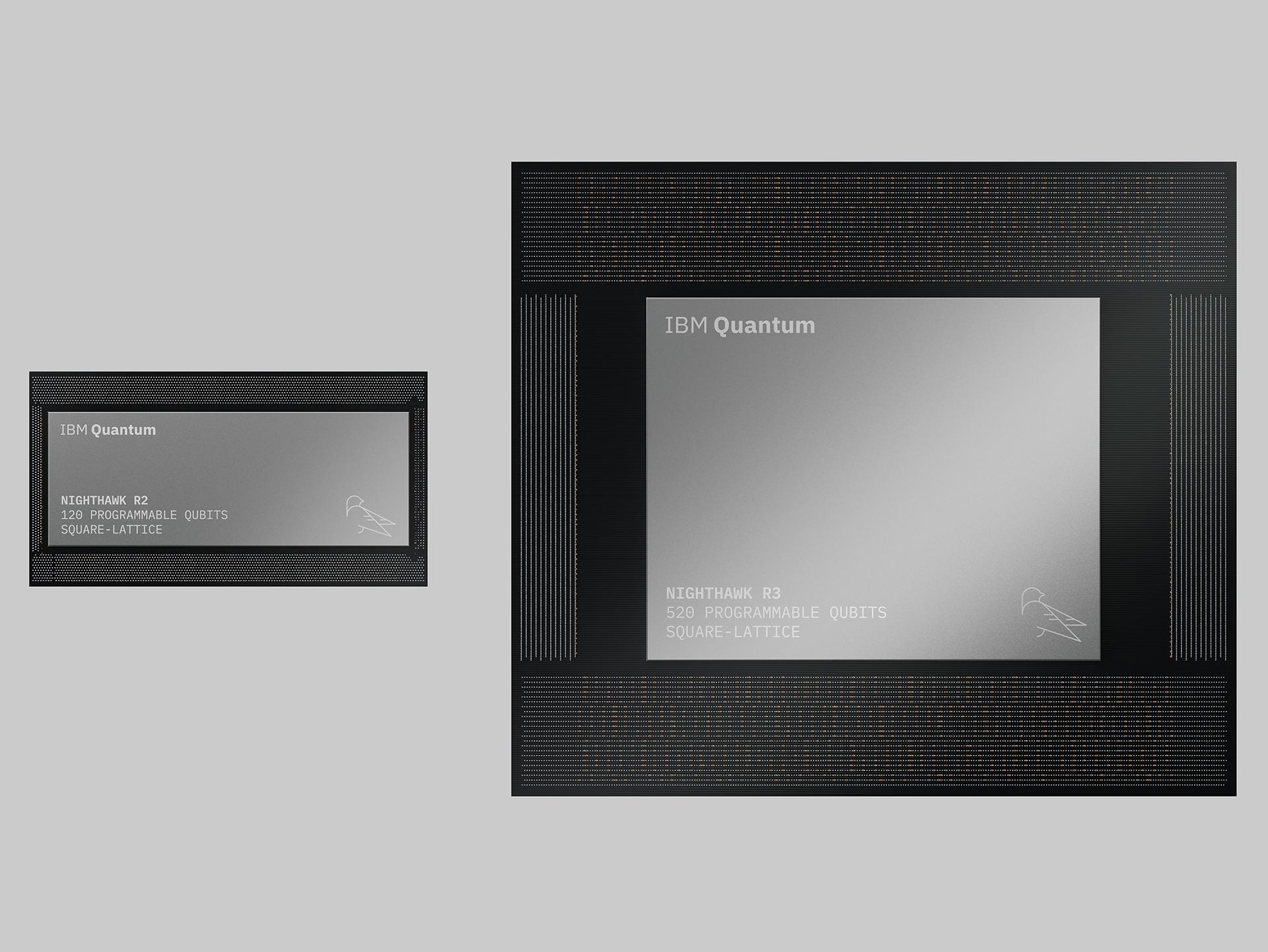
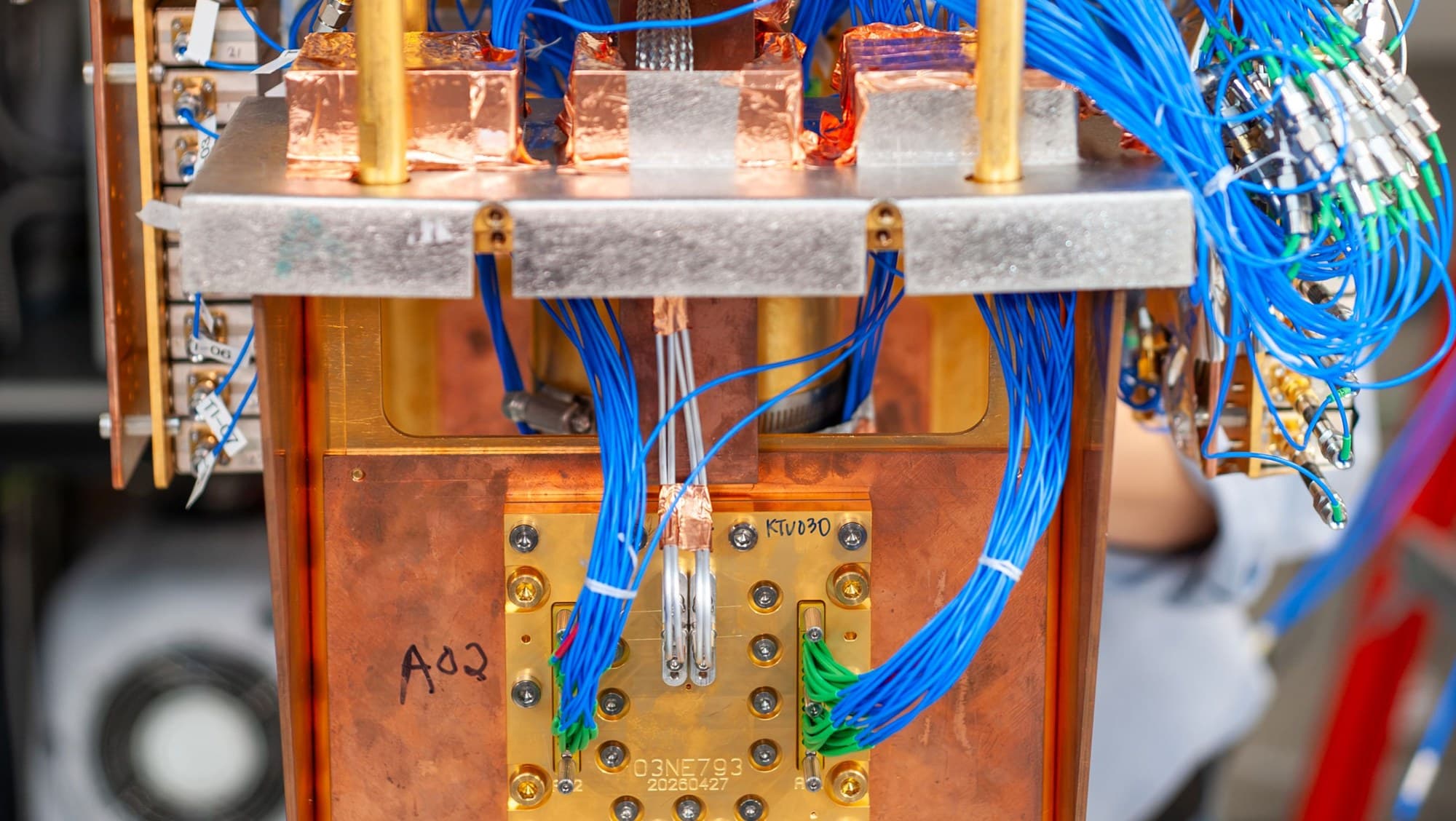
IBM's Nighthawk r2 (120 programmable qubits) beside the planned r3 (520 programmable qubits), in IBM's own images.
Image: IBM
Source · Press image from the IBM newsroom, used for news reporting.
IBM said on Nov. 11, 2026 that its next quantum processor, Nighthawk r3, is designed to execute 10,000 quantum operations across 520 programmable qubits, and that it plans to link two of them into a system of more than 1,000 qubits in 2027.
This is a design announcement. IBM's release says the chip "will be built" to these specifications and gives no ship or availability date for r3 itself; the only dated milestone is the two-chip system in 2027. SiliconANGLE and The Quantum Insider, which carries IBM's release in full, both describe r3 as upcoming and give no availability date. IBM says r3 has 520 programmable qubits and 2,034 total physical qubits; the 1,040-qubit 2027 system counts programmable qubits (2 x 520).
Why the Operation Count Is the Figure to Watch
Nighthawk r2, introduced in September and available now, supports accurate computations with more than 7,500 quantum operations on 120 qubits, according to IBM, which describes the result as accurate observable estimation with error amplification on circuits of that size; it runs up to 100,000 samples per second. Against that, r3 raises the programmable qubit count about 4.3 times (520 versus 120) but the operation figure by about 33 percent at most (10,000 is a design target, 7,500 is a 'more than' result IBM has shown), a rough comparison. Those ratios are Voltgrid's arithmetic on IBM's figures.
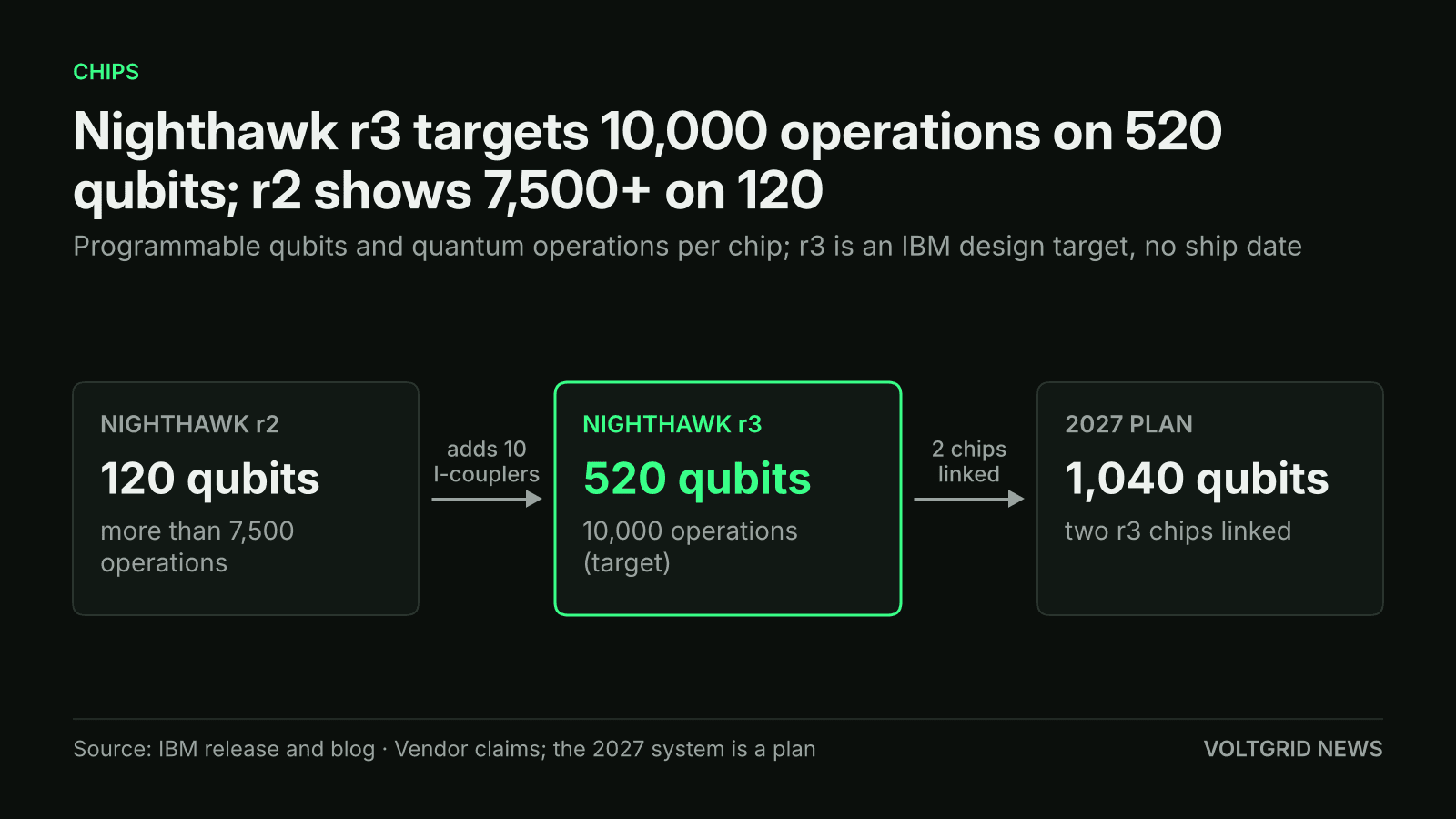
IBM's r3 target adds qubits faster than operations; the 1,040-qubit system is a 2027 plan, not a built machine.
Illustration (AI-generated)
For readers who buy or plan around compute, the operation count is the number to watch. In Voltgrid's reading, not IBM's, each operation adds some error, so the operation count limits circuit depth, while the qubit count limits width. IBM's Jay Gambetta, director of IBM Research, said useful quantum computing depends on delivering results with accuracy and speed.
What Nighthawk r3 adds in hardware
IBM says r3 keeps r2's square-lattice connectivity and fast operations and adds 10 chip-to-chip interconnects it calls l-couplers. IBM says the l-couplers are designed to connect processors into larger systems. IBM reports that four l-couplers joined Nighthawk r1 processors this year with quantum state transfer fidelity of up to 99.3 percent, 99 percent on average, toward a 99.9 percent target. SiliconANGLE gives 99.4 percent, which matches neither IBM figure; we use IBM's own.
IBM also connected two cryogenic modules into one system for the first time. It reached operating temperature in under five days and cooled below 15 millikelvin. For data-center and HPC planners, that is the practical constraint on a 2027 linked system: IBM has not said how many cryogenic modules the 2027 system will use, and it has not published power or footprint figures for it.
IBM said clients and partners including E.ON, Algorithmiq and Q-CTRL have run 34 billion circuits on r2 and report performance improvements of up to 19 times, a figure for which IBM states no baseline. E.ON reported a 15 times speedup on a quantum machine-learning task for grid optimization, and IBM with Oak Ridge National Laboratory reported 12 times on a magnetic-materials simulation. Both were measured against prior work on IBM's Heron processor, and the figures are the companies' own, as relayed in IBM's release.
On the same day IBM said its Quantum Platform now runs quantum and classical high-performance computing in one managed environment. As Voltgrid reported on Nov. 5, IBM, AMD and Oak Ridge launched a 120-qubit error correction platform that places Nighthawk beside AMD-powered Umbra.
What a Quantum Operation Count Measures
A quantum program is a circuit: a sequence of operations, or gates, applied to qubits. Each gate adds a little error, so the number of operations a processor can run accurately limits how deep a circuit can go, while the qubit count limits how wide it can be. IBM's 7,500-plus figure for Nighthawk r2 is accurate observable estimation, using error amplification, on circuits of more than 7,500 gates, according to IBM.
The r3 figure of 10,000 operations on 520 programmable qubits is a design target for a chip IBM has not yet built. Speed is a third axis: IBM says r2 runs more than 100,000 circuits per second, 25 times its Heron fleet's roughly 4,000. Until r3 exists, the figures planners can test are r2's, and IBM's own.
What is not confirmed yet
IBM has not said when r3 will be available, what it will cost, or what error rates the 10,000-operation target assumes. The 1,040-qubit figure is two times 520 and is IBM's plan, not a built system. The 99.3 percent link fidelity was measured on r1 chips, still short of the 99.9 percent target, and Voltgrid found no independent benchmark of r2 or r3 as of Nov. 11.