Lenovo ThinkPad P1 Gen 9's 8 GB RTX PRO 2000 Limits Local AI to Small Models
Notebookcheck calls 8 GB of GPU memory the ThinkPad P1 Gen 9's main weakness. StorageReview's tests ran an 8B model at Q4_0 but nothing needing 16 GB, on a workstation from about $3,200.
Chips & Power DeskEdited by Ege Erten
3 min readAI-assisted
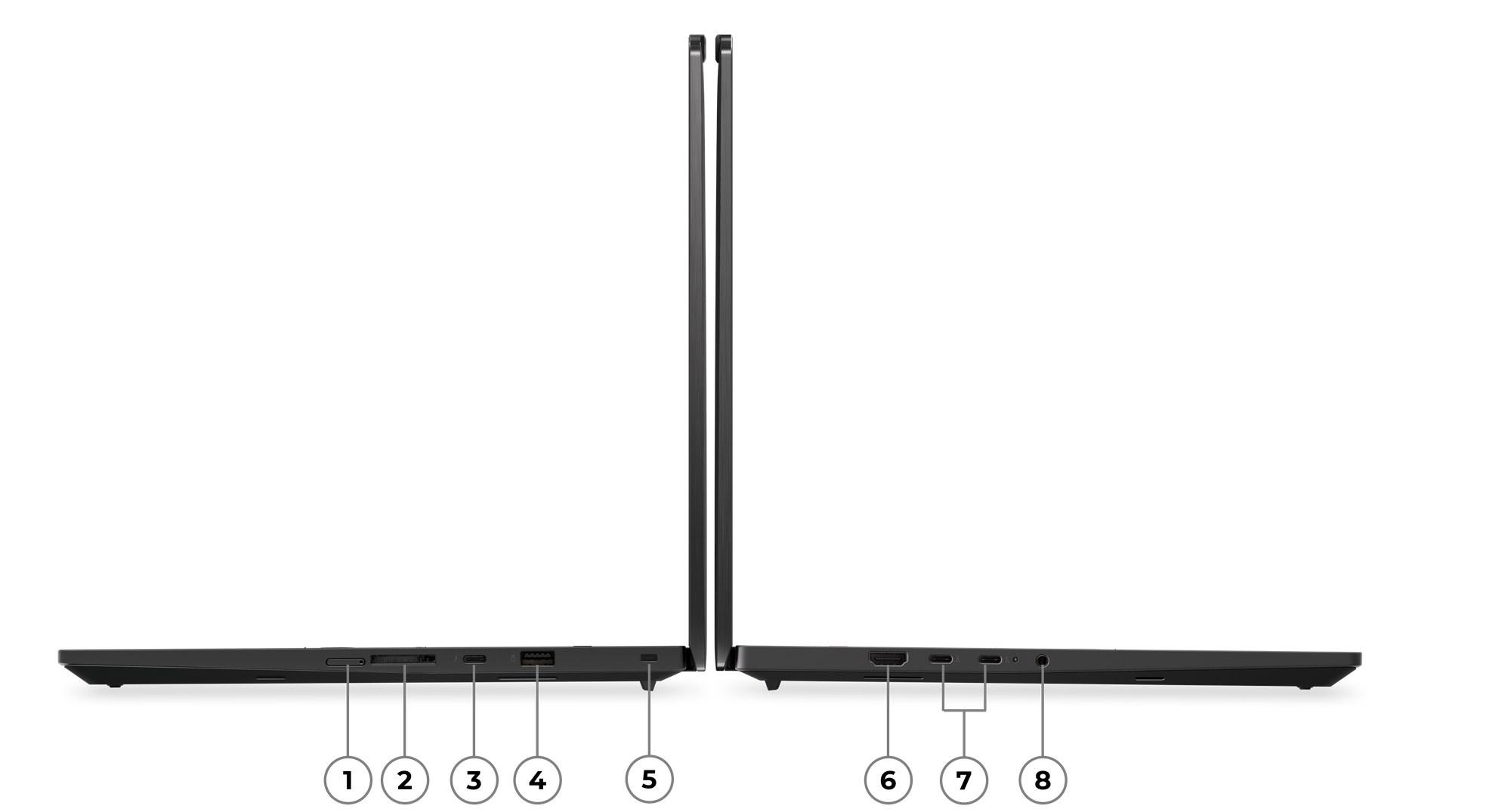
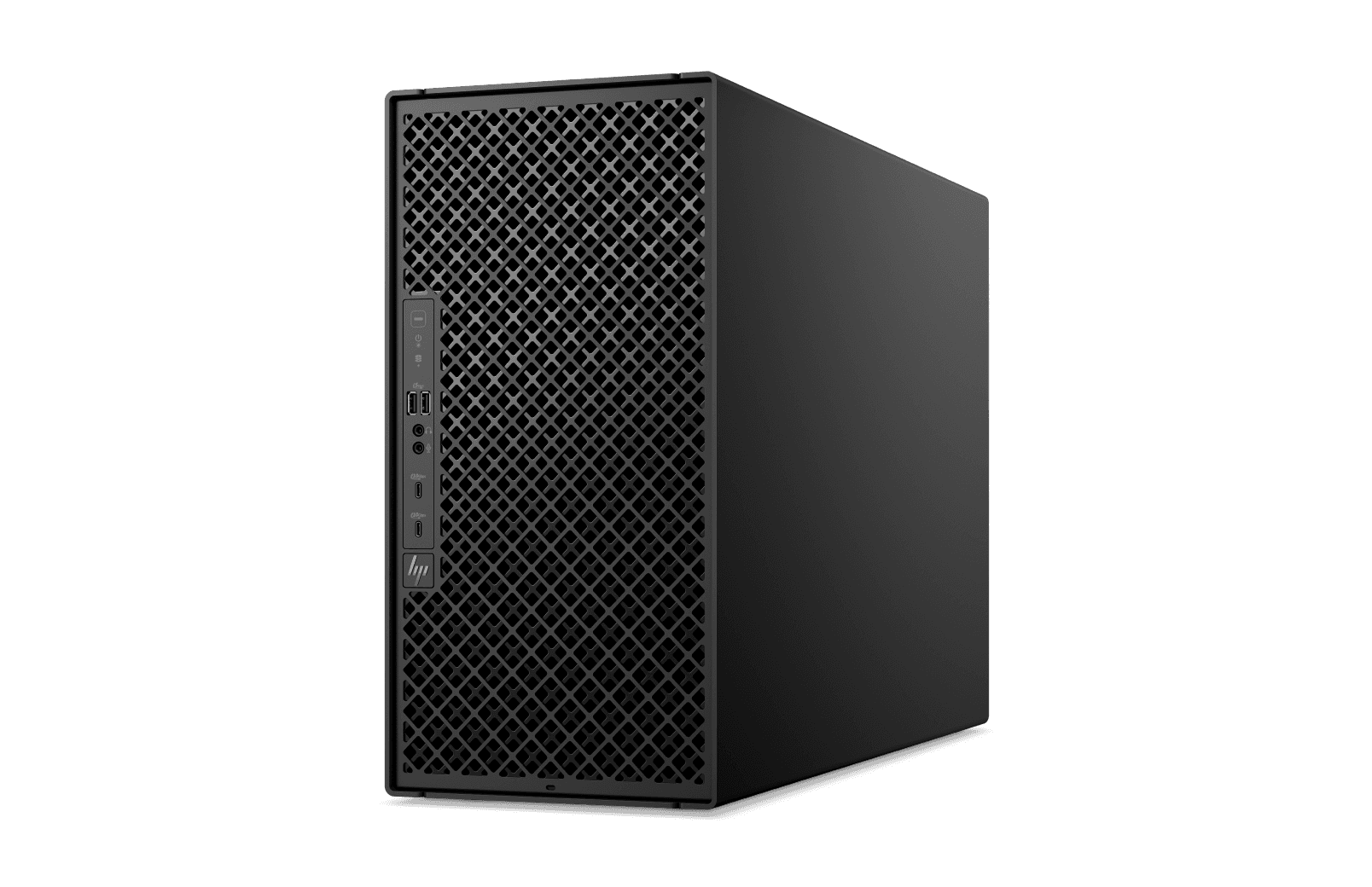
The ThinkPad P1 Gen 9, whose RTX PRO GPU options both carry 8 GB of GDDR7 (Lenovo).
Image: Lenovo
Source · Product image from Lenovo's PSREF product page, used for news reporting.
Notebookcheck argued on Nov 11 that the 8 GB of video memory on NVIDIA's RTX PRO 2000 Blackwell is the main weakness of Lenovo's ThinkPad P1 Gen 9, a 16-inch mobile workstation that the outlet's review says starts at around $3,200 in the US.
The piece, by Notebookcheck's managing editor for business laptops, Benjamin Herzig, adds no new measurements. It builds on the outlet's own review, rated on Nov 5 at 91% ("very good"), which already listed the GPU and its 75 W limit among the cons. Herzig's case is that 8 GB does not cut it for demanding work such as running AI models locally on a laptop that costs thousands of dollars. He also says the line has gone backwards: the P1 Gen 6 offered GPUs with 16 GB, up to NVIDIA's RTX 5000 class, while the Gen 9 is not sold with the 12 GB RTX PRO 3000 Blackwell.
Lenovo's own spec sheet confirms the ceiling. Its PSREF page lists two discrete GPUs for the P1 Gen 9, the RTX PRO 1000 and RTX PRO 2000 Blackwell, both with 8 GB of GDDR7, beside Intel Core Ultra processors and up to 96 GB of LPCAMM2 system memory. That larger system memory is separate from the GPU's own: in StorageReview's tests the card reported 7.7 GB available to it. Herzig contrasts this with unified-memory designs such as Apple's M-series and NVIDIA's RTX Spark, where the GPU draws on the whole memory pool.
What StorageReview measured
StorageReview's review, published Oct 26, puts numbers on the limit. Its P1 Gen 9 had a Core Ultra 9 386H, the RTX PRO 2000 at a configured 50 W TGP, 64 GB of memory and NVIDIA driver 597.16, and ran plugged in with Lenovo's Ultra Performance mode on. Under those conditions MLPerf Client v2.0, which runs its 8B model at Q4_0 quantization, gave a geometric mean of 64.8 tokens per second for Llama 3.1 8B with 0.345 s to the first token, and 111.9 tokens per second for Phi-4-mini.
StorageReview's model-load and coding-agent tests need at least 16 GB of GPU-usable memory, so gpt-oss:20b and Qwen3.6-35B-A3B were marked as not run. Of its llama-server serving tiers, only the smallest, Ministral 3 3B Reasoning at Q8_0, qualified; the 8B, 27B and 120B tiers did not. The 8B result above came from MLPerf, which sizes its context window to fit the card. StorageReview's conclusion is that the card caps local AI at models of a few billion parameters, and that buyers who want local models above about 7B parameters are shopping in a different part of the market.
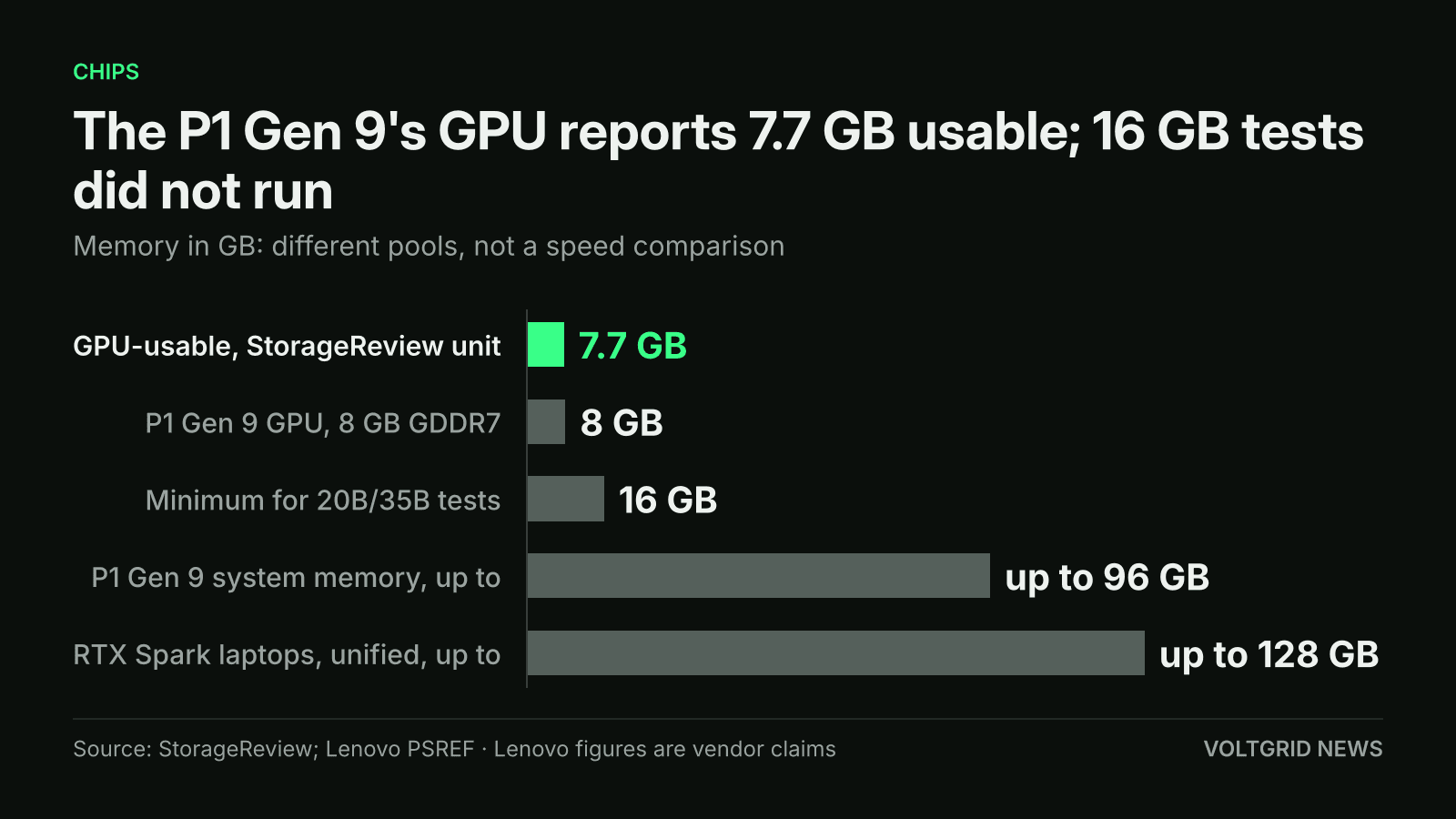
The P1 Gen 9's GPU reported 7.7 GB usable to StorageReview, below the 16 GB its larger-model tests need. Lenovo's figures are vendor claims; RTX Spark is a different machine.
Illustration (AI-generated)
The two labs tested different machines. Notebookcheck's unit had a Core Ultra 7 366H and the GPU at 75 W including 60 W of Dynamic Boost; StorageReview's had the 386H and the GPU at 50 W. Notebookcheck ran no AI workloads. Its battery result of about 22 hours, on the 366H unit, comes from a Wi-Fi browsing test at 150 cd/m² on the basic 1920x1200 IPS panel, and says nothing about runtime under GPU load.
A memory problem at workstation prices
The prices make the gap plain. Notebookcheck put its tested configuration at roughly $5,100 on lenovo.com. StorageReview quoted a build-your-own start of $3,734 and a $7,719 list price on Oct 24 for its OLED configuration, which sold for $5,399 on Oct 22.
NVIDIA's RTX Spark laptops, by contrast, start at $2,599 and are offered with up to 128 GB of unified memory.
StorageReview ran a 35B model on a 128 GB unit. Those runs used a different machine, test suite and settings, so their speeds cannot be set against the P1's; the point is what fits in memory at all.
For buyers, the P1 Gen 9 suits CAD, rendering and other professional graphics work that fits in 8 GB, plus small local models. StorageReview's 8 GB unit did not qualify for its 20B and 35B model tests, and Lenovo's PSREF page lists no P1 Gen 9 option with more than 8 GB of GPU memory. StorageReview's battery result is still to come.
Sources
- 01Lenovo ThinkPad P1 Gen 9 Review: Panther Lake, RTX PRO 2000StorageReview · storagereview.com
- 02Workstations have bad battery life? Think again: Lenovo ThinkPad P1 Gen 9 laptop reviewNotebookcheck · notebookcheck.net
- 03Not enough memory: Why the Nvidia RTX GPU is the main weakness of the Lenovo ThinkPad P1 G9Google News · AI chips · news.google.com