AMD MEXT Moves Half of EPYC DRAM to Flash, Claims 95-99% Performance
AMD says MEXT lets EPYC servers keep 95% to 99% of all-DRAM performance in its own tests with half the DRAM on NVMe flash, per The Register. No independent lab has tested it, and AMD has not given a price.
Hardware & Analysis DeskEdited by Ege Erten
6 min readAI-assisted

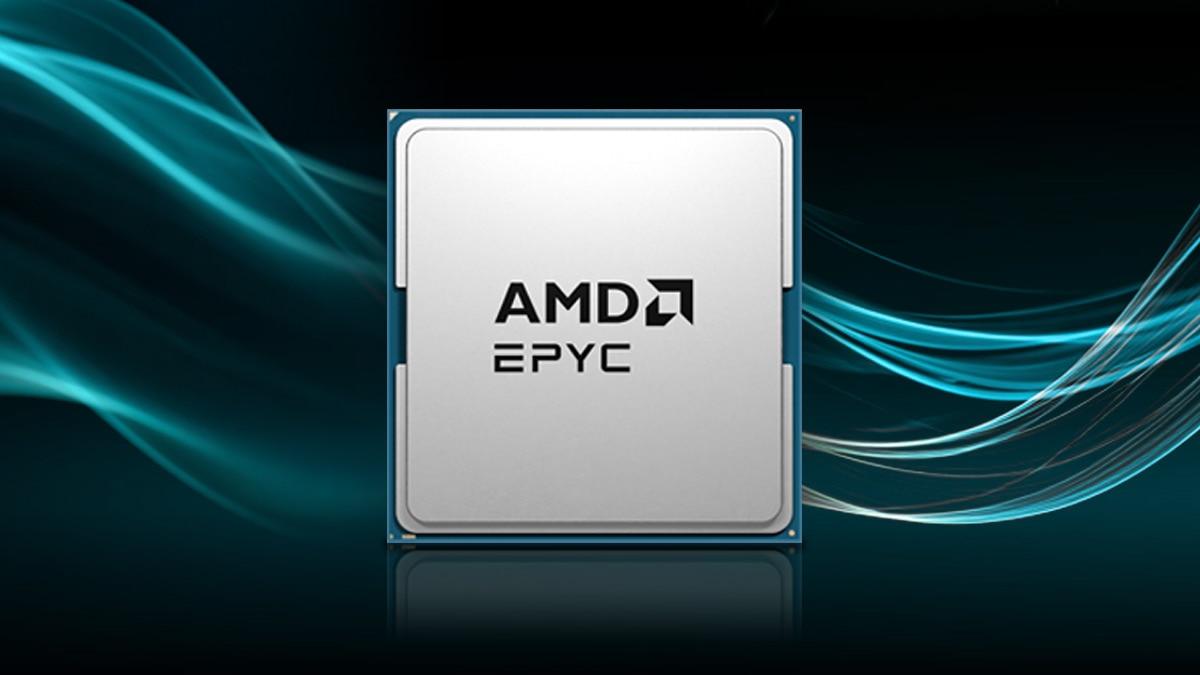
AMD's own illustration of a memory module from its MEXT product page. It is an artwork, not a photo of MEXT hardware, because the software has no hardware of its own.
Image: AMD
Source · Press image from the AMD website, used for news reporting.
AMD says its MEXT software lets EPYC servers swap half their DRAM for NVMe flash and keep 95% to 99% of all-DRAM performance in two of its own tests, The Register reported on Nov. 11.
MEXT began as a startup founded in 2023. It came out of stealth in early April 2026, The Next Platform reported, and AMD announced on June 15 that it had bought the company, without disclosing terms. Its co-founder and former chief executive, Gary Smerdon, is now AMD's corporate vice president of business development.
The pitch is aimed at the memory bill. Smerdon told The Register that memory can make up 60% to 90% of the cost of a very large-memory server. TrendForce forecast on Sept. 30 that conventional DRAM contract prices would rise another 10% to 15% quarter on quarter in the fourth quarter, with server DRAM still undersupplied, after the record contract prices Voltgrid reported. The scramble for memory also drew in OpenAI's Sam Altman, who called PC RAM used 5% of the time "quite terrible" for global allocation and later said on X that the remark was taken out of context; AMD has not linked MEXT to him.
How MEXT Moves Cold Pages to Flash
MEXT is software only. On Linux it needs a kernel driver, and a separate tool called RAM View tells operators which servers and workloads to enable it on, The Register reported. Flash is 50x cheaper per bit than DRAM and draws 30x less power per bit, Smerdon said, but it is 500x slower. He gave no device or year for those figures and did not say whether slower means latency or throughput.
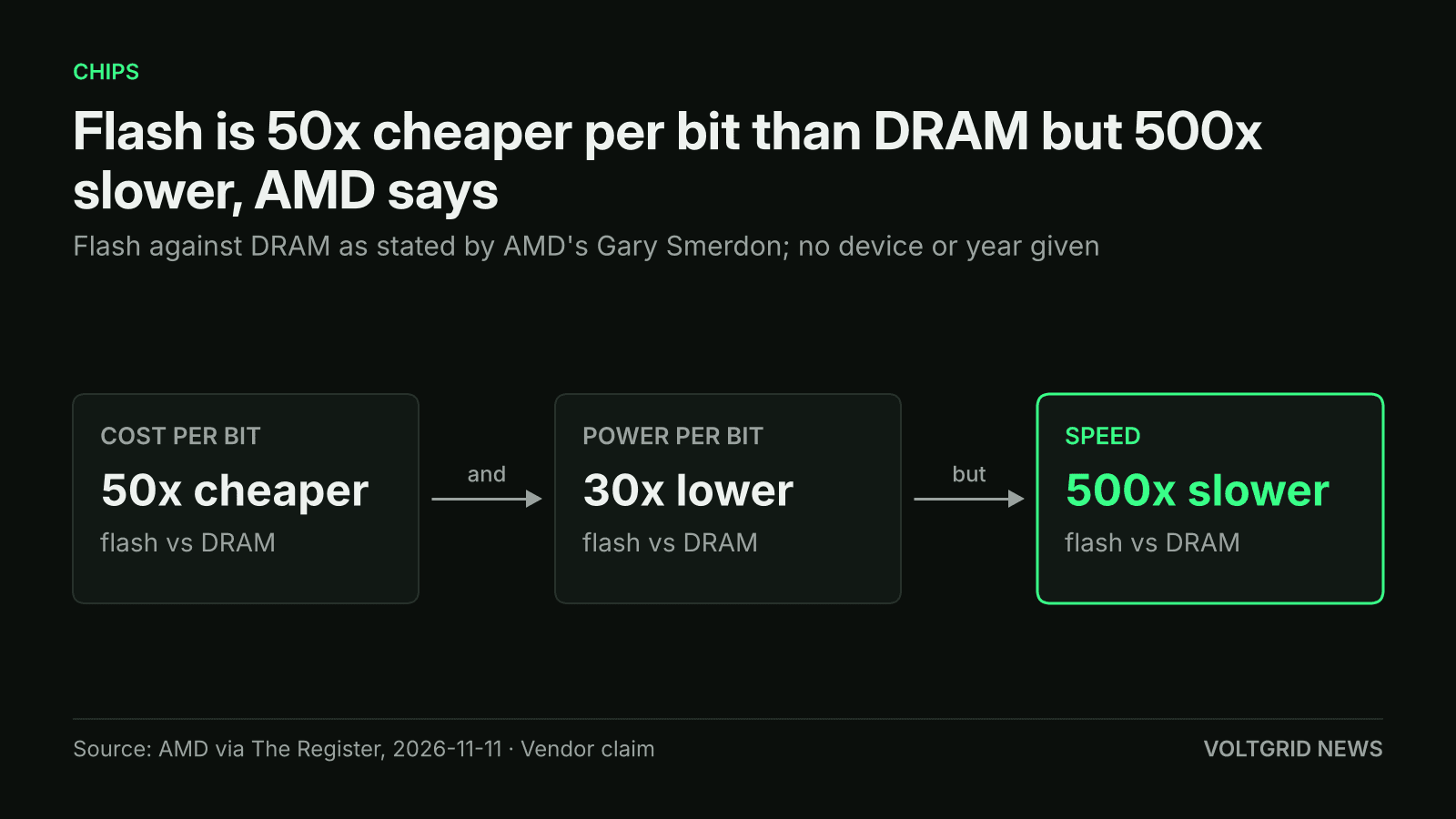
Gary Smerdon of AMD, quoted by The Register, on the per-bit trade-off MEXT works around; he did not say whether slower means latency or throughput.
Illustration (AI-generated)
Swapping to flash normally hurts because of the wait. When a program touches a page that has been moved out, it stalls while the page is read back. Cold pages are common, though: Meta found that memory untouched for five minutes averages about 35% of its fleet.
AMD says MEXT moves infrequently accessed pages to flash and uses a model to predict which pages the application will need next, returning them to DRAM before the request. If that works, Smerdon said, the application and operating system see the pages as in DRAM throughout. The workhorse model is derived from the transformer and predicts the next page much as a chatbot predicts the next word, he said. It trains on a single EPYC core in under a second and keeps retraining, with no GPU.
AMD's product page sets the requirements. A server needs a dedicated NVMe drive and swap turned off. MEXT takes two CPU cores, one for the AI engine and one for the daemon. AMD says workloads needing more than 64 GB of DRAM benefit most, and it supports the main Linux distributions, from RHEL to Ubuntu. The Register adds that in virtualized setups the software needs one core per virtual machine, so its overhead grows with the number of VMs.
What AMD Claims MEXT Delivers
On Synopsys PrimeTime, a chip-timing tool, half the memory moved to flash still gave 95% of all-DRAM performance, AMD says, as reported by The Register. At 25% DRAM and 75% flash, PrimeTime fell to 80%. On Apache Spark, AMD's MEXT team reports 99% at half the DRAM. The Register gave no hardware or settings, and wrote that Smerdon's line about "literally no impact" overstates it: the penalty depends on the application and on how much memory is offloaded.
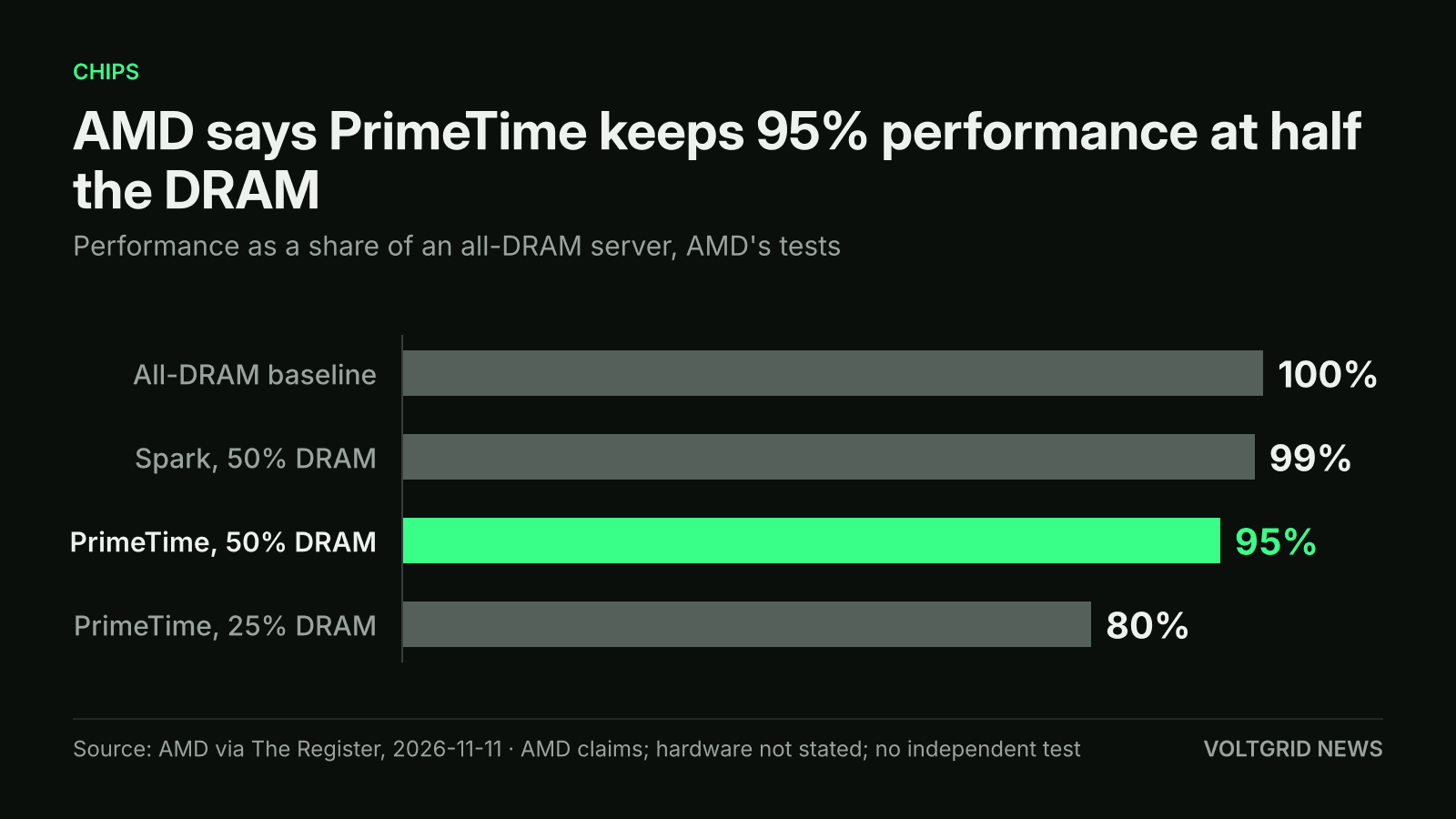
AMD's test results as reported by The Register, which gave no hardware or settings; no independent lab has tested MEXT.
Illustration (AI-generated)
Smerdon also said MEXT could cut enterprise server costs by up to 83%, and that customers have saved an estimated $5 million in avoided DRAM across the first 145 systems, in The Register's words. AMD's Oct. 30 case study appears to be a separate data set, covering AMD IT only, and AMD has not reconciled the two. AMD IT began its rollout in September 2026 on 4th and 5th Gen EPYC servers. On 86 hosts MEXT added about 58 TB of usable capacity. By AMD IT's own calculation, the same capacity in DRAM would have cost about $3.3 million, against about $601,000 for the MEXT deployment, an 82% saving. AMD's footnote says the claims were not independently verified.
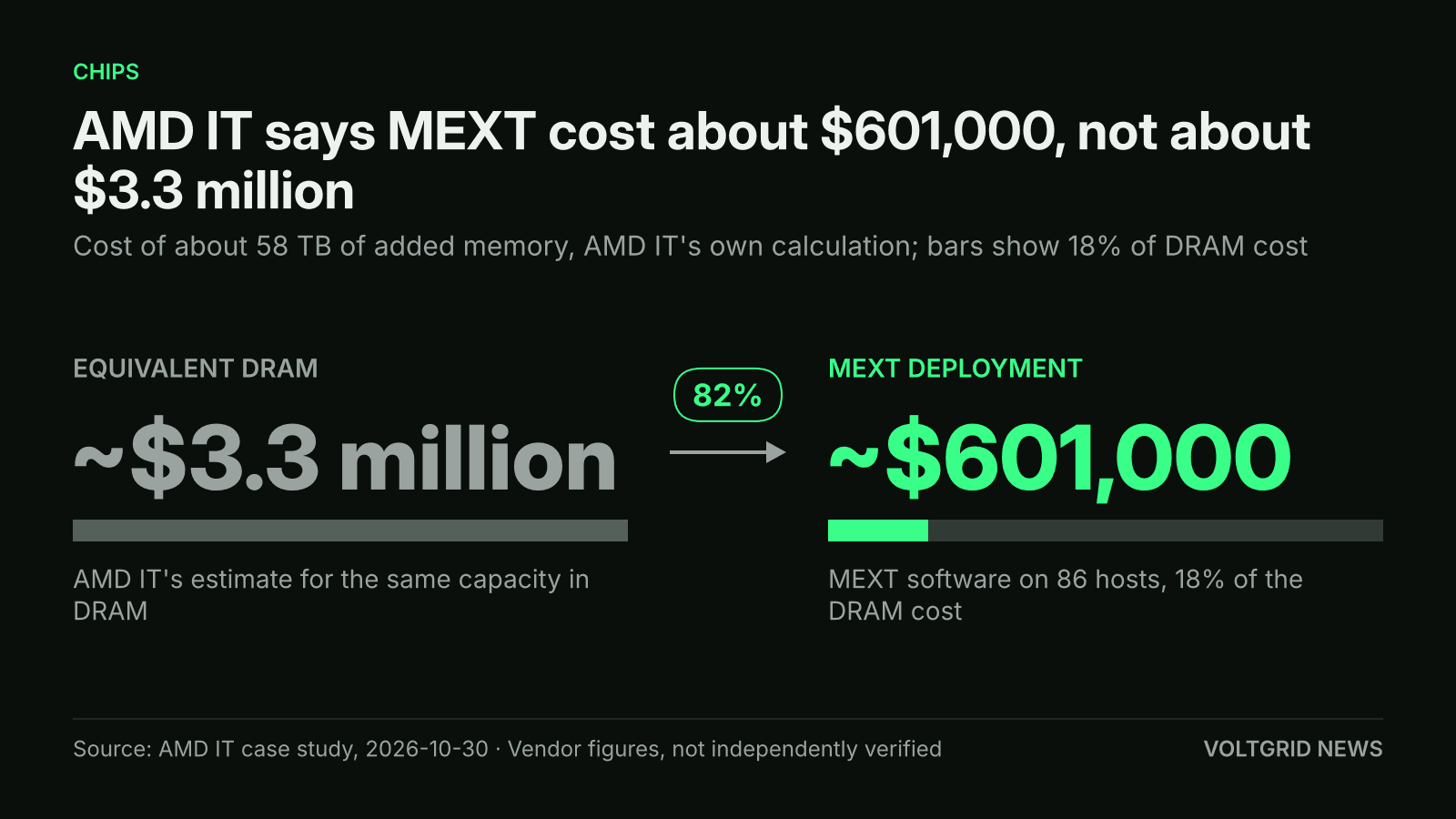
AMD IT's own calculation from its case study, not independently verified; the MEXT bar is drawn at 18% of the DRAM bar.
Illustration (AI-generated)
Before the acquisition, MEXT's own test on a 128-core EPYC 9755 showed Redis, Memcached and Neo4j with 32 GB of DRAM plus 32 GB of flash giving 1.7x the performance per dollar of 64 GB of DRAM, at roughly 95% of the throughput, The Next Platform reported. Every performance figure so far comes from AMD or from MEXT before the deal. No independent lab has published MEXT results.
MEXT vs zswap, Meta TMO and Pond
No rival publishes the same metric, so the fair comparison is mechanism and status. Linux has two free tools in the mainline kernel: zswap compresses pages on their way to swap and trades CPU cycles for less swap I/O, and zram builds compressed block devices in RAM. Neither is described in the kernel documentation as predicting which pages will be needed.
Meta's Transparent Memory Offloading (TMO) offloads to compressed memory or SSDs and has run in production since 2021. Its paper puts the cold share at 19% to 62% by application around that 35% average, lower than the 50% to 80% Smerdon attributed to a Meta paper. Google's software-defined far memory has compressed cold pages in the kernel across its fleet since 2016, and Google says that far-memory tier is at least 67% cheaper than DRAM, at about 6 microseconds of access, and holds about 20% of data on average. It uses compressed memory, not flash.
Microsoft's Pond research for Azure pools memory over CXL instead. It found that about 50% of VMs touch less than 50% of their rented memory, and that up to 25% of DRAM is stranded. Pond's evaluation found it would reduce DRAM costs by 7%, with performance within 1% to 5% of same-NUMA-node allocation, but it is research, not a deployment, and it needs new CXL hardware. Intel wound down its Optane persistent-memory business in 2022 and recognised a $559 million inventory impairment in the first nine months of that year. MemVerge, another memory software vendor, now leads its home page with memory products for AI agents.
MEXT Price, Availability and Limits
AMD is in phase one: working with OEMs such as HPE to make systems "Mext ready," The Register reported. In phase two, which has no date, AMD will sell licences through OEMs and ship EPYC platforms with RAM View preinstalled. MEXT will run only on AMD hardware, though before the deal it supported x86 and Arm. AMD has not given a price. MEXT used to charge $3.99 per GB per year.
The limits are real. Performance loss varies by workload, and Smerdon told The Next Platform that traditional relational databases are not an ideal fit. Each server gives up an NVMe drive and CPU cores. Flash is getting dearer too: TrendForce expects NAND contract prices to rise 15% to 20% in the fourth quarter, with enterprise SSD price growth speeding up. In the material reviewed, AMD has not published flash write volumes, drive-life guidance or tail-latency data for pages it fails to predict. For buyers of the EPYC Venice servers in Voltgrid's Nov. 10 review roundup, the trade is fewer DIMMs against an NVMe drive, those cores and an unpriced licence.
What to Watch: Licence Price and Independent Tests
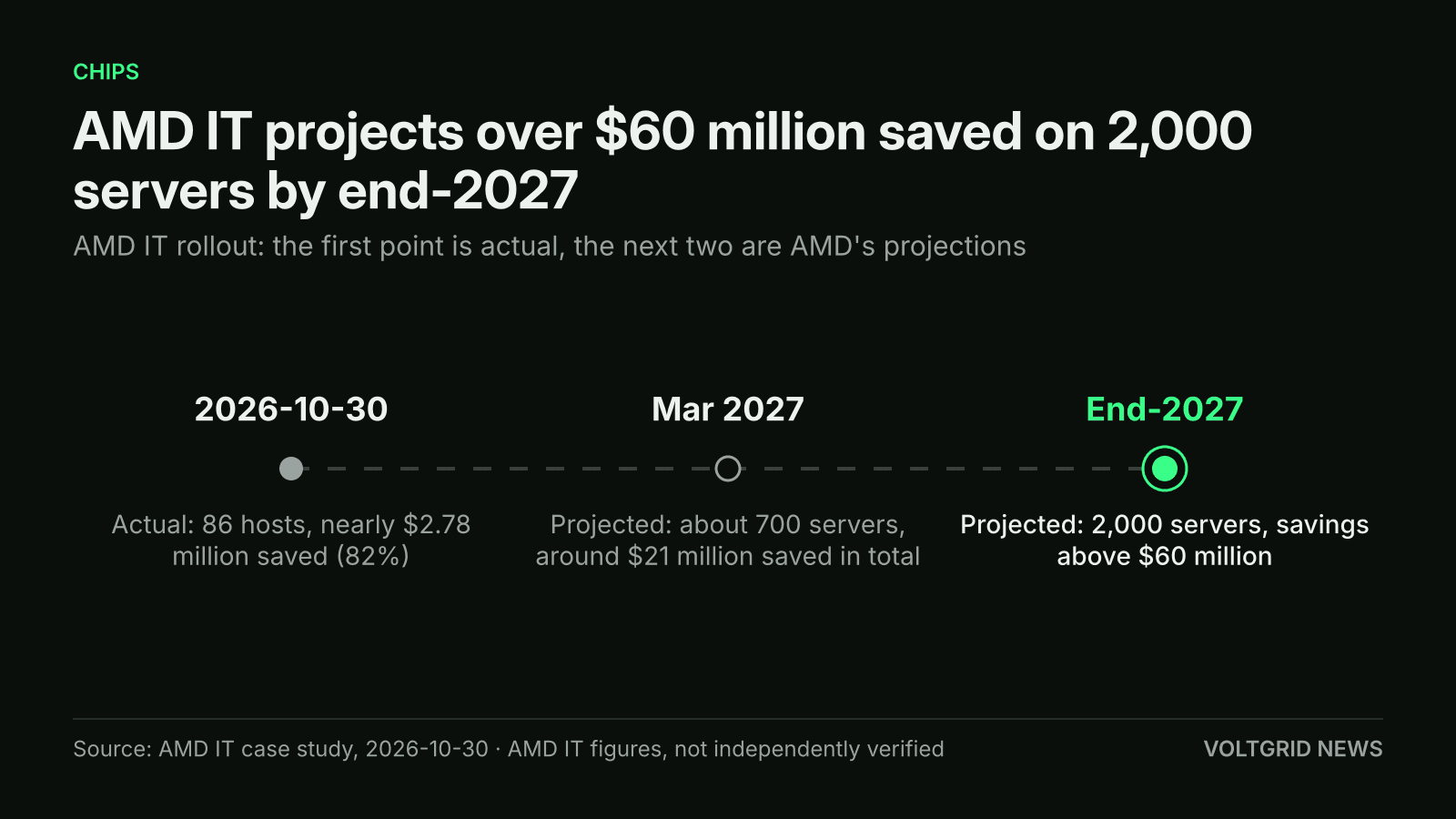
AMD IT plans to install MEXT by default on new servers. It targets about 700 servers by March 2027, which it projects will have saved around $21 million in total, and 2,000 servers by the end of 2027, with savings it puts above $60 million. Those are AMD's projections. Then come AMD's licence price, a date for phase two and the first independent tests, including tail latency and flash wear. MEXT also gives AMD a software reason to choose EPYC, as the company forecasts its server revenue doubling in 2027.
Sources
- 01Pond: CXL-Based Memory Pooling Systems for Cloud PlatformsarXiv · arxiv.org
- 02AMD MEXT Predictive Memory SoftwareAMD · amd.com
- 03AMD stretches server DRAM with flash extended memoryThe Next Platform · nextplatform.com
- 04AMD IT Avoids 82% of DRAM Expansion Costs with AMD MEXT SoftwareAMD · amd.com
- 05AMD: Where we're going we don't need (as much) DRAMThe Register · theregister.com
- 06AMD Acquires MEXT to Advance Memory Optimization for Compute InfrastructureAMD · amd.com