Google TPU 8tx and 8i Max Reuse Two Chips, Let AMD Into the Host
Google TPU 8tx and 8i Max reuse the 8t and 8i chips. 8tx swaps Axion for AMD EPYC hosts for confidential compute; Google's table lists 8i Max at 384 GB of HBM, a third more than 8i, not double.
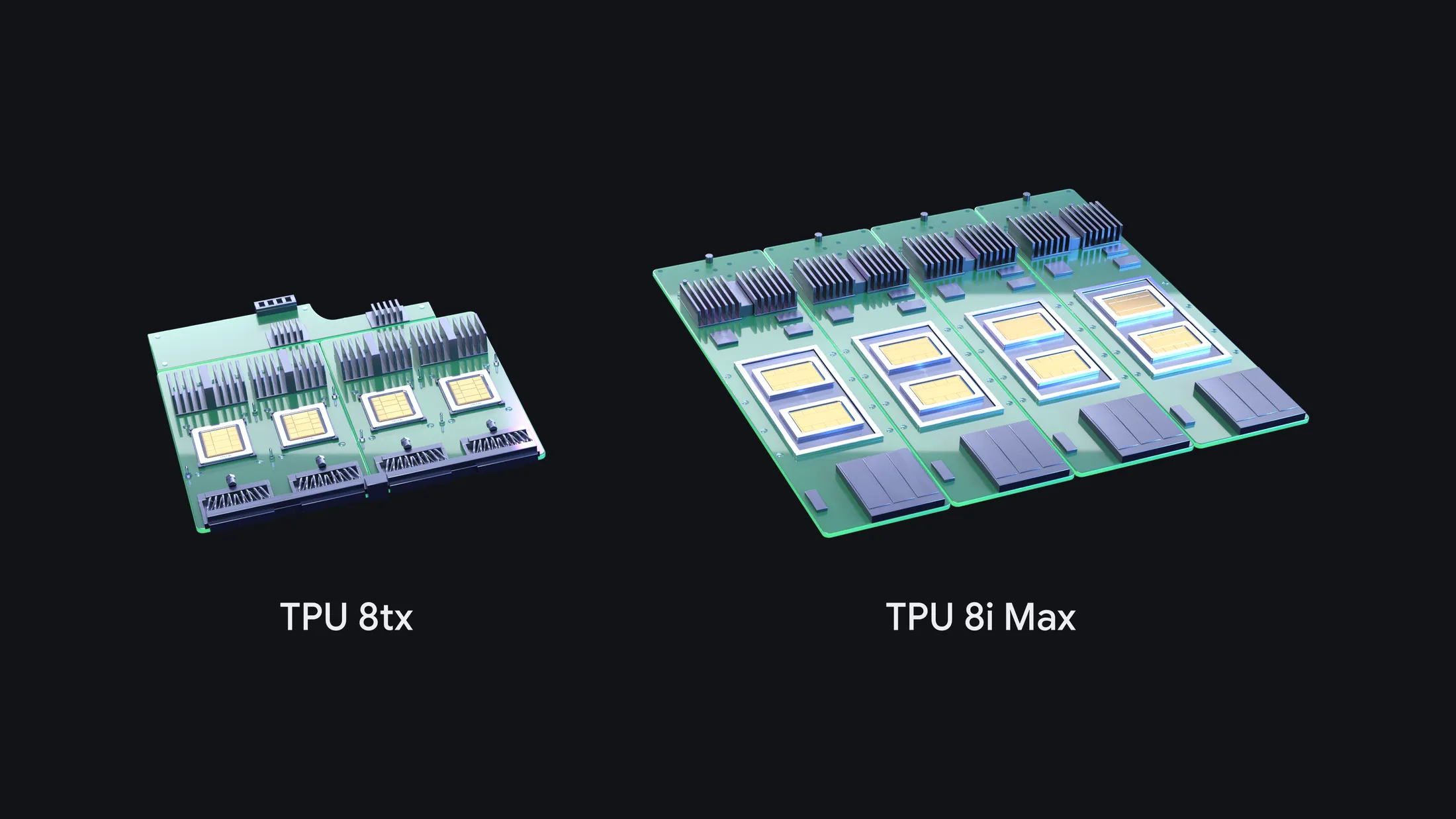
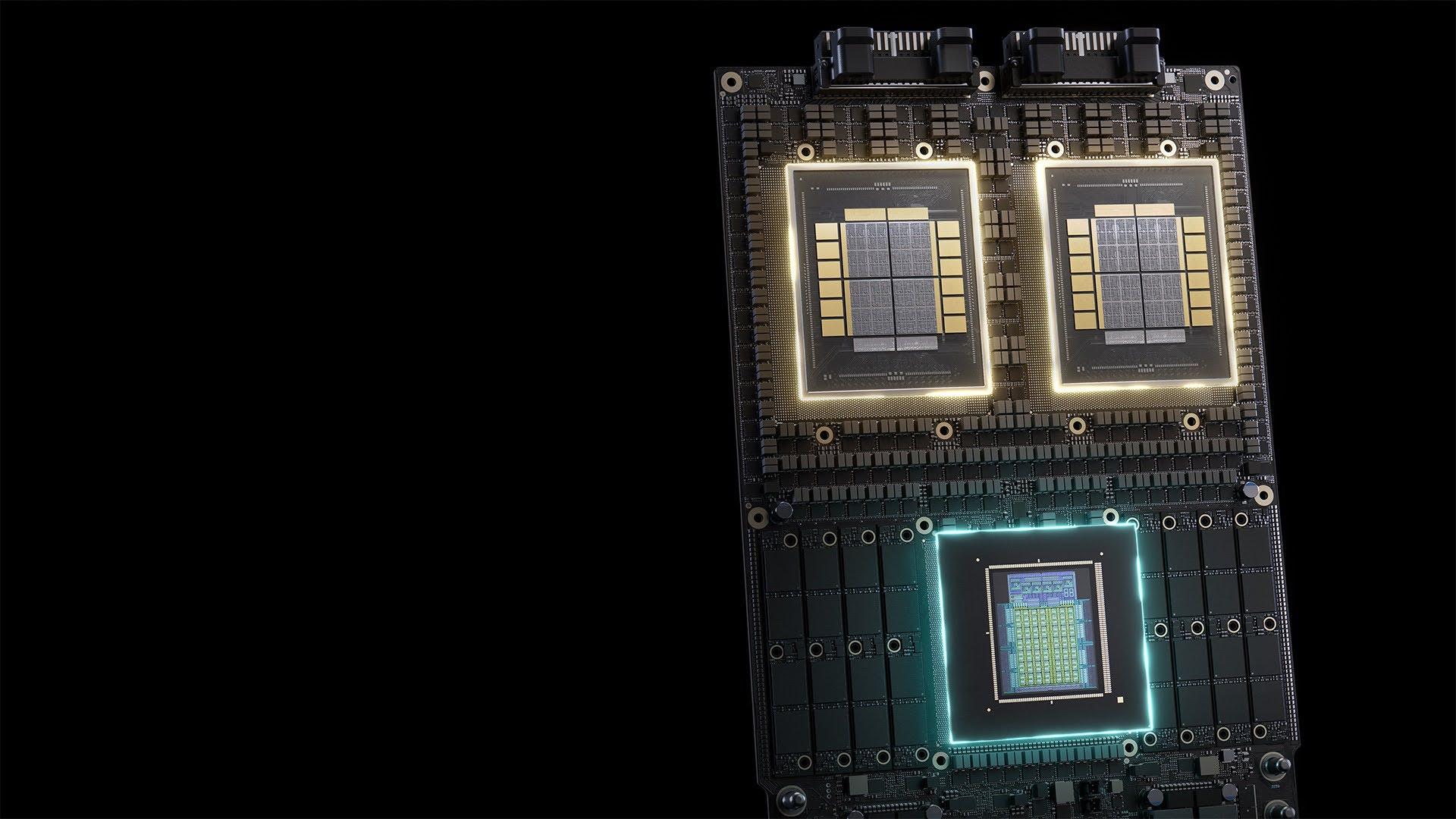
Google's image of TPU 8tx (left) and TPU 8i Max (right), from its Nov. 9 announcement. It is a Google-supplied rendering, not a photo of shipping hardware.
Image: Google
Source · Press image from the Google blog, used for news reporting.
Google added two systems to its eighth TPU generation on Nov. 9, TPU 8tx and TPU 8i Max, and neither has a new chip in it. The argument here is that Google now makes TPU products by changing the host and the package around two existing chips, and the first trade-offs of that method already show: an AMD host where Google had promised its own Arm CPU, and a doubled 8i whose memory capacity, on the one table that lists it, does not double.
What happened
Amin Vahdat announced both systems on Google's blog. He said TPU 8tx is built on the same silicon as TPU 8t, the training chip Google showed in April, but paired with 5th Generation AMD EPYC CPU hosts. That pairing gives it hardware-level confidential computing, meaning data and model weights stay encrypted and isolated even while they are being processed. The 8tx also moves to Boardfly, the low-latency network Google built for TPU 8i. Google says that gives up to 2x lower latency than TPU 8t, with a near-zero performance penalty. Google pitches it at regulated enterprises and governments, for inference and small-scale training.
TPU 8i Max puts two TPU 8i chips on one package. Google says it doubles the compute, the SRAM and the HBM bandwidth of TPU 8i and fits twice the silicon into the existing rack footprint. PC Watch reported that a server board now carries eight TPU 8i dies instead of four. Google called this the first time it has introduced four TPU systems in one year. It gave no availability date, price, power figure or named customer for either system. It said TPUs now have nearly 100 customers.
Google's blog text holds no full spec sheet. A comparison table credited to Google Cloud, which PC Watch and the Taiwanese outlet mashdigi published, fills the gaps. It lists TPU 8i Max at 20.1 PFLOPS of FP4 per package, labelled emulated, with 384 GB of HBM3e, 17.2 TB/s of HBM bandwidth and 768 MB of on-chip memory. TPU 8i is listed at 10.1 PFLOPS emulated FP4, 288 GB and 8.6 TB/s. TPU 8tx keeps 8t's 12.6 PFLOPS of native FP4 and 216 GB, but the table says its pods top out at 1,152 chips, against 9,600 for TPU 8t.
Google Cloud's spec table, as published by PC Watch: 8i Max lists 384 GB of HBM3e against 288 GB for the 8i. FP4 figures carry the table's native or emulated labels and are not like for like.
The first step of the argument is Google's own: Vahdat wrote that a new chip takes years, while a system built around a chip, including how it is packaged, can be changed quickly to meet customer needs. Both new products fit that description. The chips are the April chips. What changed is the host CPU and network on 8tx, and the package on 8i Max.
The second step is the host. In April, Google said both eighth-generation chips would, for the first time, run on its own Axion Arm CPUs. It argued that owning the stack from Axion host to accelerator allows efficiency gains that cannot be had when host and chip are designed apart. In November, its confidential TPU uses AMD. Google Cloud's Confidential VM documentation lists AMD SEV, AMD SEV-SNP and Intel TDX as its hardware technologies, and its NVIDIA GPU confidential mode works with SEV or TDX. Axion is not listed. That suggests Google took the quickest path to an attested trust stack it already runs, x86 with AMD's SEV, rather than waiting for Axion to get one. PC Watch reads it the same way: 8tx swaps Axion for EPYC (Turin) to use SEV.
The third step is memory, which is the point of 8i Max. Bandwidth doubles, so each unit of compute is fed as fast as before. Capacity does not double. Two 8i chips at 288 GB each would make 576 GB, and the table, the only place the figure appears, says 384 GB. Bandwidth goes from 8.6 to 17.2 TB/s while capacity goes from 288 GB to 384 GB. Google has not explained the gap. That matters because the product is sold for long context windows. Google is also releasing TPU Sync, open-source software that moves KV caches between HBM, host DRAM and storage. That suggests it expects 8i Max workloads to spill off the package.
Why HBM Capacity Matters for Long Context
A model answering a long prompt keeps its attention state, the KV cache, in memory. The cache grows with prompt length and with the number of users served at once, and every new token reads it again. So the chip needs memory that is big enough to hold it and fast enough to stream it.
Capacity is the open question. Google lists 288 GB for each TPU 8i, and the table gives 384 GB for the 8i Max package, a figure Google's post does not state. Where the cache outgrows the package, it has to move to host memory or storage, the job of Google's open-source TPU Sync.
The case against
The strongest objection is that none of this is new or strategic. Two dies on one package is standard practice. Google's own Ironwood had two chiplets per chip, and NVIDIA's Rubin GPU has two compute dies. On that view, 8i Max is Google catching up on package size, not a new way of building products. The AMD host can be read narrowly too. Google's table still lists 8t and 8i on Axion hosts. A confidential-computing variant for a small set of regulated buyers does not mean Google is retreating from its own CPU. Google Cloud's confidential VMs already run on AMD's SEV, alongside Intel's TDX.
The memory point also has a fair reply. The 384 GB figure comes from a table image, and Google's blog text gives no capacity at all. PC Watch wrote that 8i Max doubles memory capacity per rack, which the table does not support. Until Google publishes a spec page, the capacity question is open. A reader should treat it as a conflict between sources, not as a confirmed shortfall. The same goes for the host of 8i Max: the table lists an AMD x86 host, but Google's announcement names AMD only for 8tx.
What it means for AMD, NVIDIA and buyers
For AMD, the win is a host socket inside a TPU system, a line Google had just moved to Arm. AMD had not announced it in the sources Voltgrid read. Its size is unknown, because Google gave no volumes. SiliconANGLE and mashdigi both describe the host as a custom AMD CPU. AMD is building its own rack business at the same time, as Voltgrid reported in its story on the Meta equity deal and Helios racks.
For NVIDIA, 8i Max is a direct answer on memory. NVIDIA lists a Rubin GPU at 288 GB of HBM4 and 19.2 TB/s. Google's table gives an 8i Max package more capacity, 384 GB of HBM3e, and less bandwidth, 17.2 TB/s. Their FP4 figures are not comparable, because Google's table labels the 8i figures emulated and gives no dense or sparse label. NVIDIA also has its own long-context part, Rubin CPX with 128 GB of GDDR7, which NVIDIA said in 2025 it expected to ship at the end of 2026.
For buyers, the systems widen the range of TPUs on offer just as more of them can buy TPUs outside Google Cloud. Oracle will begin offering TPUs, Reuters reported in October, as Voltgrid covered, and The Information reported that OpenAI plans to buy them. For data centers, doubling the silicon in the same footprint means more compute per rack. Google gives no rack power figure, so the extra cooling load is not yet known. The eighth generation already relies on Google's fourth-generation liquid cooling.
What to watch
By Dec. 31, 2026, Google should make TPU 8t and 8i generally available, since in April it said they would arrive later this year. Whether 8tx and 8i Max get a date, regions and a price alongside them will show how fast this systems approach really ships. A Google spec page for 8i Max would settle both the 384 GB question and whether it runs on an AMD or an Axion host. NVIDIA reports results on Nov. 17, and AWS holds re:Invent from Nov. 30 to Dec. 4, the event where Amazon unveiled Trainium3 in 2024. NVIDIA's Rubin CPX, which NVIDIA expected at the end of 2026, is the closest rival to 8i Max for long-context work. If Google ships 8i Max with 384 GB and an AMD host, the thesis holds. Google would be building TPU products from parts, at the price of the vertical integration it argued for in April.