Intel GPU D270 Claims 1.92x-5.9x RTX PRO 6000 in FP64 Finance Tests
Intel GPU D270's SC26 benchmarks are all vendor claims: up to 5.9x an RTX PRO 6000 in FP64 option pricing, a range first shown Nov. 12. Intel gave no tokens-per-second figure, price or date.
3 min read
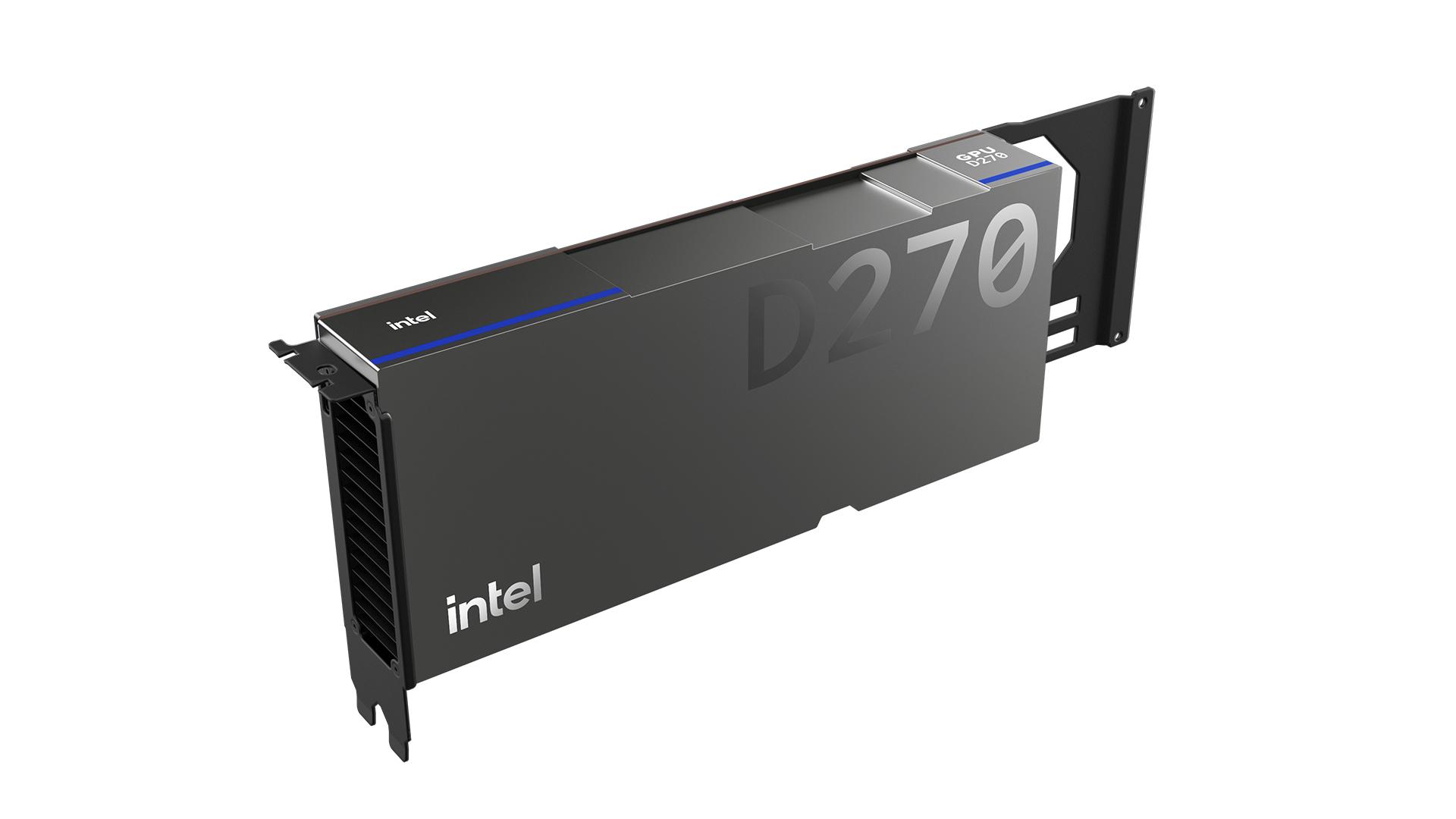
Intel's GPU D270 air-cooled PCIe card, shown in an Intel press render rather than a photograph of a shipping unit.
Image: Intel
Source · Press image from the Intel newsroom, used for news reporting.
Intel's Supercomputing 2026 material, reported Nov. 16, puts its GPU D270 at 1.92x to 5.9x the throughput of NVIDIA's RTX PRO 6000 Blackwell Server Edition in double-precision (FP64) finance workloads, a range Intel first gave at its AI Summit Seoul on Nov. 12.
Hardwareluxx reported that the tests cover binomial, Black-Scholes and Monte Carlo option-pricing methods, and that the gain varies by algorithm. Intel ran the D270 on SYCL and Intel's MKL math library and took the better of the CUDA or SYCL/MKL result for the NVIDIA card. In a separate seismic-imaging test on a 1-billion-point 3D grid, Intel said the D270 reached 45.91 billion grid points per second against 22.52 billion for its own Arc Pro B70, a ratio of 2.04 by Intel's count, as igor'sLAB reported. igor'sLAB noted that Intel gave no information on independent reproduction of the tests.
In Intel's own seismic test, the D270 reached 45.91 billion grid points/s against 22.52 billion for the Arc Pro B70; a vendor claim, not independently reproduced.
Graphic: Voltgrid News
For data-center planners the more useful number may be what Intel did not give. Hardwareluxx reported that Intel named no LLM throughput in tokens per second, so the card's main job, inference, still has no public measurement. Intel also gave no price or launch date in the material the outlets described.
Why FP64 Matters on an Inference Card
Most AI inference runs in 4-bit to 8-bit formats. Finance and seismic codes use FP64, 64-bit double precision, to keep rounding errors small. Intel lists FP64 on the D270 at full rate on its vector units, at 64 fused multiply-add operations per Xe core, but gave no clock speed or FP64 TFLOPS figure.
So Intel's 1.92x to 5.9x range is an application result, not a peak-rate comparison. In the seismic test, Intel set the D270, with 160 GB of memory at 1.5 TB/s, against its own Arc Pro B70, with 32 GB at 608 GB/s, so the test pairs two very different cards. All of these are Intel's figures, and no independent reproduction is available.
What Is New for Intel GPU D270 Since the October Specs
The card's specifications have not changed since our Oct. 18 report: 32 Xe3P cores, 256 XMX matrix engines, 160 GB of LPDDR5X at 1.5 TB/s on Intel's own card, up to 480 GB on partner cards, 350 W and air cooling. What Intel added at SC26 is the finance and seismic benchmark data. The FP64 details came from Intel's earlier Hot Chips material, Hardwareluxx says. Intel says the card spans FP4, MXFP4 and FP64, so one card can serve both inference and selected HPC jobs.
Intel also showed a split-inference design with SambaNova. In it, GPUs handle prefill, the compute-heavy reading of the prompt, SambaNova SN50 chips handle decode, the token-by-token output, and Xeon 6 and Xeon 6+ processors orchestrate. SambaNova said in a blog dated Nov. 15 that the SC26 demo runs the GLM-5.3 model on four D-Series cards plus a SambaRack SN50, in an air-cooled facility, with NVIDIA Dynamo routing requests and vLLM serving both stages.
D-Series Rack Figures and Power Draw
SambaNova put numbers on the larger design, a reference design rather than the four-card SC26 demo. It said Intel's OCP reference rack holds 80 D-Series GPUs and delivers 208 petaflops of peak FP4 compute, without saying whether that figure is dense or sparse, with 12 TB to 38 TB of memory and 120 TB/s of aggregate memory bandwidth depending on configuration. Each SambaRack SN50 holds 16 RDUs and typically needs 20 kW for inference, which SambaNova said lets it fit in many air-cooled data centers. By Voltgrid's arithmetic, a full 80-card reference rack at 350 W per card would draw 28 kW for the GPUs alone, before CPUs, networking and fans, against SambaNova's typical 20 kW for one SN50 rack; the SC26 demo itself uses four cards.
What Is Not Confirmed About the D270 Yet
Intel's own SC26 post was not readable to Voltgrid; this report rests on Hardwareluxx, igor'sLAB and SambaNova's blog. The FP64 finance results were first reported from Intel's Nov. 12 AI Summit Seoul presentation, and Seoul reports say Intel's own product page footnotes the RTX PRO 6000 figures as projections from public information, as Zaikei reported. The baseline card's power setting is not stated. Lab501 also cited Intel claims of up to 29% lower latency and 1.12x throughput on Qwen 3 30B-A3B against the RTX PRO 6000; no second outlet carried them, so they are left out. There is no independent benchmark, price or availability date. Another Voltgrid report said Maxsun plans D-series products, also without a date.
Sources
- 01Intel Xeon und GPU D-Series: HPC und KI im Systemverbundigor'sLABigorslab.de
- 02SC26: Intel nennt neue Details zu Diamond Rapids und der GPU D270Hardwareluxxhardwareluxx.de
- 03Intel puts GPU D270 at 1.92x-5.9x RTX PRO 6000 in FP64 finance workloads (AI Summit Seoul)Zaikeizaikei.co.jp
- 04The Air-Cooled Token Factory: Intel GPU D-Series + SambaRack SN50SambaNovasambanova.ai
- Published
- Sources
- 4 cited