TOP500 Record-Low Turnover: 27 New Systems as AI Factories Take Hardware
The 68th TOP500 list kept its top 10 and added a record-low 27 systems; AMD's Lux enters at No. 14 without a power figure. Either the megawatts are moving to AI factories, or the list is missing them.
5 min read
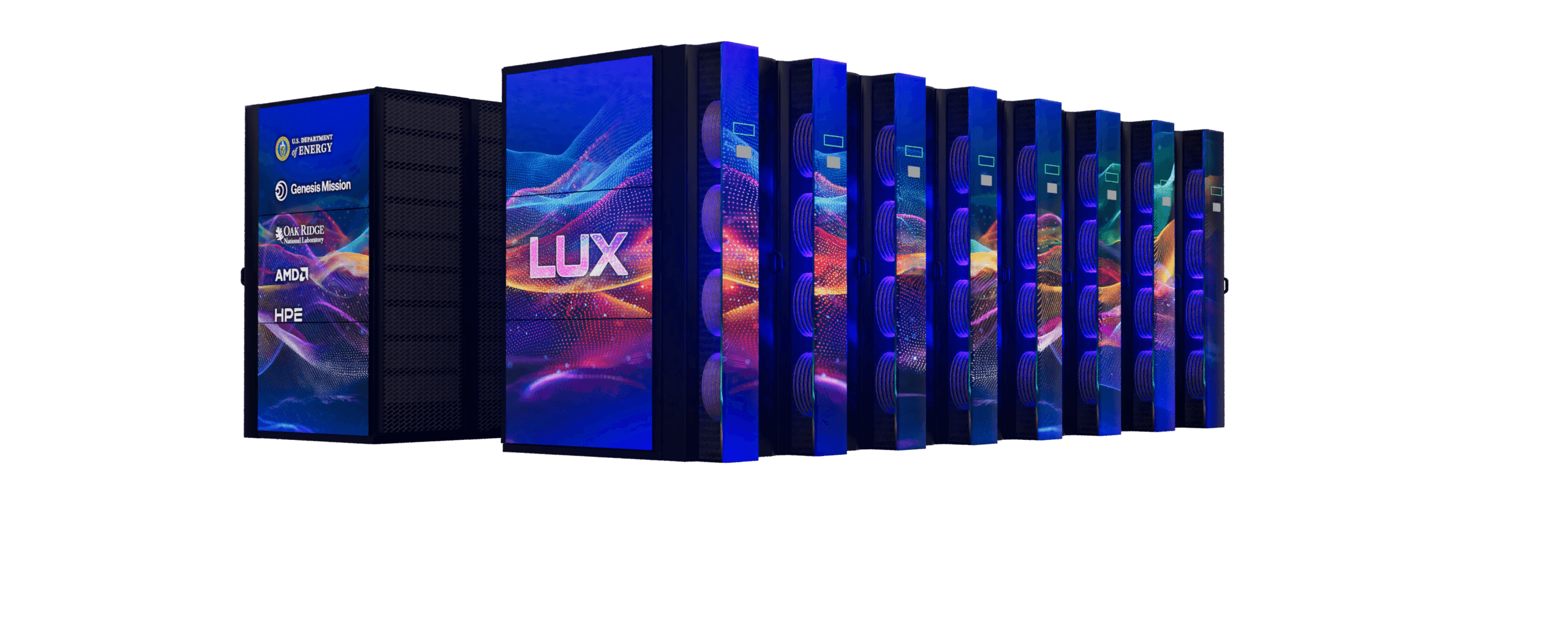
Lux, the AMD and HPE system at Oak Ridge National Laboratory that enters the November 2026 TOP500 at No. 14. ORNL rendering of the system.
Image: Oak Ridge National Laboratory
Source · Press image from the Oak Ridge National Laboratory newsroom, used for news reporting.
The 68th TOP500 list, released at SC26 in Chicago on November 16, 2026, has the same top 10 as June, and TOP500 counts only 27 new systems, the lowest turnover in the list's history. Our reading: the newest silicon and the megawatts behind it are going to AI factories, and the classic FP64 supercomputer is waiting for parts due in 2028.
What happened
TOP500's release says the 27 newcomers make up 5.4% of the list. LineShine at the National Supercomputing Centre in Shenzhen stays No. 1 with 2,198.40 PFlop/s on the High Performance Linpack (HPL) benchmark, ahead of El Capitan at Lawrence Livermore National Laboratory at 1,809.00 PFlop/s. These are results the sites submitted to TOP500, not independent tests. Growth came lower down: TOP500's release puts the No. 500 entry at 2.857 PFlop/s, up 7.3%, though its list file shows about 2.87 PFlop/s for the same slot.
The Green500 efficiency ranking did not move either. Its whole top 10 matches June, led by KAIROS in Toulouse at 73.28 GFlops/W on NVIDIA GH200 Superchips. The best AMD system, Ouranos on Instinct MI300A, sits at No. 9 with 66.46 GFlops/W. The highest new TOP500 entry is HANGANG at Korea's KISTI, a GH200 system at No. 12 with 342.6 PFlop/s and 5,789 kW, per its submitted row.
AMD's Lux at Oak Ridge National Laboratory enters at No. 14. TOP500's list file gives it 220.79 PFlop/s Rmax against 323.90 PFlop/s Rpeak, on EPYC 9575F host CPUs and Instinct MI355X GPUs in HPE ProLiant Compute XD685 nodes. Tom's Hardware reports more than 4,000 MI355X GPUs in more than 500 nodes, and the first of two machines in a $1 billion Department of Energy deal with AMD. Tom's Hardware also reports peak figures of 317 PFLOPS FP64 and 40 EFLOPS FP4; those are vendor figures, and the FP4 number is a low-precision AI peak that cannot be set beside HPL results. Lux submitted no power figure.
Tom's Hardware's headline says AMD has "over 40%" of the list, resting on 202 "AMD-powered" systems. By TOP500's own count, 199 systems (39.80%) use AMD processors, up from 38.40% six months ago; TOP500 does not use Tom's Hardware's broader definition. Either way, it counts systems, not performance.
Why it matters for power
TOP500 points to AI factories as the likely destination for the new hardware. Its release cites Epoch AI, without naming a specific report: quarterly additions to global AI compute grow roughly 2.5 times a year, cumulative AI compute has passed the equivalent of 15 million NVIDIA H100s, and five US hyperscalers held an estimated 71% of it at the end of 2025. TOP500 says this suggests growth has shifted from capability systems to capacity systems. Those are Epoch AI's estimates, not measured counts.
The submitted power rows show why a site would now spend its megawatts differently. TOP500's efficiency column, which divides Rmax by the power each site submitted, gives JUPITER Booster 63.32 GFlops/W, El Capitan 60.94, Frontier 54.98, LineShine 52.07 and Aurora 26.15. How sites measure power and what they include can differ, and these are not Green500 rankings. LineShine needs 42,220 kW, 12,535 kW more than El Capitan, for 389.4 PFlop/s more HPL. If grid connections are the scarce input for new sites, a machine of LineShine's 42 MW competes for the same megawatts as an AI cluster.
HPL efficiency is Rmax divided by power as submitted by each site, from TOP500's efficiency column; these are not Green500 ranks.
Graphic: Voltgrid News
HPL also measures something different from what AI buyers pay for. It runs in 64-bit (FP64) arithmetic; AI clusters are rated in low-precision formats such as FP8 and FP4. TOP500's mixed-precision HPL-MxP test sits in between: El Capitan scores 16.7 EFlop/s there against 1.809 EFlop/s on standard HPL, per TOP500.
In our reading, the FP64 flagship has become a slower product cycle. The next big HPC parts are years out: NVIDIA's Rubin HPC GPU is due in 2028 with no FP64 figure yet, as Voltgrid reported today. Intel's D270 claims FP64 gains in finance tests, but no D270 system is on the list. Tom's Hardware reports that ORNL's own Frontier successor, Discovery, is due in 2028.
The case against
The strongest objection is that the list is losing sight of systems, not that fewer are being built. Submission is voluntary. Microsoft Azure's Eagle at No. 7 is the only hyperscaler cloud in the top 10, and it lists no power at all. TOP500's list page says no other large Chinese system was reported. Only 204 of the 500 entries in TOP500's list file carry a power figure, and Lux is among those without one, so neither reading can be tested from the list alone.
The newcomers also undercut a clean "HPC stalled" story. By our count of the list file, 12 of its 28 first-time rows use NVIDIA B200 GPUs and two more use GB200; TOP500's release counts 27 new systems and does not say how it treats the extra row. Tom's Hardware reports that half of Lux's 3.5 million node-hours a year go to the Genesis Mission, the federal AI science programme. On this view, AI factories are full of HPL-capable hardware whose owners see no reason to stop production for a Linpack run. Both readings point to a growing gap between what the list measures and the AI compute Epoch AI estimates.
What it means for AMD, NVIDIA and HPE
For AMD, the list confirms a strong HPC installed base: El Capitan, Frontier, HPC6 and HPC7 in the top 10, and Lux as its largest MI355X entry, above the Sunrise and Zenith systems at No. 73 and No. 74. Lux turns 68% of its Rpeak into HPL, above El Capitan's 64% on TOP500's figures, but without a power row nobody can place MI355X on the Green500. For NVIDIA, GH200 still holds the Green500 top three, and B200 is the most common GPU among the newcomers. HPE built El Capitan, Frontier, HANGANG and Lux, so a slower FP64 cycle bears directly on its supercomputing order book.
What to watch
The 69th list at ISC 2027 in June will show whether turnover recovers or stays near record lows. A Lux power submission would give the first Green500 reading for MI355X. Tom's Hardware puts Discovery at ORNL in 2028, the same year NVIDIA's Rubin HPC GPU is due. If those systems arrive and submit, the top 10 should move again; if hyperscaler AI clusters keep skipping HPL, the list will keep tracking a smaller slice of the data-center build.
Sources
- 01November 2026 | Green500TOP500top500.org
- 02AMD grabs over 40% of new TOP500 list for supercomputers, up 14% since last yearTom's Hardwaretomshardware.com
- 03TOP500 Leadership Holds Steady as New System Turnover Falls to a Historic LowTOP500top500.org
- 04November 2026 | TOP500TOP500top500.org
- 05TOP500 Highlights - November 2026TOP500top500.org
- Published
- Sources
- 5 cited