Samsung Reportedly Develops Custom HBM4E for Meta on 2nm Base Die
The Bell reports Samsung is building custom HBM for Meta's own AI chip with a Samsung Foundry 2nm base die, adding Meta to the big customers it reportedly serves with custom HBM, after Nvidia and AMD. Samsung and Meta have not confirmed.
3 min read
Follows Samsung Reportedly to Make 2nm HBM Base Dies for AMD, NVIDIA at Taylor
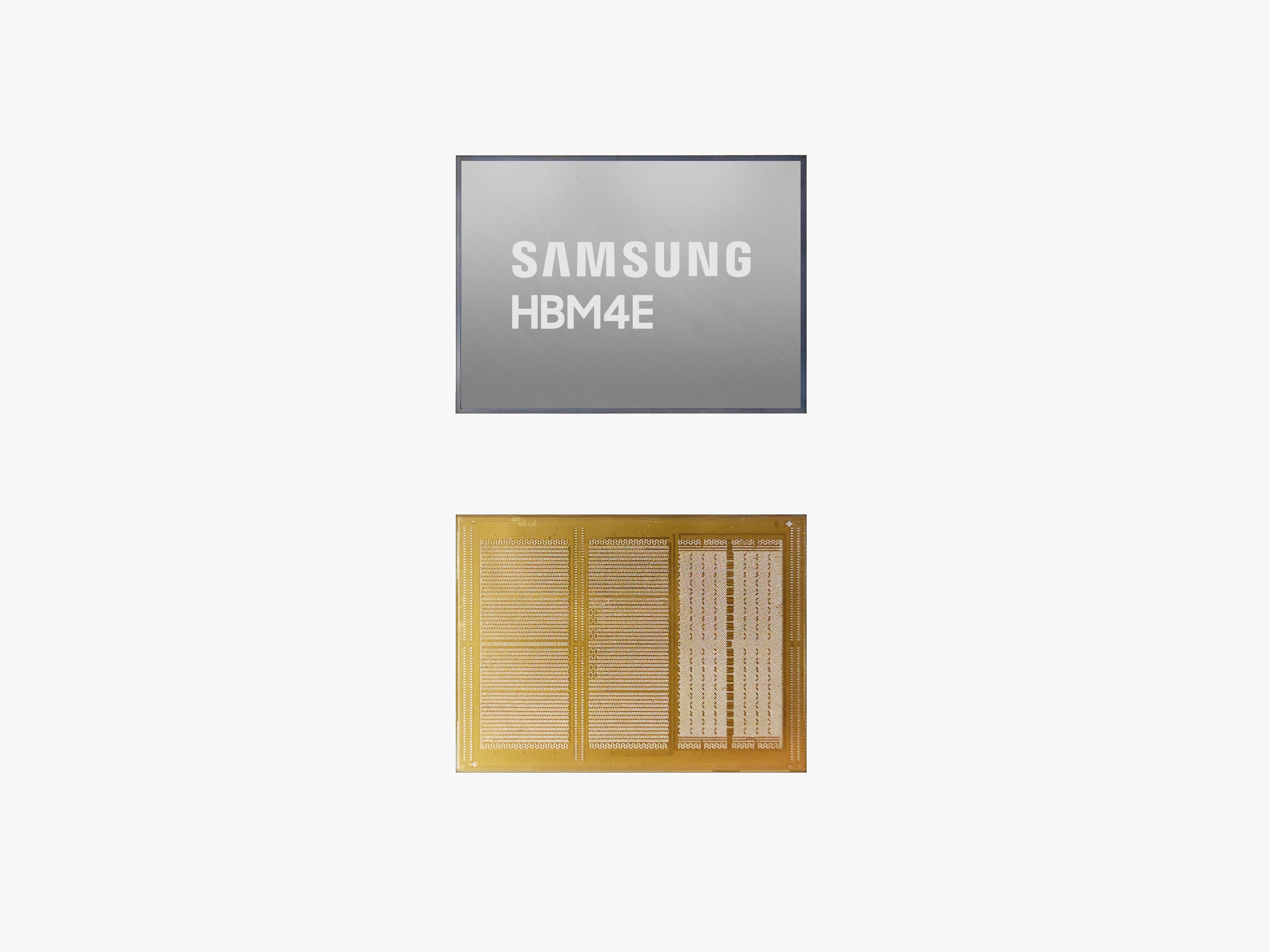
Samsung's standard 12-layer HBM4E sample; the reported Meta custom part is not shown.
Image: Samsung Electronics
Source · Press image from the Samsung Newsroom, used for news reporting.
Samsung Electronics is reportedly developing a custom high-bandwidth memory (HBM) stack for Meta's in-house AI chip, with the base die planned on Samsung Foundry's 2nm process, The Bell reported, citing industry sources.
The Bell said the product builds on HBM4E, the seventh generation of HBM, and adds the functions Meta asks for in the base die, the logic chip under the DRAM layers. The outlet's report first ran on its paid page on Nov. 13 and was opened to all readers on Nov. 17. DigiTimes ran a story on the same subject on Nov. 17 behind a paywall; we could read only its headline and teaser. Neither Samsung nor Meta has confirmed it in anything we could find, and no volume, price or ship date has been reported.
The reported Meta project would be a further customer for Samsung's base-die business, which Voltgrid covered on Nov. 3, when Samsung reportedly lined up 2nm base-die orders for AMD and NVIDIA at Taylor. The Bell now lists Meta alongside Nvidia and AMD as a target for Samsung's custom HBM.
What the base die changes
According to The Bell, HBM3 and HBM3E base dies were made on a DRAM process, which limited complex logic. Samsung moved to its own 4nm logic process for the HBM4 base die, but custom designs were limited at that stage. From HBM4E, the report says, the product line splits into standard and custom parts, and Samsung is developing 2nm and 4nm custom base dies depending on the customer.
Samsung's confirmed HBM base dies use a 4nm logic process; 2nm appears only in The Bell's report on the Meta part.
Graphic: Voltgrid News
Early custom base dies are expected to carry an HBM controller and die-to-die (D2D) interface IP, The Bell said. The outlet's reasoning is that optimizing the memory interface can cut the power spent moving data. For operators, that is the link to the rack: memory interface power is part of the accelerator's watts.
Nvidia wants TSMC, Samsung keeps 2nm in play
The same report says some customers, Nvidia among them, want Samsung's custom base dies made at TSMC, and Samsung engineers have started work on TSMC's process. SK hynix already has TSMC make its HBM4 base die, and Micron plans to do so from HBM4E, The Bell said.
TrendForce, citing Seoul Economic Daily on Oct. 19, reported that Nvidia asked Samsung, SK hynix and Micron to use TSMC's 3nm process for the base die of its NVHBM, a custom HBM4E. Samsung was validating its own 2nm process for NVHBM as a fallback if TSMC's 3nm capacity tightens. TrendForce also cited industry estimates of TSMC 3nm yields above 90% against about 60% for Samsung's 2nm (SF2); these are estimates, not company figures. Nvidia's claim for NVHBM, as relayed by TrendForce (we did not read Nvidia's own page), is up to 30% more memory bandwidth, 15% lower HBM power and 25% more compute die area than standard HBM4E.
A source close to Samsung Foundry told The Bell that next-generation HBM base dies are gradually filling Samsung's 2nm line and that custom HBM demand from big tech is strong.
What is not confirmed yet
No confirmation from Samsung or Meta has been published. The 2nm choice is Meta's reported configuration only: Samsung's official HBM4 base die is on 4nm, and the Nvidia base die is reported to be headed for TSMC. The report gives no stack height, bandwidth, capacity, volume or schedule for the Meta part, and no date for sampling. Watch for Samsung's next HBM4E and custom-HBM disclosures, and for any yield figure on 2nm base dies.
Sources
- Published
- Sources
- 2 cited