Lenovo ThinkStation PGX Review: GB10 Box Idles at 38-40 W, No US Price
ServeTheHome measured Lenovo's 128GB GB10 box at 38-40 W idle and under 200 W peak; XDA logged 25-40 tok/s on Qwen3-Coder-Next FP8. Lenovo's US store shows no price.
9 min read
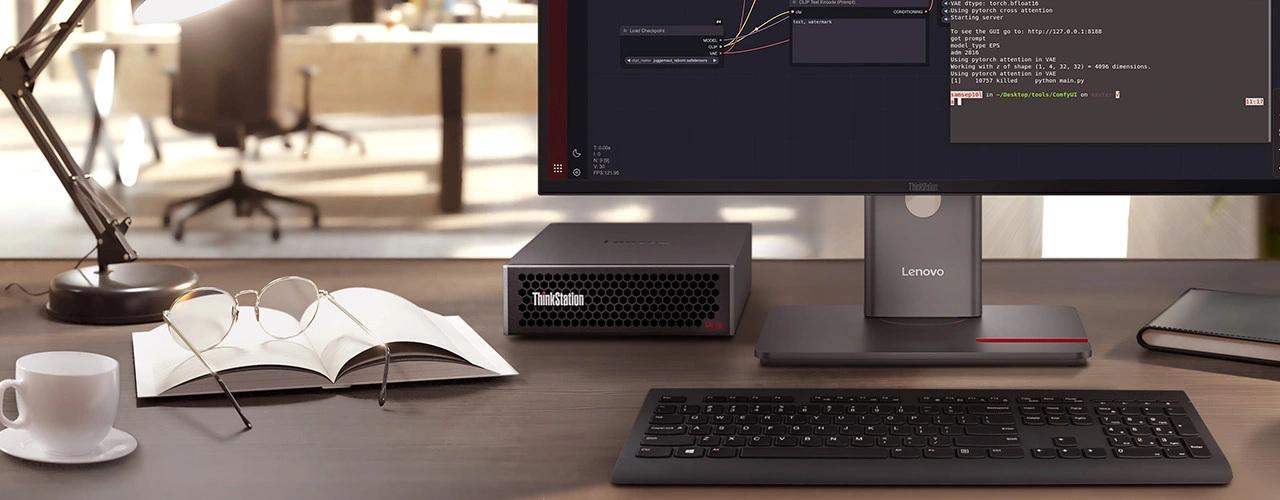
The ThinkStation PGX on a desk in Lenovo's product-page photo; the 1.2 kg box is 150 x 150 x 50.5 mm.
Image: Lenovo
Source · Press image from the Lenovo product page, used for news reporting.
ServeTheHome measured Lenovo's ThinkStation PGX, a 1.2 kg box with NVIDIA's GB10 chip and 128 GB of unified memory, at 38–40 W idle and just under 200 W peak in its Mar. 10, 2026 review. It is the same platform as NVIDIA's DGX Spark, and the two independent reviews that measured it, ServeTheHome's and XDA Developers' of Feb. 16, 2026, differ on what they compared: XDA ran no comparison with the DGX Spark, while ServeTheHome found the PGX a few percent ahead of it in many heat-soaked AI tests, a narrow margin shown only in charts. What sets the PGX apart is the badge, the cooling and the buying channel, and right now that channel is closed online: Lenovo's US product page showed no price when read on Nov. 17, 2026, only a link to contact Lenovo for pricing.
Neither outlet's text reports a gpt-oss-120b result, the model Voltgrid's other GB10 reviews are compared on. XDA measured 25–40 tokens per second on Qwen3-Coder-Next at FP8 in vLLM, and about 20 tokens per second on the 196-billion-parameter Step-3.5-Flash at 4-bit in a llama.cpp build. Those figures cannot be set against the StorageReview gpt-oss-120b results for the ASUS, Dell and HP boxes, because the model, the quantization and the tool all differ. ServeTheHome ran its own AI test suite against other GB10 systems and published the results only as charts.
What's new
The PGX is Lenovo's first ThinkStation built on an NVIDIA system-on-chip, ServeTheHome noted. Lenovo's product specifications reference (PSREF) sheet, dated July 1, 2026, lists the GB10 Grace Blackwell Superchip with a 20-core Arm CPU (10 Cortex-X925 and 10 Cortex-A725 cores) and a Blackwell GPU that Lenovo rates at up to 1 petaFLOP of AI performance at FP4. That is a sparse peak: Lenovo's PSREF gives no label, but XDA and NVIDIA's DGX Spark specification say the figure uses structured sparsity, so it is not a sustained rate.
Memory is the part that matters for local models. The PSREF lists 128 GB of LPDDR5X shared by CPU and GPU on a 256-bit bus at 273 GB/s. Because the GPU reads the same pool as the CPU, a model does not have to fit into a separate graphics card's memory. Lenovo says one PGX runs models of up to 200 billion parameters and two linked units up to 405 billion; the PSREF states no precision or context for those figures, so they are Lenovo's capacity claim, not a measured result.
For linking, the PSREF lists a 200 Gbps ConnectX-7 network card with two QSFP ports, for direct connection of two or three PGX systems; more than three need a QSFP switch, and Lenovo sells the cable separately. Ports on the back are four 20 Gbps USB-C (one of them the USB PD power input), HDMI and 10 GbE, plus Wi-Fi 7. Storage is a single self-encrypting M.2 NVMe drive of up to 4 TB, the power supply is a 240 W adapter, and the case measures 150 x 150 x 50.5 mm. Base warranty is one year of onsite service.
What Lenovo changed from NVIDIA's reference is small. ServeTheHome found the chassis and the two-fan cooler nearly identical to Gigabyte's AI TOP ATOM, a Lenovo-made 240 W adapter instead of the usual Delta unit, USB-C to USB-A adapters in the box, and a TLC drive at every storage tier. It also found that the PGX is the only 4 TB GB10 system it had seen with no PCIe Gen5 SSD option: Lenovo uses PCIe Gen4 drives throughout, in the short M.2 2242 size.
What it solves
The PGX removes the 24 GB or 32 GB ceiling of a consumer graphics card for teams that work on NVIDIA's software. XDA served Qwen3-Coder-Next, which it describes as an 80-billion-parameter coding model, at FP8 with a 170,000-token context, inside NVIDIA's own vLLM container, with weights of roughly 80 GB. That model would not fit on a 24 GB card without much heavier quantization, XDA noted. It then loaded Step-3.5-Flash, a 196-billion-parameter mixture-of-experts model, at Q4_K_S with a 140,000-token context.
The same box handled the jobs around inference. XDA fine-tuned Qwen2.5-7B with LoRA in just under 18 minutes, with memory peaking at 41.1 GB, GPU power at 65.4 W and temperature at 77°C, and found no thermal throttling. It quantized Google's MedGemma-27B to NVIDIA's 4-bit NVFP4 format in 26 minutes, peaking at 63.6 GB of memory. The fine-tune ran in NVIDIA's NGC PyTorch container and the quantization used NVIDIA's TensorRT Model Optimizer, both on DGX OS, the Ubuntu-based system every GB10 box ships with.
Memory bandwidth is the limit it does not remove. XDA says token generation is limited by memory bandwidth, and that the PGX's 273 GB/s is lower than that of Apple's M4 Max; its measured speeds were 25–40 tokens per second on Qwen3-Coder-Next at FP8 in vLLM and about 20 tokens per second on Step-3.5-Flash at Q4_K_S in llama.cpp. XDA called the first result very usable for code assistance, and the second not the fastest but certainly usable.
Pros and Cons
ServeTheHome's power figures come from the wall: 38–40 W at idle with the ConnectX-7 card connected, sustained load generally between 104 W and 160 W depending on the workload, and peaks just under 200 W against the 240 W rating. Unplugging the network link can save something like 18 W, it said. In AI tests after more than an hour of heat soak, shown in charts only, the PGX came in a few percent ahead of the DGX Spark in many tests; of eight AI tests across the field of GB10 systems, it won one and tied three. ServeTheHome called the margin narrow and expected any edge to come from cooling, one of the few things GB10 vendors control.
On the network card, ServeTheHome explained that 200 Gbps needs a PCIe 5.0 x8 link, while GB10 offers root ports of at most x4. The card therefore hangs off two x4 links and appears to the system as four network interfaces, which keeps the aggregate bandwidth but restricts network topology. That applies to every GB10 box, not only Lenovo's.
The price history is the weakest part. ServeTheHome reported in March 2026 that Lenovo offered a 1 TB configuration for around $4,100, against $4,699 for NVIDIA's 4 TB DGX Spark at the time. TechRadar's review of June 9, 2026 gave US prices from $5,079 for the 1 TB base model and UK prices from £5,200, and listed price and the 1 TB starting storage among its reasons to avoid it. Neither figure can be confirmed now, because Lenovo's US store lists none.
Who it's for
It fits an AI developer on NVIDIA's stack who needs to serve or fine-tune models too large for a 24 GB or 32 GB card, up to the 200 billion parameters Lenovo states for one unit, and who can live with single-user speeds like XDA's 25–40 tokens per second on an 80-billion-parameter model at FP8. It also fits a corporate IT department that already buys from Lenovo: ServeTheHome called it the most corporate-friendly GB10 system so far, and the PSREF lists onsite warranty service as standard. A small team that wants to try multi-node work can link two units for models of up to 405 billion parameters, by Lenovo's claim, or three over direct cables.
It does not fit a buyer who mainly wants fast single-user chat with large models and has no need for CUDA. In XDA's view, a Mac Studio with an M4 Max will typically generate tokens faster for a similar amount of money, because of its higher memory bandwidth, and a desktop with an RTX 5090 is the better pick when, in XDA's words, models fit comfortably in 24GB. Nor does it fit a buyer who needs a firm US quote this month.
How it compares
The PGX and the 128 GB models of its three closest rivals all use the same GB10 chip with 128 GB of memory; Lenovo and NVIDIA state 273 GB/s, and the reviewers' spec tables list the same figure for the ASUS and Dell boxes, so memory capacity and bandwidth do not separate them; measured speed and price might. The NVIDIA DGX Spark was listed at $6,950 for 128 GB and 4 TB on NVIDIA's marketplace in a copy recorded on Oct. 31, 2026, with stock unverified. The ASUS Ascent GX10 lists at $5,999 for 128 GB and 1 TB on ASUS's US store, out of stock when read on Nov. 11. The Dell Pro Precision with GB10 read $7,901 on Dell.com on Nov. 10 for 128 GB with a 2 TB QLC drive, and it ships with a 280 W adapter.
On speed, in its March 3, 2026 reviews, StorageReview measured gpt-oss-120b in vLLM, with equal input and output lengths, at 70 tokens per second at batch 1 on the ASUS and 68.57 on the Dell, rising to 680 and 670.83 tokens per second in aggregate at batch 64. No outlet has published the same test on the PGX, so the table under this story shows XDA's Qwen3-Coder-Next FP8 result in vLLM with one request for it, which cannot be ranked against the gpt-oss-120b figures. ServeTheHome's heat-soaked charts suggest the PGX sits at or slightly above the DGX Spark, and Voltgrid's comparison of gpt-oss-120b speeds found the measured GB10 boxes close to one another. Until a like-for-like run exists, the fair reading is that the PGX is a GB10 box like the others, not a faster one.
ServeTheHome measured idle power on four of these boxes, in separate reviews of different samples: Gigabyte's AI TOP ATOM at 36–37 W, the PGX at 38–40 W, the DGX Spark at 40–45 W in October 2025 and the ASUS GX10 at 42–47 W. Those ranges are not a like-for-like ranking. The ATOM, the PGX's twin in hardware, matched it within 0.5% in ServeTheHome's Geekbench 6 multi-core run, a CPU benchmark rather than an AI result, with the PGX ahead by an average of 3.7% in single-core tests, a lead ServeTheHome called just outside normal run-to-run variation.
ServeTheHome measured the PGX at 38-40 W idle; each bar comes from a separate review and sample, so it is not a like-for-like ranking. All four have 128 GB and 273 GB/s.
Graphic: Voltgrid News
What to watch
The first date that matters is the return of PGX configurations and prices to Lenovo's US store; Lenovo has given none, and the page read on Nov. 17, 2026 asked buyers to contact sales. The second is a gpt-oss-120b run on the PGX under the same conditions as the other GB10 reviews, which would show whether ServeTheHome's few-percent cooling edge appears in token rates.
The PGX runs NVIDIA's DGX OS like NVIDIA's own box, so the state of that software matters to its buyers too. NVIDIA fixed a display-triggered reboot loop on kernel 7.0.0-1024-nvidia on Nov. 3 and said on Nov. 5 that other crash reports were still under investigation, as Voltgrid reported; those reports concern the DGX Spark, and none has named the PGX. NVIDIA's GTC Washington, D.C. conference runs from Nov. 30 to Dec. 3, 2026, the next NVIDIA event on the calendar.
How it compares
Full table| Product | Memory | Bandwidth | AI compute | Measured speed | Price |
|---|---|---|---|---|---|
| GIGABYTE AI TOP ATOMGIGABYTE | 128 GB unified system memory[39] | 273 GB/s (LPDDR5x-8533, 256-bit)[40] | — | gpt-oss-120b, vLLM online serving, equal ISL/OSL: 60.71 tok/s at batch 1 rising to 649.62 tok/s aggregate at batch 64 (StorageReview)[40] | $7,499.99 (128 GB, 4 TB PCIe 4.0) and $9,405.63 (128 GB, 4 TB PCIe 5.0; more options from $7,999.99); 128 GB from $5,999.99 (1 TB) and $6,999.99 (2 TB) at Newegg US, read Nov 9, 2026[41] |
| GMKtec EVO-X5 Pro AI Mini PCGMKtec | 192 GB LPDDR5X-8533 onboard (8 x 24 GB, non-upgradeable); up to 160 GB allocatable as VRAM[42] | Up to 273 GB/s[43] | — | GMKtec Laboratory table: GLM-5.3-Flash UD-IQ4_XS (146.05 GB) decode 17.79 tok/s, prefill 70.18, TTFT 14.71 s; Qwen3.8-Flash-Next ROCmFP4-FAST (93.48 GB) decode 45.08 tok/s[42] | $6,799 (192 GB/2 TB) and $7,099 (192 GB/4 TB), all variants available, GMKtec US store, read Nov 9, 2026[42] |
| HP ZGX Nano AI Station (G1n)HP | 128 GB coherent unified system memory[44] | 273 GB/s (128 GB LPDDR5x)[45] | GB10: up to 1 PFLOP FP4, theoretical, using the sparsity feature; HP and reviewers list 1,000 TOPS FP4 (sparse)[31] | gpt-oss-120b, vLLM online serving, equal ISL/OSL: 69.6 tok/s at batch 1 rising to 722.9 tok/s aggregate at batch 64 (StorageReview)[46] | $7,399.00 at the HP Store for the 4 TB model; $4,759 on Amazon (Notebookcheck, review updated Oct 5, 2026)[47] |
| Lenovo ThinkStation PGXLenovoThis story | 128 GB LPDDR5X unified (256-bit)[48] | 273 GB/s[48] | Up to 1 PFLOP FP4 (Lenovo PSREF gives no sparsity label; XDA says NVIDIA's figure assumes structured sparsity) (sparse)[48] | Qwen3-Coder-Next FP8 (FP8 KV cache), vLLM NGC container, one request at a time, 170K context: 25-40 tok/s (XDA Developers, Lenovo-loaned unit)[49] | US from $5,079 (1 TB base model) on Lenovo's site, per TechRadar's review (Jun 9, 2026); UK from GBP 5,200[50] |
| MSI EdgeMesa N AI+ (128 GB, X-005US)MSI | 128 GB LPDDR5X unified system memory[51] | 273 GB/s[51] | — | — | $7,999.00 (128 GB, 4 TB, X-005US, MSI US store, read Nov 11, 2026)[51] |
| MSI EdgeXpert (MS-C931)MSI | 64 GB or 128 GB LPDDR5x unified (256-bit)[52] | 273 GB/s[52] | 1 PFLOPS FP4 (sparse)[52] | — | No list price; MSI sells via quote (Get a quote)[52] |
| NVIDIA DGX SparkNVIDIA (partner GB10 systems from Acer, ASUS, Dell, GIGABYTE, HP, Lenovo and MSI) | 128 GB; a 64 GB configuration is sold only through OEM partners[31] | 273 GB/s[31] | Up to 1 PFLOP FP4 (theoretical, using the sparsity feature) (sparse)[31] | Qwen 3.8 27B (dense) with multi-token prediction: decode of about 20 tokens/s, with time-to-first-token staying interactive out to the full 262K context.[53] | $6,950.00 (128 GB, 4 TB) on NVIDIA's enterprise marketplace with an Add To Cart button in a copy cached 07:59 UTC on 2026-10-31; stock unverified (listed out of stock on 2026-10-21); 64 GB partner systems from $4,999[54] |
| NVIDIA DGX Spark 64 GBNVIDIA (sold by Acer, ASUS, Dell, Gigabyte, HP and MSI) | 64 GB LPDDR5X unified (two units pool 128 GB over ConnectX-7)[55] | 273 GB/s (256-bit; NVIDIA spec table covers both 64 GB and 128 GB)[31] | 1 PFLOPS FP4 (sparse; NVIDIA spec table covers both memory configurations)[31] | — | from $4,999 (partner systems, Oct 2026; no Founders Edition)[55] |
Show the other 32 machinesHide the other 32 machines
| Product | Memory | Bandwidth | AI compute | Measured speed | Price |
|---|---|---|---|---|---|
| ASUS ExpertCenter Pro ET900N G3ASUS (NVIDIA DGX Station GB300 platform) | 748 GB coherent: 252 GB HBM3e (GPU) + 496 GB LPDDR5X (CPU)[1] | 7.1 TB/s (GPU HBM3e); 396 GB/s (CPU LPDDR5X)[1] | up to 20 PFLOPS AI performance (ASUS gives no precision or sparsity label) (sparse)[2] | GPT-OSS-120B MXFP4, vLLM, 512/512, 1-128 streams: 9,280 aggregate output tok/s at 128 streams; 5,023 on 8,192/1,024 (StorageReview, ASUS-supplied unit, no add-in GPU)[3] | $111,999.99 at Central Computers, US (ET900N G3-2SSD-V2, read Nov 8, 2026); no ASUS list price[4] |
| HP ZGX Fury AI StationHP | 252 GB HBM3e GPU + 496 GB LPDDR5x CPU (4x 128 GB SOCAMM); 748 GB unified[5] | 7.1 TB/s (GPU HBM3e); 396 GB/s (CPU LPDDR5x)[5] | up to 20 petaFLOPS FP4 (HP gives no sparsity label) (sparse)[5] | Two-unit cluster with an ASUS ET900N G3 over two 400G DACs: GLM-5.3 NVFP4 5,018 output tok/s at 256 streams, 512/512, vLLM 0.27.1 TP2 with MTP (StorageReview); no single-unit HP result[6] | $132,000.00 on HP Store US (ZGX Fury G1n, 3-yr warranty, no graphics card, 4x 2 TB SED SSDs; Add to cart; read Nov 11, 2026)[7] |
| MSI XpertStation WS300MSI (NVIDIA DGX Station platform) | 252 GB HBM3e GPU + 496 GB LPDDR5X CPU (748 GB coherent)[8] | 7.1 TB/s (GPU HBM3e); 396 GB/s CPU LPDDR5X[8] | — | StorageReview vLLM: gpt-oss-120b MXFP4 9,294 output tok/s at 128 streams (512/512), 5,038 on 8,192/1,024; MiniMax M3 NVFP4 1,041 at 32 streams with EAGLE3-GQA at a forced acceptance length of 3 (best-case)[8] | $99,999.00 'Start From' at Newegg US (model WS300T60L, 2x 2 TB NVMe RAID1), request-a-quote listing sold by Newegg (read Nov 15, 2026)[9] |
| NVIDIA DGX StationNVIDIA (systems built by ASUS, Dell, GIGABYTE, HP, MSI, Supermicro and Exxact) | 748 GB coherent: 252 GB HBM3e (GPU) + 496 GB LPDDR5X (CPU)[10] | GPU HBM3e 7.1 TB/s; CPU LPDDR5X 396 GB/s; NVLink-C2C 900 GB/s between them[10] | 15 PFLOPS FP4 (without sparsity)[10] | gpt-oss-120b MXFP4, vLLM, 512/512 chat workload: 9,280 output tok/s at 128 streams (MSI WS300 9,294), single GB300 (StorageReview, ASUS ExpertCenter Pro ET900N G3)[3] | No NVIDIA list price; lowest US partner listing read Nov 4, 2026: Exxact Valence VWS-158270643 from $98,450 (Tom's Hardware found $94,930 in Aug); Dell Pro Precision with GB300 lists $160,195[11] |
| Supermicro Super AI Station (ARS-511GD-NB-LCC)Supermicro (NVIDIA DGX Station platform) | 748 GB total coherent: 252 GB HBM3e GPU + 496 GB LPDDR5X system[12] | 7.1 TB/s (GPU HBM3E); 396 GB/s (CPU LPDDR5X)[13] | up to 20 PFLOPS FP4 (Supermicro gives no sparsity label; ServeTheHome describes it as sparse FP4)[12] | Qwen3.8 Flash Next NVFP4, vLLM, tool-loop 4,096-in/512-out: several scenarios exceeded 3,000 output tok/s at 32 concurrent users, still rising (ServeTheHome; RTX PRO 2000 installed)[14] | $92,887.47 before tax and shipping on Supermicro's online store (ARS-511GD-NB-LCC-01-G2); about $90,101.05 with a 3% new-customer discount (TechRadar, Sep 1, 2026)[15] |
| NVIDIA RTX PRO 6000 Blackwell Workstation EditionNVIDIA (sold through PNY, TD SYNNEX and workstation makers) | 96 GB[16] | 1,792 GB/s[16] | 4,000 AI TOPS (FP4, with sparsity) (sparse)[16] | gpt-oss-120b MXFP4, stock vLLM, 512/512 chat workload: 3,064 output tok/s at 128 streams (1,169 on 8,192/1,024 prompts); Server Edition at 600W (StorageReview)[17] | $16,000 on NVIDIA's US marketplace (Workstation Edition), listed out of stock[18] |
| Apple Mac Studio (M5 Ultra)Apple | up to 512 GB unified (96 GB on 30-core M5 Ultra; 256 GB or 512 GB on 36-core/80-core M5 Ultra)[19] | 1.2 TB/s[19] | — | GLM-5.3-Flash MLX 4-bit with MTP on TensorFold, ISL 2048/OSL 512: 94.0 tok/s at 0 context, 96.5 at 128K, 79.4 at 512K; TTFT 1.1 s at 0, 66.3 s at 128K (Tom's Hardware, 256 GB M5 Ultra)[20] | $22,299 minimum with 512 GB ($6,799 36-core CPU/80-core GPU M5 Ultra config plus $15,500 memory upgrade; Oct 28, 2026)[21] |
| Corsair FlexPrime V20C Workstation (CSW-9040004-NA)Corsair | 32 GB GDDR6 on the Arc Pro B70 GPU + 32 GB (2x 16 GB) DDR5 system memory[22] | 608 GB/s (GPU GDDR6)[22] | — | Qwen3.8 27B Q4_K_M, llama.cpp server: 19.8 tok/s at 1 request, 33.5 at 4, 35.4 at 8; TTFT 9,005 ms on 8,192-token prompt (StorageReview)[23] | $3,999.99 on Corsair US store (32 GB DDR5, 1 TB SSD; read Nov 15, 2026)[22] |
| NVIDIA RTX Spark (N1X) PCsNVIDIA (MediaTek collaborated on the custom CPU design) | Up to 128 GB LPDDR5X (20-core CPU / 6,144-core GPU version); up to 64 GB (18-core / 5,120-core laptop version)[24] | Up to 300 GB/s: LPDDR5X-9400 on a 256-bit bus (NVIDIA's product page lists no bandwidth)[25] | — | gpt-oss:20b via Ollama in a Codex CLI coding agent, 64K context: 58.5 tok/s generation, 3 of 4 tasks passed (Dell XPS 16, 20-core N1X, 64 GB; StorageReview)[26] | Laptops from $2,599; pricing and configurations vary by region[27] |
| AMD Ryzen AI Halo (Ryzen AI Max+ PRO 495, 192 GB)AMD | 192 GB LPDDR5X (256-bit)[28] | 273 GB/s[28] | — | — | $7,299.99 for the Linux version (released the week of Oct 12, 2026); Windows version coming soon[28] |
| ASUS Ascent GX10ASUS | 64 GB or 128 GB LPDDR5X-8533 unified[29] | 273 GB/s (8533 MT/s), as listed by StorageReview; ASUS's spec page states no bandwidth[30] | Up to 1 PFLOP FP4 (GB10; NVIDIA's footnote: theoretical, using the sparsity feature). ASUS's pages say 1 petaFLOP / FP4 with no sparsity label (sparse)[31] | gpt-oss-120b, vLLM online serving, equal ISL/OSL: 70 tok/s at batch 1 rising to 680 tok/s aggregate at batch 64 (StorageReview)[30] | $5,999 (128 GB, 1 TB, GX10-GG0010BN, ASUS eShop US, Oct 30, 2026)[32] |
| Dell Pro Precision with GB10 (model FCM1253; launched as Dell Pro Max with GB10)Dell | 128 GB LPDDR5x up to 8533 MT/s onboard (64 GB option also listed)[33] | 273 GB/s (128 GB LPDDR5x, 256-bit)[34] | — | gpt-oss-120b, vLLM online serving, equal ISL/OSL: 68.57 tok/s at batch 1 rising to 670.83 tok/s aggregate at batch 64 (StorageReview)[35] | $7,901.00 (default FCM1253, 128 GB, 2 TB Gen4 QLC); 4 TB TLC SED SSD option +$2,450.00; 64 GB option listed at a $2,150.00 difference (Dell.com US, read Nov 10, 2026)[36] |
| Framework Desktop (Ryzen AI Max+ PRO 495, 192 GB)Framework | 192 GB LPDDR5X-8533 soldered[37] | 273 GB/s (256-bit)[37] | — | — | $6,799 (Max+ PRO 495 192 GB DIY Edition pre-order, Nov 3, 2026; storage not included)[38] |
| Sipeed MaixStationSipeed | 128 GB LPDDR5X (256-bit)[28] | 273 GB/s (Sipeed claim)[28] | 256 TOPS FP4 (native FP4, no sparsity; Axera/Sipeed claim)[28] | — | about $3,999 expected for 128 GB, with Kickstarter launch discounts (Sipeed to Tom's Hardware, Oct 2026)[28] |
| AMD Ryzen AI Halo Developer PlatformAMD | 128 GB LPDDR5x-8000 unified[56] | 256 GB/s[56] | — | gpt-oss-120b, vLLM online serving, equal ISL/OSL 256/256: 222 tok/s aggregate at batch 64 vs 701 on DGX Spark (StorageReview)[57] | $3,999 with 2 TB SSD (Jul 2026)[57] |
| Framework Desktop (Ryzen AI Max+ 395)Framework | 128 GB LPDDR5x-8000 soldered (32 GB and 64 GB options)[58] | 256 GB/s[59] | — | gpt-oss-120b MXFP4 in LM Studio (out-of-the-box setup): roughly 45 tok/s (ServeTheHome; Ryzen AI Max+ 395, 128 GB, Windows 11 Pro)[60] | $3,449 (DIY Edition, Max+ 395 with 128 GB, system only; out of stock, Nov 3, 2026)[61] |
| Acer Veriton GN100 AI Mini WorkstationAcer | 128 GB LPDDR5x coherent unified[62] | — | — | gpt-oss-120b, vLLM, total token throughput: prefill heavy 303.61 to 2,777.56 tok/s; decode heavy 38.38 to 292.41 tok/s (batch 1 to 64, StorageReview)[63] | from $3,999 in North America (announced Sep 3, 2025; prices vary by region)[62] |
| ASRock Industrial AI BOX-A395ASRock Industrial | 128 GB LPDDR5X-8000 soldered[64] | — | — | AgentSTH V7, 32 threads: 15% ahead of the next-closest Ryzen AI Max+ 395 box (single-core within 1%); estimated SPEC CPU2026 int rate: top of a 44% spread across four 395 systems; measured by ServeTheHome, Ubuntu 26.04[65] | — |
| Beelink GTR9 Pro (Ryzen AI Max+ 495, 128 GB)Beelink | 128 GB LPDDR5X-8533 unified (soldered)[66] | — | 132 AI TOPS on Beelink's page; AMD lists the PRO 495 at Overall TOPS up to 132 and NPU TOPS up to 55; no precision stated by either[66] | 4.24 tok/s, LM Studio, Qwen3.8-35B-A3B (Beelink's own figure on its store page; quantization, context, backend and RAM size not stated)[66] | $4,799 (128 GB/2 TB), Beelink store, pre-order (read Nov 13, 2026)[66] |
| Beelink GTR9 Pro (Ryzen AI Max+ 495, 192 GB)Beelink | 192 GB LPDDR5X-8533 unified (soldered)[66] | — | 132 AI TOPS on Beelink's page; AMD lists the PRO 495 at Overall TOPS up to 132 and NPU TOPS up to 55; no precision stated by either[66] | 4.24 tok/s, LM Studio, Qwen3.8-35B-A3B (Beelink's own figure on its store page; quantization, context, backend and RAM size not stated)[66] | $7,399 (192 GB/2 TB) or $7,799 (192 GB/4 TB), Beelink store, pre-order (read Nov 13, 2026)[66] |
| Bosgame M5 MAX AI Mini PCBosgame | 192 GB unified LPDDR5 (soldered); up to 160 GB allocatable to the GPU[67] | — | — | — | $6,199 introductory first-batch pre-order price (192 GB, 2 TB PCIe 4.0 SSD), from Nov 3, 2026, until the first allocation sells out[67] |
| Dell Pro Max Micro (FCM2250)Dell | 24 GB GDDR7 on the RTX PRO 4000 SFF (23.9 GB usable measured) + 96 GB DDR5-6400 CSODIMM system RAM in StorageReview's tested build[68] | — | — | Ministral 3 8B, llama.cpp server (CUDA), 4,096-in/1,024-out: 52.0 tok/s at 1 request, 108.9 at 4; TTFT 1,477 ms (StorageReview, RTX PRO 4000 SFF 24 GB, driver 595.99.02, Ubuntu 26.04.1)[68] | From $1,449.00 on Dell.com US; RTX PRO 4000 SFF 24 GB option +$3,870.00 (read Nov 16, 2026)[69] |
| Dell Pro Precision 9 T4Dell | Up to 2x 96 GB GDDR7 (two RTX PRO 6000 Max-Q) + up to 4 TB DDR5 RDIMM in 16 slots, 8 channels[70] | — | — | MiniMax M2.7 Q4_K_M (129.3 GB) split across 2x RTX PRO 6000 Max-Q: 83.7 tok/s one user, 127.3 peak; 30.3 on one card plus system RAM (StorageReview, llama.cpp b11716, Ubuntu 26.04.1)[70] | From $5,925.00 on Dell.com US; dual RTX PRO 6000 Max-Q option +$30,820.00 (read Nov 14, 2026). StorageReview's tested build (Xeon 698X, 256 GB, 2x Max-Q) about $66,600[71] |
| Dell Pro Precision with GB300 (model FCT6263; announced as Dell Pro Max with GB300)Dell | 252 GB HBM3e GPU + 496 GB LPDDR5X CPU[72] | — | — | — | $160,195.00 (Dell.com US default config FCT6263, read Nov 8, 2026)[72] |
| Gigabyte AI TOP Aero | up to 128 GB LPDDR5X unified[73] | — | — | — | — |
| GMKtec EVO-X2 AI Mini PCGMKtec | 64 GB or 128 GB onboard LPDDR5X-8000 (non-upgradeable)[74] | — | — | Llama 3.3 70B Q6_K Instruct: 3.7-3.8 tok/s generation fully on the Radeon 8060S (about 2 tok/s CPU-only); Qwen3-32B 10.4-10.5 tok/s; 128 GB unit, short prompt, tool not named (ServeTheHome)[75] | $3,499.99 (128 GB/1 TB) and $3,649.99 (128 GB/2 TB), each against a $3,999.99 compare-at price (GMKtec US store, read Nov 11, 2026)[74] |
| HP Z2 Mini G1a WorkstationHP | up to 128 GB unified, up to 96 GB assignable to the GPU, up to 8000 MT/s[76] | — | up to 50 NPU TOPS[76] | gpt-oss-120b GGUF (63.39 GB, full GPU offload) in LM Studio: close to 40 tok/s (StorageReview)[77] | $4,781 list for StorageReview's review configuration; about $3,300 street (B&H top spec with 2 TB SSD at $3,342.65, Aug 2025)[77] |
| Microsoft Surface RTX Spark Dev BoxMicrosoft | 128 GB unified memory[78] | — | up to 1 PFLOP of AI compute (Microsoft; precision and sparsity not stated on the page) (sparse)[78] | — | From $5,999.99 (Microsoft Store US, pre-order, read Nov 1, 2026)[78] |
| MSI EdgeMesa N AI+ (64 GB) | — | — | — | — | from $4,699 in the US (64 GB soldered LPDDR5X, 1 TB PCIe Gen 5)[79] |
| Tenstorrent TT-QuietBox 2 (Blackhole)Tenstorrent | 128 GB GDDR6 on the accelerators + 256 GB DDR5-5600 system memory[80] | — | — | — | $9,999 (Oct 30, 2026)[80] |
| WiCi One (RTX 5060 Ti edition)WiCi | 16 GB GDDR7 VRAM; 1 TB NVMe 4 SSD for TurboStream weight paging (WiCi's claim: NVMe used as working VRAM). System RAM not stated[81] | — | — | — | $2,599 list (WiCi shop, Oct 2026); a $600-off code (WICIWELCOME) is applied at checkout. Early-access price was $1,999 (Notebookcheck, Engadget, Sep 2026)[81] |
| WiCi One (RTX 5090 edition)WiCi | 32 GB GDDR7 VRAM; 4 TB NVMe 5 SSD for TurboStream weight paging (WiCi's claim: NVMe used as working VRAM). System RAM not stated[81] | — | — | — | $9,999 list (WiCi shop, Oct 2026); a $600-off code (WICIWELCOME) is applied at checkout[81] |
Italic values are reported by an outlet or measured by an independent lab; the rest come from the maker. Measured speeds use different models, quantizations and tools, so read each with its source rather than against the others. Voltgrid News does not test hardware itself.
Sources (81)
- [1] ASUS
- [2] ASUS
- [3] StorageReview
- [4] Central Computers
- [5] HP
- [6] StorageReview
- [7] HP
- [8] StorageReview
- [9] Newegg
- [10] NVIDIA
- [11] Exxact
- [12] Supermicro
- [13] ServeTheHome
- [14] ServeTheHome
- [15] TechRadar
- [16] NVIDIA
- [17] StorageReview
- [18] NVIDIA
- [19] Apple
- [20] Tom's Hardware
- [21] MacRumors
- [22] Corsair
- [23] StorageReview
- [24] NVIDIA
- [25] ServeTheHome
- [26] StorageReview
- [27] NVIDIA
- [28] Tom's Hardware
- [29] ASUS
- [30] StorageReview
- [31] NVIDIA
- [32] ASUS eShop
- [33] Dell
- [34] HotHardware
- [35] StorageReview
- [36] Dell
- [37] Framework Blog
- [38] Framework
- [39] GIGABYTE (PR Newswire)
- [40] StorageReview
- [41] Newegg
- [42] GMKtec
- [43] GMKtec
- [44] HP
- [45] HotHardware
- [46] StorageReview
- [47] Notebookcheck
- [48] Lenovo PSREF
- [49] XDA Developers
- [50] TechRadar
- [51] MSI
- [52] MSI
- [53] Tom's Hardware
- [54] NVIDIA Marketplace
- [55] NVIDIA Blog
- [56] AMD
- [57] StorageReview
- [58] Framework
- [59] Framework Blog
- [60] ServeTheHome
- [61] Framework
- [62] Acer
- [63] StorageReview
- [64] ServeTheHome
- [65] ServeTheHome
- [66] Beelink
- [67] Notebookcheck
- [68] StorageReview
- [69] Dell
- [70] StorageReview
- [71] Dell
- [72] Dell
- [73] Notebookcheck
- [74] GMKtec
- [75] ServeTheHome
- [76] HP
- [77] StorageReview
- [78] Microsoft
- [79] Notebookcheck
- [80] Tenstorrent
- [81] WiCi
Sources
- 01Lenovo ThinkStation PGX Review: The NVIDIA GB10 128GB AI Workstation Goes CorporateServeTheHomeservethehome.com
- 02ThinkStation PGX Small Form Factor Workstation: Lenovo US product pageLenovolenovo.comas read on Nov 17, 2026
- 03Lenovo ThinkStation PGX mini PC workstation reviewTechRadartechradar.com
- 04ThinkStation PGX - PSREF specificationsLenovopsref.lenovo.com
- 05I served a 200 billion parameter LLM from a Lenovo workstation the size of a Mac MiniXDA Developersxda-developers.com
- Desk
- Local AI Desk
- Published
- Sources
- 5 cited