NVIDIA DGX Spark Review: 128GB GB10 Box Now Lists at $6,950
StorageReview and Tom's Hardware measured the 128GB DGX Spark well ahead of AMD's Strix Halo on gpt-oss-120b, but its 273 GB/s memory limits dense models. A 64GB unit starts at $4,999.
Local AI DeskEdited by Ege Erten
10 min readAI-assisted
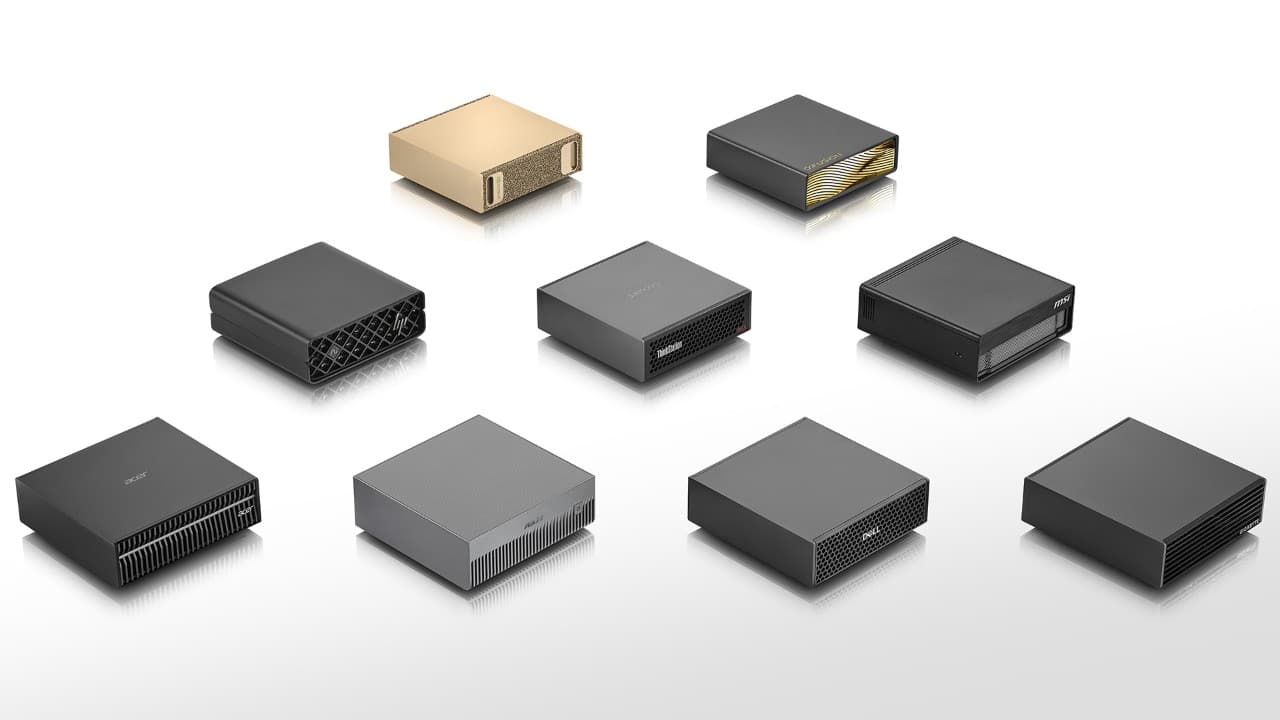
NVIDIA's DGX Spark family photo shows the gold Founders Edition (top left) with partner GB10 systems; it is not a shot of the 128 GB unit alone.
Image: NVIDIA
Source · Press image from the NVIDIA website, used for news reporting.
NVIDIA's DGX Spark puts 128 GB of unified memory at 273 GB/s in a 1.2 kg box, and NVIDIA's marketplace listed the 128 GB, 4 TB unit at $6,950 on Oct. 31, in a page capture that showed an Add To Cart button; stock is unconfirmed. NVIDIA said a 64 GB version, sold only through partners, would be available from Oct. 23 starting at $4,999.
That price is the first thing a buyer meets, and it has moved a long way. Tom's Hardware reviewed a $4,000 Founders Edition in January. StorageReview cited $4,699 in July and tied the rise to the supply crunch in LPDDR5X and NAND flash. The independent results have held steady through those changes. In StorageReview's vLLM online-serving runs at batch 64, the Spark served gpt-oss-120b 2.4 to 8.8 times faster than AMD's Ryzen AI Halo. Tom's Hardware found it quick, quiet and efficient in llama.cpp and ComfyUI. On dense models, though, a Mac Studio with far more memory bandwidth pulls well ahead. This review sets NVIDIA's specifications against what those outlets measured. Voltgrid did not test the machine.
What Is New in the DGX Spark
The core is the GB10 Grace Blackwell Superchip. NVIDIA's spec page lists a 20-core Arm CPU, with 10 Cortex-X925 and 10 Cortex-A725 cores, beside a Blackwell GPU with fifth-generation Tensor Cores. Tom's Hardware counts 6,144 CUDA cores on that GPU, which it likens to a desktop RTX 5070. The two chiplets sit on one package. NVIDIA rates the chip at 140 W, CPU and GPU together, and ships a 240 W power supply to cover the network card and peripherals.
Memory is the feature that defines the product. Both halves of the chip share one coherent pool of LPDDR5X, 128 GB or 64 GB, on a 256-bit bus at 273 GB/s. Tom's Hardware sets that figure against the 672 GB/s the RTX 5070 gets from only 12 GB of GDDR7. Reading the weights for each new token is what limits generation speed. So the Spark can hold models that no consumer graphics card can, but it writes them out at a pace set by 273 GB/s.
Networking is the second change from anything else at this size. Every unit carries a ConnectX-7 network card with two QSFP ports at 200 Gbps, plus 10 GbE. NVIDIA says up to four systems can work as one cluster, and four need an external switch. On NVIDIA's own table, two 128 GB units handle models of up to 400 billion parameters and four handle up to 700 billion.
The 64 GB configuration is the newest step. NVIDIA's Oct. 2 blog says it keeps the same GB10 chip, DGX OS and software stack as the 128 GB model. Partners Acer, ASUS, Dell, Gigabyte, HP and MSI sell it, rated for models up to 100 billion parameters. Two of them cable together into a 128 GB pool rated for 200 billion. NVIDIA claims two clustered 64 GB units delivered up to 1.7 times the performance of a single system in its own Qwen 3.8 27B test, and gave no other conditions. Voltgrid covered that launch when NVIDIA announced the partner sale.
Software is the last piece. The Spark ships with DGX OS, which Tom's Hardware describes as a lightly modified Ubuntu 24.04 LTS, and with CUDA, PyTorch, vLLM and Ollama ready to run. NVIDIA's Sync Cluster Assistant sets up the link between two units. Its Sync Model Launcher is due at the end of October and is meant to download and start Qwen3.8 27B with a few clicks. NVIDIA has not yet confirmed that it shipped.
What the DGX Spark Solves
The problem the Spark removes is fit. A 120-billion-parameter mixture-of-experts model such as gpt-oss-120b needs about 60 GB of memory by Tom's Hardware's count. That is nearly double the 32 GB on an RTX 5090. On the Spark it loads with room left for long contexts, and it runs under CUDA, the stack most model code is written for. NVIDIA rates one 128 GB unit for inference on models of up to 200 billion parameters and for fine-tuning models of up to 70 billion.
The second problem is the always-on agent that should not live in the cloud. Tom's Hardware measured about 35 W at idle with no display attached and about 160 W at the wall under a mainly GPU load. The loudest it recorded was 37.5 dBA at 18 inches, in a room with a 33 dBA floor. That is a machine that can sit on a desk and serve a coding agent or a team's model around the clock. NVIDIA pitches it for exactly that.
The third is tooling that runs on the first try. Tom's Hardware ran the LTX-2 video model in ComfyUI on the Spark and got short 720p clips in just over three minutes each. The same workflow on a Strix Halo system with ROCm 7.1.1 threw HIP errors that hung ComfyUI or crashed the desktop.
DGX Spark Pros and Cons
The throughput lead comes from StorageReview's July review of AMD's Ryzen AI Halo, which ran the vLLM online-serving benchmark on both boxes at a batch size of 64. On gpt-oss-120b, the Spark served 701 tokens per second against the Halo's 222 with 256-token inputs and outputs. It served 2,760 against 314 in a prefill-heavy run of 8,000 tokens in and 1,000 out. In a decode-heavy run of 1,000 in and 8,000 out, it served 305 against 127. StorageReview did not state the precision it used for gpt-oss-120b. These are aggregate figures across 64 concurrent requests, not the speed one user sees. The gap narrowed to about 11% in decode-heavy work on Mistral Small 3.1 24B (132 against 119 tokens per second). Decode-heavy work is the part that leans hardest on memory bandwidth.
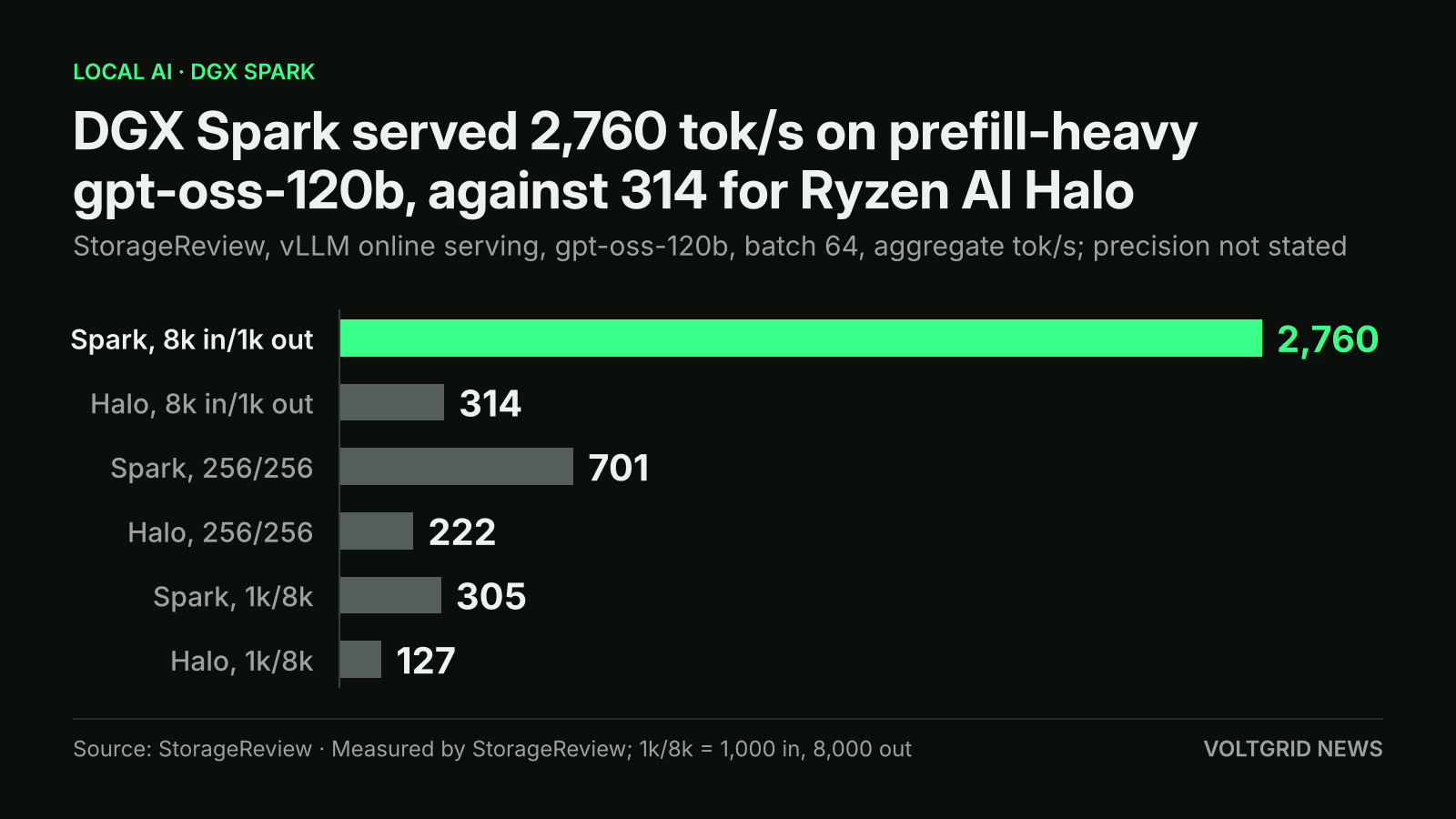
StorageReview's vLLM batch-64 runs on gpt-oss-120b: the DGX Spark led the Ryzen AI Halo in all three workloads, 2,760 to 314 tok/s in the prefill-heavy one (precision not stated).
Illustration (AI-generated)
Tom's Hardware reached the same order in llama.cpp, comparing the Spark with Corsair's AI Workstation 300, a Ryzen AI Max+ 395 system. Its tests covered Llama 3.1 8B, Gemma 3 27B, gpt-oss 120b and Qwen3-30B-A3B. The Spark led in prompt processing and in token generation at every context depth on every model. The race was closest on dense Gemma 3 27B. Those results appear only in charts, and the text does not state the quantizations, so this review quotes none of their numbers. Tom's Hardware also generated 4,096 tokens from gpt-oss 120b while logging power. At an empty context the two machines used about the same energy. At the longest contexts it tested, Strix Halo took twice as long and used twice the joules per token. Tom's Hardware logged the Spark's GPU at no more than 82 °C and about 2,450 MHz under sustained load.
The cons rest on the same sources. Tom's Hardware points out that NVIDIA's 1 PFLOP rating assumes sparse NVFP4 math, and dense NVFP4 halves it to about 500 TFLOPS. NVIDIA's own model card for Nemotron 3.5 Lightning shows the same gap from the software side. That card names one DGX Spark as a single-GPU target. The card's hardware matrix marks native FP4 for the Spark as "No - runs via Marlin", with NVFP4 weights on a W4A16 path. StorageReview notes that the Spark boots only DGX OS and takes a less common M.2 2242 drive. ServeTheHome's launch review, on a pre-production unit, flagged early display problems over HDMI.
Who Should Buy the DGX Spark
The Spark fits a developer or small team that builds on CUDA and wants a model of 70 to 120 billion parameters running locally all day. StorageReview's 701 tokens per second on gpt-oss-120b at batch 64 suggests one box can serve several concurrent users or agents. Tom's Hardware's power readings suggest it can do so at desk-friendly power and noise.
It also fits a lab that wants to try multi-node work before renting a rack. Two 128 GB units on the ConnectX-7 link reach 256 GB and NVIDIA's 400-billion-parameter rating. Four units reach 512 GB and 700 billion. The Halo, its closest rival, has no such link. StorageReview recommends the Spark for exactly that buyer, and for anyone after the most local tokens per second.
The 64 GB unit, from $4,999, fits a buyer whose models stay under NVIDIA's 100-billion-parameter rating. It also suits a team that wants to start with one box and cable in a second later. Until an outlet measures it, its speed is an inference from the 128 GB unit, not a result.
It is the wrong machine for someone who mainly wants fast single-user chat on dense models. Tom's Hardware measured about 20 tokens per second on Qwen 3.8 27B with multi-token prediction switched on. It added that time to first token stayed interactive out to the full 262,000-token context. Its text does not tie that figure to one engine or quantization. A buyer who needs Windows, or one box for both office work and models, is also better served elsewhere, StorageReview concludes.
Why Prefill and Decode Favor Different Chips
An AI model answers in two phases. Prefill reads the whole prompt at once, which is mostly arithmetic. Decode then writes one token at a time, and each token needs the weights read from memory again, so it waits on memory bandwidth.
StorageReview's vLLM runs on gpt-oss-120b at batch 64 show the split. In the prefill-heavy test the Spark served 2,760 tokens per second to the Halo's 314. In the decode-heavy test it served 305 to 127. The two boxes have close memory speeds, 273 GB/s for the Spark and 256 GB/s for the Halo, so the widest gap sits where compute counts most. For a buyer, long prompts reward the Spark's GPU, while long answers from dense models still run at the pace of the memory.
DGX Spark vs Ryzen AI Halo and Mac Studio
AMD's Ryzen AI Halo is the closest rival on paper. It has the same 128 GB, 256 GB/s against the Spark's 273 GB/s, and was listed at $3,999 with a 2 TB drive in StorageReview's July review. On StorageReview's vLLM numbers it trails by 2.4 to 8.8 times on gpt-oss-120b. Specs that close suggest the gap comes from GPU compute and software rather than memory. The Halo wins elsewhere. On Linux it beat the Spark by 11% in 7-Zip compression, 38% in decompression and 14% in an LLVM compile. It also boots Windows 11. It has only 10GbE, though, which StorageReview says rules out the Spark's kind of clustering.
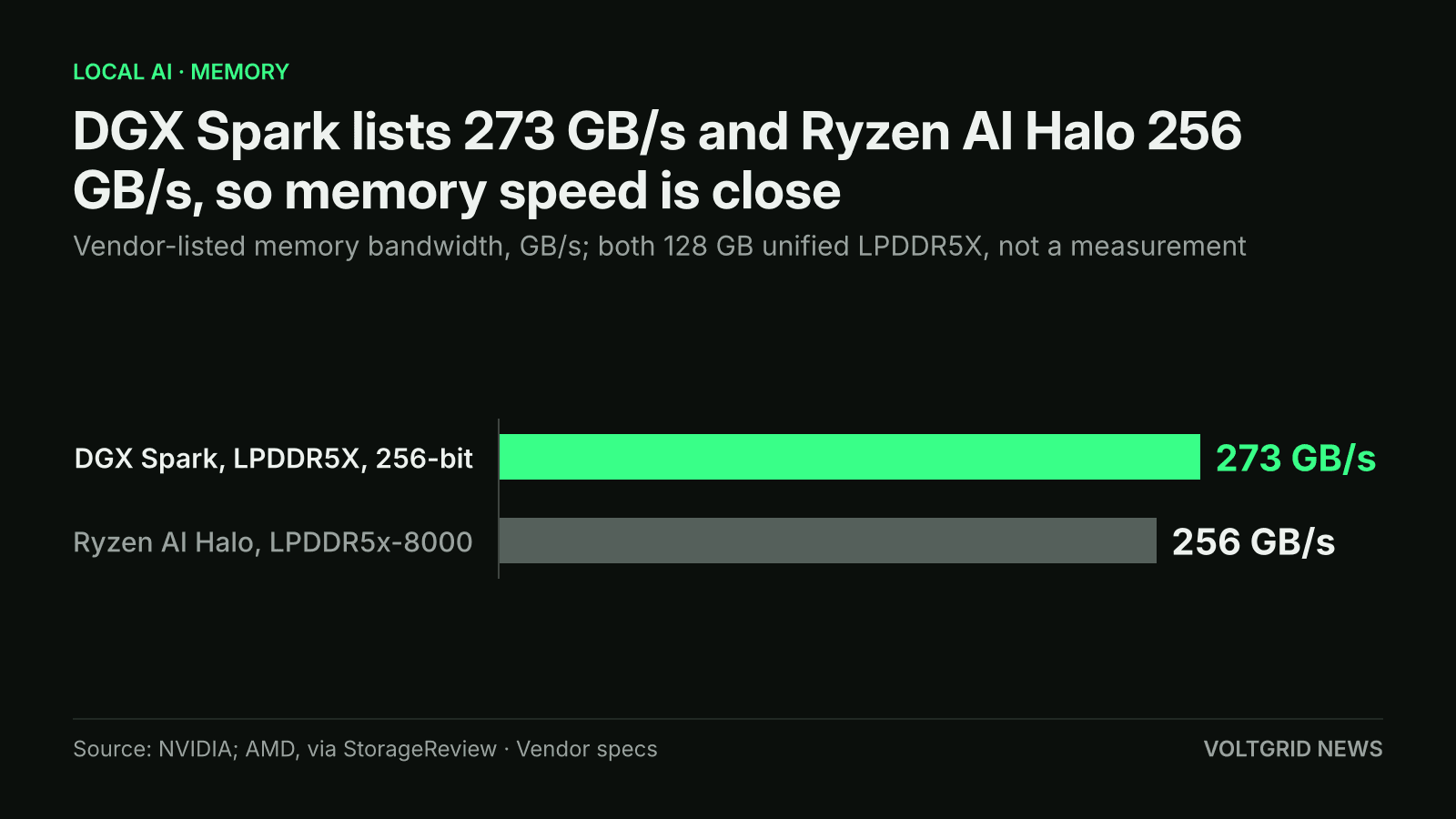
Vendor-listed specs put the DGX Spark at 273 GB/s and the Ryzen AI Halo at 256 GB/s, so memory speed alone does not explain the throughput gap.
Illustration (AI-generated)
Apple's Mac Studio with M5 Ultra is the bandwidth answer. Apple lists 1.2 TB/s and up to 512 GB of memory. In its Sept. 21 review, Tom's Hardware measured almost four times the Spark's tokens per second on Qwen 3.8-27B in Q4_K_M quantization, without naming the runner; that is a separate test from the Spark's own review. The Mac was faster at prompt processing too. Tom's Hardware reported that its 256 GB review unit cost $12,299. MacRumors, reading Apple's configurator, put the new 512 GB configuration at $22,299, and it does not run CUDA.
NVIDIA's own RTX Spark brings up to 128 GB of unified memory to Windows laptops from $2,599. ServeTheHome reports up to 300 GB/s of memory bandwidth, and NVIDIA rates it for models of up to 120 billion parameters. As Voltgrid reported, 128 GB models are now in stores. There is not yet a vLLM measurement on the same model and settings as the Spark's, so the two cannot be ranked on speed.
Partner GB10 boxes use the same chip. StorageReview measured ASUS's Ascent GX10 at 680 tokens per second on gpt-oss-120b at batch 64 in vLLM, against 701 for NVIDIA's unit in the Halo review. Those are two different reviews, from March and July, that used the same vLLM workload (gpt-oss-120b, batch 64, 256 tokens in and out); software versions and units differ. In January, Tom's Hardware said it would take the GX10 at about $3,000 over the Founders Edition. On Oct. 30, ASUS's U.S. store listed the 128 GB, 1 TB GX10 at $5,999 and out of stock. Above this class sits the DGX Station, with 252 GB of HBM3e and a 1.6 kW power budget.
What to Watch
The first dated item is NVIDIA's Sync Model Launcher, promised for the end of October. It is the tool meant to make a two-unit cluster run Qwen3.8 27B with little setup. The next is the first independent results for the 64 GB unit, along with a test of NVIDIA's claim that two of them run up to 1.7 times faster than one. Neither had appeared by Oct 31.
Price is the third. The 128 GB unit has gone from $3,999 at launch to $4,699 in February, according to NVIDIA, and $6,950 on NVIDIA's marketplace now, against a background of memory shortages. RTX Spark compact desktops, which NVIDIA says go on sale in November, will put the same class of chip in a Windows desktop. They will be the next test of whether DGX OS and its 200 Gbps clustering are worth the premium.
How it compares
Full table| Product | Memory | Bandwidth | AI compute | Measured speed | Price |
|---|---|---|---|---|---|
| HP ZGX Fury AI StationHP | 252 GB HBM3e GPU + 496 GB LPDDR5x CPU (4x 128 GB SOCAMM); 748 GB unified[1] | 7.1 TB/s (GPU HBM3e); 396 GB/s (CPU LPDDR5x)[1] | — | — | Japan list price from 28,490,000 yen incl. tax (sales from Oct 27, 2026); no US list price published[2] |
| NVIDIA DGX StationNVIDIA (systems built by ASUS, Dell, GIGABYTE, HP, MSI, Supermicro and Exxact) | 748 GB coherent: 252 GB HBM3e (GPU) + 496 GB LPDDR5X (CPU)[3] | GPU HBM3e 7.1 TB/s; CPU LPDDR5X 396 GB/s; NVLink-C2C 900 GB/s between them[3] | 15 PFLOPS FP4 (without sparsity)[3] | Over 26,000 output tokens/s aggregate on Qwen3.6-35B-A3B NVFP4 at 512 concurrent users (24-30-token input, 1,024-token output), Gigabyte W775-V10-L01; idle never below 250 W.[4] | No list price from most OEMs (sales inquiry only); ServeTheHome heard about $100K, up to $120-125K, and unlikely under $80-85K[5] |
| NVIDIA RTX PRO 6000 Blackwell Workstation EditionNVIDIA (sold through PNY, TD SYNNEX and workstation makers) | 96 GB[6] | 1,792 GB/s[6] | 4,000 AI TOPS (FP4, with sparsity) (sparse)[6] | LM Studio: Mistral Small (26 GB) at 42.4 tokens/s vs 17 on an RTX 5090; Gemma 3 27B at 29 vs 5; tied with the RTX 5090 at about 81 tokens/s on DeepSeek Llama 8B Distil, where VRAM does not limit.[7] | $16,000 on NVIDIA's US marketplace (Workstation Edition), listed out of stock[8] |
| Apple Mac Studio (M5 Ultra)Apple | up to 512 GB unified (96 GB on 30-core M5 Ultra; 256 GB or 512 GB on 36-core/80-core M5 Ultra)[9] | 1.2 TB/s[9] | — | Qwen 3.8 27B 4-bit MLX in LM Studio: about 55 tok/s on M5 Ultra (36-core, 256 GB) vs about 40 on M3 Ultra (BGR)[10] | $22,299 minimum with 512 GB ($6,799 36-core CPU/80-core GPU M5 Ultra config plus $15,500 memory upgrade; Oct 28, 2026)[11] |
| NVIDIA RTX Spark (N1X) PCsNVIDIA (MediaTek collaborated on the custom CPU design) | Up to 128 GB LPDDR5X (20-core CPU / 6,144-core GPU version); up to 64 GB (18-core / 5,120-core laptop version)[12] | Up to 300 GB/s: LPDDR5X-9400 on a 256-bit bus (NVIDIA's product page lists no bandwidth)[13] | — | gpt-oss:20b via Ollama in a Codex CLI coding agent, 64K context: 58.5 tok/s generation, 3 of 4 tasks passed (Dell XPS 16, 20-core N1X, 64 GB; StorageReview)[14] | Laptops from $2,599; pricing and configurations vary by region[15] |
| Framework Desktop (Ryzen AI Max+ PRO 495, 192 GB)Framework | 192 GB LPDDR5X-8533 soldered[16] | 273 GB/s (256-bit)[16] | — | — | from $6,799 (DIY Edition pre-order, Oct 30, 2026)[17] |
| Lenovo ThinkStation PGXLenovo | 128 GB LPDDR5X unified (256-bit)[18] | 273 GB/s[18] | — | — | about $4,100 for the 1 TB configuration (Mar 2026)[19] |
| MSI EdgeXpert (MS-C931)MSI | 64 GB or 128 GB LPDDR5x unified (256-bit)[20] | 273 GB/s[20] | 1 PFLOPS FP4 (sparse)[20] | — | No list price; MSI sells via quote (Get a quote)[20] |
| NVIDIA DGX SparkNVIDIA (partner GB10 systems from Acer, ASUS, Dell, GIGABYTE, HP, Lenovo and MSI)This story | 128 GB; a 64 GB configuration is sold only through OEM partners[21] | 273 GB/s[21] | Up to 1 PFLOP FP4 (theoretical, using the sparsity feature) (sparse)[21] | Qwen 3.8 27B (dense) with multi-token prediction: decode of about 20 tokens/s, with time-to-first-token staying interactive out to the full 262K context.[22] | $6,950.00 (128 GB, 4 TB) on NVIDIA's enterprise marketplace with an Add To Cart button in a copy cached 07:59 UTC on 2026-10-31; stock unverified (listed out of stock on 2026-10-21); 64 GB partner systems from $4,999[23] |
| NVIDIA DGX Spark 64 GBNVIDIA (sold by Acer, ASUS, Dell, Gigabyte, HP and MSI) | 64 GB LPDDR5X unified (two units pool 128 GB over ConnectX-7)[24] | 273 GB/s (256-bit; NVIDIA spec table covers both 64 GB and 128 GB)[21] | 1 PFLOPS FP4 (sparse; NVIDIA spec table covers both memory configurations)[21] | — | from $4,999 (partner systems, Oct 2026; no Founders Edition)[24] |
| AMD Ryzen AI Halo Developer PlatformAMD | 128 GB LPDDR5x-8000 unified[25] | 256 GB/s[25] | — | gpt-oss-120b, vLLM online serving, equal ISL/OSL 256/256: 222 tok/s aggregate at batch 64 vs 701 on DGX Spark (StorageReview)[26] | $3,999 with 2 TB SSD (Jul 2026)[26] |
| Framework Desktop (Ryzen AI Max+ 395)Framework | 128 GB LPDDR5x-8000 soldered (32 GB and 64 GB options)[27] | 256 GB/s[28] | — | — | $3,449 (DIY Edition, Max+ 395 with 128 GB, Oct 30, 2026)[17] |
| Acer Veriton GN100 AI Mini WorkstationAcer | 128 GB LPDDR5x coherent unified[29] | — | — | gpt-oss-120b, vLLM online serving, equal ISL/OSL: 69.65 tok/s at batch 1 rising to 713.18 tok/s aggregate at batch 64 (StorageReview)[30] | from $3,999 in North America (announced Sep 3, 2025; prices vary by region)[29] |
| ASRock Industrial AI BOX-A395ASRock Industrial | 128 GB LPDDR5X-8000 soldered[31] | — | — | — | — |
| ASUS Ascent GX10ASUS | 64 GB or 128 GB LPDDR5X-8533 unified[32] | — | — | gpt-oss-120b, vLLM online serving, equal ISL/OSL: 70 tok/s at batch 1 rising to 680 tok/s aggregate at batch 64 (StorageReview)[33] | $5,999 (128 GB, 1 TB, GX10-GG0010BN, ASUS eShop US, Oct 30, 2026)[34] |
| Dell Pro Precision with GB10 (model FCM1253; launched as Dell Pro Max with GB10)Dell | 128 GB LPDDR5x up to 8533 MT/s onboard (64 GB option also listed)[35] | — | — | gpt-oss-120b, vLLM online serving, equal ISL/OSL: 68.57 tok/s at batch 1 rising to 670.83 tok/s aggregate at batch 64 (StorageReview)[36] | $6,593 (128 GB, 2 TB QLC SSD, Dell.com US, Oct 30, 2026)[35] |
| Dell Pro Precision with GB300 (model FCT6263; announced as Dell Pro Max with GB300)Dell | 252 GB HBM3e GPU + 496 GB LPDDR5X CPU[37] | — | — | — | $159,283 (Dell.com US default config with RTX PRO 2000 display GPU and 16 TB SSD, Oct 30, 2026)[37] |
| GIGABYTE AI TOP ATOMGIGABYTE | 128 GB unified system memory[38] | — | — | gpt-oss-120b, vLLM online serving, equal ISL/OSL: 60.71 tok/s at batch 1 rising to 649.62 tok/s aggregate at batch 64 (StorageReview)[39] | — |
| GMKtec EVO-X2 AI Mini PCGMKtec | 64 GB or 128 GB onboard LPDDR5X-8000 (non-upgradeable)[40] | — | — | — | $3,499.99 (128 GB/1 TB, GMKtec US store, Oct 30, 2026; listed against $3,999.99)[40] |
| HP Z2 Mini G1a WorkstationHP | up to 128 GB unified, up to 96 GB assignable to the GPU, up to 8000 MT/s[41] | — | — | gpt-oss-120b GGUF (63.39 GB, full GPU offload) in LM Studio: close to 40 tok/s (StorageReview)[42] | — |
| HP ZGX Nano AI Station (G1n)HP | 128 GB coherent unified system memory[43] | — | — | gpt-oss-120b, vLLM online serving, equal ISL/OSL: 69.6 tok/s at batch 1 rising to 722.9 tok/s aggregate at batch 64 (StorageReview)[44] | — |
| MSI XpertStation WS300MSI (NVIDIA DGX Station platform) | 252 GB HBM3e GPU + 496 GB LPDDR5X CPU (748 GB coherent)[45] | — | — | Noise about 37-40 dBA at lower loads and 46-49 dBA at full load; GPU idle ~148 W (1.3 kW cap), Grace module idle ~78 W (300 W cap), system idle never below 250 W. Measured by ServeTheHome[46] | ServeTheHome calls it a $100K+ system; no MSI list price given[47] |
| Tenstorrent TT-QuietBox 2 (Blackhole)Tenstorrent | 128 GB GDDR6 on the accelerators + 256 GB DDR5-5600 system memory[48] | — | — | — | $9,999 (Oct 30, 2026)[48] |
Italic values are reported by an outlet or measured by an independent lab; the rest come from the maker. Measured speeds use different models, quantizations and tools, so read each with its source rather than against the others. Voltgrid News does not test hardware itself.
Sources (48)
- [1] HP
- [2] HP Japan
- [3] NVIDIA
- [4] ServeTheHome
- [5] ServeTheHome
- [6] NVIDIA
- [7] Gamers Nexus
- [8] NVIDIA
- [9] Apple
- [10] BGR
- [11] MacRumors
- [12] NVIDIA
- [13] ServeTheHome
- [14] StorageReview
- [15] NVIDIA
- [16] Framework Blog
- [17] Framework
- [18] Lenovo PSREF
- [19] ServeTheHome
- [20] MSI
- [21] NVIDIA
- [22] Tom's Hardware
- [23] NVIDIA Marketplace
- [24] NVIDIA Blog
- [25] AMD
- [26] StorageReview
- [27] Framework
- [28] Framework Blog
- [29] Acer
- [30] StorageReview
- [31] ServeTheHome
- [32] ASUS
- [33] StorageReview
- [34] ASUS eShop
- [35] Dell
- [36] StorageReview
- [37] Dell
- [38] GIGABYTE (PR Newswire)
- [39] StorageReview
- [40] GMKtec
- [41] HP
- [42] StorageReview
- [43] HP
- [44] StorageReview
- [45] StorageReview
- [46] ServeTheHome
- [47] ServeTheHome
- [48] Tenstorrent
Sources
- 01NVIDIA DGX SparkNVIDIA · nvidia.com
- 02AMD Ryzen AI Halo Review: A Dual-OS, 200B-Parameter Desktop Takes On the DGX SparkStorageReview · storagereview.com
- 03Nvidia DGX Spark review: the GB10 Superchip powers a fast and fun AI toolbox that beats out AMD's Ryzen AI Max+ 395Tom's Hardware · tomshardware.com