RTX 4080 Unlock Reaches Windows: Users Report 1.85x FP16 Gain
The nv-uefi-unlocker tool lifts the Tensor cap on RTX 20 to 40 cards from a USB stick before Windows loads, with no VBIOS flash. Users report 1.57x to 2.65x FP16 on RTX 40 at higher board power.
Chips & Power DeskEdited by Ege Erten
4 min readAI-assisted
Follows our story: NVIDIA RTX 40 gpu-unlock Users Report Up to 94.2% GEMM Gains
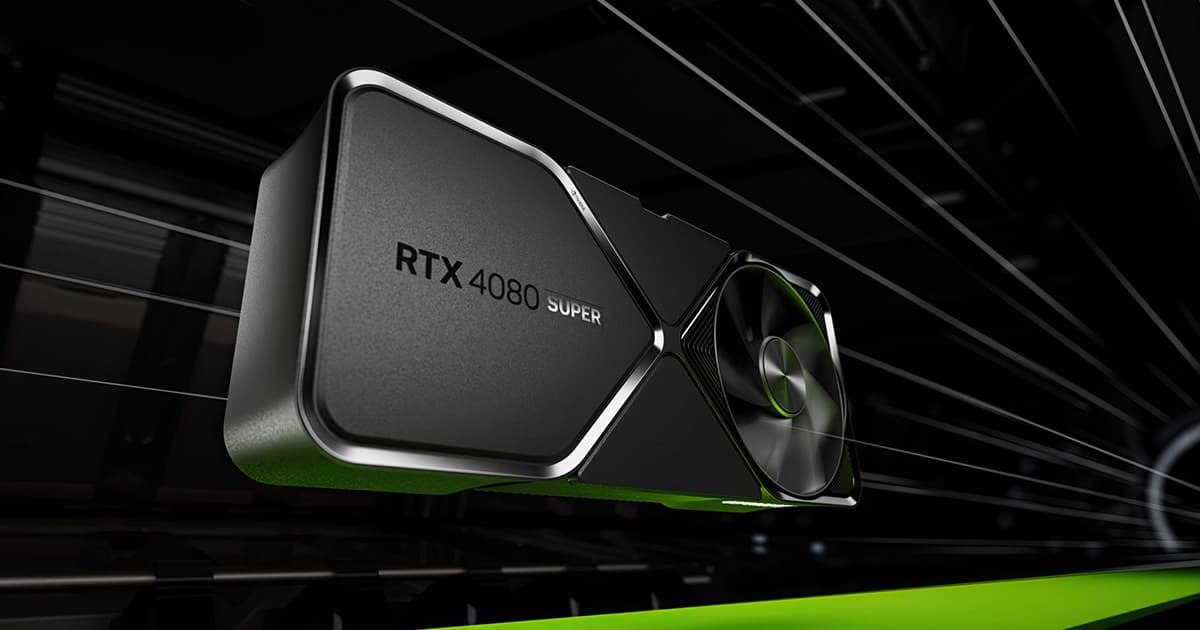
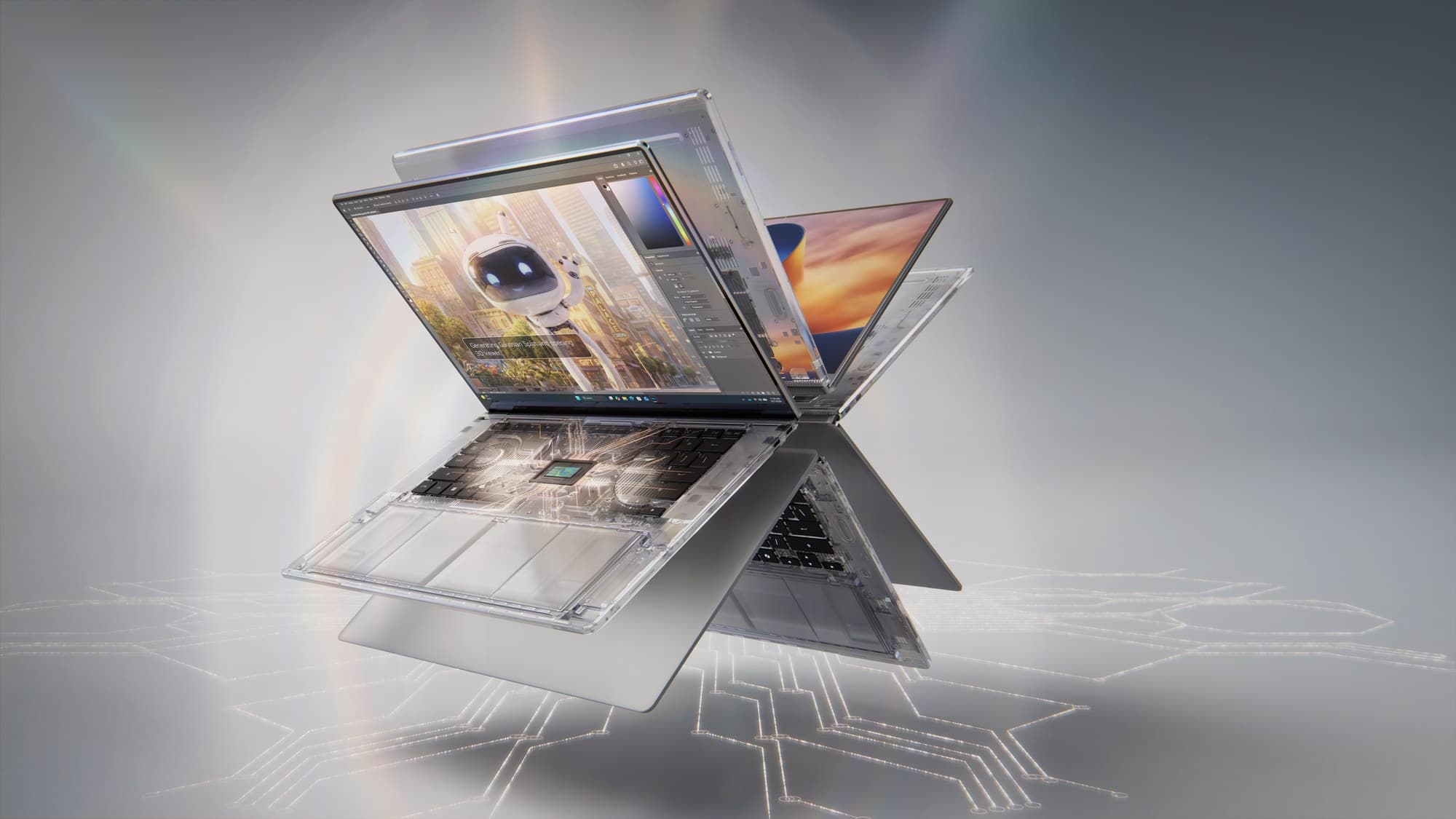
NVIDIA's RTX 4080 SUPER, shown on its RTX 4080 family page; the reports concern the RTX 4080 and other RTX 40 cards.
Image: NVIDIA
Source · Press image from the NVIDIA product page, used for news reporting.
The RTX 4080 unlock now works from Windows: a modder's boot-time tool lifts the Tensor-core throughput cap on GeForce RTX 20, 30 and 40 cards, and users report FP16 matrix gains (FP32 accumulate) of roughly 1.6x to 2.65x on RTX 40 cards, depending on card, matrix size and power limit. The tool, nv-uefi-unlocker, comes from the developer known as physicsdolphin, and its GitHub page lists RTX 50 and older Pascal cards as unsupported. Every figure below is a user or developer claim, not an NVIDIA specification.
This follows our Oct. 25 report on the gpu-unlock project, where community testers described the same cap on RTX 40 cards. The new tool runs before the NVIDIA driver loads, from a FAT32 USB stick chosen in the one-time boot menu, then hands control back to Windows, Linux or another system. TechPowerUp reported the Windows release on Oct. 30. As Voltgrid reported on Oct. 26, the RTX 4090 had already shown a similar doubling in one developer's unofficial module test. This project's own RTX 4090 report gives 1.45x to 1.71x at boost clocks, limited by power, and 2.00x only with the clock pinned to 1500 MHz.
Why FP32 Accumulate Runs at Half Rate
A tensor core multiplies small numbers and adds the products into a running total, the accumulator. NVIDIA's Ada whitepaper rates the RTX 4090 at 330.3 TFLOPS of dense FP16 tensor math with an FP16 accumulator, and 165.2 TFLOPS with an FP32 accumulator, which holds more digits. NVIDIA gives no reason for the halving.
The unlock reports measure the FP32-accumulate path. NVIDIA rates the RTX 4080 at 97.5 TFLOPS there and 194.9 TFLOPS with FP16 accumulate, against the 100.53 TFLOPS stock and about 185 TFLOPS unlocked that one owner measured. The extra work lands on the power budget: that card peaked at 341 W against NVIDIA's 320 W rating.
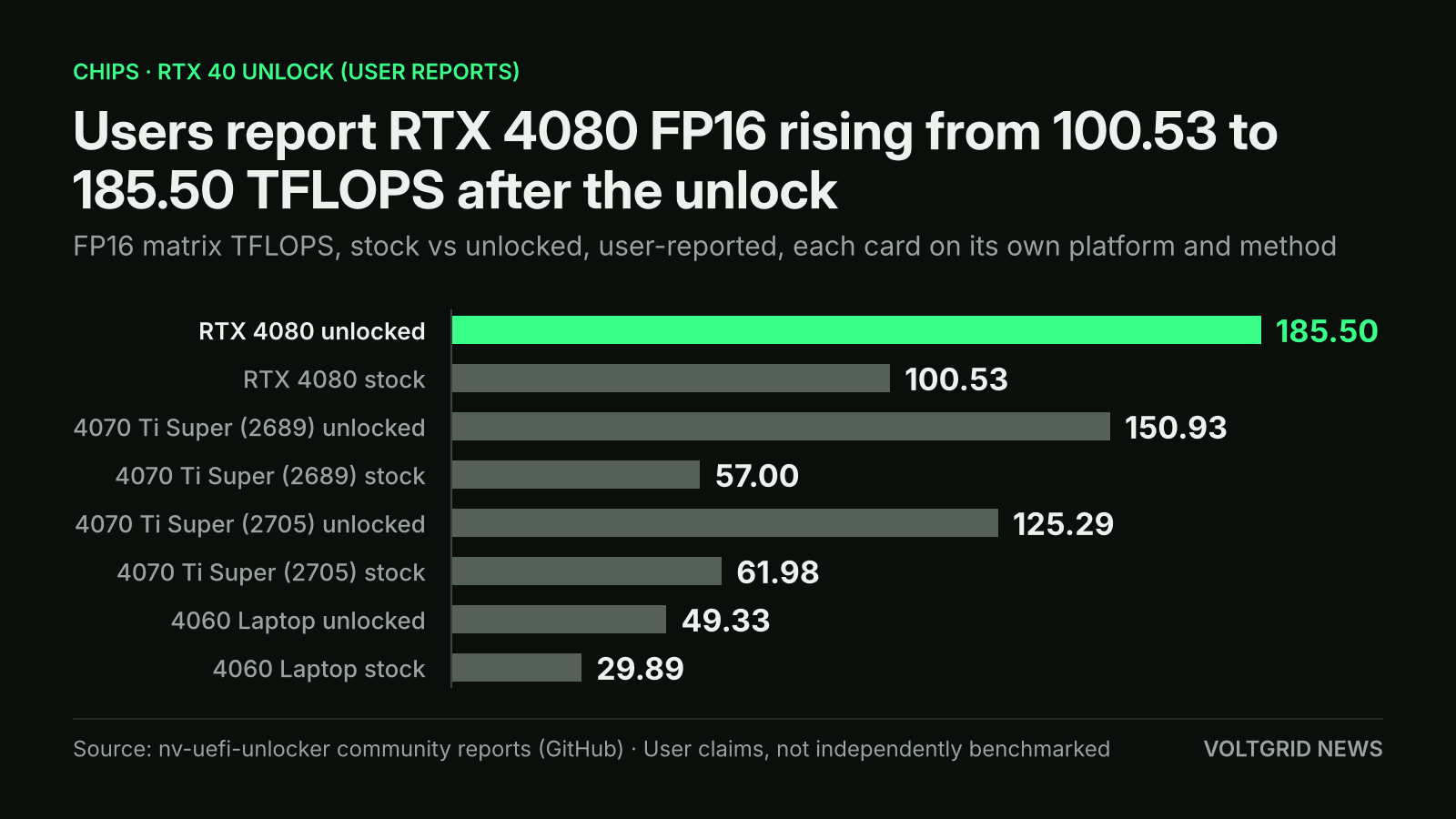
User-reported FP16 throughput on each card before and after the unlock; each result comes from a different platform and method, and none is independently benchmarked.
Illustration (AI-generated)
RTX 4080 Unlock Results and Board Power
The project's community log records several RTX 40 results, each on a different platform and method. One RTX 4080 owner measured FP16 with FP32 accumulate at 4096 matrix size rising from 100.53 to about 185 TFLOPS (1.85x) and, at 8192, from 104.49 to 164 TFLOPS (1.57x), with power peaking at 341 W. An RTX 4070 Ti Super on the AD103 chip (device ID 2705) went from 61.98 to 125.29 TFLOPS (2.02x) in a Tensor issue-rate micro-benchmark rather than a matrix multiply, at 143.5 W with the power limit left alone, so it is not comparable with the matrix figures. NVIDIA lists 285 W for this card.
A second 4070 Ti Super report comes from a card with the larger AD102 die (device ID 2689), collected by the project on Oct. 30 from an unnamed Bilibili comment with no platform details. It shows FP16 at 4096 rising from 57.00 to 150.93 TFLOPS (2.65x), and 55.50 to 127.28 TFLOPS (2.29x) at 8192. Board power in that report climbed from about 227 W to 291.58 W against that board's own 295 W limit, and the card was throttling on power. The project notes the bottleneck moves from the Tensor issue rate to the power limit. Its maintainers have not archived a boot log for that card.
Gains vary by card, matrix size and power limit, and fall in real workloads. The project's own RTX 4060 Laptop test of FP16 at 4096 went from 29.89 to about 49 TFLOPS (1.65x) with this tool alone. The project says a micro-benchmark multiplier does not apply to every application. One RTX 4060 Ti 16GB owner reported no gain in a streamed, quantised video workflow, though the same card's FP16 matrix test rose from 45.78 to 75.24 TFLOPS.
Power, Heat and Hardware Risk
The unlock raises sustained draw. The RTX 4080 report cites 341 W, and the 4070 Ti Super report moved from 227 W to nearly 292 W. For a data-center or workstation planner, that makes it a power-budget question before it is a performance one, because a card that is fed twice the matrix work may pull close to its power limit.
The developer also supports pairing the unlock with the nvoc overclocking utility. The project warns that the combination can far exceed stock power and thermal limits, tells users to check cooling and power delivery, and states that damage from over-power, over-voltage or over-temperature is the user's responsibility. In the developer's combined test with nvoc on an RTX 4060 Laptop, board power peaked at 206.8 W and the hot spot reached 104.4 C.
The setup is not trivial. It needs UEFI boot with Secure Boot off or a self-signed certificate, RTX 20 owners must first enable the GSP firmware, and the unlock clears at every power-off, so it must be replayed each cold boot. After a black screen or fault, the project says not to retry in the same session: power off fully and boot normally. One RTX 3080 Ti Laptop owner reported BIOS display errors and a missing NVMe drive after repeating the run, cleared by an embedded-controller reset.
What Is Not Confirmed Yet
NVIDIA has not commented, and the numbers have not been independently benchmarked. The project says it does not yet enforce a per-card ROM match, and its compatibility matrix marks some cards, such as the RTX 4070 Laptop, as unverified. Whether NVIDIA answers with a driver or firmware change is the thing to watch.