NVIDIA RTX 4090 Peak Tensor Rate Doubles to 331.6 TFLOPS
Tom's Hardware says an unofficial module lifted one RTX 4090's FP16 tensor rate from 165.6 to 331.6 TFLOPS. Gains in ordinary matrix math on the same cards were smaller.
2 min readAI-assisted
Tom's Hardware reported the peak on the module developer's card. NVIDIA has not published the rate.
Illustration (AI-generated)
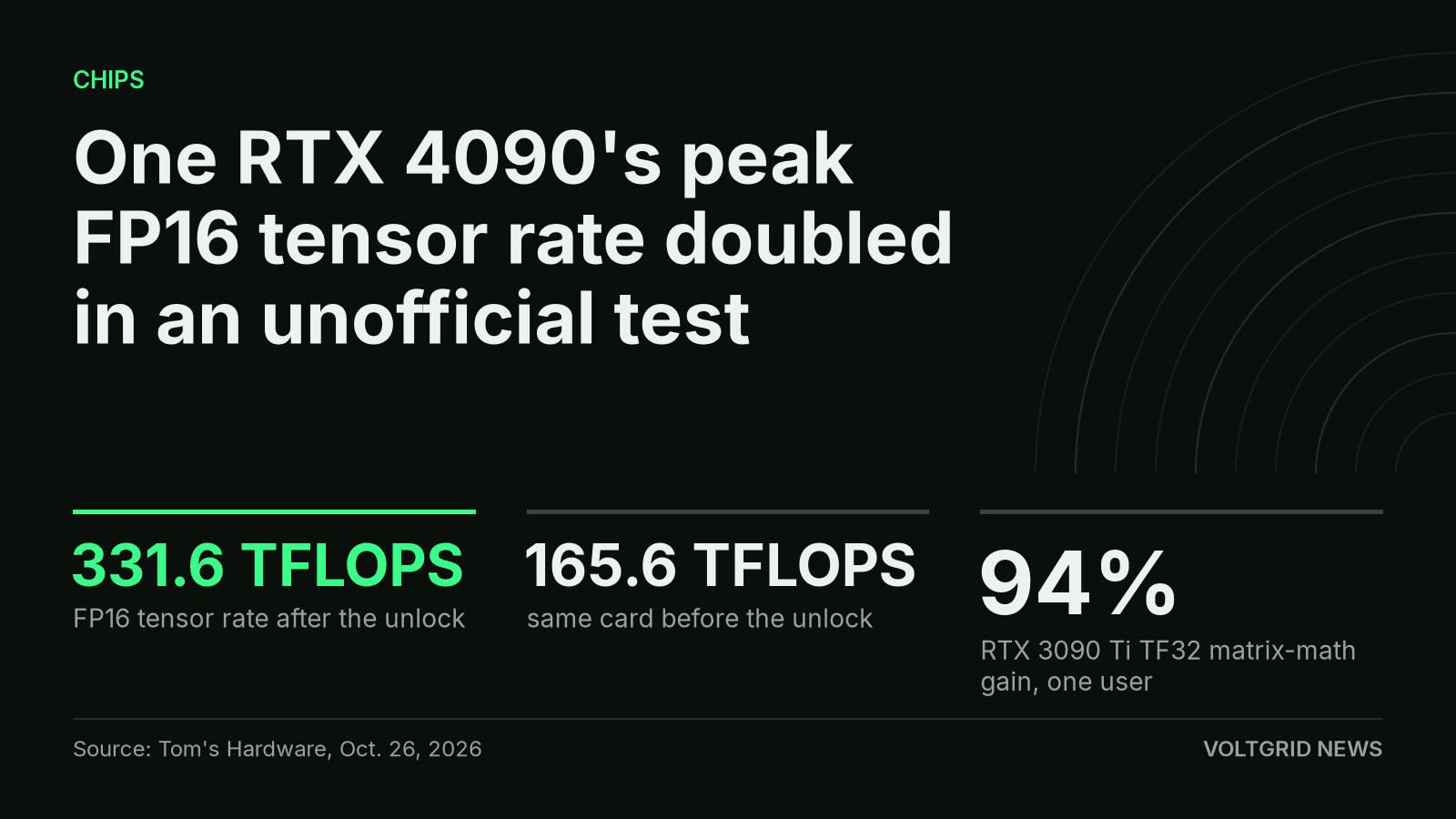
An unofficial Linux module doubled the peak FP16 tensor rate on its developer's NVIDIA GeForce RTX 4090, from 165.6 to 331.6 TFLOPS, Tom's Hardware reported on Oct. 26. The same measurement moved that card's BF16 tensor rate from 165.5 to 330.6 TFLOPS.
Those peaks are not the gains in ordinary matrix math. Tom's, citing the gpu-unlock-ada notes, says one other owner's cuBLAS median rises were 12 to 34 percent and up to 20 percent on the two formats. A separate user test of an RTX 3090 Ti, run with a modified driver, recorded matrix-multiply gains of 35 percent for FP16, 80 percent for BF16 and 94 percent for TF32.
The modules take aim at a GeForce limit that, on NVIDIA's published specifications, runs FP32-accumulate tensor math at half the FP16-accumulate rate. Tom's says that limit does not apply to Turing and Ampere professional cards. Restoring the higher rate can speed local prompt processing and image generation. It does not change the spec sheet of a data-center GPU.
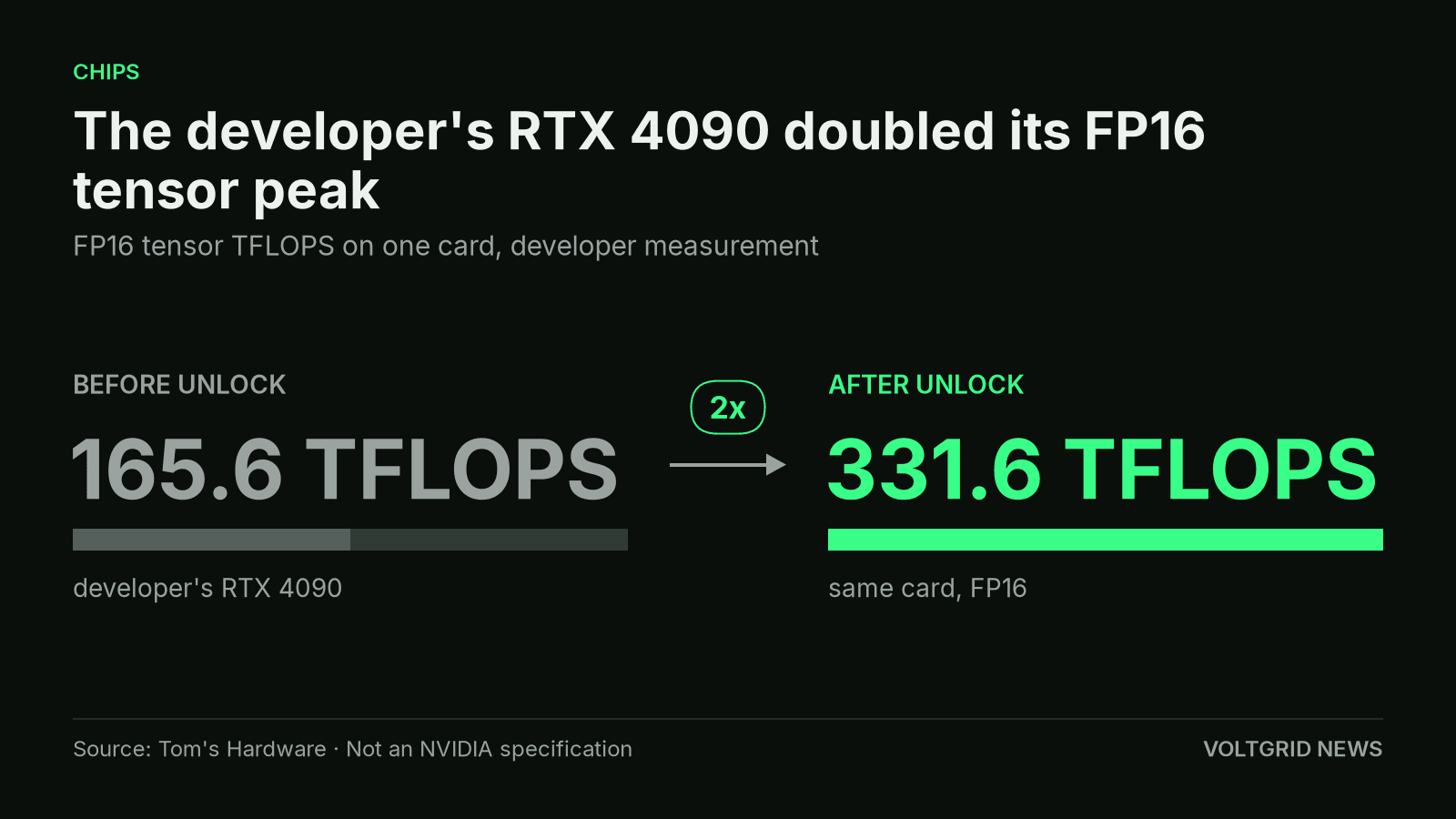
The doubling is the developer's tensor-rate reading, not an NVIDIA specification and not the smaller matrix-math result.
Illustration (AI-generated)
Three projects, three generations
Ampere cards, including the RTX 3090 Ti, sit with the gpu-unlock project. An Ada fork covers the RTX 4090, and Tom's lists experimental single-card results for the 4090 D, the 4070 Ti Super and the 4060 Ti 16 GB model. A Turing port works with the RTX 2080 Ti. Tom's says the maintainer has put Blackwell, the RTX 50 series, out of scope.
Voltgrid reported on Oct. 25 that a GitHub change posted on Oct. 24 had already extended this line of work to RTX 40 cards, including an RTX 4080 SUPER test. Monday's Tom's account adds the 4090 peak rates and the 3090 Ti matrix-math percentages, which that story did not carry.
What is not confirmed yet
NVIDIA has not published these unlocked rates. The 4090 doubling is the module developer's own card, and the 3090 Ti percentages are one user's run. Readmes quoted by Tom's warn that the mods can hang a GPU, stop a machine from booting, corrupt data or damage hardware. There is no claim of a twofold gain in games or applications. On Ampere, Tom's reports language-model prefill improving 14 to 36 percent, while decode and INT8 stayed about the same.