NVIDIA RTX 40 gpu-unlock Users Report Up to 94.2% GEMM Gains
Community reports say gpu-unlock lifts FP16 and BF16 (FP32-accumulate) matrix throughput on RTX 40 cards by up to 94.2% in one user's test, but one tester's LLM inference barely moved. The desk found no lab test, and NVIDIA has not commented.
4 min readAI-assisted
NVIDIA's product image of the RTX 4080 SUPER. The gpu-unlock figures in this story are community reports, not NVIDIA data or Voltgrid tests.
Image: NVIDIA
Source · Product image from NVIDIA's GeForce product page, used for news reporting.
Community testers report that gpu-unlock, an open-source Linux module, now lifts tensor throughput on NVIDIA RTX 40 cards, with an RTX 4080 SUPER going from 110.6 to 202.7 TFLOPS in FP16 matrix math with FP32 accumulate, in the pull request author's 8192-size dense matrix multiply.
The figures come from pull request #24 on the gpu-unlock project, posted on GitHub on Oct 24 by a contributor, woodsonl. It adds the RTX 4080 SUPER and the RTX 4060 Ti 8GB to a tool built for RTX 30 cards. The request is still open, with no reviews and no comment from the project's owner. Every number in this story is a user's own report, the project's summary of user reports, or Notebookcheck's account of them. Voltgrid did not test the module, the desk found no independent lab measurement of it, and NVIDIA has not commented.
What the module changes
Matrix units in GeForce cards run one class of work, FP16 or BF16 inputs added up in FP32, at about half the rate of NVIDIA's professional GPUs, Notebookcheck reported, citing the developer. The module loads before NVIDIA's unmodified driver, writes speed-selector registers on the card, and resets it. The project says it is not a patched NVIDIA driver and loads before the unmodified driver. Ada cards needed a different signed firmware loader, the request says, because the one used for RTX 30 halts on them.
On the RTX 4080 SUPER, the request's author reported BF16 (FP32 accumulate) rising from 110.7 to 187.4 TFLOPS and TF32 from 55.9 to 92.5 TFLOPS, in an 8192-size dense matrix multiply (GEMM). Plain FP32 on the CUDA cores did not move: 37.5 to 37.7 TFLOPS. The same author reported an RTX 4060 Ti 8GB at 47.1 to 72.7 TFLOPS in BF16. Separate user reports filed on Oct 25 point the same way. An RTX 4070 Ti owner reported BF16 at 81.1 to 149.5 TFLOPS at the stock 285 W limit. A Zotac RTX 4080 owner, using a separate Ada fork rather than the request's code, reported BF16 GEMM at 103.55 to 193.11 TFLOP/s (+86.5%) and a 94.2% gain in FP16 at size 4096, the largest figure in this story, with INT8 and scalar FP32 unchanged.
Matrix gains did not carry over to LLMs
The most detailed test, by a commenter on the request using a 32 GB RTX 4080 SUPER at a 320 W cap, found dense GEMM gains of 64% to 76% at large sizes. Local LLM inference barely moved. Prefill, the prompt-reading phase, ranged from 4.37% slower at 4,143 tokens to 9.10% faster at 65,582 tokens. Short-answer decode came in lower, 94.7 against 99.6 tokens per second, though individual samples overlapped and the tester does not claim a stable regression, and a four-client run gained 0.44%. Two of three decode outputs differed between the stock and unlocked states, and the tester ran no answer-quality check. The RTX 4070 Ti owner reported a much larger prefill jump in a two-GPU setup with decode flat, but that was not a controlled single-card comparison.
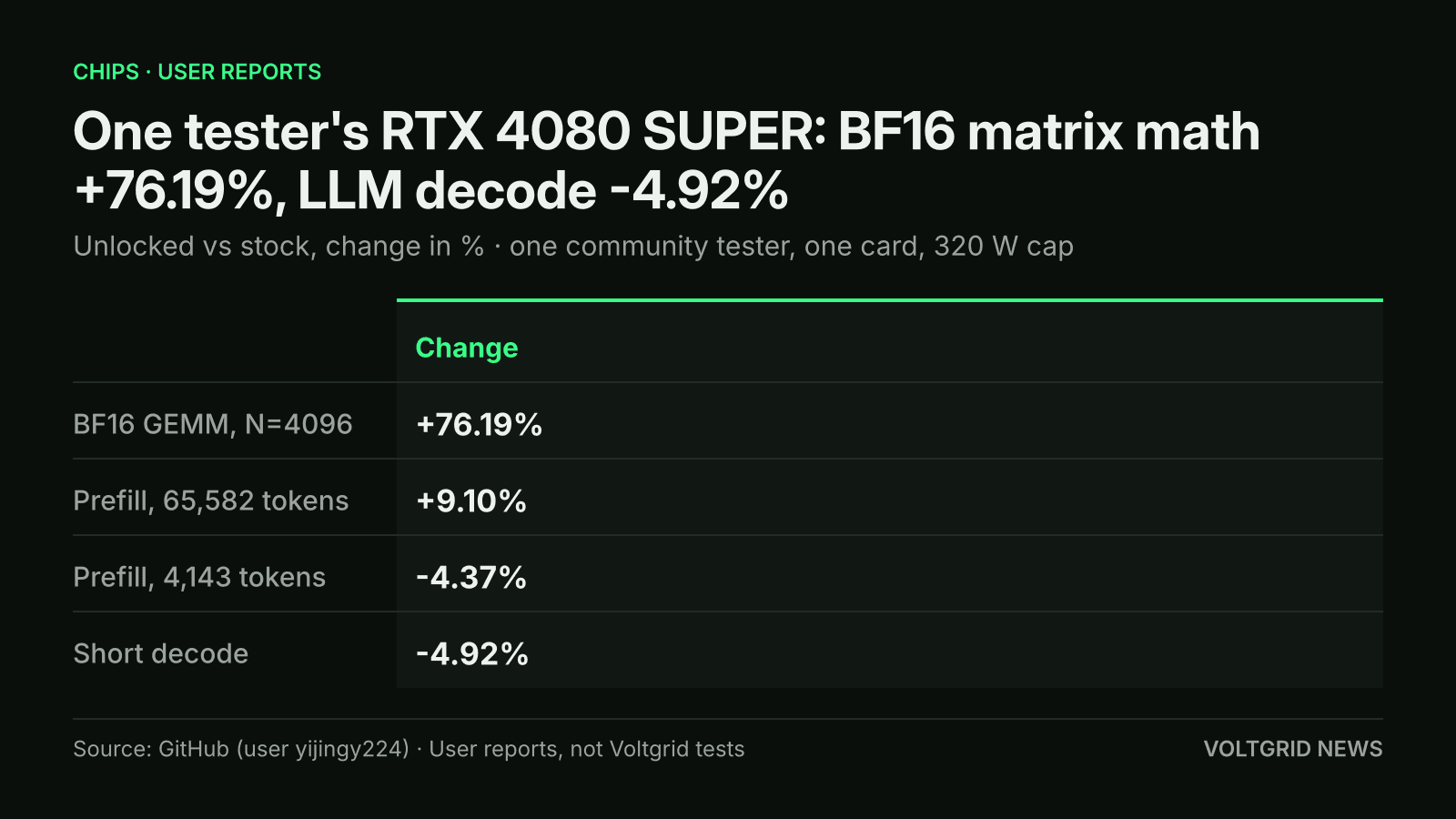
One tester's matrix-math gain did not carry over to LLM inference, according to a GitHub pull request; these are user reports, and Voltgrid did not test the module.
Illustration (AI-generated)
That pattern fits how inference works. Decode streams model weights from memory, so its speed is set by memory bandwidth, not by how fast the matrix units can issue instructions. On RTX 30 cards, the project's own summary of user reports puts prefill gains at 14% to 36%, with decode about the same. Notebookcheck reported one RTX 3090 user seeing 16% faster long-context prompt processing and token generation practically unchanged.
Why Faster Matrix Math Barely Speeds Chat
Running a language model has two phases. Prefill reads the whole prompt at once and leans on the matrix units, the part this module speeds up. Decode writes one token at a time and re-reads the model weights from memory for each, so memory bandwidth sets its pace. On an RTX 4080 SUPER, tester yijingy224 measured dense matrix multiplies up 65.74% at size 8192, yet short-answer decode came in at 94.7 tokens per second against 99.6.
Prefill ranged from 4.37% slower to 9.10% faster on that one card. The project's own summary of RTX 30 reports puts prefill gains at 14% to 36%, with decode about the same. A matrix benchmark can double while a local chat session barely changes, and the desk found no lab test of either.
What is not confirmed yet
The 4080 SUPER tester's board peaked at 308.07 W unlocked against 294.92 W stock, on one card and one boot pair. Long-run stability, warranty status and output correctness at scale are untested. Suspend resets the change but the module re-applies it on resume, the project says, and a laptop commenter reports runtime power management can also reset it. Notebookcheck says no independently verified gaming benchmarks exist, and the tool is Linux-only apart from an experimental Windows port. The next markers are a maintainer review of the request, a first lab measurement, and any NVIDIA driver or firmware response.
Sources
- 01Compatibility report: Zotac RTX 4080 (Ada), Arch LinuxGitHub (Zagitta/gpu-unlock) · github.com
- 02Compatibility report: Inno3D RTX 4070 Ti (AD104), Debian 13GitHub (Zagitta/gpu-unlock) · github.com
- 03Nvidia RTX 3090 performance nearly doubles with free GPU unlock, but there's a catchNotebookcheck · notebookcheck.net
- 04RTX 4080 SUPER (AD103) and RTX 4060 Ti 8GB (AD106) supportGitHub (Zagitta/gpu-unlock) · github.com
- 05GPU-unlock: FP/BF16 instruction issue rate on Nvidia 3000's cardsHacker News · front page · github.com