gpt-oss-120b Speeds: GB10 Boxes Within 15.3%, RTX PRO 6000 Peaks at 6.8x
Five NVIDIA GB10 boxes run gpt-oss-120b within 15.3% of each other in one lab's total-token test, and on its output-token test an RTX PRO 6000 peaked at 6.8x a GB10. Other labs' figures give a range, not a rank.
Local AI DeskEdited by Ege Erten
7 min readAI-assisted
Follows GB10 Boxes Compared: Similar gpt-oss-120b Speed, Prices $4,759 to $7,967
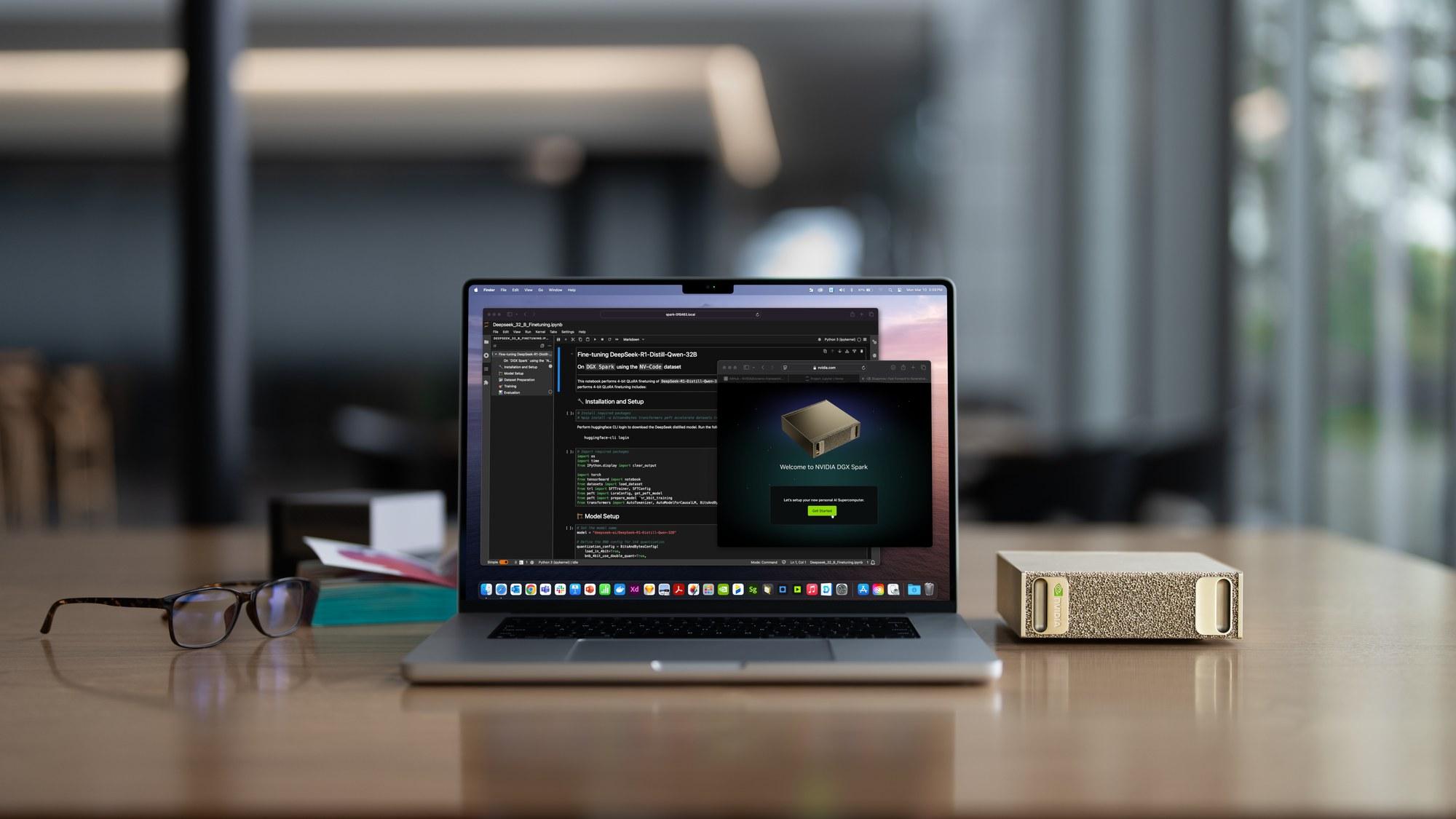
NVIDIA's DGX Spark, the GB10 reference box. Five GB10 desktops ran gpt-oss-120b within 15.3% of each other for one user in StorageReview's tests.
Image: NVIDIA
Source · Press image from the NVIDIA newsroom, used for news reporting.
One user running OpenAI's gpt-oss-120b on an NVIDIA GB10 desktop gets 60.71 to 70 tokens per second in StorageReview's vLLM tests, a count of prompt and output tokens together. In the same lab's llama.cpp test with 8,192-token prompts, an RTX PRO 6000 card wrote 182.7 output tokens per second. AMD Strix Halo boxes ran about 40 to 45 in LM Studio, and HotHardware reported about 24.
These are the single-user figures independent labs have published for desk machines that run a 120-billion-parameter model. They are not one league table: the labs counted different things with different tools. Only one lab's numbers, on one harness and one token count, rank machines. On those terms, five GB10 boxes sit within 15.3% of each other, and an RTX PRO 6000 card put out 6.8 times the output tokens of a GB10 box at full load. The rest give a range.
The Common Test: gpt-oss-120b, Measured Four Ways
gpt-oss-120b is the shared yardstick because it fits almost everywhere. Its MXFP4 four-bit GGUF build is a 63.39 GB file, StorageReview reported, so it loads on any 128 GB unified-memory box and on a 96 GB RTX PRO 6000 card. We found four kinds of run.
The first is StorageReview's vLLM online serving sweep on GB10 boxes: equal input and output lengths, batch 1 to 64, total tokens counted. The second is StorageReview's newer vLLM harness for workstation GPUs, which reports output tokens (and total tokens separately) at up to 128 streams on 512-token prompts and 512-token outputs. The third is llama.cpp's server, which StorageReview used on the RTX PRO 6000 with 8,192-token prompts and 1,024-token outputs. The fourth is LM Studio, a desktop app run by one user, used by ServeTheHome, StorageReview and HotHardware on Strix Halo machines.
A tokens-per-second figure is only as good as its count. Some tests count only the words the machine writes, called output tokens. Others also count the prompt it reads, which goes through many times faster, so a total figure looks bigger. The second trap is the batch, the number of requests answered at once. At batch 1 one person gets the whole machine; at batch 64 the headline figure is shared among 64 requests. Two numbers compare only when the model, the software, the prompt length, the batch and the token count all match.
GB10 Boxes: 60.71 to 70 tok/s for One User
StorageReview published four GB10 reviews on March 3, 2026, all on the same vLLM sweep, counting prompt and output tokens. At batch 1, the ASUS Ascent GX10 ran 70 tok/s, the Acer Veriton GN100 69.65, the Dell Pro Max with GB10 68.57 and the Gigabyte AI TOP ATOM 60.71. The HP ZGX Nano, reviewed on April 24, ran 69.6. Top to bottom, that is a 15.3% spread at batch 1 (70 divided by 60.71, our arithmetic). StorageReview did not state the quantization for the sweep; gpt-oss-120b ships in MXFP4.
Five GB10 boxes, one lab, one harness: 60.71 to 70 tok/s for one user, a 15.3% spread, counting prompt and output tokens.
Chart: Voltgrid News; data: StorageReview
Illustration (AI-generated)
The batch-64 figures are in our Nov. 2 GB10 comparison, from HP's 722.9 tok/s down to Gigabyte's 649.62. That story did not compute the multiple. Every box multiplied its batch-1 figure by 9.71 to 10.70 times: ASUS 9.71 (680 over 70), Dell 9.78 (670.83 over 68.57), Acer 10.24 (713.18 over 69.65), HP 10.39 (722.9 over 69.6) and Gigabyte 10.70 (649.62 over 60.71). Split 64 ways, each request gets 10.15 to 11.30 tok/s of total throughput (649.62 and 722.9 over 64), so a shared box serves a team, but each member waits far longer than a lone user.
All five share NVIDIA's 128 GB of memory at 273 GB/s. The HP run came 52 days after the others, and StorageReview did not say whether newer software helped it. The Acer review and the ASUS review carry the thermals and storage that do separate them.
Strix Halo, RTX PRO 6000 and the Mac Studio Against Them
The one same-lab test of AMD's Strix Halo against GB10 is StorageReview's July 6 Ryzen AI Halo review. At batch 64, with 256 tokens in and 256 out, the Halo served 222 tok/s against 701 for the DGX Spark, a gap of 3.16 times (701 over 222). StorageReview did not state the quantization. The gap depends on the workload: with 8,192-token prompts and 1,024-token outputs the Spark reached 2,760 against the Halo's 314, about 8.8 times, and with 1,024 tokens in and 8,192 out it was 305 against 127, about 2.4 times, StorageReview reported. AMD lists 256 GB/s and NVIDIA 273 GB/s; a bandwidth difference of about 7% (273 over 256) cannot explain a 3.16x gap, which points to compute and software, as our Halo review argued.
For one user, the Strix Halo figures come from LM Studio. ServeTheHome measured about 45 tok/s on the Framework Desktop in LM Studio's default setup. StorageReview measured close to 40 on HP's Z2 Mini G1a with 96 GB assigned to the GPU. HotHardware reported about 24 on the same HP machine and app in a Sept. 24, 2025 review, with 64 GB the largest practical GPU-memory setting, as our Z2 Mini review reported. That is a 1.9 times range (45 over 24) for one chip in one app. Settings and software versions differ, so it does not rank the machines.
In StorageReview's Oct. 20 review of Dell's Pro Precision 9 T2 tower, llama.cpp served gpt-oss-120b at 182.7 output tok/s to one user on the 600W Workstation Edition and 160.6 on the 300W Max-Q, after 8,192-token prompts; the review did not state the quantization. With 64 concurrent requests, the 600W card moved 3,805 tok/s counting prompt and output tokens, but each request received 6.6 output tok/s, and output across all 64 came to 422.8 tok/s, StorageReview measured. That is 2.3 times the single-user 182.7 (422.8 over 182.7, our arithmetic). The 182.7 is not comparable with the GB10's 70: it counts only output tokens, on a different tool and with 8,192-token prompts.
The like-for-like comparison comes from StorageReview's Aug. 24 review of MSI's XpertStation WS300, which ran an RTX PRO 6000 Workstation Edition and a Spark-class GB10 unit, an Acer GN100, on one vLLM harness with 512 tokens in and 512 out. Counting output tokens at peak, over 1 to 128 streams, the card reached 3,384 tok/s against 500 for the GB10 box, 6.8 times as much (3,384 over 500, our arithmetic), while the GB300-based WS300 reached 9,294. NVIDIA rates the card at 96 GB and 1,792 GB/s. Our RTX PRO 6000 review has its heat issues, and owners have reported 12V-2x6 cable damage.
Counting output tokens only on one harness, an RTX PRO 6000 peaked at 3,384 tok/s against 500 for a GB10 box, 6.8 times as much.
Chart: Voltgrid News; data: StorageReview
Illustration (AI-generated)
We found no gpt-oss-120b result from a recognized lab for Apple's Mac Studio with M5 Ultra, which Apple lists at 1.2 TB/s, more than four times a GB10's 273 GB/s. The nearest Apple figure is the M5 Max: tbreak reported 75.65 tok/s on gpt-oss-120b in Ollama on a 128 GB Mac Studio on Sept. 21, against 44.06 for an ASUS Ascent GX10 from the reviewer's earlier testing. Tom's Hardware's Nov. 10 M5 Ultra tests, which we compared with the Spark, used other models, with figures shown only in its charts. On Qwen 3.8 27B in llama.cpp the Mac finished an agent replay in 555.2 seconds against 1,020.2 for a Dell GB10. On GLM-5.3-Flash, with the TensorFold engine, an MLX 4-bit build and multi-token prediction, it wrote 94.0 tok/s at zero context.
Why the Numbers Differ, and Which Ones Compare
StorageReview's own runs show the trap. In July, a DGX Spark served 701 tok/s at batch 64 on gpt-oss-120b. In the Aug. 24 WS300 review, the same lab put a Spark-class GB10 unit at 500 output tok/s at peak. The 701 and the 500 differ mainly in what they count: the July figure matches the March sweep, which counts prompt and output tokens, while the August figure counts output only, with longer prompts, more streams, a different GB10 unit and newer software.
Numbers drift even within one harness. StorageReview logged the RTX PRO 6000 at a peak of 3,384 output tok/s in August and 3,064 at 128 streams on Nov. 3, when it tested the 600W Server Edition beside the DGX Station's 9,280. The August figure is 10.4% higher (3,384 over 3,064). The card edition and host changed in between.
What compares is narrow. The five GB10 boxes compare with each other on StorageReview's March and April total-token sweep. The Spark and the Halo compare at batch 64 in July. Within each of StorageReview's August and November reviews, the RTX PRO 6000 compares with the WS300 or the DGX Station on output tokens at up to 128 streams, and in August with a GB10 box. Single-user LM Studio figures on Strix Halo give a range, not a rank.
For engineers sizing a deployment, the shared-load figure matters more than the single-user one. On the one harness that ran both, the RTX PRO 6000 put out 6.8 times a GB10 box's output tokens at peak, so the card serves a shared team far better. A GB10 box's 9.71 to 10.70 times gain from batch 1 to 64 is a total-token multiple and does not compare with the card's 2.3 times output-token gain in llama.cpp. For investors, the spread inside the GB10 family is 11.3% at batch 64 (722.9 over 649.62) and 15.3% at batch 1, which leaves price, stock and support to decide sales. Before comparing any two figures, ask for the tool, the batch and the token count.
What to Watch
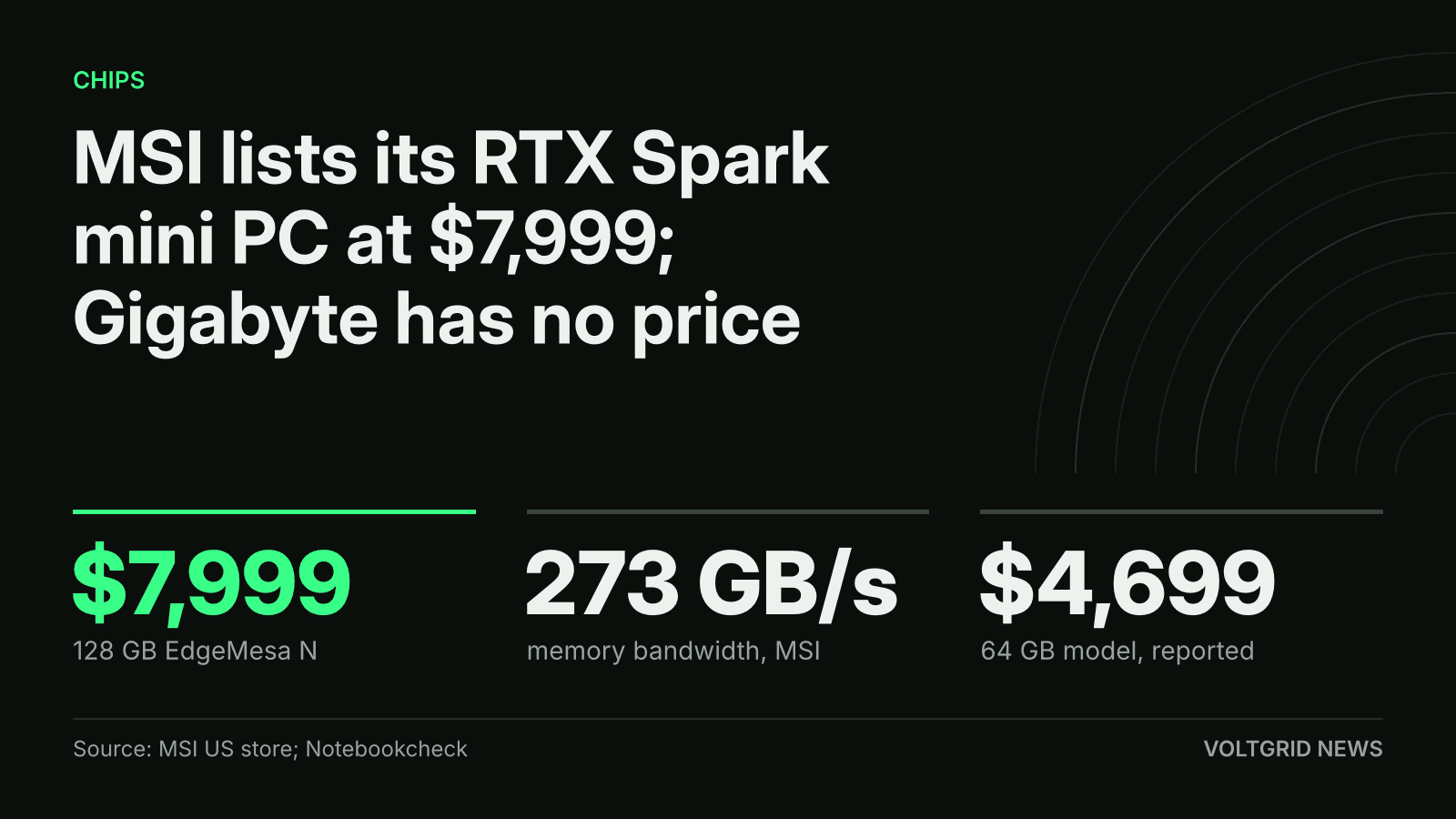
Apple's 512 GB Mac Studio configuration is due Dec. 3, as our review reported, and a gpt-oss-120b run on any M5 Ultra would fill the largest gap here. Framework listed Batch 3 of its 192 GB Desktop for December; independent tests will show what its 273 GB/s changes on Strix Halo. NVIDIA says DGX Station for Windows arrives in December 2026. MSI's RTX Spark mini PC, the EdgeMesa N, lists at $7,999 but was out of stock on Nov. 11, as we reported, and we found no published gpt-oss-120b run on it. On GB10, the kernel 7.0 freezes we reported on Nov. 9 were still open, and any fix could move the numbers. None of the March GB10 sweeps has been rerun on current software.
How it compares
Full table| Product | Memory | Bandwidth | AI compute | Measured speed | Price |
|---|---|---|---|---|---|
| ASUS ExpertCenter Pro ET900N G3ASUS (NVIDIA DGX Station GB300 platform) | 748 GB coherent: 252 GB HBM3e (GPU) + 496 GB LPDDR5X (CPU)[1] | 7.1 TB/s (GPU HBM3e); 396 GB/s (CPU LPDDR5X)[1] | up to 20 PFLOPS AI performance (ASUS gives no precision or sparsity label) (sparse)[2] | GPT-OSS-120B MXFP4, vLLM, 512/512, 1-128 streams: 9,280 aggregate output tok/s at 128 streams; 5,023 on 8,192/1,024 (StorageReview, ASUS-supplied unit, no add-in GPU)[3] | $111,999.99 at Central Computers, US (ET900N G3-2SSD-V2, read Nov 8, 2026); no ASUS list price[4] |
| HP ZGX Fury AI StationHP | 252 GB HBM3e GPU + 496 GB LPDDR5x CPU (4x 128 GB SOCAMM); 748 GB unified[5] | 7.1 TB/s (GPU HBM3e); 396 GB/s (CPU LPDDR5x)[5] | up to 20 petaFLOPS FP4 (HP gives no sparsity label) (sparse)[5] | Two-unit cluster with an ASUS ET900N G3 over two 400G DACs: GLM-5.3 NVFP4 5,018 output tok/s at 256 streams, 512/512, vLLM 0.27.1 TP2 with MTP (StorageReview); no single-unit HP result[6] | $132,000.00 on HP Store US (ZGX Fury G1n, 3-yr warranty, no graphics card, 4x 2 TB SED SSDs; Add to cart; read Nov 11, 2026)[7] |
| NVIDIA DGX StationNVIDIA (systems built by ASUS, Dell, GIGABYTE, HP, MSI, Supermicro and Exxact) | 748 GB coherent: 252 GB HBM3e (GPU) + 496 GB LPDDR5X (CPU)[8] | GPU HBM3e 7.1 TB/s; CPU LPDDR5X 396 GB/s; NVLink-C2C 900 GB/s between them[8] | 15 PFLOPS FP4 (without sparsity)[8] | gpt-oss-120b MXFP4, vLLM, 512/512 chat workload: 9,280 output tok/s at 128 streams (MSI WS300 9,294), single GB300 (StorageReview, ASUS ExpertCenter Pro ET900N G3)[3] | No NVIDIA list price; lowest US partner listing read Nov 4, 2026: Exxact Valence VWS-158270643 from $98,450 (Tom's Hardware found $94,930 in Aug); Dell Pro Precision with GB300 lists $160,195[9] |
| Supermicro Super AI Station (ARS-511GD-NB-LCC)Supermicro (NVIDIA DGX Station platform) | 748 GB total coherent: 252 GB HBM3e GPU + 496 GB LPDDR5X system[10] | 7.1 TB/s (GPU HBM3E); 396 GB/s (CPU LPDDR5X)[11] | up to 20 PFLOPS FP4 (Supermicro gives no sparsity label; ServeTheHome describes it as sparse FP4)[10] | Qwen3.8 Flash Next NVFP4, vLLM, tool-loop 4,096-in/512-out: several scenarios exceeded 3,000 output tok/s at 32 concurrent users, still rising (ServeTheHome; RTX PRO 2000 installed)[12] | $92,887.47 before tax and shipping on Supermicro's online store (ARS-511GD-NB-LCC-01-G2); about $90,101.05 with a 3% new-customer discount (TechRadar, Sep 1, 2026)[13] |
| NVIDIA RTX PRO 6000 Blackwell Workstation EditionNVIDIA (sold through PNY, TD SYNNEX and workstation makers) | 96 GB[14] | 1,792 GB/s[14] | 4,000 AI TOPS (FP4, with sparsity) (sparse)[14] | gpt-oss-120b MXFP4, stock vLLM, 512/512 chat workload: 3,064 output tok/s at 128 streams (1,169 on 8,192/1,024 prompts); Server Edition at 600W (StorageReview)[15] | $16,000 on NVIDIA's US marketplace (Workstation Edition), listed out of stock[16] |
| Apple Mac Studio (M5 Ultra)Apple | up to 512 GB unified (96 GB on 30-core M5 Ultra; 256 GB or 512 GB on 36-core/80-core M5 Ultra)[17] | 1.2 TB/s[17] | — | GLM-5.3-Flash MLX 4-bit with MTP on TensorFold, ISL 2048/OSL 512: 94.0 tok/s at 0 context, 96.5 at 128K, 79.4 at 512K; TTFT 1.1 s at 0, 66.3 s at 128K (Tom's Hardware, 256 GB M5 Ultra)[18] | $22,299 minimum with 512 GB ($6,799 36-core CPU/80-core GPU M5 Ultra config plus $15,500 memory upgrade; Oct 28, 2026)[19] |
| NVIDIA RTX Spark (N1X) PCsNVIDIA (MediaTek collaborated on the custom CPU design) | Up to 128 GB LPDDR5X (20-core CPU / 6,144-core GPU version); up to 64 GB (18-core / 5,120-core laptop version)[20] | Up to 300 GB/s: LPDDR5X-9400 on a 256-bit bus (NVIDIA's product page lists no bandwidth)[21] | — | gpt-oss:20b via Ollama in a Codex CLI coding agent, 64K context: 58.5 tok/s generation, 3 of 4 tasks passed (Dell XPS 16, 20-core N1X, 64 GB; StorageReview)[22] | Laptops from $2,599; pricing and configurations vary by region[23] |
| AMD Ryzen AI Halo (Ryzen AI Max+ PRO 495, 192 GB)AMD | 192 GB LPDDR5X (256-bit)[24] | 273 GB/s[24] | — | — | $7,299.99 for the Linux version (released the week of Oct 12, 2026); Windows version coming soon[24] |
Show the other 29 machinesHide the other 29 machines
| Product | Memory | Bandwidth | AI compute | Measured speed | Price |
|---|---|---|---|---|---|
| ASUS Ascent GX10ASUS | 64 GB or 128 GB LPDDR5X-8533 unified[25] | 273 GB/s (8533 MT/s), as listed by StorageReview; ASUS's spec page states no bandwidth[26] | Up to 1 PFLOP FP4 (GB10; NVIDIA's footnote: theoretical, using the sparsity feature). ASUS's pages say 1 petaFLOP / FP4 with no sparsity label (sparse)[27] | gpt-oss-120b, vLLM online serving, equal ISL/OSL: 70 tok/s at batch 1 rising to 680 tok/s aggregate at batch 64 (StorageReview)[26] | $5,999 (128 GB, 1 TB, GX10-GG0010BN, ASUS eShop US, Oct 30, 2026)[28] |
| Dell Pro Precision with GB10 (model FCM1253; launched as Dell Pro Max with GB10)Dell | 128 GB LPDDR5x up to 8533 MT/s onboard (64 GB option also listed)[29] | 273 GB/s (128 GB LPDDR5x, 256-bit)[30] | — | gpt-oss-120b, vLLM online serving, equal ISL/OSL: 68.57 tok/s at batch 1 rising to 670.83 tok/s aggregate at batch 64 (StorageReview)[31] | $7,901.00 (default FCM1253, 128 GB, 2 TB Gen4 QLC); 4 TB TLC SED SSD option +$2,450.00; 64 GB option listed at a $2,150.00 difference (Dell.com US, read Nov 10, 2026)[32] |
| Framework Desktop (Ryzen AI Max+ PRO 495, 192 GB)Framework | 192 GB LPDDR5X-8533 soldered[33] | 273 GB/s (256-bit)[33] | — | — | $6,799 (Max+ PRO 495 192 GB DIY Edition pre-order, Nov 3, 2026; storage not included)[34] |
| GIGABYTE AI TOP ATOMGIGABYTE | 128 GB unified system memory[35] | 273 GB/s (LPDDR5x-8533, 256-bit)[36] | — | gpt-oss-120b, vLLM online serving, equal ISL/OSL: 60.71 tok/s at batch 1 rising to 649.62 tok/s aggregate at batch 64 (StorageReview)[36] | $7,499.99 (128 GB, 4 TB PCIe 4.0) and $9,405.63 (128 GB, 4 TB PCIe 5.0; more options from $7,999.99); 128 GB from $5,999.99 (1 TB) and $6,999.99 (2 TB) at Newegg US, read Nov 9, 2026[37] |
| GMKtec EVO-X5 Pro AI Mini PCGMKtec | 192 GB LPDDR5X-8533 onboard (8 x 24 GB, non-upgradeable); up to 160 GB allocatable as VRAM[38] | Up to 273 GB/s[39] | — | GMKtec Laboratory table: GLM-5.3-Flash UD-IQ4_XS (146.05 GB) decode 17.79 tok/s, prefill 70.18, TTFT 14.71 s; Qwen3.8-Flash-Next ROCmFP4-FAST (93.48 GB) decode 45.08 tok/s[38] | $6,799 (192 GB/2 TB) and $7,099 (192 GB/4 TB), all variants available, GMKtec US store, read Nov 9, 2026[38] |
| HP ZGX Nano AI Station (G1n)HP | 128 GB coherent unified system memory[40] | 273 GB/s (128 GB LPDDR5x)[41] | GB10: up to 1 PFLOP FP4, theoretical, using the sparsity feature; HP and reviewers list 1,000 TOPS FP4 (sparse)[27] | gpt-oss-120b, vLLM online serving, equal ISL/OSL: 69.6 tok/s at batch 1 rising to 722.9 tok/s aggregate at batch 64 (StorageReview)[42] | $7,399.00 at the HP Store for the 4 TB model; $4,759 on Amazon (Notebookcheck, review updated Oct 5, 2026)[43] |
| Lenovo ThinkStation PGXLenovo | 128 GB LPDDR5X unified (256-bit)[44] | 273 GB/s[44] | — | — | US from $5,079 (1 TB base model) on Lenovo's site, per TechRadar's review (Jun 9, 2026); UK from GBP 5,200[45] |
| MSI EdgeMesa N AI+ (128 GB, X-005US)MSI | 128 GB LPDDR5X unified system memory[46] | 273 GB/s[46] | — | — | $7,999.00 (128 GB, 4 TB, X-005US, MSI US store, read Nov 11, 2026)[46] |
| MSI EdgeXpert (MS-C931)MSI | 64 GB or 128 GB LPDDR5x unified (256-bit)[47] | 273 GB/s[47] | 1 PFLOPS FP4 (sparse)[47] | — | No list price; MSI sells via quote (Get a quote)[47] |
| NVIDIA DGX SparkNVIDIA (partner GB10 systems from Acer, ASUS, Dell, GIGABYTE, HP, Lenovo and MSI) | 128 GB; a 64 GB configuration is sold only through OEM partners[27] | 273 GB/s[27] | Up to 1 PFLOP FP4 (theoretical, using the sparsity feature) (sparse)[27] | Qwen 3.8 27B (dense) with multi-token prediction: decode of about 20 tokens/s, with time-to-first-token staying interactive out to the full 262K context.[48] | $6,950.00 (128 GB, 4 TB) on NVIDIA's enterprise marketplace with an Add To Cart button in a copy cached 07:59 UTC on 2026-10-31; stock unverified (listed out of stock on 2026-10-21); 64 GB partner systems from $4,999[49] |
| NVIDIA DGX Spark 64 GBNVIDIA (sold by Acer, ASUS, Dell, Gigabyte, HP and MSI) | 64 GB LPDDR5X unified (two units pool 128 GB over ConnectX-7)[50] | 273 GB/s (256-bit; NVIDIA spec table covers both 64 GB and 128 GB)[27] | 1 PFLOPS FP4 (sparse; NVIDIA spec table covers both memory configurations)[27] | — | from $4,999 (partner systems, Oct 2026; no Founders Edition)[50] |
| Sipeed MaixStationSipeed | 128 GB LPDDR5X (256-bit)[24] | 273 GB/s (Sipeed claim)[24] | 256 TOPS FP4 (native FP4, no sparsity; Axera/Sipeed claim)[24] | — | about $3,999 expected for 128 GB, with Kickstarter launch discounts (Sipeed to Tom's Hardware, Oct 2026)[24] |
| AMD Ryzen AI Halo Developer PlatformAMD | 128 GB LPDDR5x-8000 unified[51] | 256 GB/s[51] | — | gpt-oss-120b, vLLM online serving, equal ISL/OSL 256/256: 222 tok/s aggregate at batch 64 vs 701 on DGX Spark (StorageReview)[52] | $3,999 with 2 TB SSD (Jul 2026)[52] |
| Framework Desktop (Ryzen AI Max+ 395)Framework | 128 GB LPDDR5x-8000 soldered (32 GB and 64 GB options)[53] | 256 GB/s[54] | — | gpt-oss-120b MXFP4 in LM Studio (out-of-the-box setup): roughly 45 tok/s (ServeTheHome; Ryzen AI Max+ 395, 128 GB, Windows 11 Pro)[55] | $3,449 (DIY Edition, Max+ 395 with 128 GB, system only; out of stock, Nov 3, 2026)[56] |
| Acer Veriton GN100 AI Mini WorkstationAcer | 128 GB LPDDR5x coherent unified[57] | — | — | gpt-oss-120b, vLLM, total token throughput: prefill heavy 303.61 to 2,777.56 tok/s; decode heavy 38.38 to 292.41 tok/s (batch 1 to 64, StorageReview)[58] | from $3,999 in North America (announced Sep 3, 2025; prices vary by region)[57] |
| ASRock Industrial AI BOX-A395ASRock Industrial | 128 GB LPDDR5X-8000 soldered[59] | — | — | AgentSTH V7, 32 threads: 15% ahead of the next-closest Ryzen AI Max+ 395 box (single-core within 1%); estimated SPEC CPU2026 int rate: top of a 44% spread across four 395 systems; measured by ServeTheHome, Ubuntu 26.04[60] | — |
| Beelink GTR9 Pro (Ryzen AI Max+ 495, 128 GB)Beelink | 128 GB LPDDR5X-8533 unified (soldered)[61] | — | 132 AI TOPS on Beelink's page; AMD lists the PRO 495 at Overall TOPS up to 132 and NPU TOPS up to 55; no precision stated by either[61] | 4.24 tok/s, LM Studio, Qwen3.8-35B-A3B (Beelink's own figure on its store page; quantization, context, backend and RAM size not stated)[61] | $4,799 (128 GB/2 TB), Beelink store, pre-order (read Nov 13, 2026)[61] |
| Beelink GTR9 Pro (Ryzen AI Max+ 495, 192 GB)Beelink | 192 GB LPDDR5X-8533 unified (soldered)[61] | — | 132 AI TOPS on Beelink's page; AMD lists the PRO 495 at Overall TOPS up to 132 and NPU TOPS up to 55; no precision stated by either[61] | 4.24 tok/s, LM Studio, Qwen3.8-35B-A3B (Beelink's own figure on its store page; quantization, context, backend and RAM size not stated)[61] | $7,399 (192 GB/2 TB) or $7,799 (192 GB/4 TB), Beelink store, pre-order (read Nov 13, 2026)[61] |
| Bosgame M5 MAX AI Mini PCBosgame | 192 GB unified LPDDR5 (soldered); up to 160 GB allocatable to the GPU[62] | — | — | — | $6,199 introductory first-batch pre-order price (192 GB, 2 TB PCIe 4.0 SSD), from Nov 3, 2026, until the first allocation sells out[62] |
| Dell Pro Precision with GB300 (model FCT6263; announced as Dell Pro Max with GB300)Dell | 252 GB HBM3e GPU + 496 GB LPDDR5X CPU[63] | — | — | — | $160,195.00 (Dell.com US default config FCT6263, read Nov 8, 2026)[63] |
| Gigabyte AI TOP Aero | up to 128 GB LPDDR5X unified[64] | — | — | — | — |
| GMKtec EVO-X2 AI Mini PCGMKtec | 64 GB or 128 GB onboard LPDDR5X-8000 (non-upgradeable)[65] | — | — | Llama 3.3 70B Q6_K Instruct: 3.7-3.8 tok/s generation fully on the Radeon 8060S (about 2 tok/s CPU-only); Qwen3-32B 10.4-10.5 tok/s; 128 GB unit, short prompt, tool not named (ServeTheHome)[66] | $3,499.99 (128 GB/1 TB) and $3,649.99 (128 GB/2 TB), each against a $3,999.99 compare-at price (GMKtec US store, read Nov 11, 2026)[65] |
| HP Z2 Mini G1a WorkstationHP | up to 128 GB unified, up to 96 GB assignable to the GPU, up to 8000 MT/s[67] | — | up to 50 NPU TOPS[67] | gpt-oss-120b GGUF (63.39 GB, full GPU offload) in LM Studio: close to 40 tok/s (StorageReview)[68] | $4,781 list for StorageReview's review configuration; about $3,300 street (B&H top spec with 2 TB SSD at $3,342.65, Aug 2025)[68] |
| Microsoft Surface RTX Spark Dev BoxMicrosoft | 128 GB unified memory[69] | — | up to 1 PFLOP of AI compute (Microsoft; precision and sparsity not stated on the page) (sparse)[69] | — | From $5,999.99 (Microsoft Store US, pre-order, read Nov 1, 2026)[69] |
| MSI EdgeMesa N AI+ (64 GB) | — | — | — | — | from $4,699 in the US (64 GB soldered LPDDR5X, 1 TB PCIe Gen 5)[70] |
| MSI XpertStation WS300MSI (NVIDIA DGX Station platform) | 252 GB HBM3e GPU + 496 GB LPDDR5X CPU (748 GB coherent)[71] | — | — | StorageReview vLLM: gpt-oss-120b MXFP4 9,294 output tok/s at 128 streams (512/512), 5,038 on 8,192/1,024; MiniMax M3 NVFP4 1,041 at 32 streams with EAGLE3-GQA at a forced acceptance length of 3 (best-case)[71] | $99,999.00 'Start From' at Newegg US (model WS300T60L, 2x 2 TB NVMe RAID1), sold by Newegg as a request-a-quote listing (read Nov 4, 2026)[72] |
| Tenstorrent TT-QuietBox 2 (Blackhole)Tenstorrent | 128 GB GDDR6 on the accelerators + 256 GB DDR5-5600 system memory[73] | — | — | — | $9,999 (Oct 30, 2026)[73] |
| WiCi One (RTX 5060 Ti edition)WiCi | 16 GB GDDR7 VRAM; 1 TB NVMe 4 SSD for TurboStream weight paging (WiCi's claim: NVMe used as working VRAM). System RAM not stated[74] | — | — | — | $2,599 list (WiCi shop, Oct 2026); a $600-off code (WICIWELCOME) is applied at checkout. Early-access price was $1,999 (Notebookcheck, Engadget, Sep 2026)[74] |
| WiCi One (RTX 5090 edition)WiCi | 32 GB GDDR7 VRAM; 4 TB NVMe 5 SSD for TurboStream weight paging (WiCi's claim: NVMe used as working VRAM). System RAM not stated[74] | — | — | — | $9,999 list (WiCi shop, Oct 2026); a $600-off code (WICIWELCOME) is applied at checkout[74] |
Italic values are reported by an outlet or measured by an independent lab; the rest come from the maker. Measured speeds use different models, quantizations and tools, so read each with its source rather than against the others. Voltgrid News does not test hardware itself.
Sources (74)
- [1] ASUS
- [2] ASUS
- [3] StorageReview
- [4] Central Computers
- [5] HP
- [6] StorageReview
- [7] HP
- [8] NVIDIA
- [9] Exxact
- [10] Supermicro
- [11] ServeTheHome
- [12] ServeTheHome
- [13] TechRadar
- [14] NVIDIA
- [15] StorageReview
- [16] NVIDIA
- [17] Apple
- [18] Tom's Hardware
- [19] MacRumors
- [20] NVIDIA
- [21] ServeTheHome
- [22] StorageReview
- [23] NVIDIA
- [24] Tom's Hardware
- [25] ASUS
- [26] StorageReview
- [27] NVIDIA
- [28] ASUS eShop
- [29] Dell
- [30] HotHardware
- [31] StorageReview
- [32] Dell
- [33] Framework Blog
- [34] Framework
- [35] GIGABYTE (PR Newswire)
- [36] StorageReview
- [37] Newegg
- [38] GMKtec
- [39] GMKtec
- [40] HP
- [41] HotHardware
- [42] StorageReview
- [43] Notebookcheck
- [44] Lenovo PSREF
- [45] TechRadar
- [46] MSI
- [47] MSI
- [48] Tom's Hardware
- [49] NVIDIA Marketplace
- [50] NVIDIA Blog
- [51] AMD
- [52] StorageReview
- [53] Framework
- [54] Framework Blog
- [55] ServeTheHome
- [56] Framework
- [57] Acer
- [58] StorageReview
- [59] ServeTheHome
- [60] ServeTheHome
- [61] Beelink
- [62] Notebookcheck
- [63] Dell
- [64] Notebookcheck
- [65] GMKtec
- [66] ServeTheHome
- [67] HP
- [68] StorageReview
- [69] Microsoft
- [70] Notebookcheck
- [71] StorageReview
- [72] Newegg
- [73] Tenstorrent
- [74] WiCi
Sources
- Desk
- Local AI Desk
- Editor
- Ege Erten
- Published
- Sources
- 3 cited
- Standards
- AI-assisted