RTX 5090 Price: 210% Over List at Newegg on Nov. 13, RX 9070 XT 59%
Newegg's cheapest new RTX 5090 was $6,199.99 on Nov. 13 against a $1,999 list price, tracker ComponentPrices shows; the RTX 5080 ran 130% over, the 5070 Ti 79% and AMD's RX 9070 XT 59%. Card makers point to memory costs and thinner supply.
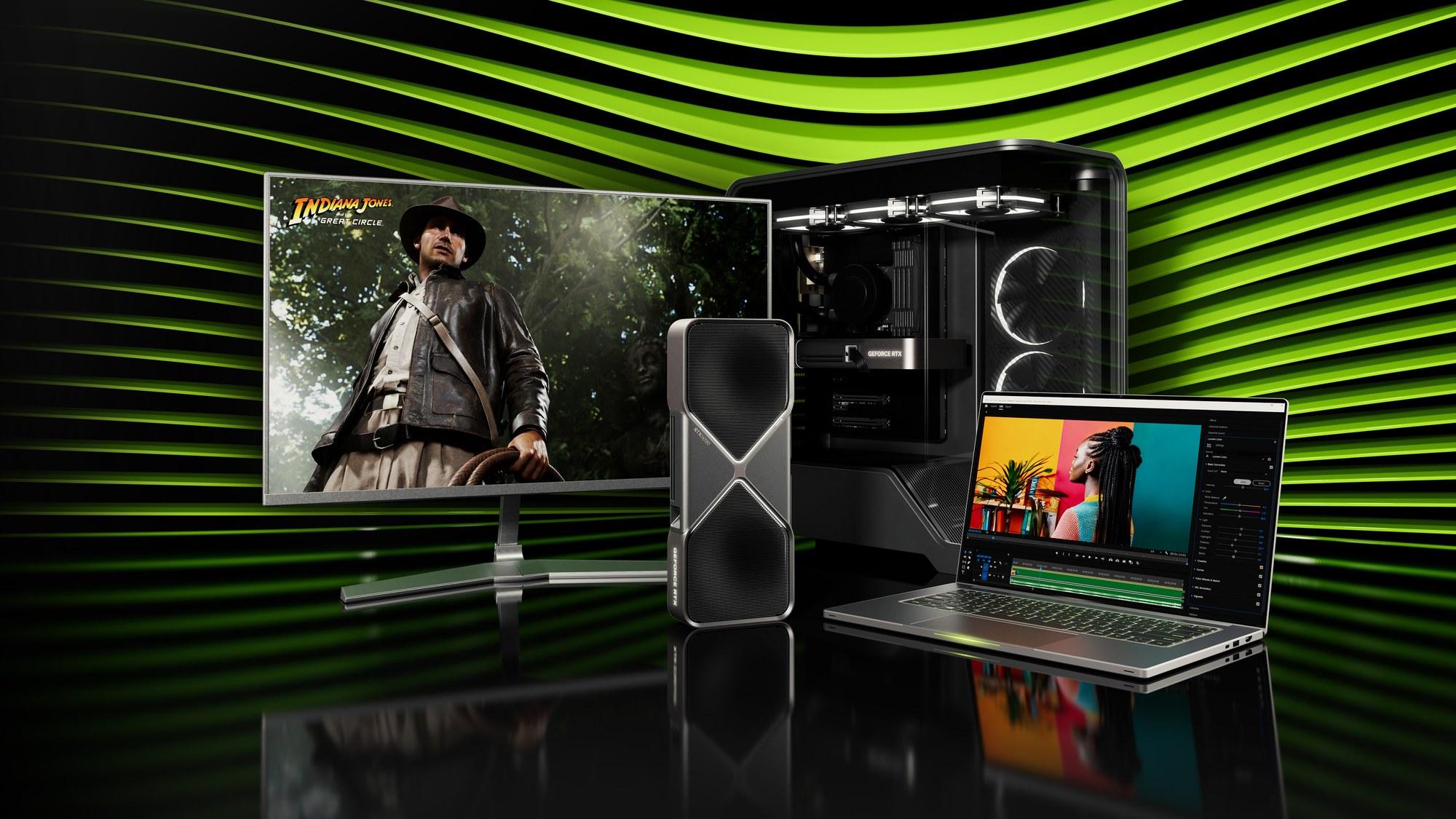
NVIDIA launched the GeForce RTX 50 series with a $1,999 list price for the RTX 5090; Newegg's cheapest RTX 5090 was $6,199.99 on Nov. 13.
Image: NVIDIA
Source · Press image from the NVIDIA newsroom, used for news reporting.
Newegg's cheapest new GeForce RTX 5090 was listed at $6,199.99 on Nov. 13, according to price tracker ComponentPrices, which logs that one US store: 210% above NVIDIA's $1,999 launch price. Across four current gaming cards there, the premium ran from 59% to 210%.
A card's list price, or MSRP, is the price NVIDIA or AMD announced at launch for the basic version: $1,999 for the RTX 5090, $999 for the RTX 5080, $749 for the RTX 5070 Ti and $599 for AMD's Radeon RX 9070 XT. Most cards are built by board makers such as Asus, Gigabyte or Sapphire, which set their own prices, often with higher list prices of their own, and stores then set the shelf price. A tracker's lowest in-stock figure is the cheapest new card from any of those makers that a store would sell on the day it looked. A large gap above list is a shelf price, not a price change by NVIDIA or AMD.
The gap per card, on two dates
Each tracker's four rows, read on its own date, give a like-for-like comparison. At Newegg on Nov. 13, the RTX 5090 carried a $4,201 premium ($6,199.99 against $1,999), or 3.10 times list. The RTX 5080 carried $1,301 ($2,299.99 against $999), or 130% over. The RTX 5070 Ti carried $591 ($1,339.99 against $749), or 79% over. The RX 9070 XT carried $351 ($949.99 against $599), or 59% over. Bought together, the four cost $10,789.96 at those listings against $4,346 at list: 2.48 times, or 148% more.
At Newegg on Nov. 13, the RTX 5090 ran 210% over list and AMD's RX 9070 XT 59%; Tom's Hardware's Nov. 3 index read 53% to 246%.
Chart: Voltgrid News
Illustration (AI-generated)
Tom's Hardware's GPU price index, which lists the lowest price for an available card from any board maker at US retailers and was last updated on Nov. 3, gives the second reading. There the RTX 5090 sat at $6,919, 246% over list; the RTX 5080 at $1,999, 100% over; the RTX 5070 Ti at $1,399, 87% over; and the RX 9070 XT at $919, 53% over. Those four cost $11,236 against the same $4,346 list total: 2.59 times, or 159% more. Tom's warns that retailers sometimes switch to third-party sellers automatically, so a row can be a marketplace listing, and its own Oct. 30 report had found the cheapest RTX 5080 at $2,199.99.
The two readings are not one series: one logs a single store, the other many. Within Newegg alone, the cheapest RTX 5090 fell from $6,979.99 on Nov. 5 to $6,199.99 on Nov. 10, a $780 drop, and stood there again on Nov. 13, ComponentPrices' daily log shows. Notebookcheck found the cheapest RTX 5070 Ti at $1,339.99, a Gigabyte card at Newegg, on Nov. 6, up $160 or about 13.6% from $1,179.99 on Oct. 29. Both Notebookcheck readings, before and after Nov. 3, sit below Tom's $1,399 row, and neither outlet explains the gap, so we report both and average neither. TechSpot's quarterly survey had recorded a $9,400 US low for the RTX 5090 in October, as Voltgrid reported, on a different method again.
Memory: what each card carries and what it costs
A graphics card's memory is a set of separate chips soldered around the GPU. Its capacity is the number of chips times the size of each chip, and the chip count is fixed by the memory bus: one chip per 32-bit channel, so the RTX 5080's 256-bit bus takes eight. Its 16 GB is eight 2 GB chips. A 24 GB version on the same GPU needs eight 3 GB chips, so the price of one memory part can decide whether a whole product exists.
That is the reported reason a 24 GB RTX 5080 will not launch in January. A Board Channels post on Nov. 11 said NVIDIA told partners it had cancelled the card's planned January 2027 launch because 3 GB GDDR7 chips cost roughly three times as much as 2 GB chips, as Voltgrid reported. Reports differ on scope: Notebookcheck describes a cancelled China launch, Club386 the card itself. NVIDIA has not confirmed it and never announced the card. The newest chip prices we found are from July, when a VideoCardz source, cited by The FPS Review, put a 3 GB GDDR7 chip at $60 to $70 and a 2 GB chip at about $20. By our arithmetic on those reported figures, that is $10 per GB against $20 to $23, or about $160 of memory on a 16 GB card against $480 to $560 for 24 GB.
The RTX 5090, RTX 5080 and RTX 5070 Ti use GDDR7, NVIDIA's specifications show; the RX 9070 XT uses 16 GB of the older GDDR6. Both kinds are moving. In July, NVIDIA's board partners were reportedly hit with higher prices for the GDDR6 and GDDR7 memory kits their RTX cards need, The FPS Review reported, citing Benchlife via VideoCardz. Chinese supply-chain channel ChannelGate says GDDR6 prices rose 8% to 10% in the third quarter, and AMD reportedly plans a second increase on the GPU-and-memory kits it sells to board makers, as Voltgrid reported on Oct. 31. AMD has not confirmed either increase.
PC Partner, which builds Zotac, Inno3D, Manli and Sapphire cards, said in its first-half results that graphics memory costs were expected to rise further, driving a substantial increase in card costs in the second half, Tom's Hardware reported in August. The memory makers see no quick relief: Micron's chief executive said demand will exceed supply in 2027 and 2028, and Winbond's chairman said on Nov. 7 only that he hopes prices have peaked, as Voltgrid reported.
Memory does not explain the whole gap. At July's reported chip prices, the RTX 5080's 16 GB would cost about $160, against a street premium of $1,000 in Tom's Nov. 3 index and $1,301 at Newegg on Nov. 13. TechSpot argued in early November that the card's memory had not become $700 more expensive. Analyst Jon Peddie told Tom's Hardware in August that he suspects card makers' profits are rising, and that they are raising card prices by more than their memory costs went up. That is the counter-case: part of the premium is margin, taken somewhere between the GPU kit and the shelf.
Supply: fewer chips for board makers, emptier shelves
The second cause is how many GPUs reach the shelf. NVIDIA's US store had dropped the RTX 5090 by Oct. 17 and the RTX 5080 around Oct. 30, Tom's Hardware found, while the RTX 5070 Ti and RTX 5070 were still listed as out of stock at the end of October, as Voltgrid reported. NVIDIA has not said either top card is discontinued. Its senior vice president Jeff Fisher said RTX 5090 production continues, with supply somewhat constrained, Tom's Hardware reported, citing Taiwanese outlets 4Gamers and SJTV.
The cuts are clearest in China, though every figure there is reported, not confirmed. ChannelGate said NVIDIA's board partners were raising RTX 50 prices in November by up to roughly $500 on top models, as Voltgrid reported on Nov. 3. That dollar figure is converted from yuan cost-price changes; Wccftech puts the top rise, on the China-only RTX 5090D V2, at $330 to $550. A Nov. 12 Board Channels post said AMD's gaming GPU supply to Chinese board partners had fallen 20% to 50% since October and would stay tight until January 2027, as Voltgrid reported.
NVIDIA's US store dropped both top cards by the end of October; AMD's China supply reportedly fell 20% to 50% since October.
Chart: Voltgrid News
Illustration (AI-generated)
Worldwide, PC Partner said in its first-half results that its card shipments fell substantially from the previous half and that availability would likely fall further, Tom's Hardware reported, even as Jon Peddie Research counted 12.5 million desktop cards shipped in the second quarter, the most since early 2022.
Who pays: gamers, home AI builders and PC builders
For gamers, the AMD card was the cheapest of these four with 16 GB, at $949.99 against $1,339.99 for the RTX 5070 Ti at Newegg on Nov. 13. For anyone running language models at home, memory capacity decides which models fit, and the street price per GB shows who pays most. By our arithmetic on those Nov. 13 listings, the RTX 5090 costs $193.75 per GB of memory ($6,199.99 for 32 GB), against $62 at list ($1,999 for 32 GB). The RTX 5080 costs $143.75 per GB ($2,299.99 for 16 GB), the RTX 5070 Ti $83.75 and the RX 9070 XT $59.37, each with 16 GB. The only card of the four with more than 16 GB carries the largest premium, and it also draws the most power: 575 W total graphics power, NVIDIA says, against 360 W for the RTX 5080 and 304 W board power for the RX 9070 XT, AMD says.
Per GB of memory, the RTX 5090 cost $193.75 at Newegg on Nov. 13, against $62 at its list price.
Chart: Voltgrid News
Illustration (AI-generated)
What it means for engineers and investors: the premium is not flowing through NVIDIA's or AMD's list prices. No one discloses where it goes: the kits NVIDIA and AMD sell to board makers have reportedly risen, memory costs more, and board makers and retailers set the final price. For a builder sizing a home or lab inference box, the cheapest current RTX 50 card with more than 16 GB costs more than three times its list price. The older 24 GB RTX 4090 sat at $4,999 in Tom's Nov. 3 index, 3.1 times its $1,599 launch price, often from second-hand sellers, Tom's Hardware warns. That argues for waiting or for a different machine class. For an investor, the sign to watch is whether NVIDIA's gaming revenue holds up while its own US store has listed neither top card since late October.
What to watch
On Nov. 17 at 2 p.m. PT, NVIDIA holds its third-quarter fiscal 2027 results call. Any remark on the RTX 5080's status or the 24 GB model would be the first official word on either. Black Friday, Nov. 27, will show whether US listings fall back toward list; Tom's Hardware said on Oct. 30 that the RTX 5080 was unlikely to be available by Black Friday. In January 2027, Board Channels expects AMD's tight supply to ease, and the reportedly cancelled 24 GB RTX 5080 had been due then, according to the same forum. CES runs Jan. 6 to 9, 2027. No official price change on any of the four cards has been announced so far.
Sources
- 01AMD Radeon RX 9070 XT specificationsAMDamd.com
- 02AMD Unveils Next-Generation AMD RDNA 4 Architecture with the Launch of AMD Radeon RX 9000 Series Graphics CardsAMDir.amd.com
- 03NVIDIA RTX Blackwell GPU Architecture whitepaperNVIDIAimages.nvidia.com
- 04GPU price tracking 2026: lowest price on every graphics card from Nvidia, AMD, and Intel todayTom's Hardwaretomshardware.com
- 05GeForce RTX 5070 Family specificationsNVIDIAnvidia.com
- 06NVIDIA Blackwell GeForce RTX 50 Series Opens New World of AI Computer GraphicsNVIDIAnvidianews.nvidia.com
- Editor
- Ege Erten
- Published
- Sources
- 6 cited
- Standards
- AI-assisted