Megaspeed Malaysia Unit in AI Chip Re-Export Check; Singapore Charges 5th
Speedmatrix, Megaspeed's Malaysian unit, is under review by MITI and customs over possible AI chip re-exports, as Singapore charged a fifth person over 917 servers. No export is shown yet.
Chips & Power DeskEdited by Ege Erten
3 min readAI-assisted
Follows NVIDIA CEO Jensen Huang: China Reportedly Recruited Megaspeed Executive
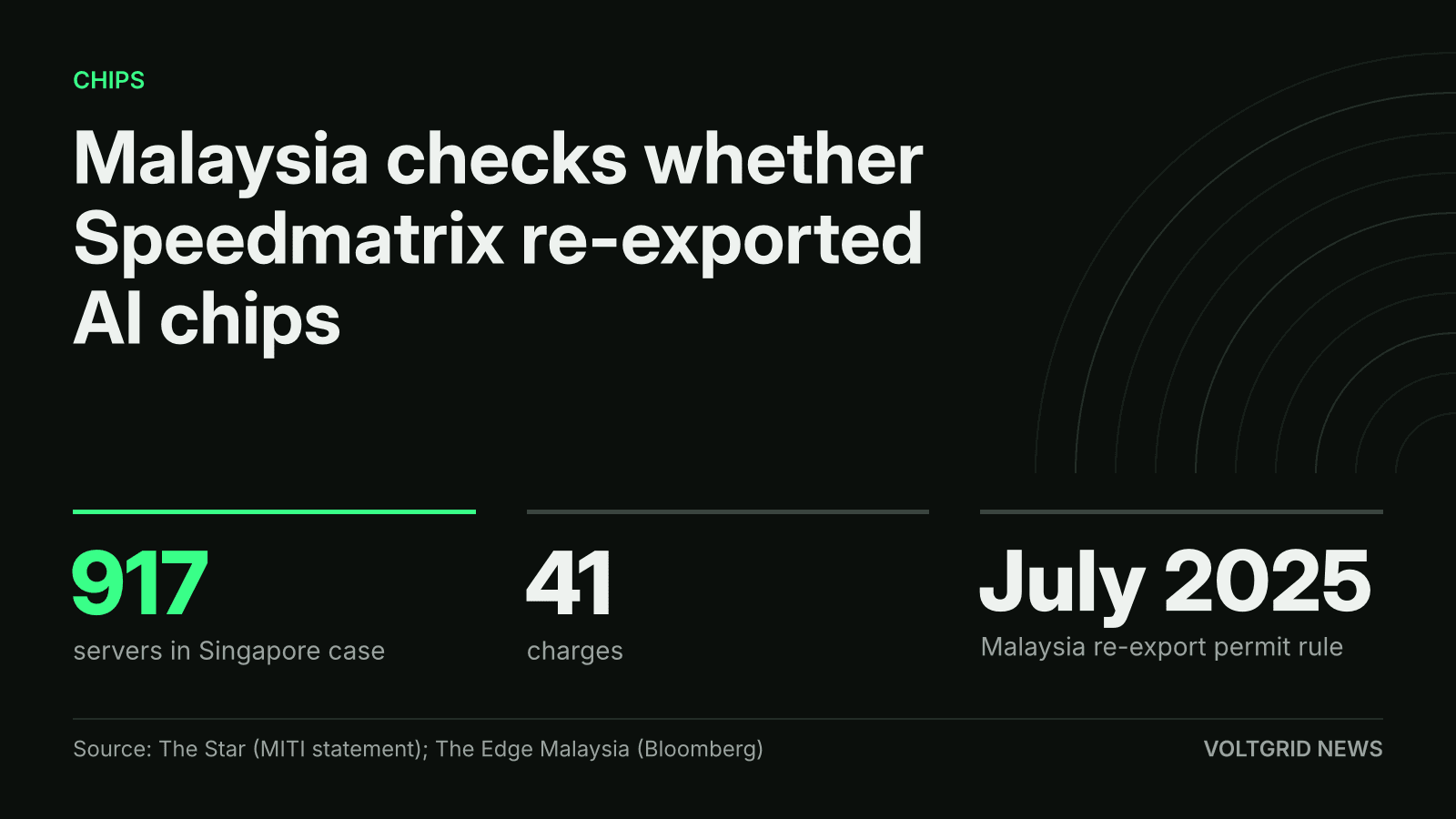
Key facts: Singapore's case involves 917 servers and 41 charges; Malaysia's re-export permit rule dates from July 2025.
Illustration (AI-generated)
Malaysia's trade ministry said on Nov. 13 that it is working with customs to determine whether AI chips imported by Speedmatrix, the local unit of Singapore's Megaspeed International, were later re-exported, as Singapore charged a fifth person over 917 servers on the same day.
The Ministry of Investment, Trade and Industry (MITI) said in a statement, as carried by The Star and AFP via the Korea Times, that Speedmatrix is a tenant at Malaysian data centers and brings in its own servers and AI chips. MITI said it has never cleared Megaspeed or Speedmatrix, and that its verification visits to the sites were routine monitoring of the data-center sector, not a company-specific sign-off. Prime Minister Anwar Ibrahim told reporters there was no indication so far that the chips were exported from Malaysia, and that Malaysia has received no formal request from Singapore or the United States, according to Bernama via The Star.
Malaysia: the test is re-export, not import
Importing AI chips into Malaysia needs no permit or licence, MITI said. Since July 2025, however, anyone who wants to export, re-export, transship or transit high-performance US AI chips from or through the country must first obtain a MITI permit under the Strategic Trade Act 2010, and giving customs false information about such goods is an offence under the Customs Act 1967. The probe therefore turns on movement out of Malaysia, not on the chips arriving. MITI added that it is working with authorities in Singapore and the United States and is considering further measures to tighten controls where necessary. Minister Johari Abdul Ghani said Malaysia would facilitate any formal request, and that buying GPUs for use in a data center is a different matter from re-exporting them.
Singapore: 41 charges over 917 servers
Singapore police said on Nov. 13 they charged Shi Bingzhe, 34, with 41 counts including money laundering offences, according to Bloomberg as carried by The Edge Malaysia. It also charged Superphi Pte Ltd and NJ Global Financial Pte Ltd, two firms where he was a director. With his consent, police said, the two companies acquired 917 servers from Aperia International Pte Ltd across 41 transactions between May 2024 and February 2025, and had reasonable grounds to believe the servers were benefits of Aperia's alleged fraud by false representation.
The 917 servers changed hands in 41 transactions between May 2024 and February 2025; Singapore charged a fifth person on Nov 13.
Illustration (AI-generated)
Four other companies, including Aperia, were charged in July over false statements about the end-users of servers bought from Dell Technologies, Super Micro Computer and Asustek Computer. Prosecutors said in March 2025 that the alleged transactions totaled about US$390 million, per Bloomberg. Bloomberg reports that Singapore has now charged five people, and the servers are suspected of containing Nvidia chips; the Singapore case is separate from the Megaspeed review, and neither source ties Megaspeed to the 917 servers.
Why it matters for AI hardware supply
Two Southeast Asian data-center hubs are now treating the chip trail as an enforcement matter. For data-center operators and server makers, the exposure is documentation: end-user declarations at the point of sale, and permits at the point of re-export. The Megaspeed thread began with a US intelligence memo about executive Alice Huang, as Voltgrid reported. The Korea Times, citing AFP, said Singapore barred Alice Huang from re-entering in February for giving investigators inaccurate information about her role, though she was not investigated for espionage.
On the US side, the decision is still pending, with Commerce holding the pen on a Megaspeed Entity List listing.
MITI has not said whether any chips left Malaysia, and Anwar said none has been indicated so far. One report that Malaysia is drafting legislation to tighten data-center oversight rests on a single source that Voltgrid could not read in full, so it is not treated as confirmed. The Singapore charges are allegations, and neither government statement names Nvidia as a party. Nvidia chief executive Jensen Huang resigned on Nov. 12, according to The Edge and the Korea Times.
Sources
- Editor
- Ege Erten
- Published
- Sources
- 2 cited
- Standards
- AI-assisted