AI Chip Supply Chain Q3: SK hynix Revenue Up 328%, Short to 2030
Read like for like, eight AI chip suppliers' Q3 reports put memory far ahead: SK hynix revenue up 328%, Samsung 127%. Applied Materials and Lam Research hit records and point to tools and cleanroom space as the next limit.
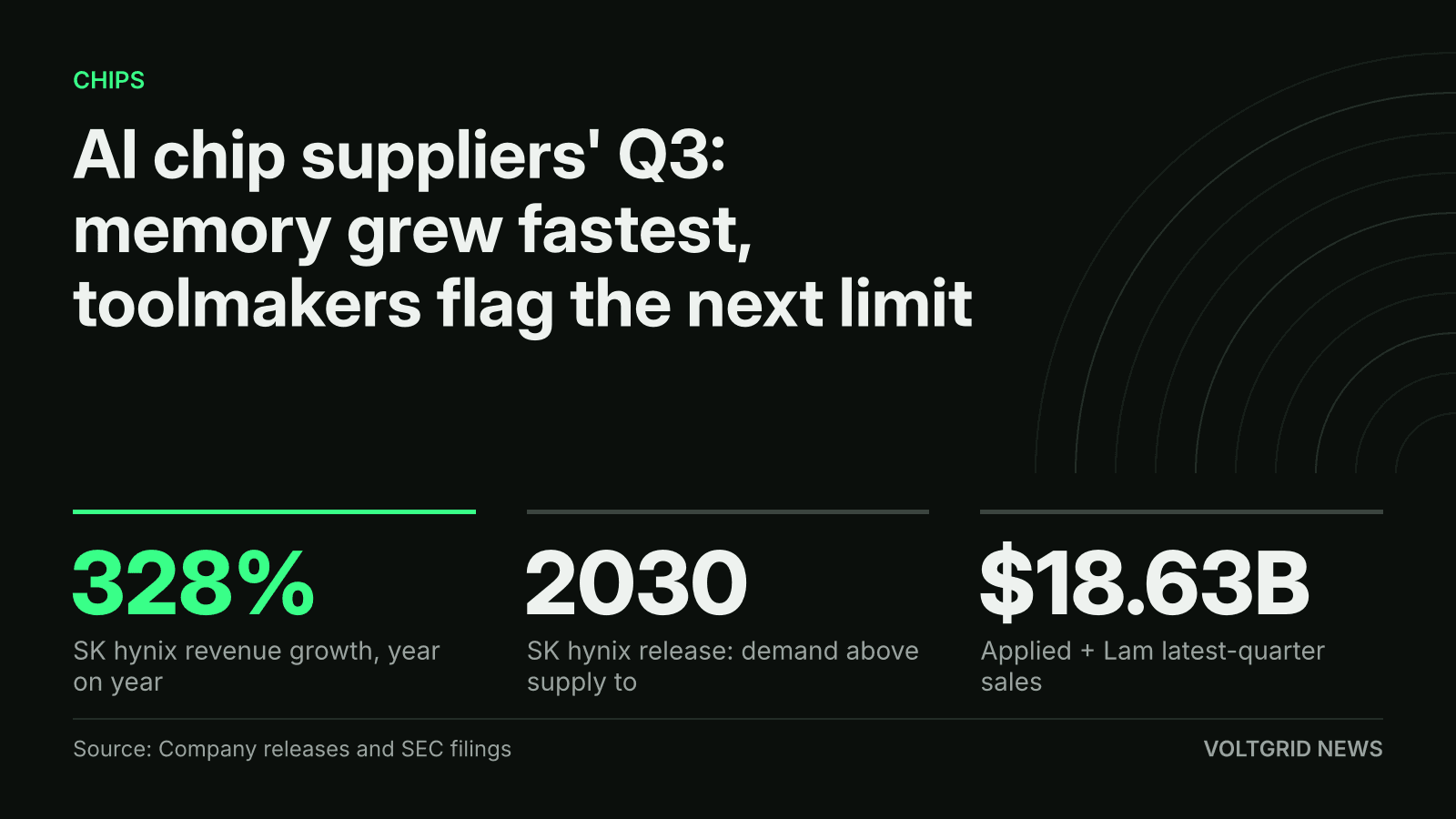
Memory makers grew fastest in the third quarter; toolmakers point to equipment and cleanroom space as the next limit.
Voltgrid News
Illustration (AI-generated)
Third-quarter reports from the companies that make, supply and equip AI chips point to one constraint. Memory grew fastest: SK hynix revenue rose 328% and Samsung's 127% from a year earlier, and SK hynix's release says demand will outrun supply through 2030. SMIC ran its fabs at 97.3% utilization, and Applied Materials and Lam Research booked record sales of $10.41 billion and $8.22 billion. Read together, they suggest the squeeze is moving to the machines and cleanroom space that make chips.
Foundries: TSMC guides higher, SMIC runs at 97.3%
TSMC reported October revenue of NT$586.89 billion on Nov. 10, up 59.7% from October 2025 and 14.7% from September. Its Oct. 15 third-quarter release put quarterly revenue at NT$1,494.24 billion, up 50.9% in New Taiwan dollars and 41.2% in U.S. dollars, at $46.72 billion. The two growth rates use different currencies. Voltgrid's October revenue report has the monthly arithmetic.
TSMC guided the fourth quarter to $52.3 billion to $54.3 billion. The midpoint of $53.3 billion is 14.1% above the third quarter's $46.72 billion. At TSMC's assumed NT$31.8 to the dollar, the range is NT$1,663 billion to NT$1,727 billion; less October's NT$586.89 billion, that leaves about NT$538 billion to NT$570 billion a month for November and December, 3% to 8% below October. The guide already allows October to be the quarter's peak month.
SMIC, China's largest foundry, reported on Nov. 12 third-quarter revenue of $3,190.0 million, up 6.1% from the second quarter and 33.9% from $2,381.8 million a year earlier, by our arithmetic. SMIC's results announcement put utilization at 97.3%, up from 93.7% in the second quarter and 95.8% a year earlier, on monthly capacity of 1,116,750 eight-inch-equivalent wafers. The release does not tie that to AI: consumer electronics was 40.6% of wafer revenue. It guided fourth-quarter revenue up 4% to 6%, with gross margin of 26% to 28%. Our earlier report on the quarter covers the margin and capital spending.
A fab's utilization rate is the share of its capacity actually turning out wafers: SMIC divides wafers out by estimated quarterly capacity, counting 8-inch and 12-inch lines in eight-inch equivalents. At 97.3%, almost every machine is busy, so output grows only as fast as new equipment is delivered, installed and qualified. A full fab cannot simply run harder, which is why toolmakers' lead times and cleanroom space matter.
On the Nov. 13 call, co-CEO Zhao Haijun said AI-related supply chains will stay tight through 2027, according to Reuters as carried by The Standard. He also said memory supply and demand should balance around the middle to end of 2028 and that some equipment orders take more than 24 months to arrive. That is management's view, reported by one wire service; our report on the call has more.
Memory: years of output committed, and price outrunning volume
Samsung Electronics reported third-quarter operating profit of KRW 107.4 trillion on revenue of KRW 195.3 trillion, up 127% from KRW 86.1 trillion a year earlier by our arithmetic (195.3 divided by 86.1). Its Device Solutions chip division earned KRW 106.5 trillion of that, about 99% (106.5 divided by 107.4). Samsung's release said AI demand in 2027 will "far exceed" industry supply. On the earnings call, Samsung said negotiations for its 2027 HBM (high-bandwidth memory) volumes are complete at target prices, which BusinessKorea described as effectively sold out, and that it has memory long-term agreements with 10 large customers. As we reported, that is not in a filing.
SK hynix reported record third-quarter operating profit of KRW 83.3338 trillion on revenue of KRW 104.6155 trillion, an 80% operating margin, with revenue up 328% from KRW 24.4489 trillion a year earlier (104.6155 divided by 24.4489). Its release says demand will exceed supply through 2030. On the call, DRAM marketing vice president Park Jun-deok said that, counting long-term agreement volumes and demand under specific negotiation, DRAM and HBM volumes through 2029 are effectively sold out, according to Money Today and Kyunghyang Shinmun. The release says its long-term agreements with 14 major customers cover more than 50% of 2027 and 2028 production capacity, at prices set within an agreed range, and the company expects HBM4 to pass HBM3E in shipments and revenue in the fourth quarter.
Counterpoint Research, as relayed by Yonhap and Seoul Economic Daily, put third-quarter DRAM revenue shares at Samsung 38%, SK hynix 29%, Micron 21% and CXMT 9%. It also said, as quoted by Seoul Economic Daily, that bit shipments grew only about 4% in the quarter while DRAM revenue was up 369% from a year earlier, a sign that price, not volume, is doing the work. DRAM share is not HBM share, as our share report explains.
Tools: DRAM rose to 33% of Applied's chip-tool sales
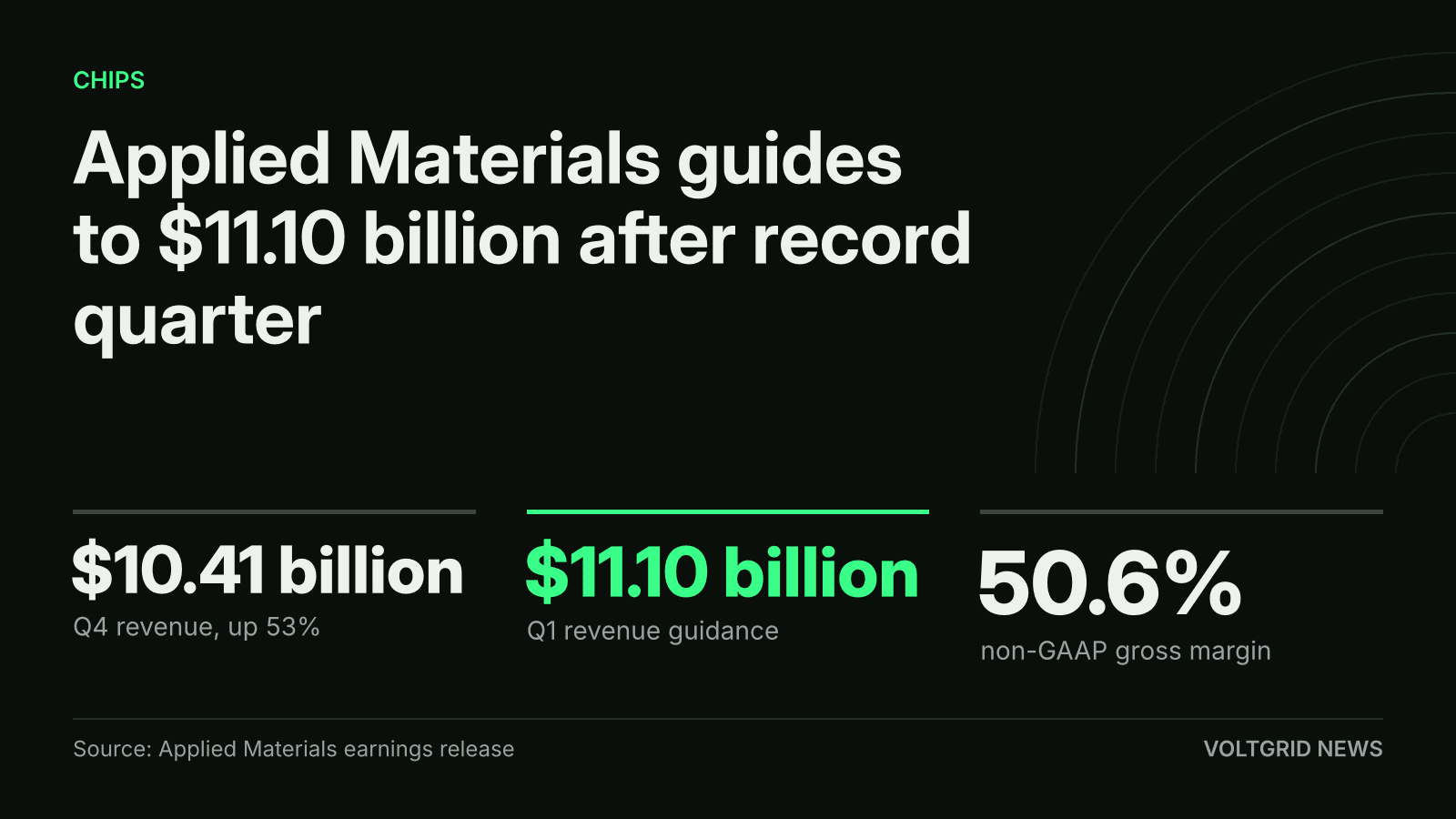
Applied Materials reported on Nov. 12 record fiscal fourth-quarter revenue of $10.41 billion, up 53% from $6.80 billion a year earlier. Its Semiconductor Systems unit sold $7,996 million of wafer-fab tools, against $4,879 million a year earlier. DRAM was 33% of those sales, against 28%, flash 9% against 6%, and foundry and logic 58% against 66%.
DRAM took a larger share of Applied's Semiconductor Systems sales as foundry and logic fell from 66% to 58%.
Voltgrid News
Illustration (AI-generated)
Applying the rounded shares gives about $2,639 million of DRAM tools now (33% of $7,996 million) against about $1,366 million a year ago (28% of $4,879 million), a rise of roughly 93%. Foundry and logic tools grew about 44%, from roughly $3,220 million to $4,638 million. Applied guided fiscal first-quarter revenue to $11.10 billion, plus or minus $500 million, 6.6% above the quarter just reported at the midpoint. The release does not break out HBM, so any link from DRAM tools to HBM output is an inference.
Lam Research reported $8.22 billion for the quarter ended Sept. 27, up 54.4% from $5.32 billion in its quarterly filing, and guided December-quarter revenue to $8.60 billion, plus or minus $400 million. Together, the two U.S. toolmakers sold $18.63 billion in their latest quarters (10.41 plus 8.22), services and support included, and guided to a $19.70 billion midpoint sum (11.10 plus 8.60). Their quarters end a month apart, so the sum is rough. Lam sees wafer fab equipment spending in the mid-$150 billion range in 2026 and, in a preliminary outlook, above $200 billion in 2027, with DRAM growing fastest, and says cleanroom space and component supply limit what its customers can build, as Voltgrid reported. Tokyo Electron's own estimate, reported by Reuters, is about $160 billion in 2026 and above $210 billion in 2027, and it forecast operating profit of ¥1.169 trillion for the year to March 2027, up 87.1% from ¥624.9 billion (our report). TEL's 2027 floor is $10 billion above Lam's, and its 2026 estimate is about $5 billion higher.
ASML reported on Oct. 14 net sales of €11,662 million, up 25.0% from €9,326 million in the second quarter, according to its release as published by Seeking Alpha, and guided the fourth quarter to €14.2 billion to €15.2 billion. It said planned supply for 2027 and 2028 will not fully meet customer demand.
Accelerator makers: AMD, Cerebras and the Nov. 17 test for NVIDIA
AMD reported third-quarter revenue of $13,377 million on Nov. 3, up 45%, with Data Center at $8,546 million, up 97%, and guided the fourth quarter to about $17 billion, plus or minus 3%. We reported that the guide leans on Helios racks and Venice processors.
Cerebras reported on Nov. 12 core revenue, a non-GAAP measure, of $230.9 million, up 70%, with GAAP revenue a record $210.8 million, and guided the fourth quarter to $310 million to $330 million. The midpoint is 38.6% above the third quarter. It has 700 gross megawatts of data-center capacity under contract for delivery by the end of 2027, contracted rather than delivered, as our Cerebras report notes.
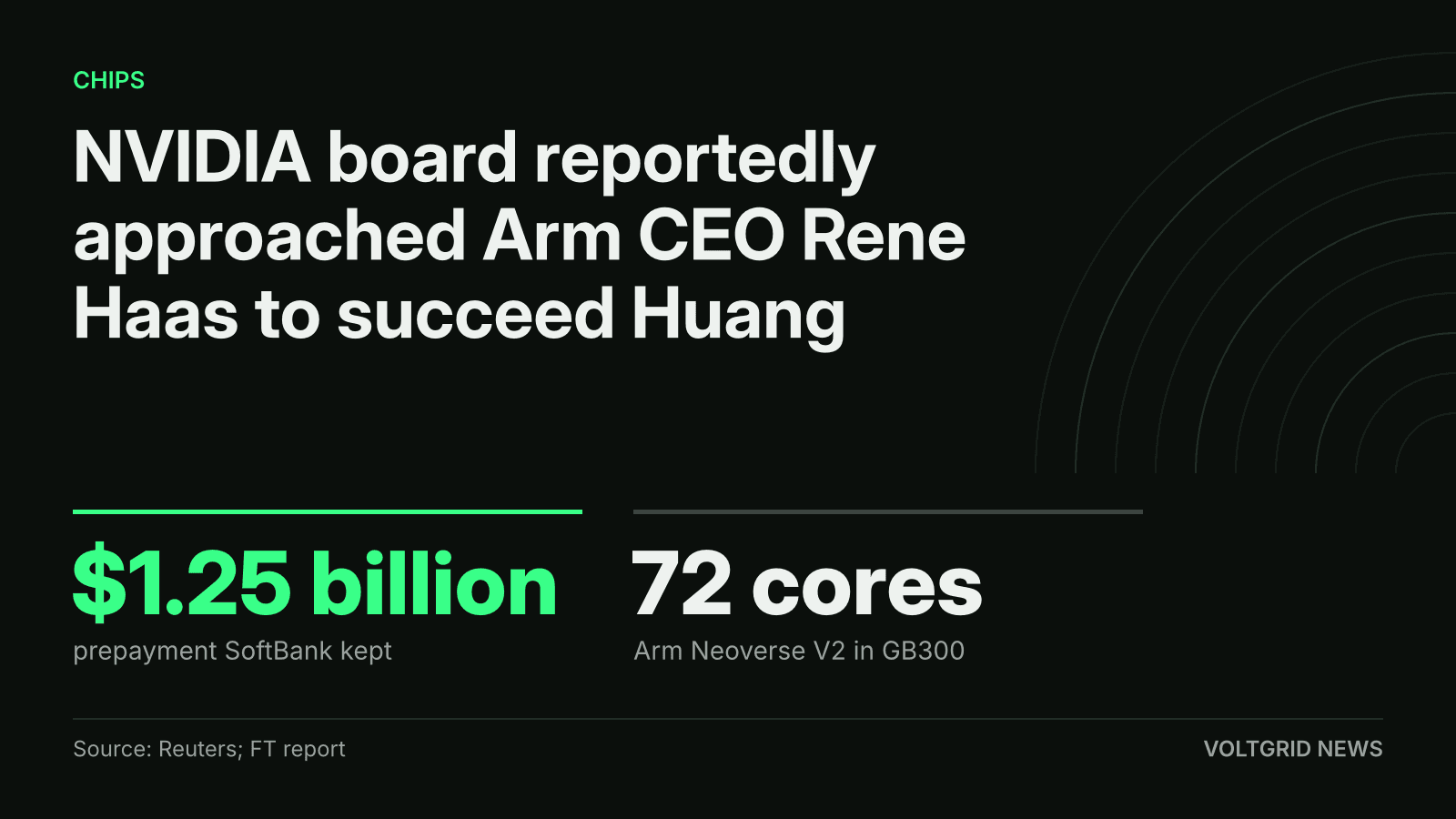
NVIDIA reports fiscal third-quarter results on Tuesday, Nov. 17, at about 1:20 p.m. PT. In August it guided revenue to $108.0 billion, plus or minus 2%, or $105.8 billion to $110.2 billion, 12.3% above the second quarter's $96.2 billion, with no China data-center compute revenue assumed. The report comes days after NVIDIA said on Nov. 12 that Jensen Huang had resigned as president, chief executive and director (its 8-K dates the board's acceptance to Nov. 11), with Chief Financial Officer Colette Kress as interim CEO. NVIDIA has not said why. Its board expects operations, customer commitments and the roadmap to continue without interruption, and the Nov. 17 report stands as scheduled. The test is whether revenue lands inside that range and whether those commitments hold.
What the quarter means, and what to watch
For engineers and investors, the chain is the point. SMIC's fabs are nearly full at 97.3%; SK hynix and Samsung, as reported from their calls, say their HBM output for 2027 (SK hynix: through 2029) is committed, and both releases say demand will outrun supply. The next constraint is tools, which Lam, ASML and SMIC each describe in terms of lead times, cleanroom space or supply that trails demand. This is our reading, not a figure any company reported.
Like for like, latest-quarter revenue growth from a year earlier was 328% at SK hynix and 127% at Samsung (both in won), 70% at Cerebras (core revenue), 54.4% at Lam, 53% at Applied, 45% at AMD, 41.2% at TSMC in U.S. dollars and 33.9% at SMIC. Both memory makers grew more than twice as fast as either U.S. toolmaker (127% and 328% against 53% and 54.4%).
Like for like, memory makers outgrew the foundries and toolmakers that supply them. SK hynix and Samsung in won; TSMC in U.S. dollars; Cerebras core revenue.
Voltgrid News
Illustration (AI-generated)
Nov. 17: NVIDIA's results and call, against the $105.8 billion to $110.2 billion guide.
Around Dec. 10 (expected, not announced): TSMC's November revenue, against the NT$538 billion to NT$570 billion a month its guidance implies. The date is inferred from past filings.
Fourth quarter: SK hynix's expected HBM4 crossover over HBM3E, and Samsung's first Taylor, Texas fab, which the Korea Herald reports could begin trial runs in mid-to-late December; Samsung has confirmed no date.
January 2027: Lam's call, where it said it expects a clearer view of cleanroom schedules, and Samsung's board decision on shareholder returns in late January.
Not confirmed: the Samsung, SK hynix and SMIC call remarks come from press accounts, the Counterpoint shares from relays. SK hynix's results are preliminary, and no maker has published HBM-only revenue for the quarter.
Sources
- 01Lam Research September 2026 quarter release (Ex. 99.1)Lam Research (SEC)sec.gov
- 02SMIC Reports Unaudited Results for the Three Months Ended September 30, 2026 (HKEX announcement)SMICsmic.cdn.shwebspace.com
- 03SK hynix Announces 3Q26 Financial ResultsSK hynixnews.skhynix.com
- 04NVIDIA Sets Conference Call for Third-Quarter Financial ResultsNVIDIAnvidianews.nvidia.com
- 05NVIDIA Announces Financial Results for Second Quarter Fiscal 2027NVIDIAnvidianews.nvidia.com
- 06Applied Materials Q4 FY2026 earnings release (Ex. 99.1)Applied Materials (SEC)sec.gov
- Editor
- Ege Erten
- Published
- Sources
- 6 cited
- Standards
- AI-assisted