Samsung Says HBM Supply Sold Out for 2027, Signs LTAs With 10 Customers
Samsung Electronics said on its Oct. 29 call that next year's planned HBM is sold out at target prices, and it is negotiating LTAs with 10 more customers, Korean press reported.
2 min readAI-assisted
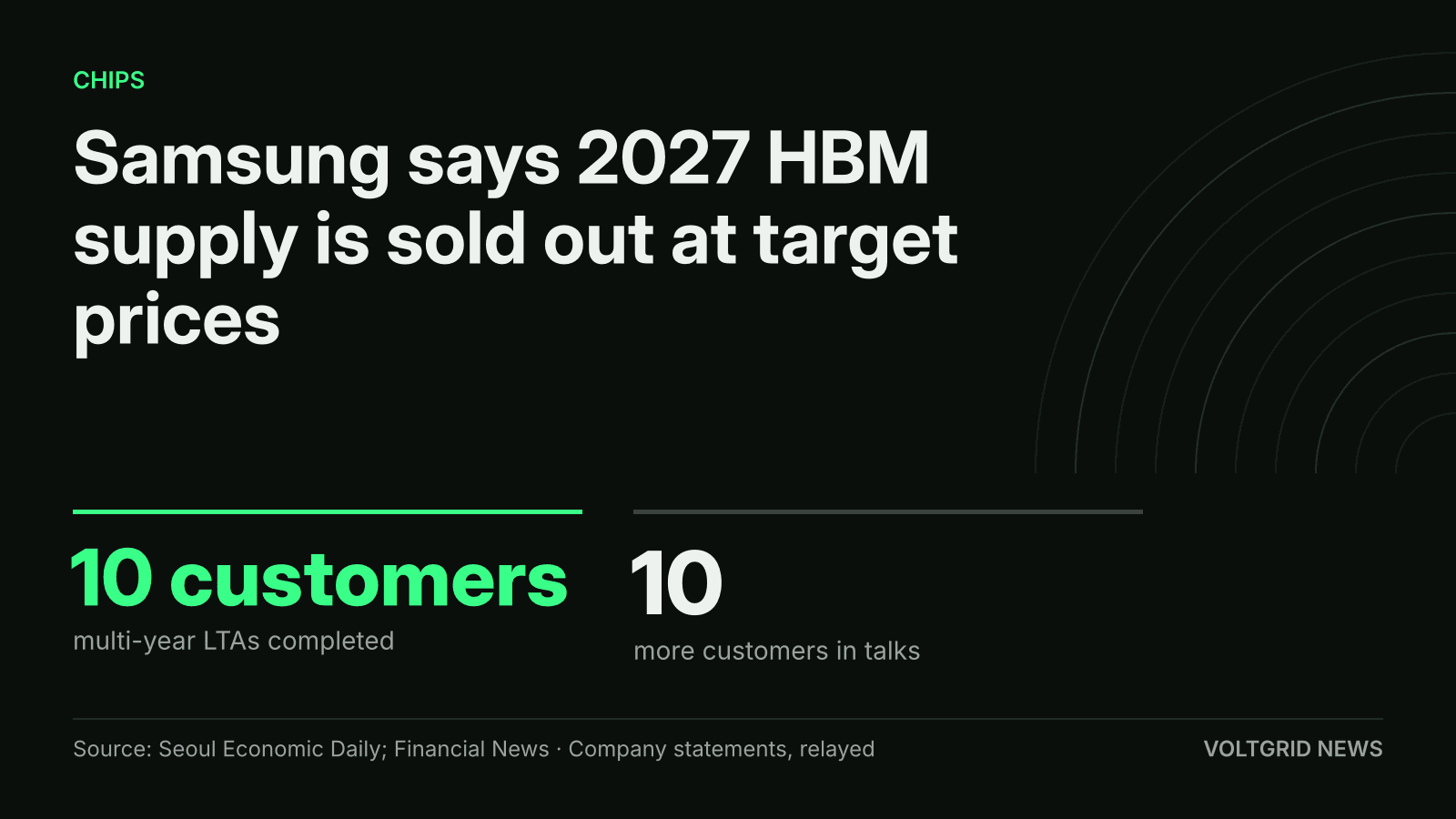
Samsung said on its Oct. 29 call that 10 customers have completed multi-year LTAs, as relayed by Korean press.
Illustration (AI-generated)
Samsung Electronics said on its third-quarter earnings call on Oct. 29 that its planned high-bandwidth memory (HBM) supply for next year is sold out at its target prices, and that it has completed multi-year long-term agreements (LTAs) with 10 large customers, according to Seoul Economic Daily and Financial News.
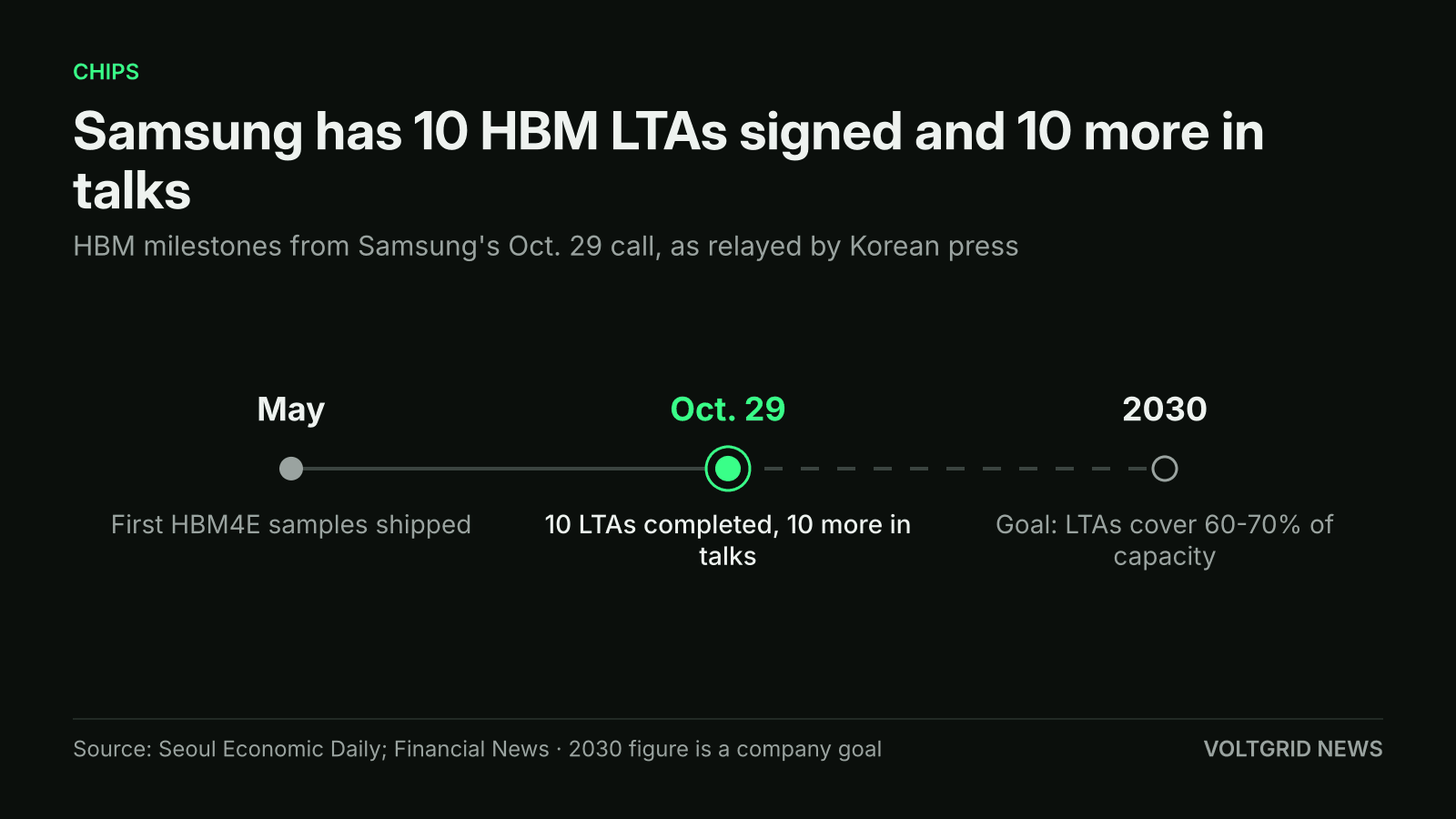
Samsung's Oct. 29 call put 10 completed HBM LTAs and 10 more in talks on the record, Korean press reported.
Illustration (AI-generated)
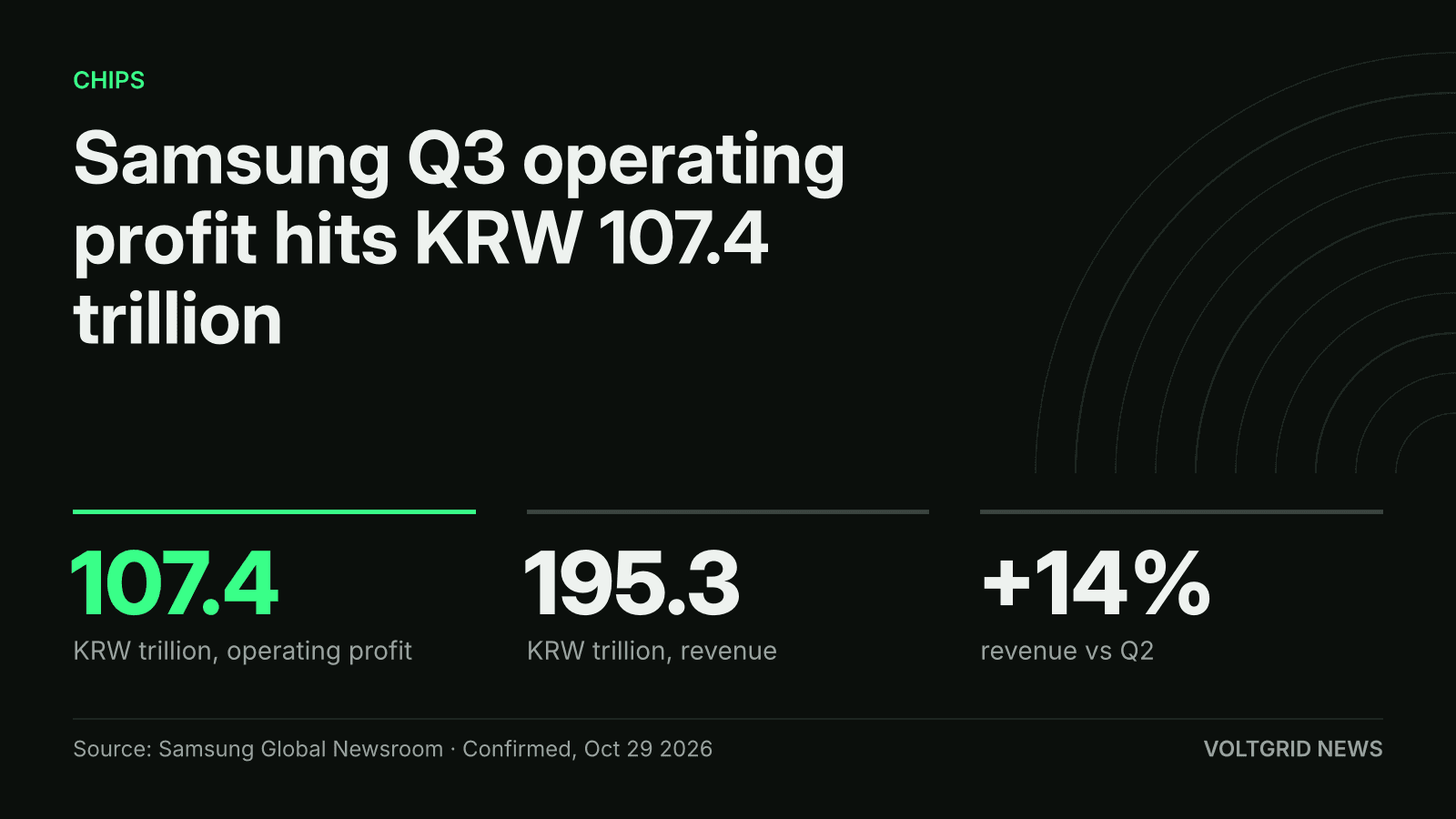
That is new since Voltgrid's report on Samsung's Q3 results, which was based on the company's results release, also dated Oct. 29. That release reported KRW 107.4 trillion in operating profit but gave no HBM revenue figure and no supply terms. The call adds the contract and HBM4 detail below, all of it from Samsung executives as relayed by Korean business press, not from a filing.
Financial News reported that Samsung is negotiating LTAs with 10 more customers, some of them at a final stage. It said Samsung's goal is for LTAs to cover 60% to 70% of its production capacity by 2030. Seoul Economic Daily reported that pricing talks for next year's HBM are complete at target levels and that major customers are still asking for more volume.
For data-center planners the contract detail matters more than the quarter. Accelerator and server volumes depend on memory supply, and a sold-out year with customers asking for more means HBM allocation, not only GPU or ASIC supply, sets how fast capacity can be filled in 2027.
HBM4 Sales and Market Share
Financial News reported that Samsung's HBM4 revenue more than tripled from the second quarter and that HBM4 now makes up about 60% of its HBM revenue. Seoul Economic Daily worded it as a goal, saying Samsung aims to raise HBM4 to 60% to 70% of HBM revenue. The two reports do not match exactly, and Samsung's own figures were not available for this report.
Both outlets said Samsung told investors it reached its goal of an HBM market share equal to its overall DRAM share in the third quarter. Financial News put that at about 40%, its own estimate based on Counterpoint Research's 38% DRAM share for the second quarter. This fits the Bernstein estimate that Samsung led Q3 HBM revenue at $8.7 billion, which remains an outside estimate and not a Samsung result.
Samsung also said it shipped the first HBM4E samples in May and has had positive early feedback from customers, according to both reports. Neither gave a mass-production date for HBM4E. Samsung's Pyeongtaek fab restart, reported earlier this month, is the capacity side of the same race with SK hynix.
Outlook for 2027
Financial News reported that Samsung expects some softness in mobile and PC demand next year, offset by higher data-center spending from major hyperscalers. It also expects its Device Solutions division, which holds the chip businesses, to post earnings growth above 2026's.
What is not confirmed yet
The call remarks reach us through Korean press summaries, and the customers behind the 10 signed LTAs are not named. Pricing terms, contracted volumes and the HBM4 revenue share have not been published by Samsung in a filing. The 60% to 70% LTA coverage is a 2030 goal, not a current share of capacity.