NVIDIA Hugging Face $12.93B Deal Reportedly Draws DOJ Questions
The Justice Department has asked how NVIDIA's Hugging Face purchase would affect AI competition, Reuters reports, as a wider conduct probe continues. No action is announced; NVIDIA expects a close in H1 2027.
2 min readAI-assisted

NVIDIA's own artwork for its Hugging Face announcement. It is a logo graphic, not a photo of the companies' sites.
Image: NVIDIA
Source · Press image from the NVIDIA newsroom, used for news reporting.
The US Justice Department has made inquiries about how NVIDIA's $12.93 billion Hugging Face acquisition would affect competition in artificial intelligence, Reuters reported on Oct. 28, citing two people familiar with the matter.
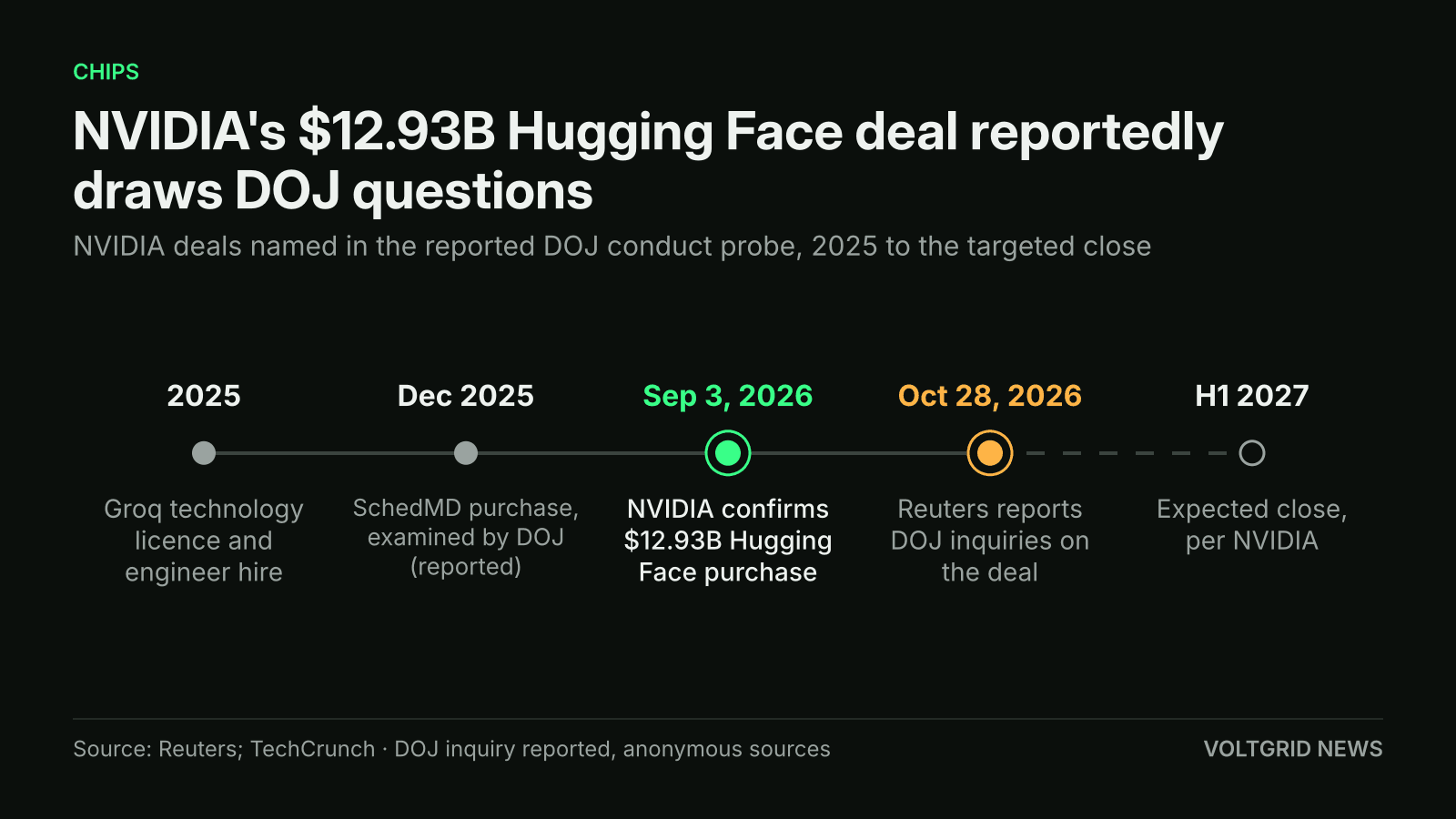
DOJ inquiries on the Hugging Face deal were reported on Oct. 28, 2026; NVIDIA expects to close in H1 2027, per Reuters and TechCrunch.
Illustration (AI-generated)
According to Reuters, officials have asked whether the acquisition would let NVIDIA "capture a fundamental distribution point for AI." They have also asked how NVIDIA might use the platform to harm rivals or gain leverage, and they are asking questions about Hugging Face's competitors. NVIDIA and the Justice Department declined to comment, and Hugging Face did not respond to Reuters. NVIDIA has said the deal is expected to close in the first half of 2027.
The questions sit inside a broader, years-long review of NVIDIA's conduct that Reuters says began under former President Joe Biden and has continued under President Donald Trump. Its recent questioning covers NVIDIA's acquisitions, investments, sales practices and whether the company has pressured customers. Reuters notes that government investigations are not evidence of wrongdoing, that the probe may not result in any Justice Department action, and that there is no indication President Trump has any involvement.
What the Justice Department is reportedly examining
Reuters says the department has looked at NVIDIA's December 2025 purchase of SchedMD, a purchase that raised worries among AI specialists about access to its open-source supercomputer software, and at its acquisition of Run:ai, which makes software that helps AI chips run more efficiently. Both are described as part of the conduct probe, not as separate cases.
The report also covers NVIDIA's 2025 deal to license technology from chip startup Groq and hire its engineers. Reuters says officials have explored whether NVIDIA offered larger allocations of AI chips to customers that bought its networking equipment and Groq processors. For buyers planning data-center capacity, that is the part with direct supply consequences, because allocation terms decide who receives accelerators and when.
The deal NVIDIA announced
NVIDIA confirmed the Hugging Face purchase on Sept. 3, according to TechCrunch. Hugging Face hosts three million models, and its platform is used by more than 18 million developers, per the same report. In a blog post, NVIDIA CEO Jensen Huang said Hugging Face "will remain an open platform for the entire AI ecosystem" and that NVIDIA compute will not be required to build on or deploy through it.
That promise is what the Justice Department's questions appear to test. Owning a main place where open models are shared is a different kind of position from selling the chips, which is the distinction the reported questions turn on. Voltgrid has followed how far NVIDIA's reach now extends, from its $3 billion stake in Meta's equity offering to Dell's first Groq 3 LPU rack, which builds on the Groq technology now under scrutiny.
What is not confirmed yet
Reuters names no formal Justice Department action, and the report does not say a second request or a merger challenge has been filed. The two sources are anonymous, and neither NVIDIA nor the department has described the scope of the inquiry. The Justice Department spokesperson told Reuters that it would be inappropriate to conduct a merger investigation under the guise of a conduct investigation. The next signals to watch are any formal merger review of the Hugging Face deal and whether NVIDIA changes its stated commitments on openness before the targeted first-half 2027 close.