Samsung Electro-Mechanics Q3 Profit Rises 165% to KRW 691B, a Record
Samsung Electro-Mechanics posted record Q3 revenue of KRW 3.7633 trillion, with AI server MLCCs and chip substrates driving growth, The Elec reported. Its substrate unit grew 58% on the year.
2 min readAI-assisted
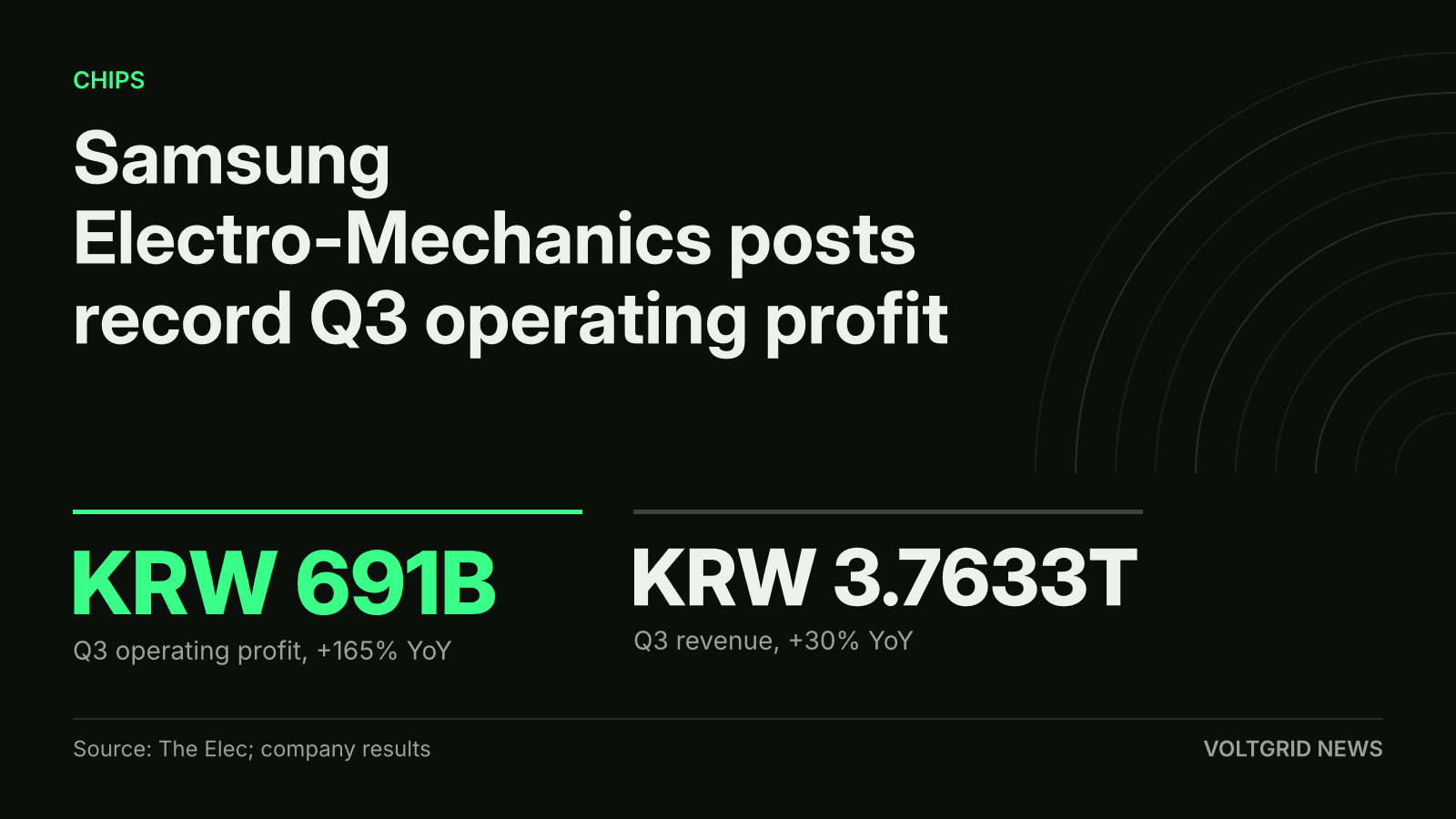
Samsung Electro-Mechanics reported record Q3 operating profit of KRW 691B on revenue of KRW 3.7633T, according to The Elec.
Illustration (AI-generated)
Samsung Electro-Mechanics posted record third-quarter results announced on Oct. 28, with consolidated revenue of KRW 3.7633 trillion, up 30% from a year earlier, and operating profit of KRW 691 billion, up 165%, The Elec reported on Oct. 29.
Both figures are company records, according to The Elec. Revenue passed the previous high of KRW 3.4571 trillion set in the second quarter of 2026, and operating profit passed the KRW 455.8 billion peak of the third quarter of 2021. The Elec said operating profit also beat the analyst consensus of KRW 645.3 billion.
The results show where AI demand is landing in the supply chain beyond GPUs and memory: in the passive components and substrates that every accelerator board and server needs. Voltgrid News reported earlier on NVIDIA's substrate supply plan, which added Samsung Electro-Mechanics as a supplier.
MLCCs and Substrates Drive Growth
The Component Solution unit, which makes multilayer ceramic capacitors (MLCCs), had revenue of KRW 1.883 trillion, up 36%, The Elec reported. The company attributed the growth to AI data-center products, including servers, networking equipment and power systems. It said rising server GPU specifications are pushing up MLCC demand, and that the capacitance required is more than doubling each year. That is a company claim, and The Elec gave no baseline.
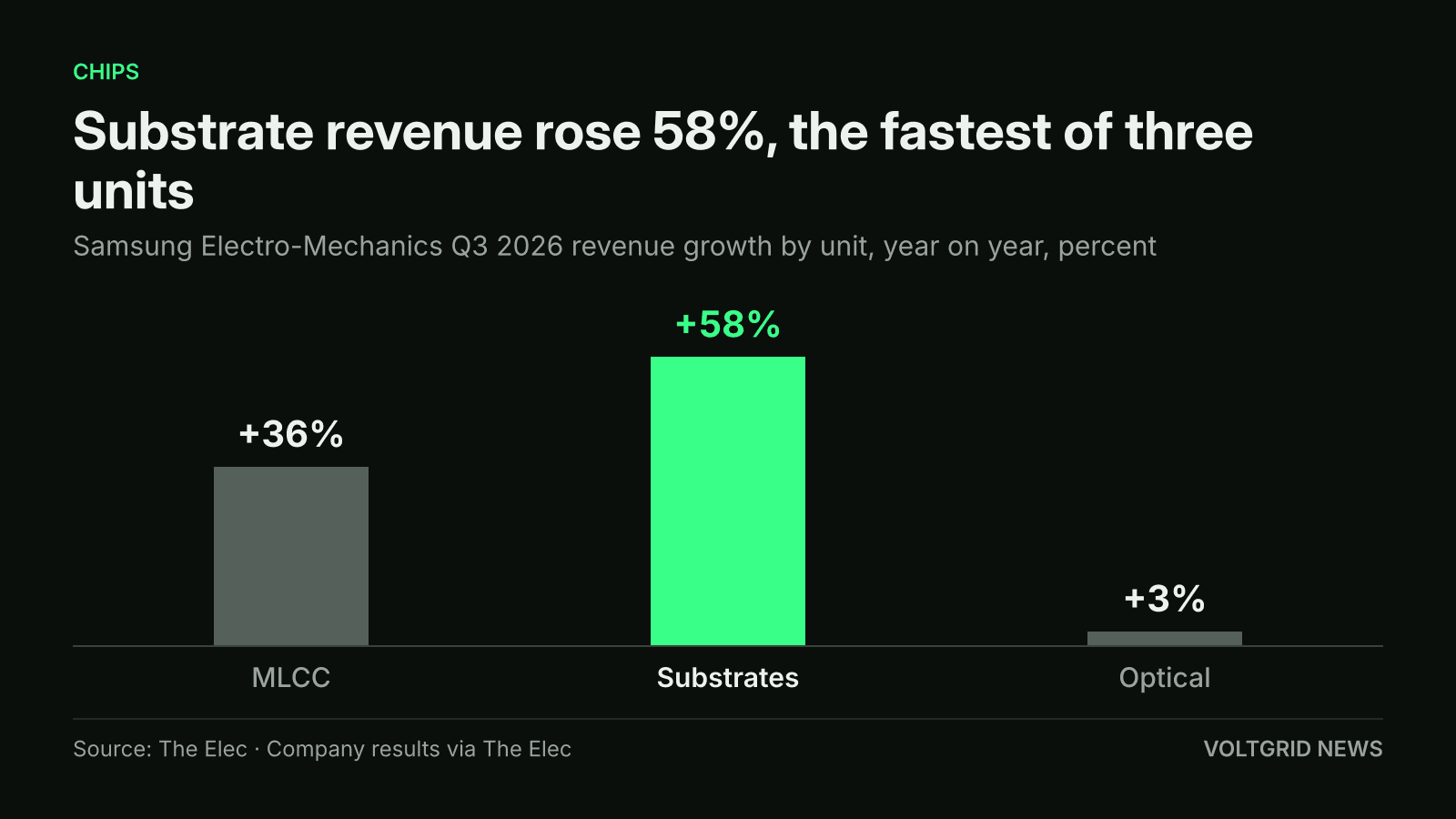
Package Solution (substrates) revenue grew 58% year on year, the fastest of the three units, according to The Elec.
Illustration (AI-generated)
The Package Solution unit, which makes substrates, had revenue of KRW 939 billion, up 58%. The company cited supply of server CPU, AI accelerator and networking substrates, along with high-performance substrates for driver-assistance and autonomous driving. The Optical Solution unit, which makes camera modules, had revenue of KRW 941.3 billion, up 3%, on foldable-phone and automotive demand.
Package Solution grew faster than any other unit this quarter. The article does not break out AI accelerator substrates on their own.
Capacity and Contracts
In September, the company announced a KRW 6.78 trillion investment to expand flip-chip ball grid array (FC-BGA) substrate capacity, mainly at its Sejong and Vietnam sites, according to The Elec. The company also said it will respond to long-term supply agreements (LTAs) for MLCCs with major customers, without naming them.
For the fourth quarter, the company expects strong performance to continue on AI data-center and automotive demand. It plans to begin mass production of camera modules for customers' next-generation flagship devices, and to expand supply for autonomous driving and humanoid robots.
What is not confirmed yet
The Elec's report does not give the size of the LTAs, the customers or the share of MLCC sales they cover. It also does not say when the FC-BGA expansion starts producing, so the effect on substrate supply is not yet measurable. The consensus comparison is The Elec's.