AMD Q4 Guidance of $17 Billion Is a Helios Bet, Inventory Up 35%
AMD guided Q4 to about $17 billion after record Q3 revenue of $13.4 billion, with Data Center at $8.5 billion. Inventories rose 35% and free cash flow fell as it builds ahead for Helios and Venice.
Hardware & Analysis DeskEdited by Ege Erten
5 min readAI-assisted
Follows our story: AMD, Talen, Vistra Earnings Nov 3-6: AI Hardware and Energy Week Ahead
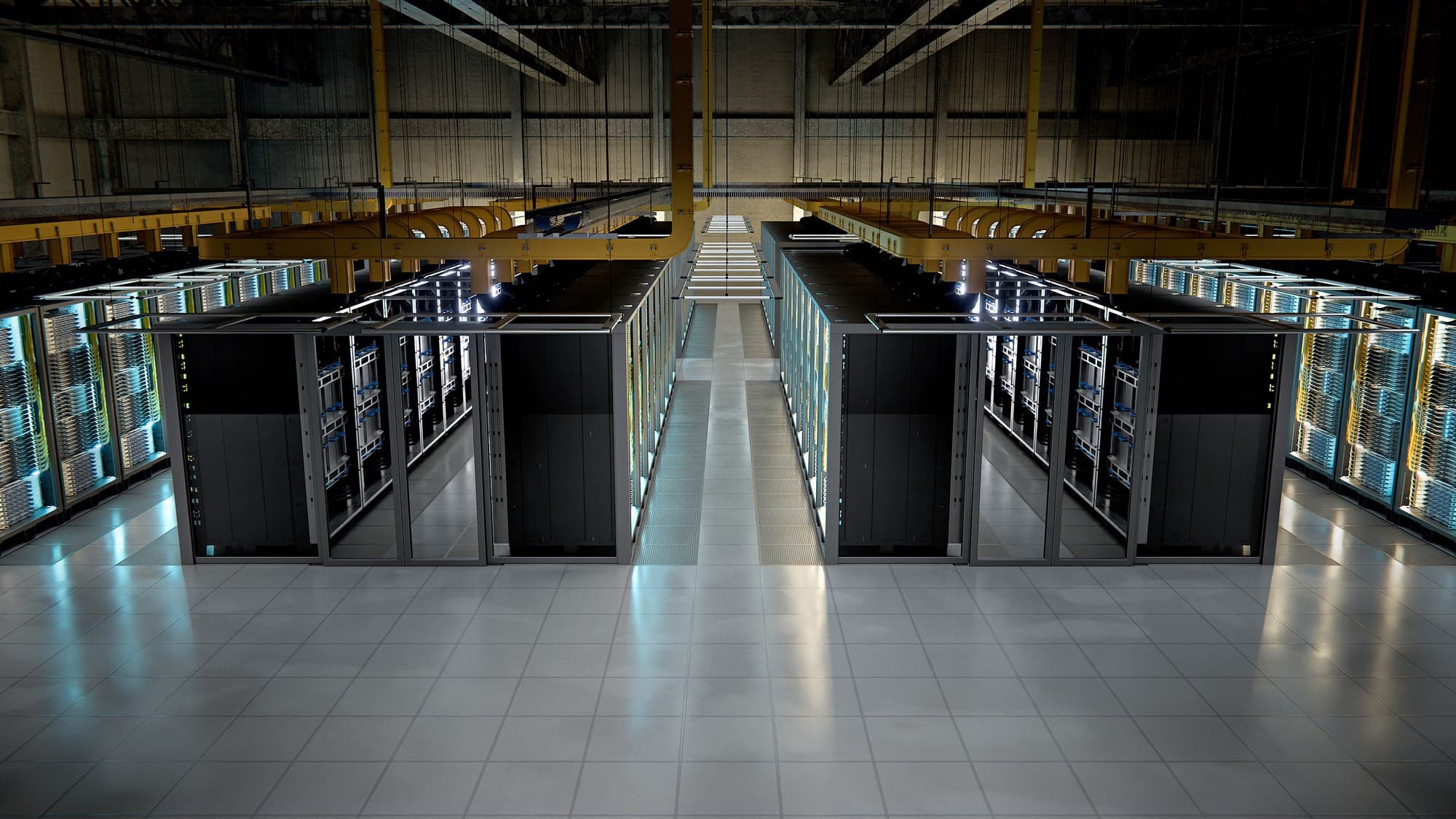
AMD Helios rackscale solution, launched at Advancing AI 2026, the system AMD's fourth-quarter outlook leans on.
Image: AMD
Source · Press image from the AMD newsroom, used for news reporting.
AMD's fourth-quarter 2026 revenue guidance is about $17 billion, plus or minus 3%, after the company reported record third-quarter revenue of $13.4 billion on Nov. 3. The release ties that guide to scaling Helios and Venice, which makes it, in our reading, largely a bet on those two, and AMD has already put its balance sheet behind it.
What happened
Revenue for the quarter ended Sept. 26 was $13,377 million, up 45% from a year earlier and 16% from the second quarter, AMD said in its earnings release. Chair and CEO Lisa Su said revenue came in above the high end of the company's guidance. Non-GAAP gross margin was 56% and non-GAAP earnings per share rose 74% to $2.09; on a GAAP basis, gross margin was 54% and diluted EPS was $1.46.
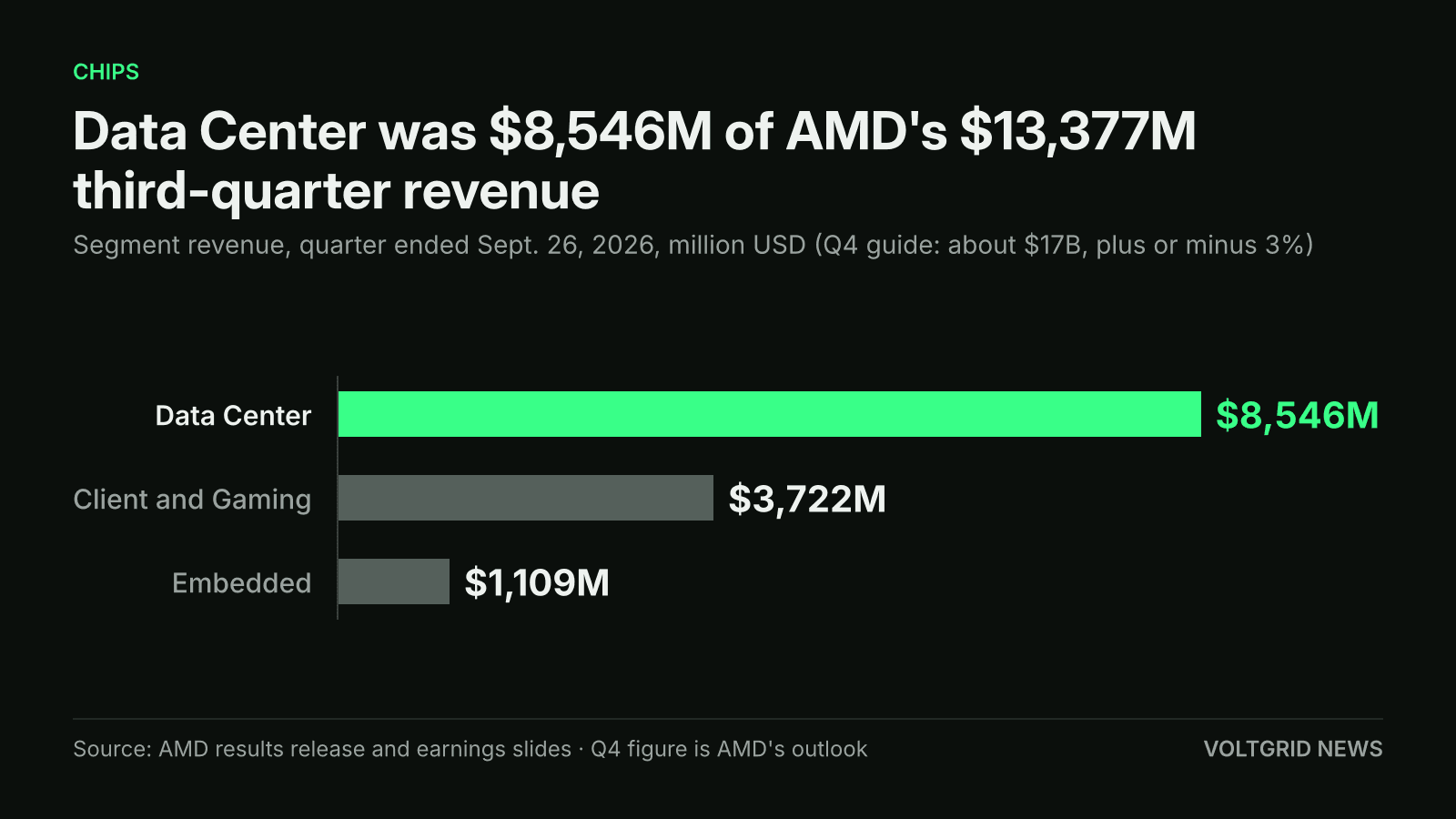
Data Center was $8,546M of AMD's $13,377M quarterly revenue; AMD guides fourth-quarter revenue to about $17B, plus or minus 3%.
Illustration (AI-generated)
The Data Center segment, which holds Instinct accelerators and EPYC server processors, brought in a record $8,546 million, up 97% from $4,341 million a year earlier. AMD credited EPYC demand and the launch of its Instinct MI450 Series GPUs. Segment operating income rose 168% to $2,882 million, and its operating margin widened to 34% from 25%, according to the earnings slides.
The rest of the company moved less. Client and Gaming revenue fell 8% to $3.7 billion: the Client business grew 7% to $2.9 billion on Ryzen mobile processors, while Gaming dropped 40% to $773 million on lower semi-custom console chip and Radeon graphics sales. That segment's operating income fell to $573 million from $867 million. Embedded revenue rose 29% to $1.1 billion.
For the fourth quarter, AMD said the midpoint of its range is about 66% above the year-earlier quarter and about 27% above the third quarter, with non-GAAP gross margin of about 55%, a point below the third quarter. Su tied the acceleration to scaling production of Helios and "Venice", the 6th Gen EPYC server CPU that AMD says is built on TSMC's 2 nm process.
Why the guide is a Helios bet
Helios is AMD's first rack-scale reference design: 18 compute trays holding 72 Instinct MI455X GPUs and 18 Venice CPUs, plus 6 switch trays, in one liquid-cooled rack, according to AMD's product brochure, which the company sets against NVIDIA's Vera Rubin NVL72. The Q3 release names the MI450 Series; MI455X is the Helios part in the brochure. Because partners build Helios into full racks, each order carries GPUs, CPUs and networking together, and in our reading a few deployments can move a company-wide guide. AMD said Anthropic, Meta, Microsoft, OpenAI and Oracle Cloud Infrastructure are running models and workloads on the first Helios systems, and that HPE will supply the first Helios by HPE systems to Vultr. Those are AMD's statements, and the release gives no deployment sizes.
The segment numbers point the same way. Data Center earned $2,882 million in operating income in the quarter; Client and Gaming earned $573 million and Embedded $453 million. The CFO, Jean Hu, said the fourth-quarter outlook is driven by Data Center demand. If the guide holds, AMD names Helios and Venice as the drivers of the step from $13.4 billion to about $17 billion, and Client and Gaming shrank year on year, so the increase most likely comes largely from them.
The balance sheet suggests AMD has built ahead of that ramp. Inventories rose 35% in one quarter, to $11,463 million from $8,468 million, the slides show. Free cash flow fell to $554 million from $1,558 million in the second quarter and $1,530 million a year earlier. Total debt more than doubled to $7,079 million after a $4.75 billion senior-note issue in August, while cash and short-term investments reached a record $15.8 billion. AMD did not explain the inventory build in the release; parts and finished racks staged for fourth-quarter Helios shipments would fit the pattern, but that is an inference, not a company statement.
Why a 72-GPU Rack Changes the Order
A rack-scale system makes dozens of accelerators work as one machine. In Helios, AMD says, 72 MI455X GPUs share one scale-up domain over UALink over Ethernet, with 260 TB/s of aggregate scale-up bandwidth and 31 TB of HBM4 memory per rack. A model too large for one GPU's 432 GB can be spread across the rack without leaving it.
That changes what a customer buys. AMD describes Helios as a reference design that partners build into systems, so one order carries GPUs, CPUs, switch trays and networking together, in a liquid-cooled rack.
The case against
The alternative reading is that AMD is still two businesses and the client one is doing well on its own. AMD's Client revenue grew 7% in the same quarter that Intel's Client Computing and Physical AI Group fell 5% to $8.1 billion, and Intel's CFO said he expects the PC slowdown to continue through the first half of 2027, in his words "at least", as Voltgrid reported on Oct. 29. Gaining ground in a shrinking, memory-constrained PC market is a real result, and AMD also said its Ryzen AI Halo platform with Ryzen AI Max PRO 400 Series processors is now on sale.
The inventory build can also be read as risk rather than readiness. A 35% quarterly jump in inventory, falling free cash flow and new debt mean that if Helios acceptance or customer timing slips, the costs arrive before the revenue. A named customer list is not a backlog figure, and AMD gave none in the release. AMD did not say why it expects gross margin to ease to about 55%.
What it means for NVIDIA, Intel and buyers
For NVIDIA, the release says Helios is running at several large AI labs and clouds at once. On paper, AMD lists 23.3 TB/s and 432 GB of HBM4 per MI455X, while NVIDIA's October Vera Rubin NVL72 spec table lists 19.2 TB/s and 288 GB per Rubin GPU, down from "up to 22 TB/s" in July, as Voltgrid reported on Nov. 1; no independent benchmark of either rack has been published.
For Intel, AMD's server and client growth lands against a company that guided fourth-quarter revenue to $15.0 billion to $16.0 billion, below AMD's own guide. For data-center operators, a Helios ramp means a second supplier of liquid-cooled, 72-GPU racks of this kind (NVIDIA sells one too) when they negotiate with NVIDIA, though AMD has not published delivery volumes.
What to watch
AMD's conference call at 22:00 UTC on Nov. 3 may add the Instinct GPU revenue split, Helios unit volumes and the reason for the inventory build; this analysis does not draw on it. NVIDIA's fiscal third-quarter report is expected on Nov. 17. AMD's fourth-quarter report, due in early 2027, will show whether the $17 billion guide held and whether inventories converted to revenue. All figures here are AMD's own, from its release and slides, and Intel's from its Oct. 29 release; no recognized outlet's post-results report or consensus comparison was available at the time of writing, so this piece does not compare the results with analyst estimates.