DeepSeek V5 Reportedly Set for Huawei Ascend 950 Training in 2027
DeepSeek reportedly plans to train V5 mainly on Huawei Ascend 950 chips, per Caiwen News via TrendForce on Nov. 3. It would move Ascend beyond inference; neither company has confirmed.
Chips & Power DeskEdited by Ege Erten
2 min readAI-assisted
Follows our story: DeepSeek Adds Huawei Ascend Support in Six Repos, SemiAnalysis Says
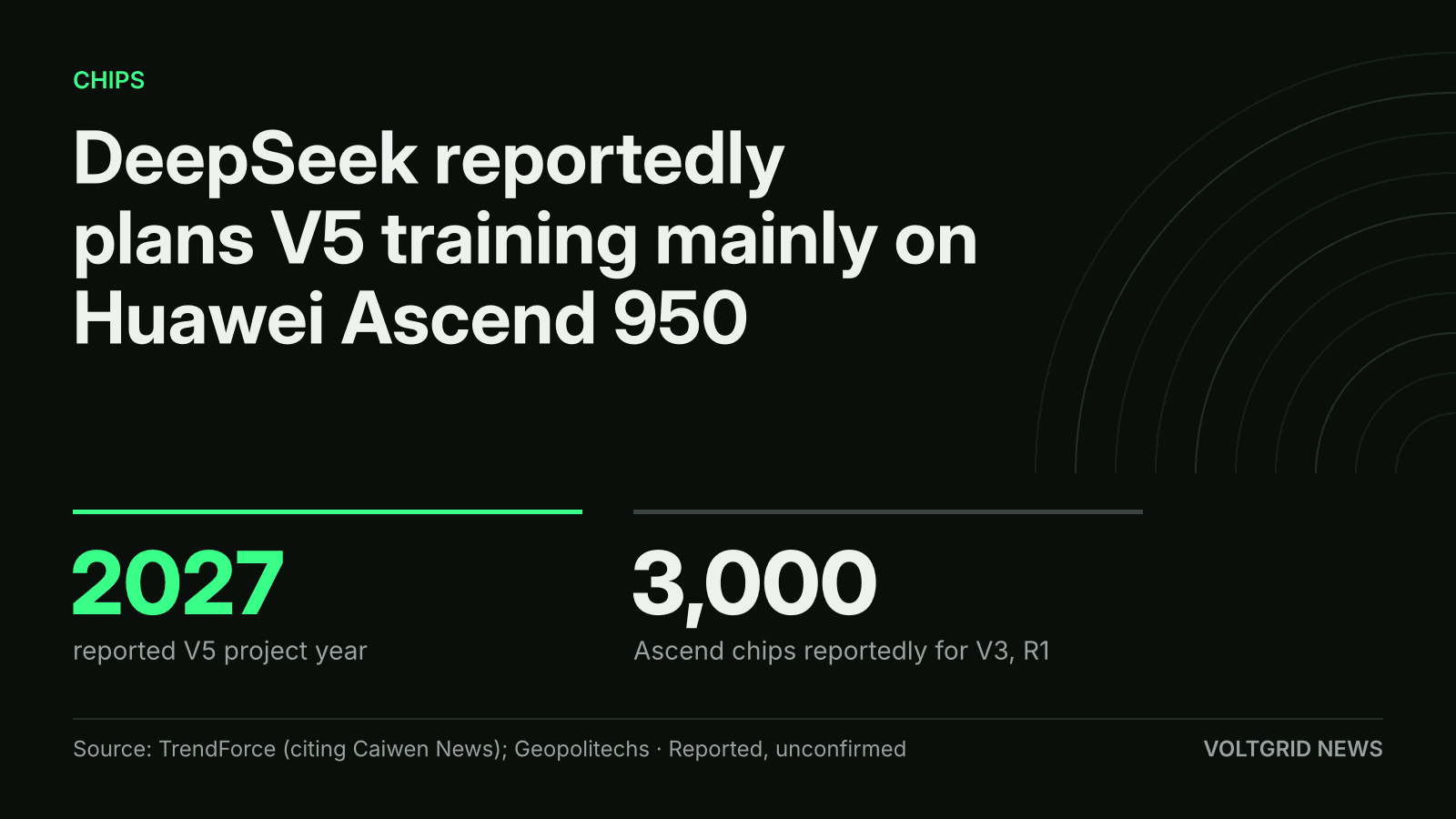
The report comes from Caiwen News via TrendForce and is not confirmed by DeepSeek or Huawei.
Illustration (AI-generated)
DeepSeek reportedly plans to train its V5 model mainly on Huawei Ascend 950 chips, a project expected in 2027, according to Caiwen News via TrendForce on Nov. 3. Neither DeepSeek nor Huawei has confirmed the report.
If the plan holds, it would move Ascend from inference into model training. According to Caiwen, Ascend chips have so far been used mainly for inference, and V5 could become DeepSeek's first large language model trained natively on Ascend 950. Geopolitechs, also citing multiple industry sources, reports a similar plan to pre-train V5 on Ascend and notes the report has not been independently confirmed.
The reported reason is supply. Caiwen's sources say US export restrictions limit DeepSeek's access to NVIDIA's latest high-end chips, and previously approved H-series GPUs are reportedly struggling to meet the training demands of models such as V4 and V5. Caiwen also says Ascend is DeepSeek's primary training platform, with no reported adoption of chips from other Chinese makers, including Moore Threads.
For capacity planners, the shift matters because training runs differ from inference serving: they occupy large clusters for long, continuous periods, so any Ascend capacity committed to V5 would be tied up for the duration. No chip count, cluster size or power figure has been reported, so the load cannot be sized yet.
How DeepSeek and Huawei Ascend Have Worked Together
The tie-up is not new. As Voltgrid reported on Oct. 22, DeepSeek added Ascend support in six code repositories, according to SemiAnalysis, a software step aimed at inference. Geopolitechs adds that Huawei reportedly deployed more than 3,000 Ascend chips for DeepSeek V3 and R1 on Huawei Cloud around the Chinese New Year of 2025, and that Huawei said after DeepSeek V4's April 2026 release that its Ascend SuperPoD systems could fully support the V4 family.
Geopolitechs also points to post-training: a research consortium in Shenzhen recently completed full-parameter post-training of DeepSeek V4-Pro, a 1.6-trillion-parameter model, on a cluster of Ascend 910C chips. That is post-training, not pre-training from scratch, which Geopolitechs calls considerably more demanding.
Caiwen's sources say Huawei holds no stake in DeepSeek. The cooperation is limited to products, computing resources and technical optimization, even as market chatter points to new DeepSeek funding and a possible IPO.
Huawei Ascend Roadmap: 960DT Due in 2027
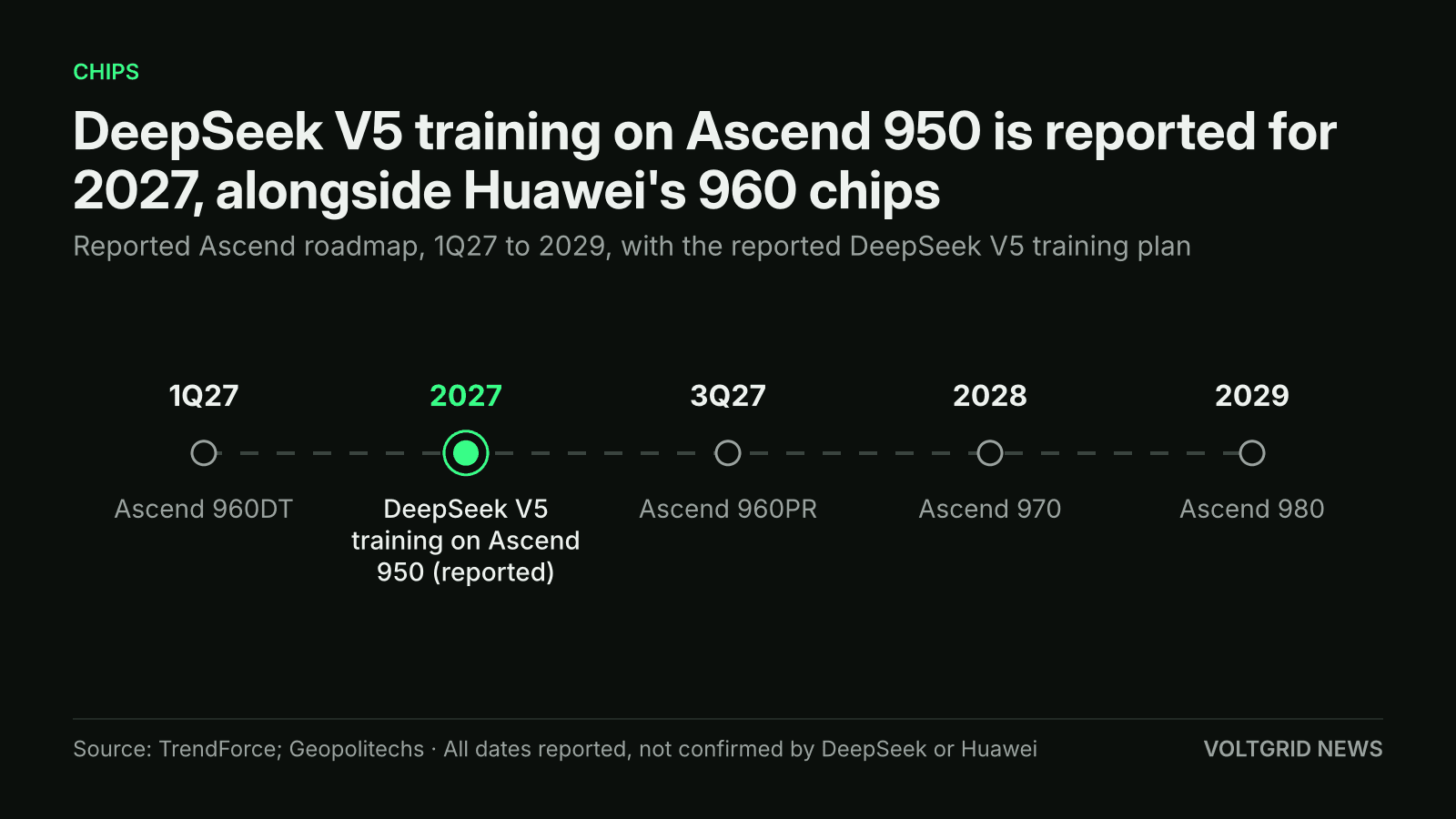
Reported dates for Huawei's Ascend roadmap and the DeepSeek V5 plan, per TrendForce and Geopolitechs; neither company has confirmed.
Illustration (AI-generated)
The timing lines up with Huawei's schedule. Citing Huawei Rotating Chairman David Wang, TrendForce reported that the Ascend 960DT is now expected in the first quarter of 2027, three quarters ahead of plan. The Ascend 960PR is reported for the third quarter of 2027, one quarter early, followed by the Ascend 970 in 2028 and the 980 in 2029.
What Neither DeepSeek Nor Huawei Has Confirmed
Neither DeepSeek nor Huawei has commented on the V5 plan. According to Caiwen, V5 is still in a selection phase, and its specifications, capabilities and launch date are undisclosed; a 2027 release depends on training progress. The reports rely on unnamed industry sources, and Geopolitechs says the plan's technical and commercial viability will depend on training stability, cluster performance and software maturity. Other outlets on Nov. 3 gave different timing and chip counts, drawn from social-media posts and unnamed sources; Voltgrid has not verified them and does not use them here.