SambaNova SN50 Inference Systems: Supermicro Plans 10,000 Chips
Supermicro will build, sell and support SambaNova SN50 inference systems paired with NVIDIA GPUs, starting with neoclouds. The Nov. 3 release gives no rack power, cooling, price or ship date.
Chips & Power DeskEdited by Ege Erten
3 min readAI-assisted

The SambaNova SN50 RDU, shown on the company's SN50 launch graphic; the image is not a Supermicro system.
Image: SambaNova
Source · Press image from the SambaNova newsroom, used for news reporting.
SambaNova said on Nov. 3, 2026 that Supermicro will build, sell and support SambaNova SN50 inference systems that pair the chips with NVIDIA GPUs, with an initial plan for 10,000 SN50 chips.
The release, distributed by Business Wire, calls it a strategic collaboration. Supermicro will integrate, test, deliver and support the systems, including on-site service, while SambaNova engineers get models running on SN50 and help with deployments. The companies will start with neoclouds (GPU-cloud operators) and sovereign clouds, then move to enterprises that run AI in their own data centers. Securities.io describes the rollout as phased and notes that no pricing, contract value or revenue expectation was disclosed.
The 10,000 figure is an initial plan for chips, not an order, a shipment or a rack count. The Nov. 3 release gives no chips-per-rack figure for the Supermicro systems. SambaNova's own SambaRack SN50 combines 16 SN50 chips, the company said in February, but Supermicro's configuration has not been published, so Voltgrid does not turn 10,000 chips into a rack count.
Supermicro Rack Power and Cooling Are Unpublished
The design splits inference in two. NVIDIA GPUs run prefill, the compute-bound step that reads the prompt. SN50 chips run decode, the memory-bound step that writes the answer one token at a time. SambaNova says agentic workloads spend most of their time in decode.
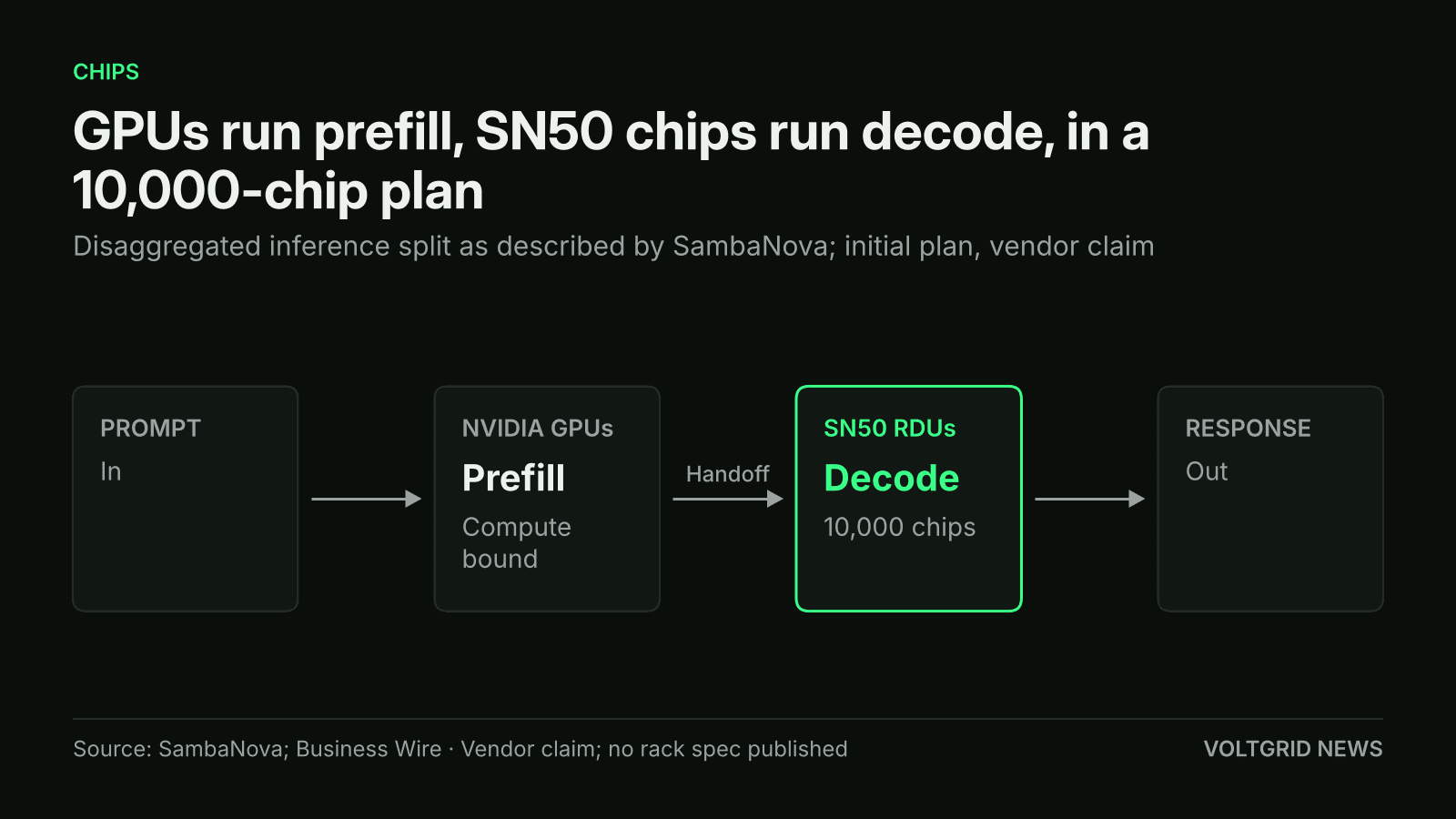
SambaNova describes GPUs handling prefill and SN50 chips handling decode; the 10,000-chip figure is an initial plan.
Illustration (AI-generated)
The pitch to operators is capacity without a new building. The release says SN50 serves large models without extreme rack power density, which makes it easier to deploy in existing data centers, and that operators can add inference capacity without waiting for build-outs constrained by power and cooling. SambaNova also says the approach extends the useful life of GPUs customers already own. These are vendor statements. No rack power in kilowatts and no cooling method has been published for the Supermicro-built systems.
SambaNova has published a figure for its own SN50 rack: in February it said a SambaRack SN50 averages 20 kW and operates in existing air-cooled data centers. Its previous-generation SN40-powered SambaRack was listed at 10 kW average, also air-cooled. Both are SambaNova's figures for its own racks, not for the Supermicro systems.
Why Decode Needs Memory, Not Just Compute
Decode writes an answer one token at a time, and each token re-reads the model's weights, so the chip waits on memory more than on arithmetic. That is the case SambaNova makes for a dataflow chip with large memory close to the compute, and for a modest power budget per rack rather than the densest GPU racks.
SN50 is SambaNova's fifth-generation Reconfigurable Dataflow Unit (RDU). According to SambaNova's datasheet, it is built on a TSMC 5 nm process and carries three memory tiers: 432 MB of on-chip SRAM, 64 GB of HBM2E (high-bandwidth memory) and DDR5 of up to 2 TB. Hot data stays in SRAM, larger pools sit further out. SambaNova says interconnected SambaRacks scale up to 256 SN50 accelerators.
SambaNova's performance claims date from its Feb. 24 launch, not from this announcement. It says SN50 has 5x the maximum speed of competitive chips and a 3x lower total cost of ownership than GPUs. The 5x rests on a Llama 3.3 70B FP8 test at 895 versus 184 tokens per second per user against NVIDIA's B200, citing SemiAnalysis InferenceX. Those are vendor claims, and the Nov. 3 release adds no new benchmark numbers.
What Is Not Confirmed: Price, Customers and Ship Date
Third-party inference silicon is arriving through server makers' catalogs. As Voltgrid reported, Dell launched its first Groq 3 LPU rack, the PowerEdge XE9810, due in Q1 2027. Supermicro's route differs in that the SN50 systems are meant to sit beside NVIDIA GPUs.
The Nov. 3 release names no customer, no price and no ship date for the Supermicro systems. At its February launch, SambaNova said SN50 would ship to customers later in 2026, with SoftBank Corp. as its first customer; that is a roadmap statement, and whether Supermicro-built systems follow that schedule is not stated. SambaNova expects the collaboration to bring significantly more high-performance inference capacity online in 2027 than would otherwise be possible, without giving a figure.
Watch for the Supermicro rack configuration, its power draw and cooling requirement, and the first named neocloud buyer. Those three details decide whether the existing-data-center claim holds for these systems.
Sources
- 01Supermicro to Deliver SambaNova AI Systems in Phased RolloutSecurities.io · securities.io
- 02SambaNova SN50 Chips to Power Supermicro's New Inference Racks, Delivering High-Performance Inference to Data Centers WorldwideGoogle News · Financial Times · news.google.com
- 03Supermicro Will Build and Sell SambaNova-Powered Inference SystemsSambaNova · sambanova.ai