AI Capex Ledger: Big Four Guide $720-740B for 2026, $1.02T Leases Pending
Alphabet, Microsoft, Amazon and Meta guide $720-740 billion of calendar-2026 capex, each defined differently; CoreWeave and Nebius add $64-66 billion, and the four disclose $1.02 trillion of leases not yet started.
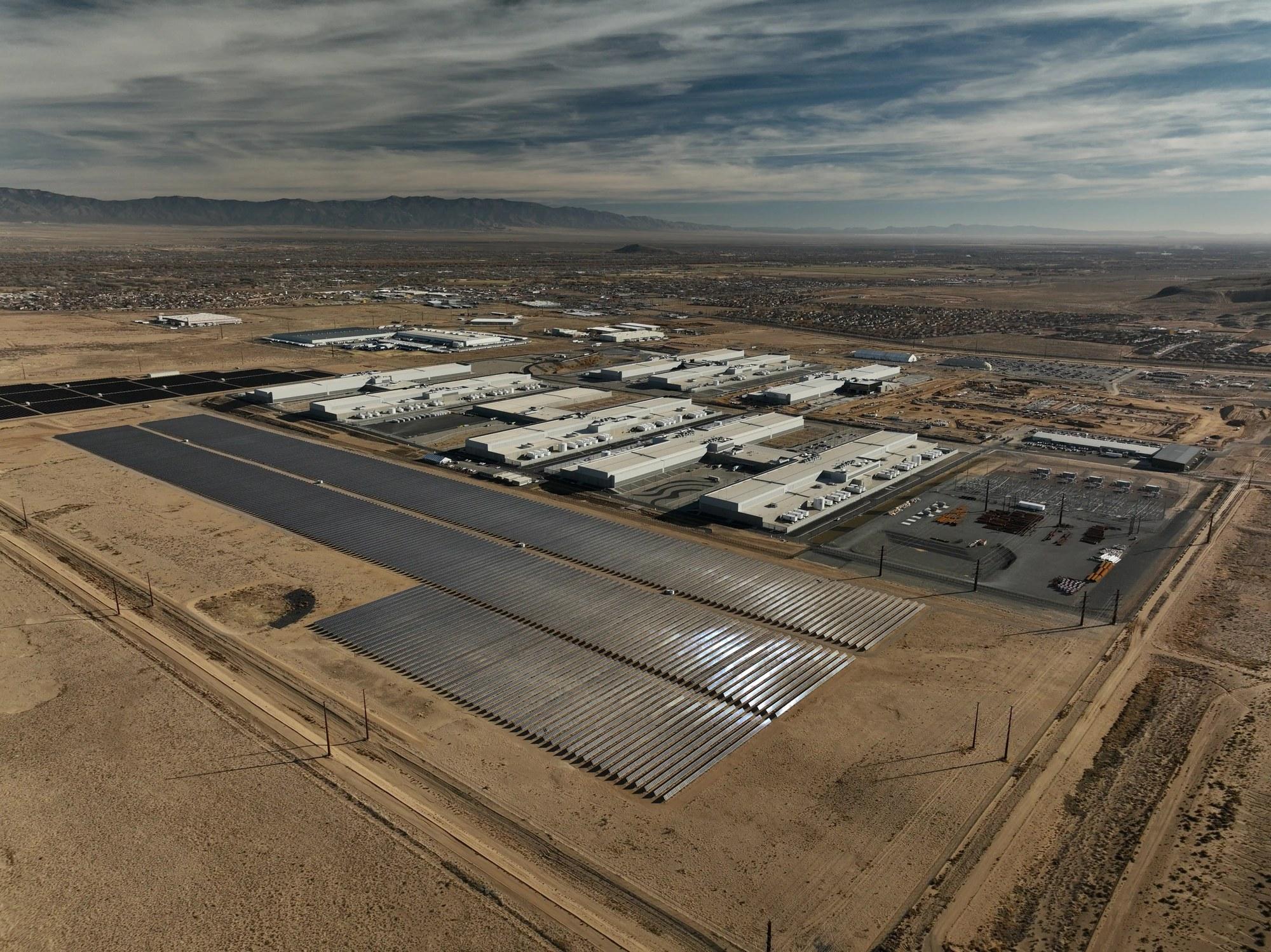
Meta's Los Lunas, New Mexico campus. Meta guides $135 billion to $145 billion of 2026 capex and reports $355.73 billion of leases not yet started.
Image: Meta
Source · Press image from the Meta Data Centers site, used for news reporting.
Alphabet, Microsoft, Amazon and Meta now guide to between $720 billion and $740 billion of calendar-2026 capital spending, by the companies' own third-quarter statements, and CoreWeave and Nebius add another $64 billion to $66 billion. The years match, but that headline sum mixes four different definitions of capex, and the larger exposure sits mostly outside it: the four hyperscalers disclose about $1.02 trillion of leases that have not yet started.
The five big spenders: guidance, definition and source
Alphabet told analysts on its Oct. 28 call that its 2026 capex range of $195 billion to $205 billion was unchanged, and that spending will "increase significantly" in 2027, according to the call transcript. Third-quarter capex was $51.4 billion, and Alphabet said about 65% of its technical-infrastructure spending went to servers and networking and 35% to data centers, as Voltgrid reported on Alphabet's quarter. Its 10-Q shows $131.95 billion spent through September, implying $63 billion to $73 billion in the fourth quarter (195 or 205, minus 131.95).
Microsoft's chief financial officer Amy Hood said on the Oct. 28 call that calendar-2026 spend should be about $170 billion, with more than $50 billion in the December quarter. In July she put it at about $175 billion, after Microsoft lengthened datacenter useful lives to 25 years, a change that moves more future leases from finance leases, which count as capex, to operating leases, which do not. Microsoft's capex line includes finance leases: the September quarter was $45.2 billion, of which finance leases were $7.4 billion, while cash paid for property and equipment was $39.4 billion, the number behind Voltgrid's earlier report that capex doubled.
Amazon's Oct. 29 release says it continues to expect 2026 cash capital expenditures of about $220 billion, a measure that leaves out finance leases. Its 10-Q shows $172.2 billion of purchases net of proceeds through nine months, so the fourth quarter implies about $47.8 billion (220 minus 172.2, Voltgrid arithmetic), below the $75.9 billion of the third quarter. Meta guides $135 billion to $145 billion, including principal payments on finance leases, narrowed from $130 billion to $145 billion in its Oct. 21 results release, filed with the SEC, with $34.9 billion spent in the third quarter. On that basis it has spent $85.8 billion through September ($83.06 billion plus $2.77 billion of finance-lease principal), implying $49 billion to $59 billion in the fourth quarter (135 or 145, minus 85.8).
Amazon guides the most, about $220 billion; the four hyperscalers' ranges sum to $720-740 billion on different capex definitions.
Voltgrid News
Illustration (AI-generated)
Capital expenditure, or capex, is what a company spends on long-lived assets such as servers, chips and buildings, and companies count it differently. Alphabet and Amazon report cash paid for equipment, Amazon net of sale proceeds and incentives. Meta adds the principal it repays on finance leases. Microsoft books a finance lease's full value as capex the day the lease starts and leaves operating leases out. The same leased data hall can count as capex at one company and not at another, so the four figures add up only to a rough scale.
Oracle is the outlier on timing. Its fiscal year ends May 31, so its $90 billion to $95 billion gross capex outlook for fiscal 2027 covers June 2026 to May 2027, and net cash capex after customer prepayments is not expected to exceed $70 billion, MarketBeat reported from the Sept. 10 call; Oracle's own filings give no range. Its 10-Q confirms $28.5 billion of capex in the quarter to Aug. 31. We leave Oracle out of the calendar-year total; adding it would give $810 billion to $835 billion on mixed years. J.P. Morgan estimates the five largest U.S. hyperscalers, which it does not name, will spend $697 billion in 2026, below the four companies' own $720-740 billion, a sign of how much definitions differ.
Neoclouds: larger bills on thinner balance sheets
CoreWeave, in its Nov. 10 release, raised the low end of 2026 capex to $37 billion to $39 billion, from $35 billion to $39 billion, and said it expects about $9 billion of customer prepayments and deposits over the next three months. It reports 1.7 GW of active power against 4.6 GW contracted, about 37% (1.7 divided by 4.6), as Voltgrid covered.
Nebius said on Nov. 12 that it now expects about $27 billion of 2026 capex, up from $20 billion to $25 billion, and a first 2027 outlook of $40 billion to $45 billion, with prepayments and asset-backed financing expected to cover 75% to 85% of the 2027 figure. Nebius did not say whether the $27 billion includes finance leases, per our Nebius report. CoreWeave and Nebius together come to $64 billion to $66 billion, about 9% of the four hyperscalers' range (64 divided by 740, and 66 divided by 720).
Guidance moved both ways this autumn: Nebius lifted its 2026 capex to about $27 billion while Microsoft trimmed its calendar-2026 figure to about $170 billion.
Voltgrid News
Illustration (AI-generated)
IREN is smaller and on a June fiscal year. Its Nov. 5 results release, as distributed by GlobeNewswire, lists $15 billion of remaining planned fiscal-2027 capex, $9 billion met by cash, committed GPU financing and prepayments and $6 billion still a target subject to markets. It also moved its more than $4 billion annualized recurring revenue target to January 2027, as Voltgrid reported. That $15 billion is a remainder, not a full-year guide, so we exclude it from the total.
Who carries the risk: $1.02 trillion of leases not yet started
Capex is the visible half. The other half is "leases not yet commenced": agreed payments for buildings, power and capacity that start to count on the balance sheet only when the site is handed over. Microsoft's 10-Q shows $364.6 billion, primarily datacenters, commencing between fiscal 2027 and 2034, with some arrangements subject to contractual conditions being met. Meta reports $355.73 billion, starting between the rest of 2026 and 2036. Amazon lists $164.9 billion, and Alphabet's 10-Q $130.5 billion, primarily data centers and energy infrastructure, starting between 2026 and 2031. The sum is about $1.02 trillion ($364.6 billion plus $355.73 billion plus $164.9 billion plus $130.5 billion). Alphabet also told analysts of $152 billion of pre-commencement leases and other obligations, a wider measure. The figures are undiscounted, defined differently and include non-data-center items, so treat the sum as scale, not a liability. Part of it will reach future capex as Microsoft's finance leases start and Meta repays lease principal, so the two totals should not be added.
Leases not yet started at the four hyperscalers, about $1.02 trillion, outweigh their 2026 capex guidance; the bases differ and should not be added.
Voltgrid News
Illustration (AI-generated)
Meta sold $15.0 billion of U.S. dollar notes on Nov. 5 and €9.0 billion of euro notes on Nov. 12, according to its 8-Ks, after announcing a $95 billion raise on Oct. 26 that CNBC and The Guardian reported. Its Oct. 29 8-K shows the preferred-stock part of that sale closed the same day. Its 10-Q also shows $41.5 billion of maximum residual value guarantees on unconsolidated data center ventures. Oracle closed a $10 billion stock sale and $10 billion of notes on Nov. 4, using all of the $20 billion cap on new capital through fiscal 2030 that it set at its Oct. 28 investor day, on top of a $20 billion at-the-market stock sale completed in its first quarter. The investor-day plan targets positive free cash flow in the second half of fiscal 2028.
Backstops pass the risk to another balance sheet. Google backstops certain of Anthropic's obligations under about $19 billion of lease commitments for about 401 MW at TeraWulf's Hawesville, Kentucky campus. The filing gives no backstop amount, and each backstop takes effect only when the final data hall under its lease commences, per TeraWulf's filing. SoftBank wrote off ¥597.2 billion ($3.7 billion) on power equipment for its U.S. sites and expects project finance non-recourse to the parent, per our SoftBank report. Microsoft, meanwhile, is reportedly tightening oversight of neocloud builds, which matters because that tenant demand backs the debt.
What the totals mean for chips, power and construction
For chip suppliers, the mix matters more than the sum. Alphabet puts 65% of its technical-infrastructure spending in servers and networking, which is at most about $33 billion of the $51.4 billion quarter (51.4 times 0.65), since the share applies to technical infrastructure, the vast majority of capex. Microsoft says roughly three quarters of its $45.2 billion went to short-lived assets, mainly CPUs and GPUs, about $34 billion. Both cite higher memory and storage costs, so part of the growth is price, not volume.
For power and construction, the constraint is delivery, not budget. Microsoft's cut came from third-party capacity arriving late, Nebius moved colocation capacity to the first half of 2027, and IREN's Texas timing slipped. A budget that rises while handover dates slip means spend is stacking up in equipment and prepayments ahead of energized halls. CoreWeave expects more than 1.85 GW active at year-end against more than 4.6 GW contracted, and Nebius expects 5 GW contracted, so the gap between contracted and active power is where the next year of grid and generator work sits.
For investors, the question is cash. Alphabet's third-quarter free cash flow was negative $9.1 billion, Meta's negative $2.12 billion, and Oracle's negative $5.4 billion in the quarter to Aug. 31, while Microsoft stayed positive at $18.6 billion and says it expects to stay so in fiscal 2027. Debt, equity and customer prepayments are filling the gap, and Nebius and IREN fell more than 16% and CoreWeave about 12% on Nov. 5 after a Bloomberg report on Microsoft's neocloud oversight, Reuters reported.
What to watch
NVIDIA has yet to report its third quarter of fiscal 2027; those results are the first supplier read on whether these budgets are converting to orders. IREN's $4 billion revenue target could slip from January to February 2027. Nebius expects annualized run-rate revenue above $7 billion in February 2027 and CoreWeave expects about $9 billion of prepayments by roughly February.
Alphabet will detail 2027 capex on its fourth-quarter call, and Microsoft's December quarter should show whether spending passes $50 billion. Neither company has announced a date. Oracle's fiscal second quarter ends Nov. 30; Oracle has not announced its results date. Meta can settle the common-stock part of its sale, made through forward agreements, on dates of its choosing up to Nov. 19, 2027.
Caveats: Microsoft states its guidance only on its call, and Oracle's range is MarketBeat's report of its call. The J.P. Morgan estimate and these totals use different bases.
Sources
- 01Alphabet Q3 2026 earnings call transcriptAlphabet Investor Relationss206.q4cdn.com
- 02Microsoft FY2027 Q1 earnings conference callMicrosoft Investor Relationsmicrosoft.com
- 03Amazon Q3 2026 earnings releaseAmazonaboutamazon.com
- 04Microsoft Form 10-Q, quarter ended Sept. 30, 2026SEC EDGARsec.gov
- 05Meta Form 8-K, $15.0B USD notesSEC EDGARsec.gov
- 06Meta Form 10-Q, quarter ended Sept. 30, 2026SEC EDGARsec.gov
- Editor
- Ege Erten
- Published
- Sources
- 6 cited
- Standards
- AI-assisted

