Data Center Water: Google Drew 13.6B Gallons in 2025, Amazon 2.5B
Google's data centers withdrew 13.6 billion gallons in 2025, 81% of it potable; Amazon's withdrew 2.5 billion. Microsoft and Meta report company-wide totals, and replenishment pledges are estimates, not meters.
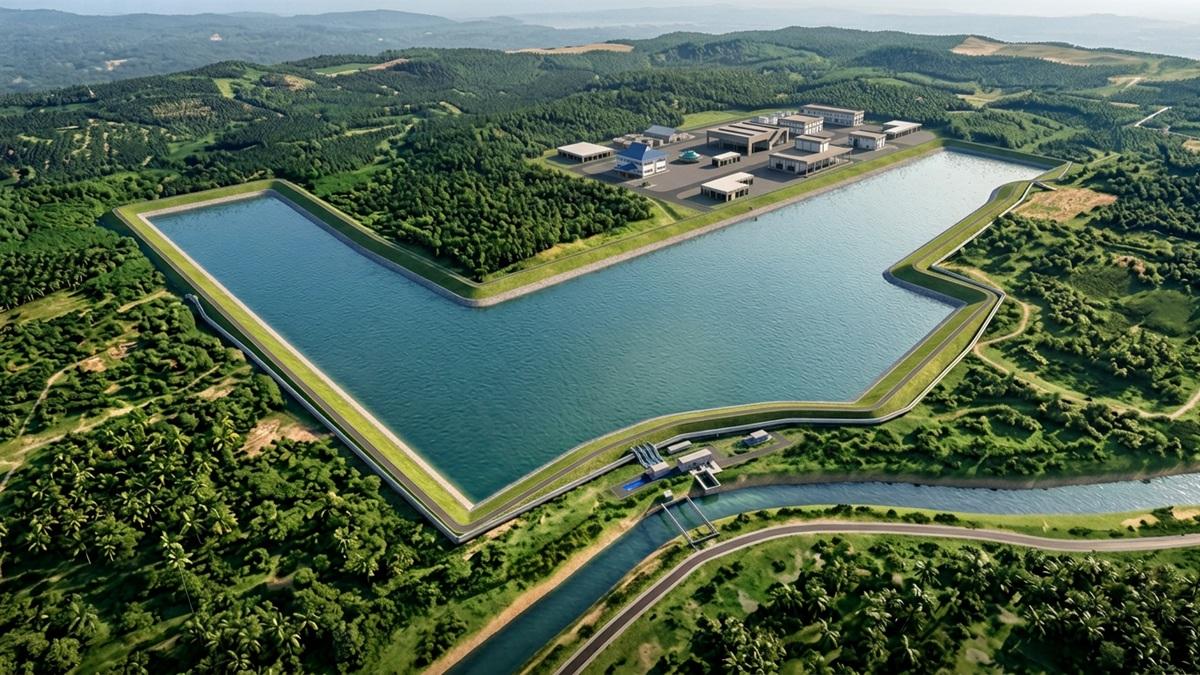
Artist's impression of the off-river reservoir and treatment plant Google is funding in Negeri Sembilan, Malaysia, to supply 65 million liters of potable water a day.
Image: Google
Source · Press image from the Google Cloud press corner, used for news reporting.
Google's data centers withdrew 13.6 billion gallons of water in 2025, and 81% of it was potable, according to Google's 2026 Environmental Report. Amazon says its data centers withdrew 9.4 billion liters, about 2.5 billion gallons, in the same year.
Those two are like for like: water drawn into data centers in calendar 2025. The others are not. Microsoft reports 13,266 megaliters (ML) withdrawn in its fiscal 2025, about 3.5 billion gallons, and Meta's latest report shows 5,637 ML for 2024, about 1.5 billion gallons. Both are company-wide figures that include offices and labs, so the four cannot simply be ranked.
For siting, the potable share is the number local boards ask about. Google's tables split data center withdrawal into potable, non-potable and reclaimed water. Amazon says 26 of its data centers used reclaimed water for cooling in 2025, keeping 849 million liters of potable water in place, and that 13 utilities are contracted to supply reclaimed water to 130. The Microsoft, Amazon and Meta documents we read give no company-wide potable total, so drinking-water use can be sourced in full for one of the four operators.
What operators disclose, and on what basis
Withdrawal and consumption are different numbers. Withdrawal is all the water a data center takes from a utility, river or well. Much of it goes back out, usually to a sewer or treatment plant, as discharge. Consumption is what does not come back, mostly water evaporated in cooling towers to carry heat away. Google's data centers withdrew 13,562 million gallons in 2025 and discharged 3,039 million, so they consumed 10,523 million. A company that reports only withdrawal, as Amazon does, cannot be ranked against one reporting consumption. Water use effectiveness (WUE) is a third measure: Amazon defines its version as liters withdrawn per kilowatt-hour of IT load.
Across data centers and offices, Google withdrew 14,689 million gallons in 2025, up 33% from 11,011 million in 2024, and consumed 10,869 million, up 34% from 8,135 million. Of the data center withdrawal, 10,949 million gallons (80.7%) was potable, 1,695 million non-potable and 918 million reclaimed wastewater.
Amazon's 2025 sustainability report puts WUE at 0.12 liters per kWh, down 20% from 0.15 in 2024 and 52% from 0.25 in 2021, and says its data centers withdraw about one-seventh of what an average data center does. It says 48% of withdrawals were in low water-stress regions and 22% in high or extremely high stress regions, and that direct evaporative cooling needs water for less than 10% of the year. Latitude Media reported on June 11, 2026 that this was Amazon's first annual water total for its data centers.
Microsoft's 2026 Environmental Data Fact Sheet, for the year ended June 30, 2025, lists 13,266 ML withdrawn and 8,170 ML consumed, up 22% from 6,693 ML, across offices, datacenters and labs. Third-party water supplied 13,192 ML, or 99.4%. Half of withdrawals, and 3,926 ML or 48% of consumption, were in water-stressed areas. Microsoft says its totals combine utility-bill data with estimates, and that it uses water use efficiency metrics to estimate datacenter withdrawal and consumption, so these are partly modeled figures.
Meta's 2025 Environmental Data Index, covering calendar 2024, shows 5,637 ML withdrawn, up 51% from 3,726 ML in 2020, and 3,123 ML consumed, of which data centers were 2,974 ML. Another 1,019 ML withdrawn to build data centers is excluded. A 2026 report was not on Meta's sustainability site on November 13.
Our totals, with inputs. Withdrawal in million gallons: Google data centers 13,562, Microsoft 3,504, Amazon 2,483 and Meta 1,489, which sum to 21,038 million gallons, or about 21 billion. Google's data centers are 64% of that (13,562 / 21,038). With Google's offices included, 14,689, the sum is 22,165 million. The Microsoft, Amazon and Meta figures are our conversions at 3.78541 liters per gallon. Consumption, where Amazon does not report one: Google 10,869, Microsoft 2,158 and Meta 825, or 13,852 million gallons. Both sums mix calendar and fiscal years, 2024 and 2025, and offices with data centers, so treat them as scale, not a ranking.
Google's data centers withdrew 13,562 million gallons in 2025, far above Amazon's 2,483. Microsoft (FY25) and Meta (2024) figures are company-wide; gallon conversions are ours.
Chart: Voltgrid News
Illustration (AI-generated)
Permits and local water deals
Permits show what a single site may draw or discharge. At Microsoft's Granger, Indiana campus, the 200,000 gallons an hour that St. Joseph County's drainage board approved on Nov. 2 is construction dewatering, not cooling water, and no cooling design for the campus is public (our Granger report has the pumping arithmetic).
Google's Port Dickson deal runs the other way. Google said on Nov. 1 (Nov. 2 in Malaysia) that it is funding US$160 million for an off-river storage reservoir and water treatment plant in Negeri Sembilan, with Gamuda as builder, as we reported. The plant will deliver 65 million liters of potable water a day, about 17 million gallons by our conversion, for the campus and for public supply. Google has not said how much the campus will draw.
xAI, now SpaceXAI, planned a Memphis plant to recycle up to 13 million gallons (49.2 million liters) of wastewater a day for its data centers, an $80 million project, according to Baxtel's June 23, 2026 report. Work began in September 2025 and stalled in April. A City of Memphis statement said the company committed to resume construction no later than Q1 2027. The Daily Memphian reported on Aug. 14, 2026 that SpaceXAI had again committed to restart; we found no report since that construction has resumed. On paper the two plants are comparable: Memphis would supply 49.2 million liters a day of reclaimed water, Port Dickson 65 million of potable water.
Granger's 200,000 gallons an hour is construction dewatering; Port Dickson will supply 65 million liters of potable water a day; Memphis has a restart pledged by Q1 2027.
Chart: Voltgrid News
Illustration (AI-generated)
Rules are also arriving as limits. Thailand's draft rule, which its Data Centre Board reviews on Nov. 27, would require 80% reuse of monthly cooling-tower blowdown (details). Finland's regulator said Google's Muhos ditching needs a Water Act permit. Gaps remain: an environmental assessment for a Space Force data center on Maui did not state its water use.
Designs that cut water, and what they cost in power
The design lever is to stop evaporating water for heat rejection. Daikin Applied's 60 MW D60-W reference design uses dry coolers, so it needs no cooling-tower make-up water, with liquid cooling carrying 92% of the IT load, as we reported. It gives no WUE and is not a measured site. NVIDIA says a 2-gigawatt DSX deployment could save 54 million liters a day against cooling-tower designs (our report). That is a vendor claim; divided by 2 GW it is 27 million liters a day per gigawatt.
Evaporation saves power, though. Amazon says its evaporative design cuts electricity demand year-round, most in peak summer when the grid is stressed. Google says water cooling takes less energy than air cooling, and reports that its The Dalles, Oregon sites needed 6% to 10% extra energy for overhead such as cooling and power distribution in the fourth quarter of 2025, against a 54% industry average that Google cites. Those are company figures for one site and one quarter. Dry designs trade water for fan, chiller and compressor power on hot days. Daikin's design runs with chillers off only while the dry-cooler leaving-fluid temperature plus the heat-exchanger approach stays at or below 41°C; above that, it brings them in.
Waste heat is a second route: Endeavour and Trevi Systems claim up to 200,000 gallons of clean water per megawatt a day from brackish groundwater (the plan), a company projection, not a site result.
Pledges against measurements
Targets and measurements sit in the same reports. Google's target is to replenish 120% of the freshwater it consumes by 2030. Its 2025 figure is 7,717 million gallons replenished, 78% of 9,947 million freshwater consumed, up from 63% in 2024; a third party estimates the benefit under a volumetric accounting method. Google lists 19,722 million gallons of replenishment capacity in 2030, against the 11,936 million that 120% of 2025 consumption would require (9,947 x 1.2).
Amazon's report says its replenishment projects returned 9.4 billion liters in 2025, the same volume its data centers withdrew, yet it counts 75% progress toward its 2030 water-positive goal at data centers, up from 53% in 2024, under its own methodology. Latitude Media reported in June that the company said it returned two-thirds. The three figures do not reconcile publicly. Meta aims to restore 200% of consumption in high-stress regions and 100% in medium-stress ones by 2030, and says projects returned over 1.59 billion gallons in 2024 to high and medium water stress regions.
Microsoft says it replenished more water than it withdrew in fiscal 2025, "more than 14 million cubic meters" (over 14,000 ML) against 13,266 ML withdrawn; The Register reported the figure as 14,278 ML. Against 8,170 ML consumed, that is about 175% on The Register's figure (14,278 / 8,170) and over 171% on Microsoft's (14,000 / 8,170). Meta's 1.59 billion gallons set beside 0.825 billion consumed company-wide is not a test of its goal, which applies watershed by watershed. Replenishment is an estimate of benefit, while consumption is a meter reading or a model.
For engineers and investors, the practical points are two. Water supply now arrives as site capex: US$160 million at Port Dickson, $80 million at Memphis. And delivery can slip, as Memphis shows. A design that avoids evaporation moves the constraint from the water permit to the power budget, so a site's water and electricity applications should be read together.
What to watch
On Nov. 27, 2026, Thailand's Data Centre Board reviews the 80% blowdown-reuse draft. If issued, it takes effect 180 days after Royal Gazette publication.
Thailand's Data Centre Board reviews the 80% blowdown-reuse draft on Nov. 27, 2026; SpaceXAI has committed to restart its Memphis plant by Q1 2027.
Chart: Voltgrid News
Illustration (AI-generated)
At Granger, WNDU puts the dewatering between mid-December and early April; WSBT reports about 40 days. A filing of the campus's cooling design and utility water agreement would show operating demand.
By Q1 2027, SpaceXAI has committed to restart construction of its Memphis recycling plant, according to a City of Memphis statement. Port Dickson has no completion date from Google or Gamuda.
Meta's report for 2025 is the next gap. Its last came on Sept. 12, 2025. Amazon and Microsoft published on July 1 and July 9, 2026, Google the same summer. Compare the 2027 editions for the potable share. The 2030 replenishment targets are the longer test.
Sources
- 01Meta 2025 Sustainability ReportMetasustainability.atmeta.com
- 022025 Amazon Sustainability ReportAmazonsustainability.aboutamazon.com
- 03Responsibly building the AI futureMicrosoft On the Issuesblogs.microsoft.com
- 042026 Microsoft Environmental Data Fact SheetMicrosoftcdn-dynmedia-1.microsoft.com
- 05Meta 2025 Environmental Data IndexMetasustainability.atmeta.com
- 06Google 2026 Environmental ReportGooglesustainability.google
- Editor
- Ege Erten
- Published
- Sources
- 6 cited
- Standards
- AI-assisted