Thailand Data Centre Draft Rule Would Require 80% Cooling Blowdown Reuse
Thailand's Data Centre Board reviews a draft rule on November 27 requiring data centres to reuse 80% of cooling-tower blowdown. It would take effect 180 days after Royal Gazette publication.
3 min readAI-assisted
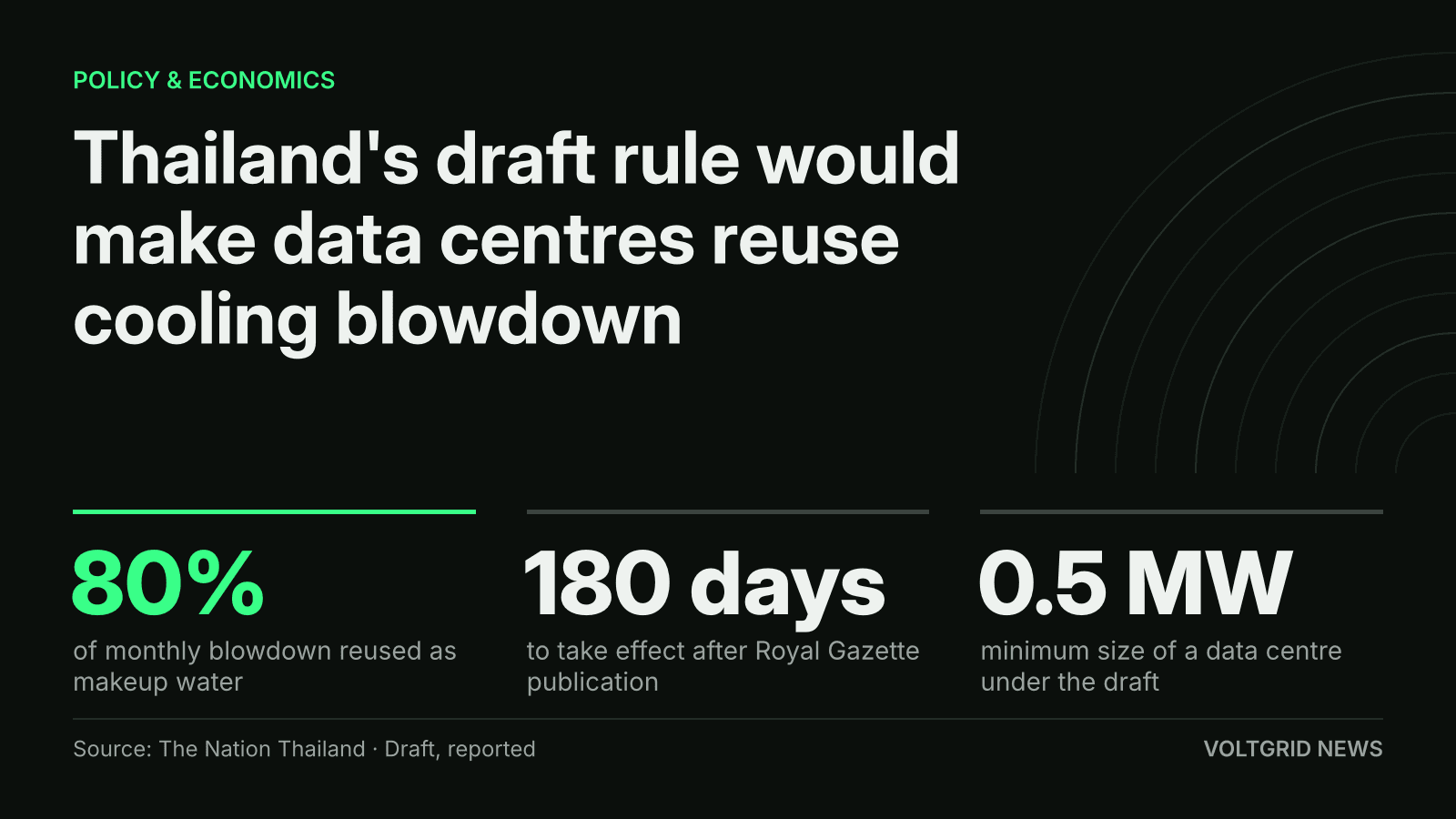
The draft would take effect 180 days after Royal Gazette publication, as reported by The Nation Thailand; it is not yet adopted.
Illustration (AI-generated)
Thailand's Data Centre Board is due to review a draft data centre rule on November 27, a ministerial regulation that would require data centres to treat and reuse at least 80% of their monthly cooling-tower blowdown, according to The Nation Thailand.
The draft would be issued under the Building Control Act of 1979 and take effect 180 days after publication in the Royal Gazette. The board, chaired by Deputy Prime Minister and Finance Minister Ekniti Nitithanprapas, considers it before the formal issuing process begins. Deputy Interior Minister Polapee Suwunchwee, who chairs the subcommittee on locations, urban planning, buildings and structures, is preparing to submit it. This is a draft, not a rule in force.
What the rule changes
Blowdown is the water bled from an evaporative cooling loop to keep dissolved solids from building up. Under the draft, operators must collect and treat it and reuse at least 80% of the monthly discharge volume as makeup water. The Nation reports that circulating water, water already treated repeatedly and water from other sources do not count toward the 80%.
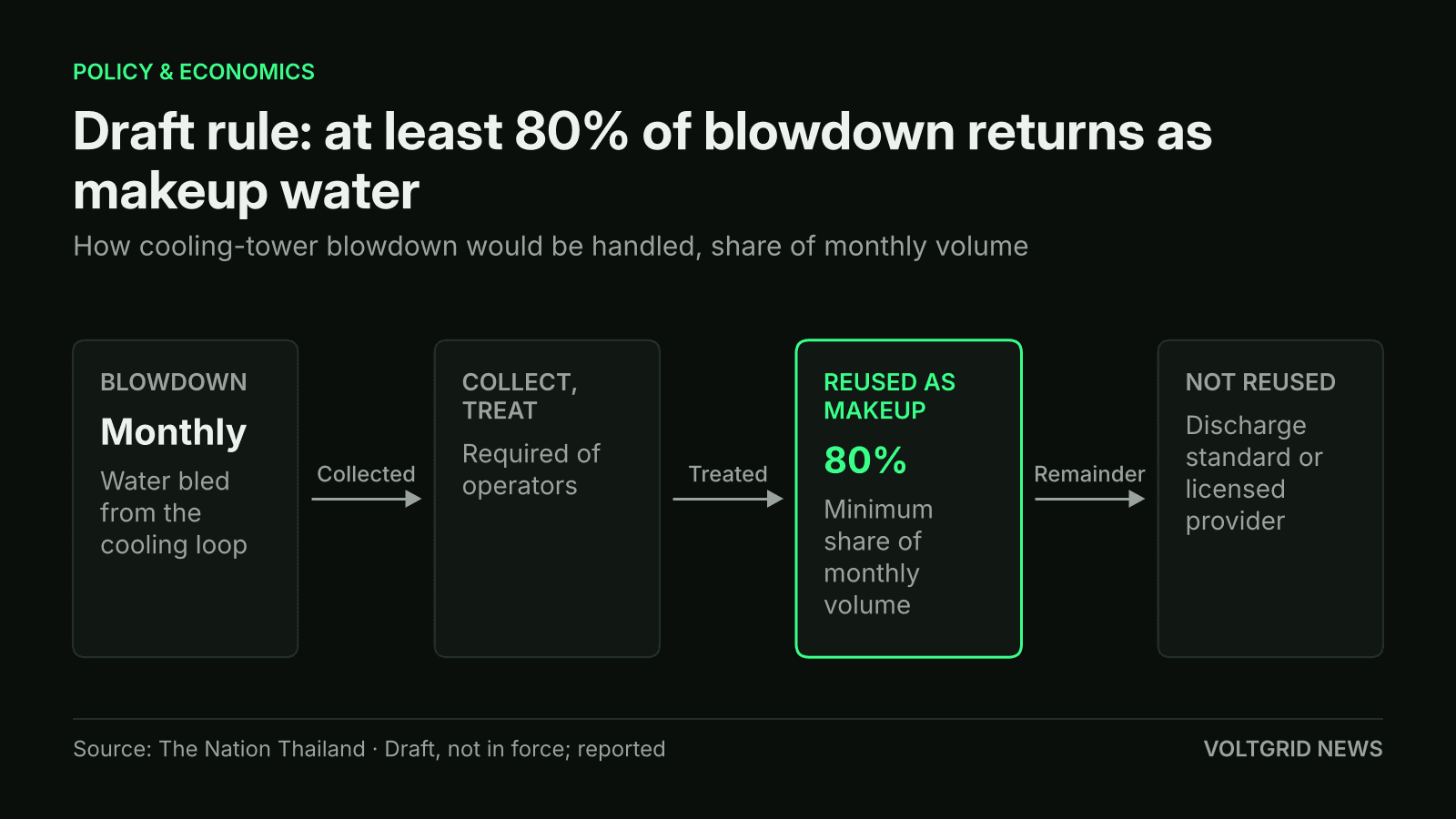
Under the draft, at least 80% of monthly blowdown would return as makeup water, according to The Nation Thailand.
Illustration (AI-generated)
Whatever is not reused must meet the discharge standards in the Ministry of Natural Resources and Environment's 2024 notification. Operators that cannot meet them must send the wastewater to a licensed treatment provider. Discharging non-compliant wastewater, or diluting it with clean water, would be prohibited. Operators must also install meters and file monthly reports on water balances, water quality and pollution loads. Voltgrid News reported earlier on Google's Muhos data center water permit.
Why it matters for cooling design
For evaporative-cooled sites, the 80% figure turns blowdown from a waste stream into a treatment and recycling load. Sites would need on-site treatment capacity or a contract with a licensed provider, plus metering that can stand up to a monthly audit. The Nation's report gives no compliance cost, so the opex effect cannot be sized from it. The direction is clear, though: water handling becomes a design input alongside power, which matters for developers choosing between cooling-tower, hybrid and closed-loop designs in a market that is adding capacity.
The draft sits inside a wider building-code package. It defines a data centre as a facility using at least 0.5 MW of electricity and sorts sites into categories from 0.5 MW up to 200 MW or more, with setbacks, fire-suppression and emergency-power duties that rise with size. Existing data centres, licensed or operating before the rule takes effect, would get one year to upgrade fire protection, emergency power and environmental measures.
What is not confirmed yet
The text can still change. The Nation says meeting documents flag possible revisions to open-space wording and setback distances, and ask for a clearer definition of electricity use. The Nation attributes its account to Thansettakij and the draft documents; Voltgrid has not seen the draft text itself. Whether the board approves it on November 27, and whether the 80% threshold survives, is not known.
Separately, the Board of Investment (BOI) has conditions for tax incentives that are not part of this draft. BOI secretary-general Narit Therdsteerasukdi said the framework covers efficient electricity and water use, environmental impact and siting, and projects must employ at least 50% Thai nationals in specialist and management roles before claiming incentives.
The next dated step is the board meeting on November 27. If it clears the draft, the regulation still has to be issued and published in the Royal Gazette, and the 180-day clock starts only then. Operators with evaporative cooling in Thailand should watch for the final threshold, the reporting format and the treatment-provider licensing route.