OpenAI Says Chip Design Models Cut Up to 14% of PPA on AMD GPU IP
OpenAI says its chip design models found up to 14% power, performance and area gains on AMD flagship GPU IP in under five months; no AMD statement was found, and no product or tape-out date was named.
3 min read
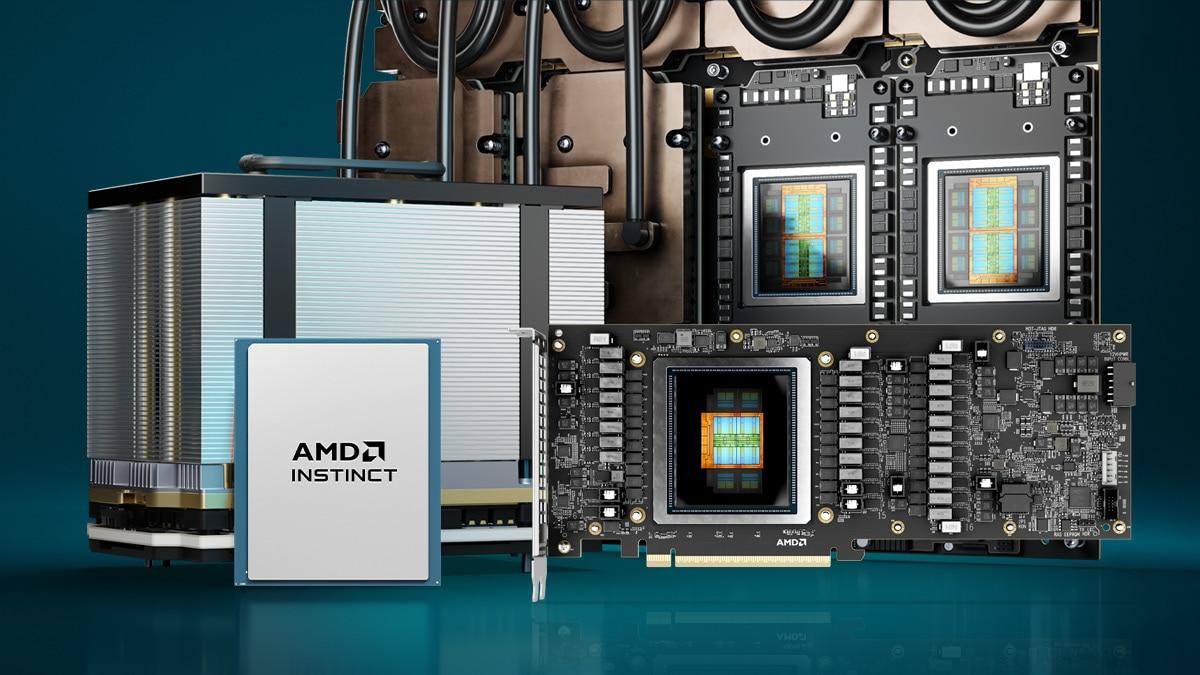
AMD Instinct accelerators, from AMD's product page. OpenAI did not name which AMD product carries the changes it describes.
Image: AMD
Source · Press image from the AMD website, used for news reporting.
OpenAI said on Nov. 18 that its chip design models found up to 14% power, performance and area (PPA) gains on AMD's flagship GPU design blocks, a result it puts at roughly a year of progress in under five months.
In a blog post, OpenAI said the gains are measured against baselines AMD had already heavily optimized. The model rewrote SystemVerilog RTL, the code that describes a chip's circuits, and used Synopsys tools to check that each rewrite kept the block's behavior and to weigh the trade-offs. OpenAI also said AMD verified single-digit percentage PPA gains across key blocks of its upcoming flagship CPU, using designs the model wrote. The Next Web, which reported the post, repeats these figures as OpenAI's account.
AMD has already put some of the changes into a recent design it sent for manufacturing and added others to its production design files for later versions, OpenAI said. We found no AMD statement confirming any of this, and OpenAI named neither a product nor a tape-out date.
Why it matters for power, area and tape-out
PPA is a bundle. "Up to 14%" is a best case for the blocks OpenAI worked on, and the post does not say how much of that lands as lower watts, higher clocks or smaller silicon, or how it carries into a finished GPU. For a data-center operator the useful reading is indirect: any watts saved per accelerator multiply across racks, and any area saved leaves room for more compute or more memory beside it. Neither follows until AMD ships silicon and publishes numbers.
On schedule, the evidence is OpenAI's own. For its Jalapeño inference chip, IEEE Spectrum reported that the project went from first architecture concept to first silicon in under 20 months, with nine months between first RTL and tape-out, the point where the finished design goes to the foundry. That design team averaged fewer than 100 people, not counting Broadcom, Spectrum said. Broadcom handled physical design from the gates onward, and one outside expert told Spectrum that Broadcom's help was essential to the pace.
OpenAI's figures put Jalapeño at first silicon in under 20 months, with 9 months from first RTL to tape-out; the two spans start at different points.
Graphic: Voltgrid News
What the post says about Jalapeño
OpenAI began using GPT-4o on Jalapeño in early 2025. Its team estimates that model-proposed changes cut standard-cell area by about 13% in the vector unit and about 10% in the matrix unit, and says the changes were proven in silicon during bring-up. One multiplier redesign used about 15% less cell area in synthesis and cut latency from two clock cycles to one. Spectrum separately reported that OpenAI put the 10% matrix-unit figure at Hot Chips 2026, measured against an optimized human baseline.
OpenAI also tested its models on two small open-source RISC-V cores, PicoRV32 and Ibex. GPT-6.2 Astra scored highest on both tasks. It cautioned that designing from written requirements was easier, because models could drop features the original cores carry, such as performance counters.
What is not confirmed yet
None of the AMD figures has been independently audited, and no design files are public. It is unclear which AMD product carries the changes, when it ships, or whether the gains survive physical implementation. A saved year of RTL work is also not the same as a shorter product schedule, because manufacturing and validation time are unchanged. The AMD link is commercial as well as technical: AMD booked a $1.1 billion warrant charge in Q3 tied to its OpenAI and Meta chip deals, and OpenAI's own accelerator is one of the custom chips Voltgrid has counted competing for the same foundry and memory supply. OpenAI is also training GPT-Synopsys with Synopsys to drive the design tools directly. The next test is a named AMD part with measured watts and die area.
Sources
- Published
- Sources
- 3 cited