EDF EPR2: French Auditor Puts 6 Reactors at €84B, Warns Below €70/MWh
France's Cour des comptes says power prices under €70/MWh would swell EDF's EPR2 funding need, weeks before EDF's expected final investment decision. The state may have to give up dividends.
3 min read
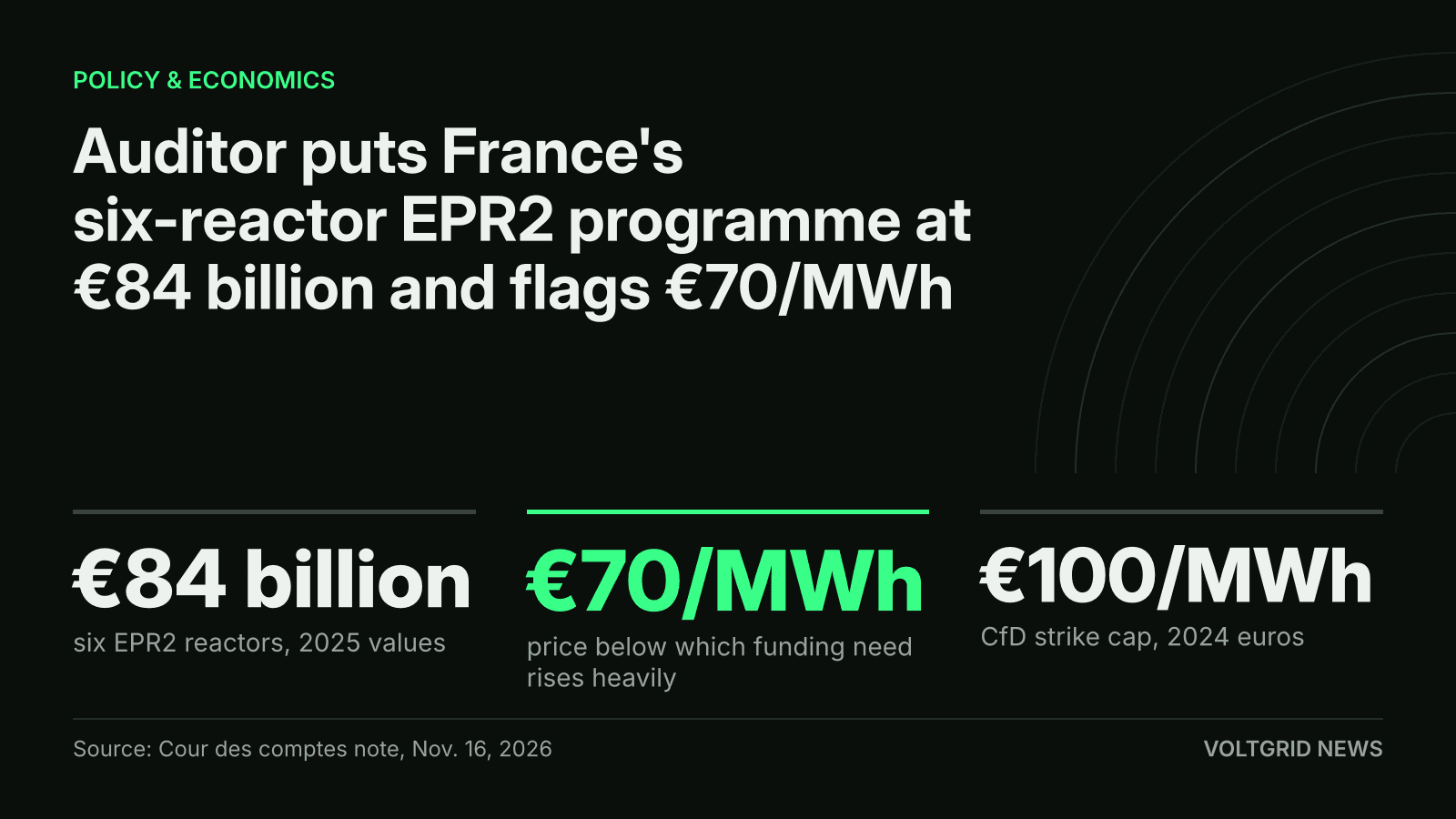
Key figures from the Cour des comptes note of Nov. 16, 2026: €84 billion in 2025 values for six EPR2 reactors, €70/MWh price line, €100/MWh CfD strike cap (2024 euros).
Graphic: Voltgrid News
France's Cour des comptes, the state audit court, put the cost of EDF's six-reactor EPR2 programme at €84 billion in 2025 values in a note published on Nov. 16, 2026, and warned that wholesale power prices below €70 per megawatt-hour (MWh) would sharply raise EDF's financing need.
The €84 billion restates the €72.8 billion budget EDF set in 2020 values; it is a price-level conversion by the court, not a new overrun. According to Reuters, the report comes weeks before EDF is expected to take its final investment decision on the project, and first commercial operation is scheduled from 2038. The court's note covers all state support for energy production, which it puts at more than €13 billion a year, of which more than €10 billion goes to electricity.
For EDF, the price line is the exposure. The court said that below €70/MWh the group's funding need for construction would grow heavily and its ability to fund the programme without extra state money, beyond the subsidised loans already announced, would be constrained. The note also says forward prices for 2028 to 2032 sit between €50 and €60/MWh, and that 2027 forwards stayed under €65/MWh from Jan. 1, 2025 to the end of August 2026 before a recent rise.
The court's €70/MWh line sits above the €50-60/MWh forwards for 2028-2032; the CfD strike cap is at most €100/MWh in 2024 euros, from 2038 for the first three reactor pairs.
Graphic: Voltgrid News
What the support package contains
The state's support has two layers, according to the court. First, a subsidised loan from the Caisse des dépôts et consignations, backed by regulated savings funds, covering up to 60% of construction cost. The court's illustration: if the loan balance reaches €50 billion in 2035 and the Caisse's funding cost averages 3%, the annual budget cost of the interest subsidy is €1.5 billion, with the first budget outlays from 2027.
Second, a contract for difference (CfD) for the first three pairs of reactors, announced after the Nuclear Policy Council of March 17, 2025. It sets a strike price of at most €100 per MWh in 2024 euros, runs 40 years from 2038, and triggers state payments to EDF whenever market prices fall short. The court says the CfD will have no budget impact before the first EPR2 units start up, at the earliest in 2038. The forward range above is far below that cap, though the forwards cover 2028 to 2032 and the CfD pays out only from 2038.
Who pays if prices stay low
In unfavourable price scenarios, the court said, one lever for the state would be to waive cash dividends from EDF for all or part of the construction period. In some scenarios that could weigh on the public finances by about €65 billion cumulatively over 2026 to 2040. The state is already a heavy backer of EDF: the court lists capital injections of €3 billion in 2017, €2.1 billion in 2022 and €2.4 billion in 2023, plus €8.6 billion of cash dividends forgone since 2015. It also recalls its January 2025 estimate of €23.7 billion (2023 euros) for Flamanville 3, the cost blowout Reuters says the auditor cited as a warning for six units.
For power buyers, including data-center developers, the court's logic cuts two ways: the low-price scenarios that strain EDF's funding also lower their power bills. The court also says, as Reuters reports, that extending the existing fleet's life to 60 years remains France's cheapest low-carbon option. Voltgrid News reported earlier on South Korea's review of a US nuclear advance, another state-linked nuclear financing question.
What is not confirmed yet
EDF has not yet taken its final investment decision, and the European Commission opened an in-depth state-aid investigation in April into whether France's planned support for the programme complies with EU rules, according to World Nuclear News. Neither the decision date nor the Commission's findings are known. The €65 billion dividend figure is the court's estimate for "certain scenarios", not a forecast, and the court's price scenarios are its own assumptions rather than EDF's.
Sources
- Published
- Sources
- 2 cited