India Battery PLI Has Built 1.4 GWh of 50 GWh Target, No Incentive Paid
NITI Aayog and IIM Ahmedabad report no commercial production under India's Rs 18,100 crore cell scheme, and fault its 25% and 60% domestic value-addition rules.
3 min read
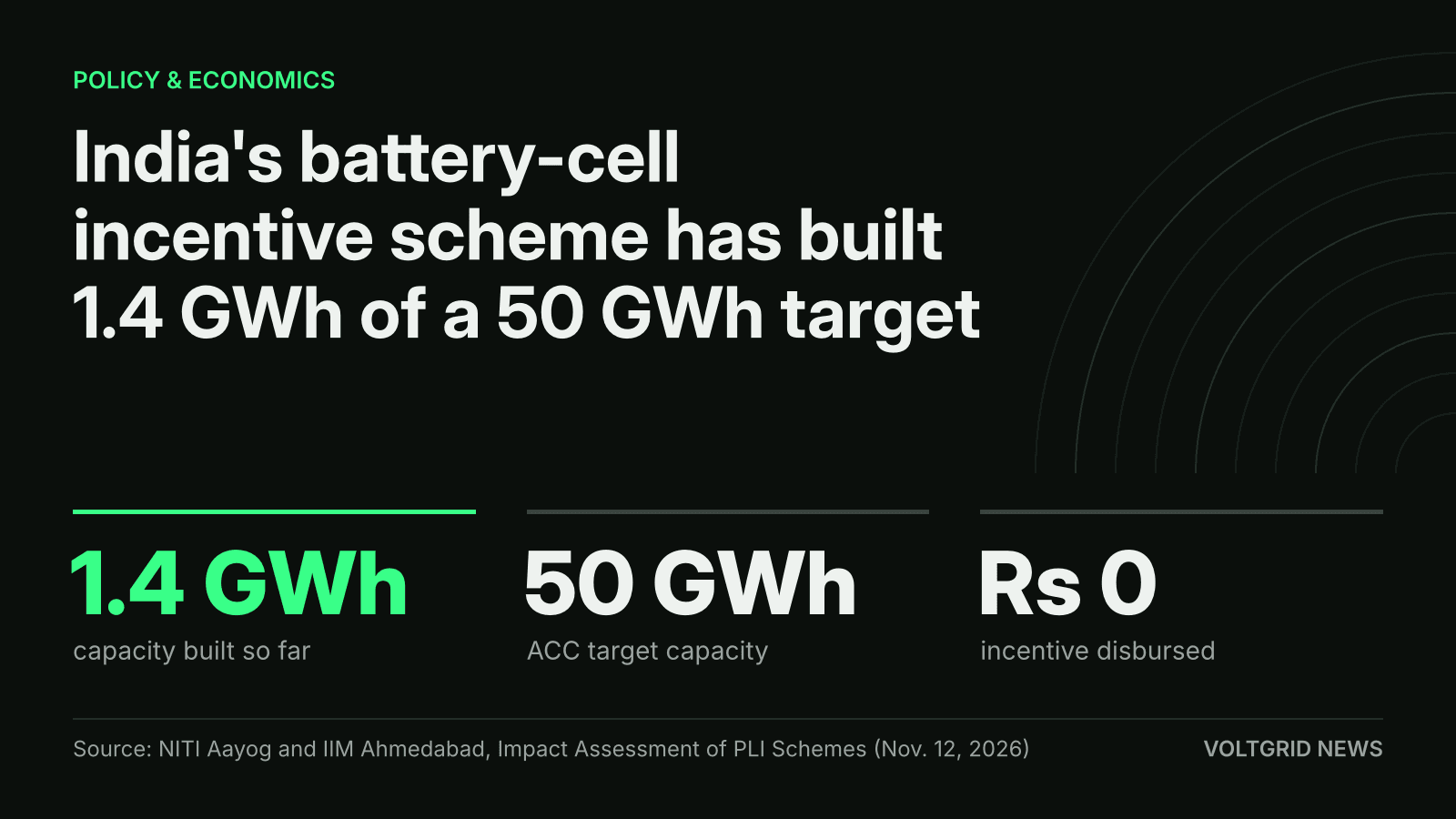
NITI Aayog's report says the ACC scheme has built 1.4 GWh against a 50 GWh target and disbursed no incentive.
Graphic: Voltgrid News
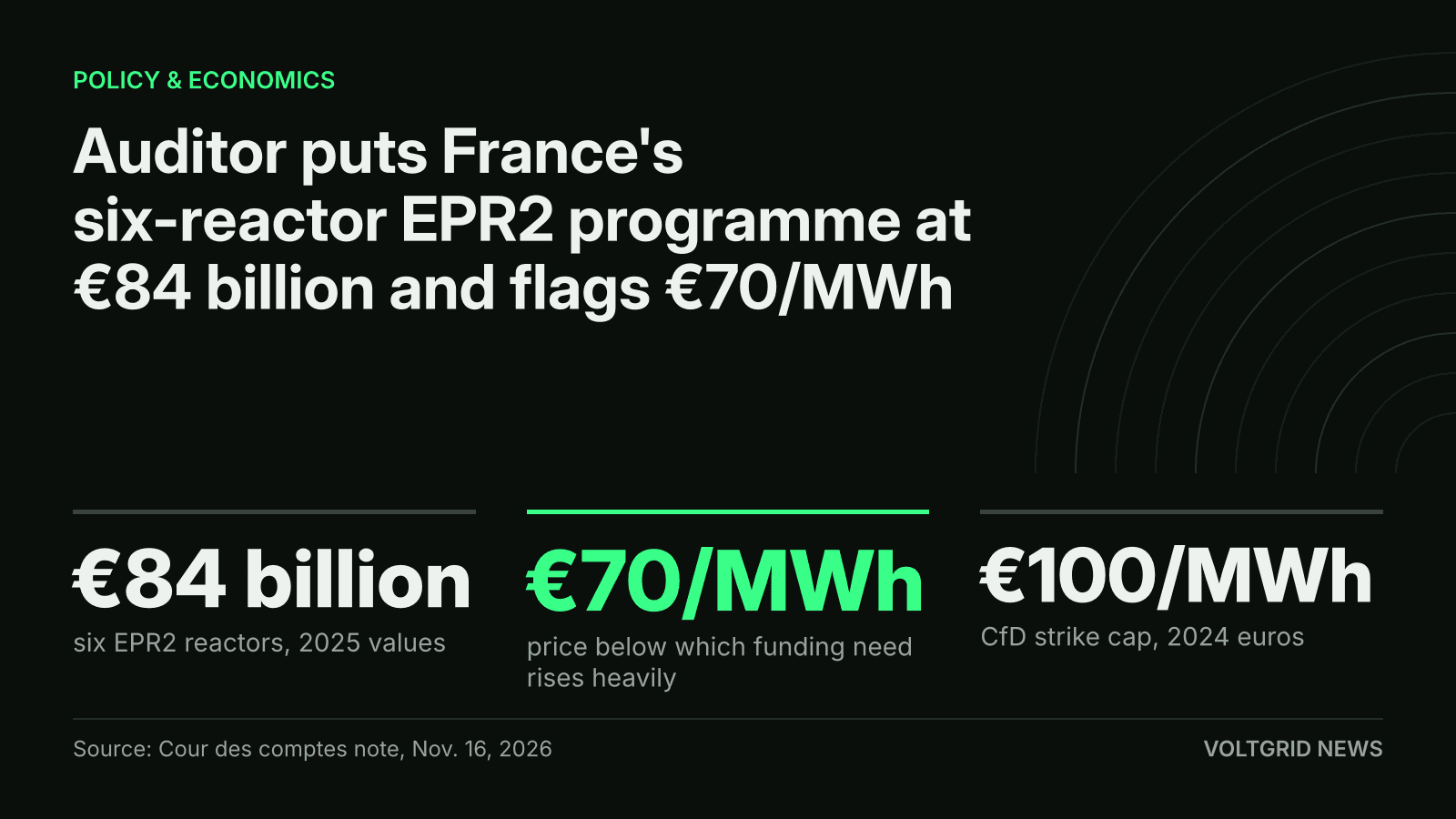
India's Rs 18,100 crore production-linked incentive (PLI) scheme for advanced chemistry cell (ACC) batteries has built about 1.4 GWh of its 50 GWh target and paid no incentive, NITI Aayog said in a report released on Nov. 12.
The report, "Impact Assessment of PLI Schemes", was prepared with the Indian Institute of Management, Ahmedabad as knowledge partner and covers all 14 PLI sectors. Its ACC chapter says commercial production has not begun, that most beneficiary firms are still building infrastructure and capacity, and that this explains why no production or incentive disbursement is reported. Cumulative investment was Rs 4,570 crore and cumulative employment 1,245 jobs through March 2026, according to the report's sector table, which lists production and exports as yet to commence. ANI reported the same figures on Nov. 14.
The 1.4 GWh number is not new. A study by JMK Research and the Institute for Energy Economics and Financial Analysis (IEEFA), reported by Business Today on Jan. 22, put commissioned capacity at 1.4 GWh, or 2.8% of the target, against the scheme's 2025 deadline, all of it by Ola Electric, with no incentive disbursed as of October 2025. What is new is that the government's own think tank now confirms the gap, and its chapter reports the same 1.4 GWh.
Why the local-content rules are in the dock
The report ties the lag to limited domestic battery technology and continued reliance on foreign expertise, imported machinery, project delays and a shortage of skilled labour. It also says India lacks an upstream supply of cathodes, anodes, lithium and cobalt, which makes localisation hard. Slower electric-vehicle demand has also dampened investment, and the report calls the lag "not merely cyclical but rooted in deeper structural constraints".
On policy design, the report says the domestic value-addition (DVA) rules appear misaligned with India's current industrial base and have delayed capacity creation. Beneficiaries must reach 25% DVA by the end of the second year and 60% by the end of the fifth. It also cites strict timelines and a short gestation period, and notes that one unnamed beneficiary was disqualified for suppressing material facts. The ACC chapter proposes no revised threshold.
What the gap means for cells and storage
The scheme pays only on actual production and sales, so a plant that does not ship cells earns nothing. The report counts no domestic ACC output, and the same January study quoted a JMK analyst putting India's reliance on imported cells at close to 100%. The NITI report gives no import figure of its own. Voltgrid reported on Oct. 23 that India's downstream storage manufacturing capacity is about 86 GWh, with cells only 8% of it, and on Nov. 15 that Waaree commissioned a 5.15 GWh battery pack line in Gujarat. In those figures, pack and assembly capacity is running ahead of cell capacity.
Next to the other schemes the shortfall stands out. The automobile scheme had drawn Rs 44,326 crore of investment by March 2026, against Rs 4,570 crore for ACC. The Press Information Bureau release says nearly 70% of targeted segments are on track and describes ACC batteries only as seeing gradual capacity creation, without giving the 1.4 GWh figure. That matters for grid storage as well: the cabinet approved Rs 14,500 crore of viability-gap funding for 92 GWh of grid storage on Nov. 4, while the report counts no domestic cell production to supply such systems.
The ACC battery scheme had drawn Rs 4,570 crore of investment by March 2026, against Rs 44,326 crore for the automobile scheme.
Graphic: Voltgrid News
What the report recommends and what is not confirmed yet
The closing recommendations apply to PLI as a whole. They call for demand-side measures such as domestic procurement frameworks and strategic government purchasing alongside output incentives, standardised reporting across ministries, a bigger industry say in setting targets and patience in sectors with long gestation. It keeps a positive outlook for ACC but says impact will show only over time.
Not confirmed: which beneficiaries hold the 1.4 GWh, when the 50 GWh target will now be met (the report says only "at a later date"), whether the 25% and 60% thresholds will be changed, and the date the capacity figure refers to, since the chapter says "as of now" while its investment and jobs figures run to March 2026.
Sources
- 01India's battery manufacturing incentive scheme sees minuscule deliveryBusiness Todaybusinesstoday.in
- 02Battery PLI scheme achieves just 1.4 GWh capacity against 50 GWh target, faces delays: NITI Aayog reportANIaninews.in
- 03NITI Aayog Launches Report on Impact Assessment of PLI SchemesPress Information Bureau (Government of India)pib.gov.in
- 04Impact Assessment of PLI Schemes (NITI Aayog and IIM Ahmedabad)NITI Aayogniti.gov.in
- Published
- Sources
- 4 cited