Emerald Horizon Pitches 10 MW Container Thorium Unit, Storage First
Emerald Horizon says its unbuilt, unlicensed thorium generator would deliver about 10 MW electric per container module; the prototype is due in 2029, a demonstration plant in 2031, and storage ships first.
3 min readAI-assisted
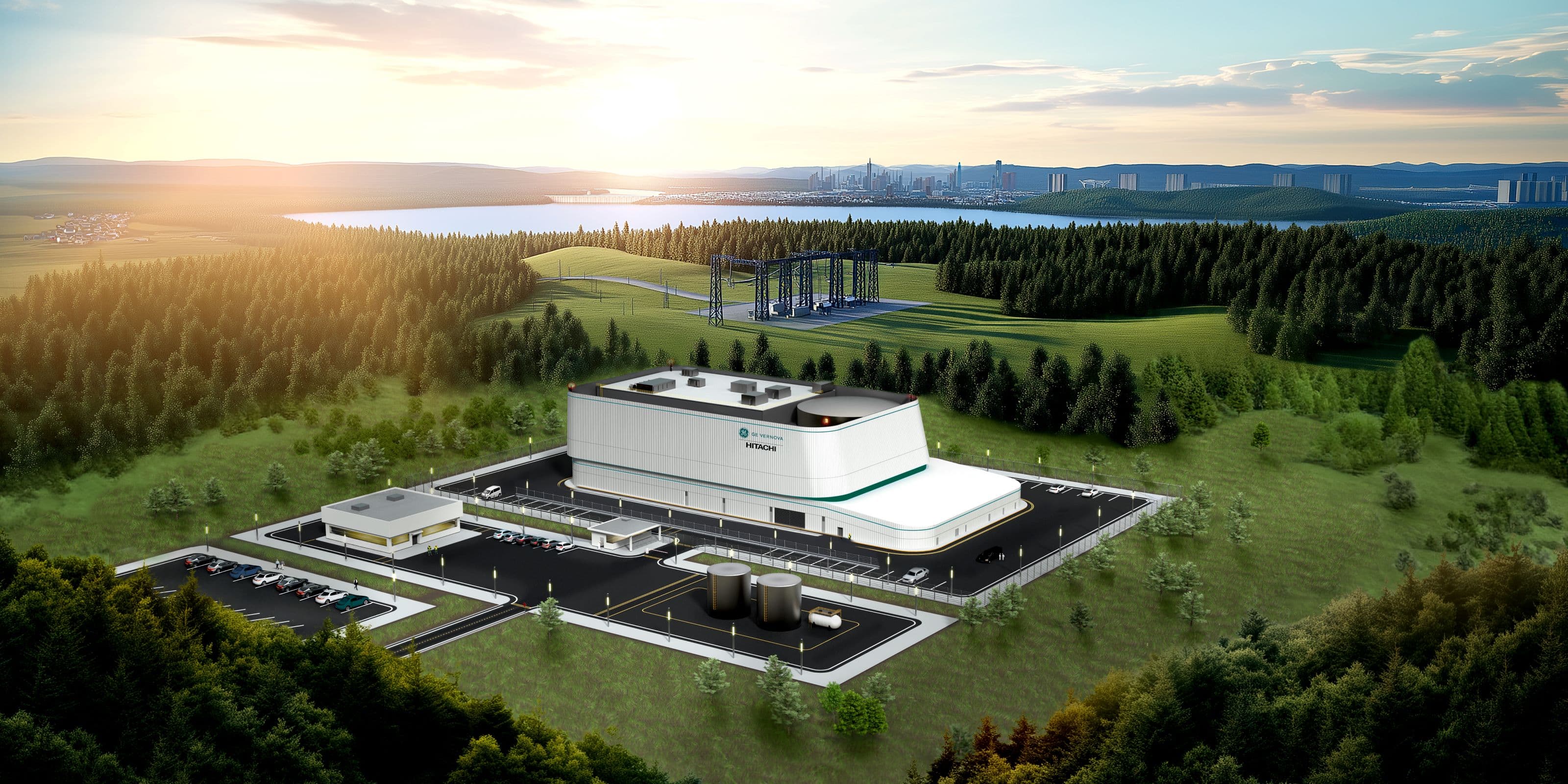
Emerald Horizon's own rendering of a container module, shown in the ADES section of its website. It is an illustration, not a photo of a built unit; the design is unbuilt and unlicensed.
Image: Emerald Horizon AG
Source · Company rendering from the Emerald Horizon AG website, used for news reporting.
Emerald Horizon AG, a Graz-based start-up, is pitching a container-sized thorium generator it rates at roughly 10 MW electric, POWER Magazine reported on October 20, 2026; the design is unbuilt and unlicensed.
The unit is called ADES, short for accelerator-driven energy source. The company, listed on the Vienna Stock Exchange since June 26, 2026, rates one module at 25 MW thermal and roughly 10 MW electric, figures its September 8, 2026 press release also gives. CEO Florian Wagner told POWER that first-generation modules might deliver closer to 7 MW electric. He also acknowledged that accelerators with the required output do not yet fit in one container, so early units may need two or three.
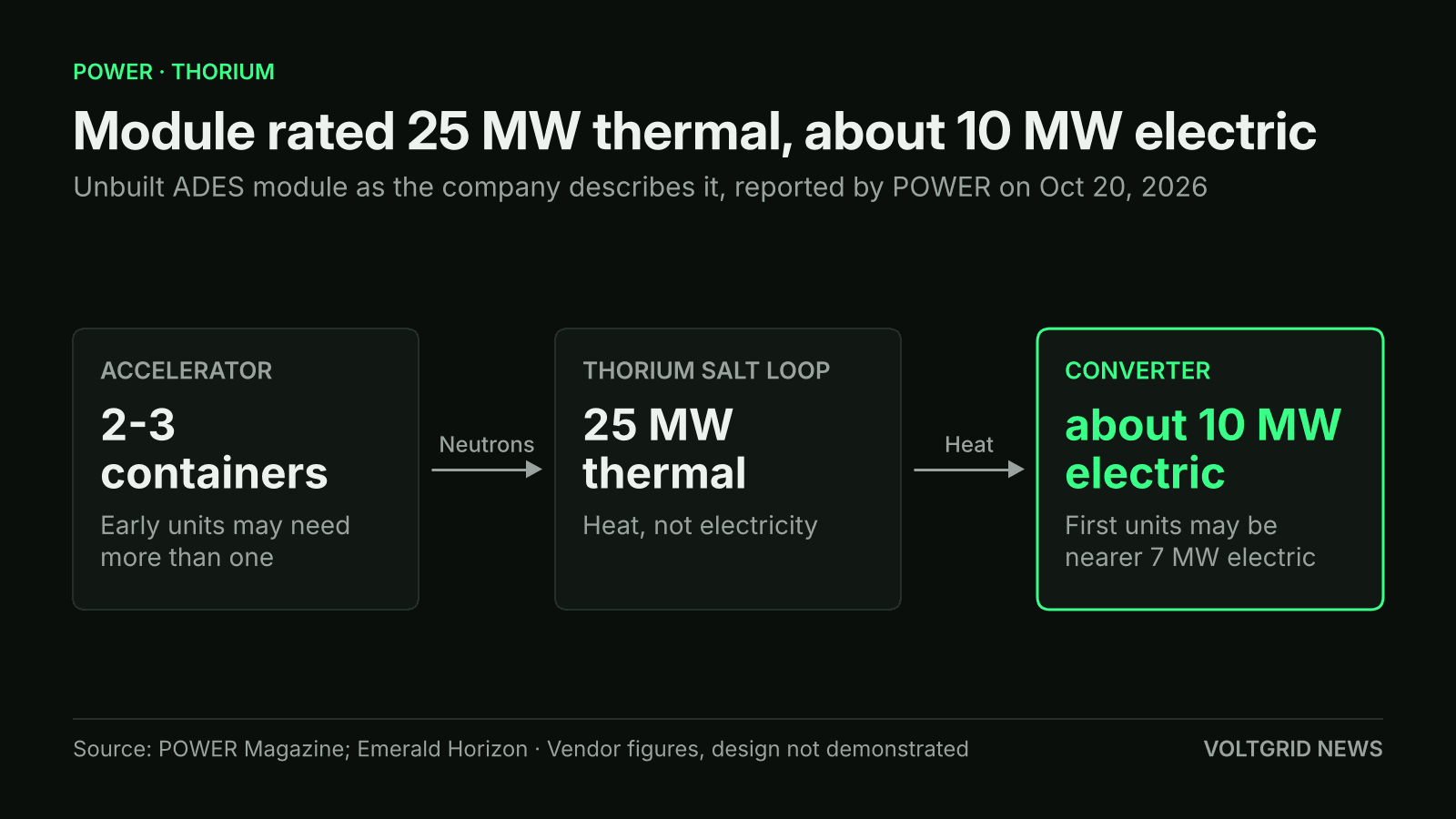
Emerald Horizon rates one module at 25 MW thermal and about 10 MW electric, according to POWER Magazine's Oct 20, 2026 report; these are company figures for a design that has not been built.
Illustration (AI-generated)
Data centers are part of the pitch. Wagner said a site needing 10 to 20 MW could run on a small cluster of containers with built-in redundancy. By Voltgrid's arithmetic, a 20 MW site at 7 MW electric per module needs three modules before any spare. None of this is a supply option yet: no data-center customer is named, and the only product on offer is storage, which holds power rather than making it.
How it is meant to work, and what ships first
ADES is subcritical. An accelerator supplies neutrons to thorium dissolved in a circulating fluoride salt, and the company says the reaction stops when the accelerator is switched off. A module is meant to run 20 years without refueling, then the 40-foot container holding the salt loop is swapped out. Its roughly 80% fuel-conversion goal is a design target, not a demonstrated result, POWER noted.
Storage comes first. DUALstorePLUS couples battery containers with molten-salt heat storage. Each module holds about 5 MWh of lithium iron phosphate battery capacity at about 94% roundtrip efficiency plus 5 MWh thermal of salt, and a system can be configured from 5 MWh to 100 MWh. The company said battery deliveries could begin as early as the fourth quarter of 2026 and the molten-salt unit from 2028, under energy-as-a-service contracts of up to 20 years.
Timeline, money and the regulator
The company's website puts ADES prototype completion in 2029, and it told POWER it targets a demonstration plant in 2031, then serial production. It rates the generator at technology readiness level 4.5 on a nine-point scale. POWER places the prototype in Eindhoven, the Netherlands, with manufacturer VDL Groep, while the company's homepage names its Slovak subsidiary as the intended prototype and demonstration site. A 1 MW molten-salt test loop (POWER does not say whether thermal or electric) is due in 2027. VDL's Markjan Vermeer said the joint demonstrator is meant to validate the reactor's central non-nuclear technologies.
Wagner is targeting 8.5 euro cents per kilowatt-hour for 20 years, against 18 cents for German industrial customers with fees and taxes and 11.5 cents for on-site power without a grid fee, according to the company presentation. That presentation assumes a 75 million euro prototype and up to 150 million euros more for scale-up. Company filings show 2025 revenue of 224,983 euros, no material revenue from energy-system sales in the first half of 2026, and cash of 3.75 million euros on June 30, 2026. On July 1, 2026 Wagner, the majority shareholder, committed 20 million euros of new equity in four tranches, the first planned for the fourth quarter of 2026 or first quarter of 2027.
What is not confirmed yet
Regulation is the open question, and the company's half-year report says no nuclear licence is in hand. Pillsbury Winthrop Shaw Pittman LLP is advising on whether ADES could follow a non-reactor accelerator route or a limited advanced-nuclear framework at the US Nuclear Regulatory Commission (NRC), and Wagner hopes regulators will treat it as nuclear adjacent. "We don't know it yet," he said. For scale, Voltgrid reported that X-energy's four-unit Xe-100 plant for Dow in Texas had its construction-permit application tendered to the NRC on March 31, 2025, with a permit decision expected in the first half of 2027. Emerald Horizon has not said it has filed.
The company has offered no energy-as-a-service contract to a potential customer for the full storage-and-generator system, though it said numerous nondisclosure agreements are signed. On September 8, 2026 it said it would explain the accelerator at its next press conference; its press page lists none as of October 25, 2026. On October 21, 2026, the day after POWER's report, it announced a headquarters move within Graz and repeated a 2029 prototype and 2031 demonstration plant, citing about 10 MW of electricity per module without the lower first-generation figure. It named no customer, regulator filing or new funding. Every performance and price figure above comes from the company.