Hillsboro Extends Data Center Moratorium 6 Months to Study Impacts
Hillsboro's council voted Nov. 17 to extend its pause on new data centers and battery storage by six months, as the city finishes impact studies and a second set of rules.
2 min read
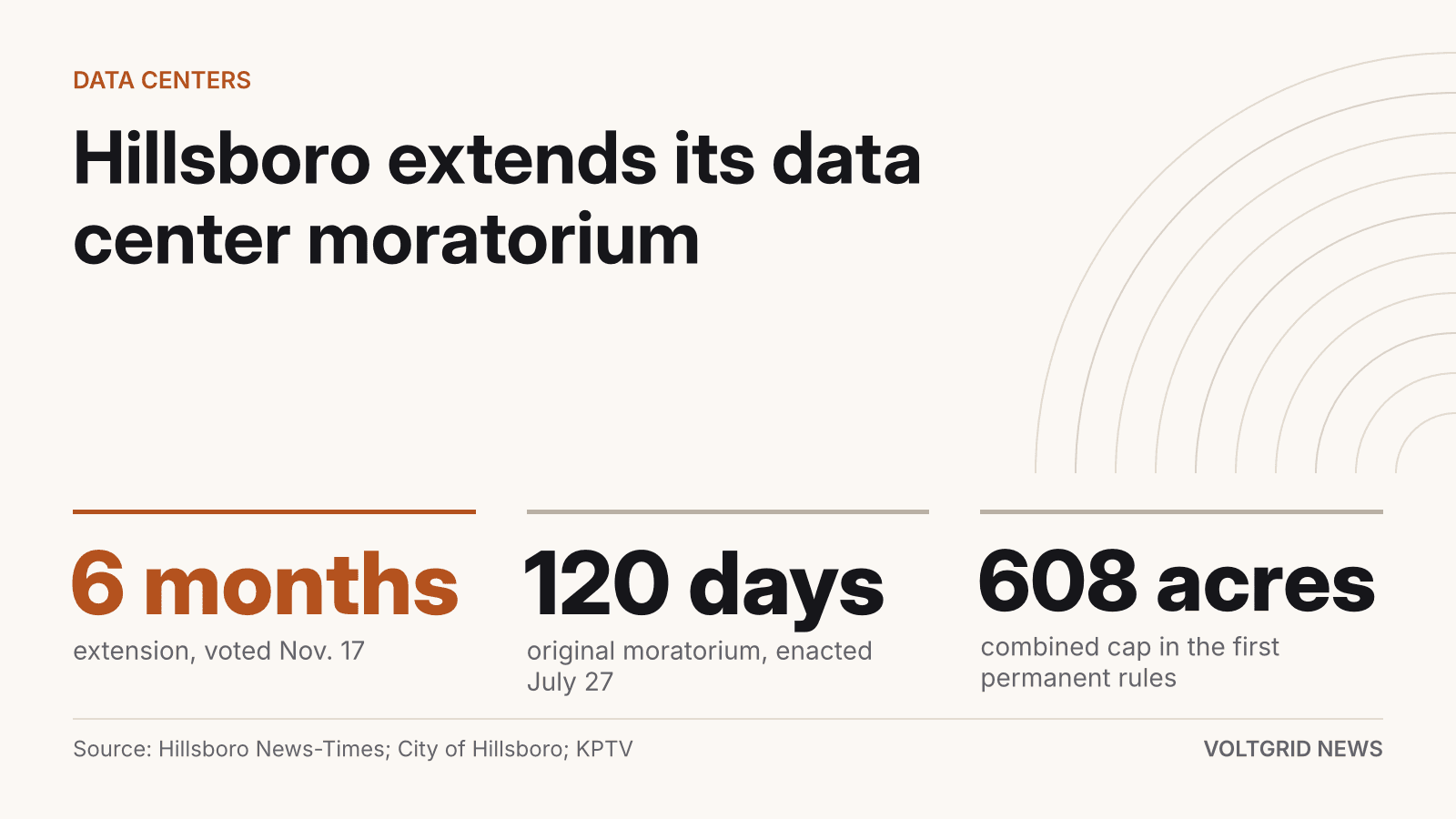
Hillsboro's council voted Nov. 17 to extend the moratorium by six months, as reported by the Hillsboro News-Times.
Graphic: Voltgrid News
The Hillsboro, Oregon, City Council voted unanimously on Nov. 17 to extend its moratorium on new and expanded data centers and battery energy storage systems by six months, the Hillsboro News-Times reported.
The Nov. 17 vote came a week before the original 120-day moratorium was due to expire on Nov. 24.
Graphic: Voltgrid News
The pause was set to lapse on Nov. 24. The city said in a Nov. 12 notice that the original 120-day moratorium was enacted on July 27 and that state law lets a council extend it for up to six months, the maximum. KPTV reported that the vote followed testimony from nearly a dozen residents, and that officials must show the problem behind the moratorium still exists, that reasonable progress is being made, and that a specific duration is set.
The extension keeps new and expanded data center and storage development on hold while the city finishes its studies. The city manager said the studies will be public, so the inputs behind the next rules will be visible before they are adopted.
What the Pause Covers
According to the News-Times, the moratorium sits on top of the city's first permanent rules, approved Oct. 20 and effective Nov. 19. Those limit standalone data centers mainly to the Industrial Park and Industrial Sanctuary zones and part of the Jackson East area, with a combined 608-acre cap across those areas. They also require public hearings for new standalone data centers, set a temporary 1,000-foot buffer between data centers and schools, and limit facilities used mainly for energy storage to 12 acres.
The resolution, as the News-Times described it, counts about 260 acres of data centers built or approved before December 2020 and another 322 acres since then, including projects in permitting or with land-use vesting. None of the reports gives a megawatt threshold or names the projects the pause holds. Neither does any report state Hillsboro's power demand or a utility's grid-connection timeline.
On water, the News-Times reported that City Manager Robby Hammond expects to pay for most of the studies from enterprise zone revenues, with some water-related costs possibly drawn from city water funds. KPTV quoted residents who asked whether groundwater would run dry and how much air pollution their children would face.
Studies and the Next Rule Round
Hammond said the city is finalizing contracts for its impact studies, and the environmental assessment is expected to take at least five or six months. The city chose the consulting firm ECOnorthwest for the economic study earlier in November, per the resolution. City attorney Chad Jacobs said the findings will shape a second round of code changes on building heights, buffers, green-building requirements and other environmental protections. Battery storage will be evaluated separately.
Hillsboro is one of several US localities that voted on pauses this month. Voltgrid News reported that Springfield extended its moratorium 120 days to Feb. 24, 2027, and that Oakland's council voted unanimously to hold new approvals until Oct. 5, 2027. Our tally of 17 moratorium cases since Oct. 1 puts the Hillsboro vote in that wider pattern.
What is not confirmed yet
The reports do not print the exact new end date. Six months from the Nov. 24 expiry points to late May 2027, but that is arithmetic, not a date from the resolution. Officials said they hope to finish the studies and the second round of amendments before mid-May, and Hammond said the city could seek another extension if more time is needed. KPTV did not report a tally, so the unanimous vote rests on the News-Times account.
Sources
- Published
- Sources
- 3 cited