Data Center Moratoriums, Lawsuits and Votes: 17 Cases Since Oct. 1
Of 17 data center moratoriums, lawsuits, votes and protests since Oct. 1, five state a megawatt figure: 4,854 MW in all, 4,434 MW of it in the US. None of the five is shown halted; approved sites keep moving.
Hardware & Analysis DeskEdited by Ege Erten
8 min readAI-assisted
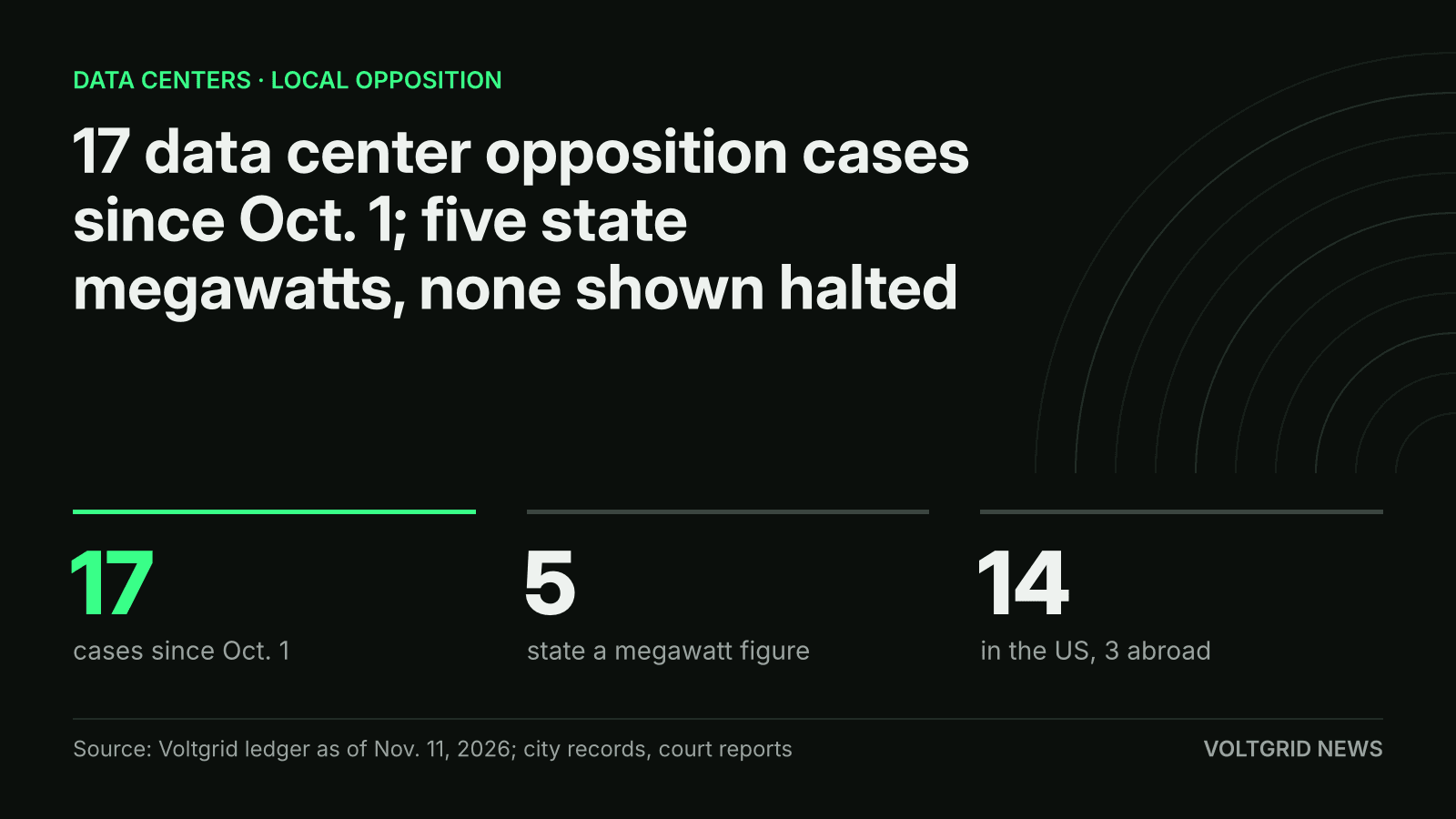
Voltgrid logged 17 data center moratorium, lawsuit, vote and protest cases since Oct. 1; none of the five with a stated megawatt figure is shown to be stopped.
Voltgrid News
Illustration (AI-generated)
Since Oct. 1, Voltgrid has logged 17 data center moratorium, lawsuit, vote and protest cases, 14 in the US and three abroad, and five of them carry a project megawatt figure in the public record: OpenAI's Project Camellia in Effingham County, Georgia (3,200 MW), Hermantown, Minnesota (500 MW), the Navy's NAVWAR site in San Diego (400 MW), Aurora, Colorado (334 MW) and Point Tupper, Nova Scotia (420 MW). They add to 4,854 MW, of which 4,434 MW is in the US. None of those five is shown to be stopped.
This ledger is as of Nov. 11, 2026 and counts a megawatt or dollar figure only where an official body, a court filing or a named outlet states it.
Data Center Moratorium Cases Since Oct. 1
A moratorium is a temporary freeze on new applications or approvals while a city writes its rules. It is not a ban and does not cancel permits already granted, so a pause can pass unanimously and still stop nothing. Seven cities adopted one in the period. San Diego's council ratified Mayor Todd Gloria's pause unanimously on Oct. 27, for 45 days with renewals possible. Memphis passed a 135-day pause on Oct. 20 after a 12-month moratorium failed 6-6, WSMV and Building Design + Construction reported. Mountain Home, Idaho, halted applications on Oct. 27, and Mooresville, North Carolina, approved 12 months on Nov. 2. Romulus, Michigan, voted unanimously on Nov. 9 for 180 days and widened its proposal from facilities of at least 1 GW to every size, WDIV reported. Boise followed on Nov. 10 with a pause of up to six months. Oakland, which adopted its 45-day pause on Oct. 6, voted unanimously on Nov. 10 to extend it to Oct. 5, 2027, The Oaklandside and NBC Bay Area reported; our report has the detail.
Seven of the 17 cases are adopted moratoriums and four are lawsuits; 14 are in the US and 3 abroad, as of Nov. 11.
Voltgrid News
Illustration (AI-generated)
Two efforts went the other way. Aurora, Colorado, fell one vote short of the seven needed to revisit a pause on Oct. 26, and a further attempt on Nov. 9 was not taken up, Sentinel Colorado reported. Sioux County, Iowa, lifted its moratorium on Oct. 27 and adopted an ordinance. At the ballot, Sunbury, Ohio, passed a charter ban on data centers of 25 MW or more by 2,809 to 763, according to unofficial Delaware County Board of Elections results. CNBC reported data center opponents ahead in every measure with results, out of 41 on ballots in 10 states, except Harwood, North Dakota; counts are unofficial.
Four legal cases (OpenAI's Camellia, Google's Botetourt and Hermantown, xAI's Southaven) and three protest or withdrawal cases (Amsterdam, Point Tupper, Sydney) complete the 17. In Amsterdam, protesters broke into Microsoft's construction site on Nov. 6, and police detained 150 to 200 people by their own early count. Stockland dropped its 25,400 m² Sydney data center from the Cooks Cove plan, which Australia's ABC linked to backlash though Stockland gave no reason.
Twelve of the 17 cases state no project megawatt figure in the reports cited here. Boise, Romulus and Mountain Home each report no application pending, so those pauses are preventive. The five figures differ in kind. Georgia Power says its contract to serve OpenAI's Effingham County project, filed with the Georgia Public Service Commission in July and since approved, includes 3,200 MW of new demand. MPR News says Hermantown's Google campus is expected to need 500 MW. Voice of San Diego reported that Manchester Financial Group was considering a 400 MW data center on the Navy's NAVWAR site, according to Times of San Diego; the land is federal, and Manchester says nothing is final. Vantage told The Denver Post that its Trident project in Aurora is designed to use 334 MW; Aurora had already accepted that application. EverWind's reported plans for Point Tupper, leased to Anthropic, call for 95 MW in 2027 and 420 MW by mid-2028; no moratorium exists in Nova Scotia, so that case is a protest. Together: 3,200 + 500 + 400 + 334 = 4,434 MW in the US, plus 420 MW in Canada, 4,854 MW in all.
The five megawatt figures are different kinds of number, and none of the five is shown to be stopped.
Voltgrid News
Illustration (AI-generated)
Dollars appear in three US cases: about $20 billion for OpenAI's Camellia campus, $3 billion for Google's Botetourt campus and $2 billion for Amazon's Sunbury plan, which is a proposal. As reported, they add to $25 billion (20 + 3 + 2), an approximate sum on mixed bases. Abroad, EverWind calls Point Tupper a $10 billion plan and ABC puts the Cooks Cove precinct in Sydney at about $3.5 billion, in Canadian and Australian dollars respectively; we leave both out of the US sum. For scale, SemiAnalysis, as Tom's Hardware reported, counts more than 300 local moratoriums and finds only three projects, about 2.3 GW of about 21 GW in moratorium areas, likely to be delayed, against about 38 GW of US data center IT capacity forecast for 2027. That is 11% of the capacity in moratorium areas (2.3 divided by 21) and 6% of the 2027 forecast (2.3 divided by 38). About 0.8 GW of the 2.3 GW comes from New York's state pause, the count leaves out Texas, and it dates from Oct. 17. Its 38 GW is IT capacity, ours is site demand on mixed bases, so the two are not like for like.
The 20 MW Threshold in Data Center Rules
Every moratorium or ban needs a trigger. Four local triggers sit between 10 MW and 25 MW. Boise's ordinance covers facilities larger than 100,000 sq ft or with projected demand of at least 20 MW at full buildout, CBS2 reported. Sunbury's ban starts at 25 MW, and Sioux County's September proposal capped at 25 MW. Emporia, Kansas, voters passed a ban on facilities above 10 MW peak load or 100,000 gallons of water a day, Route Fifty reported. The exception is Romulus, whose draft began at 1 GW, 50 times Boise's line (1,000 divided by 20), before the council widened it to every size.
At federal level the line has moved. The September draft of the Senate permitting bill, S. 5653, applied its data center ratepayer protections to loads of 20 MW or more, according to the bill text. The bill now moves as a substitute amendment to House bill H.R. 2347, released Nov. 7 and pending; per the Senate's published text, it has no megawatt threshold: it would bar shifting the incremental cost of serving any newly connected computing load onto other customers and give FERC 90 days to propose a rule, which could still set its own cutoff. The Senate voted 73-25 on Nov. 9 for cloture on the motion to proceed to H.R. 2347 (roll call 257) and 62-21 on Nov. 10 to proceed (roll call 258). Nothing has passed.
No ordinance or report cited here explains why 20 MW was chosen. A 4.5 MW Hillsboro, Oregon, purchase falls far below Boise's line, though Hillsboro has its own moratorium in force, while Hermantown's 500 MW is 25 times Boise's line (500 divided by 20) and Point Tupper's 420 MW is 21 times it.
Data Center Lawsuits: No Halt Order in Four Cases
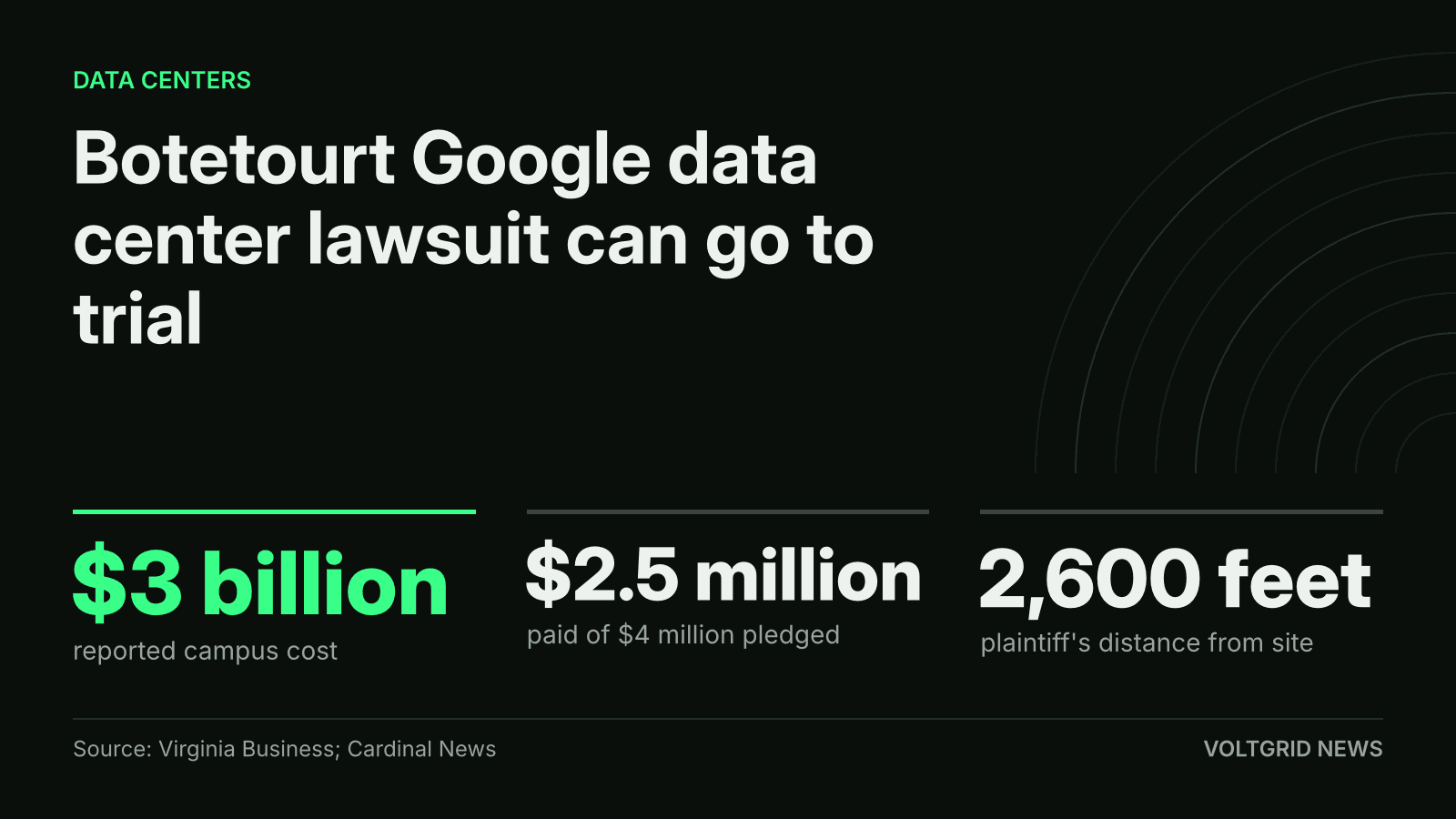
In Botetourt County, Virginia, Judge Michael Doucette ruled on Nov. 10 that a resident's FOIA suit over the Google deal can proceed, Cardinal News reported. The suit concerns the June 24, 2025, approval of an agreement for a $3 billion campus; it alleges a closed meeting off the agenda, then a 5-0 vote without discussion. The county's plea on remedies is still open, a further hearing is set for Monday, Nov. 16, and grading has begun.
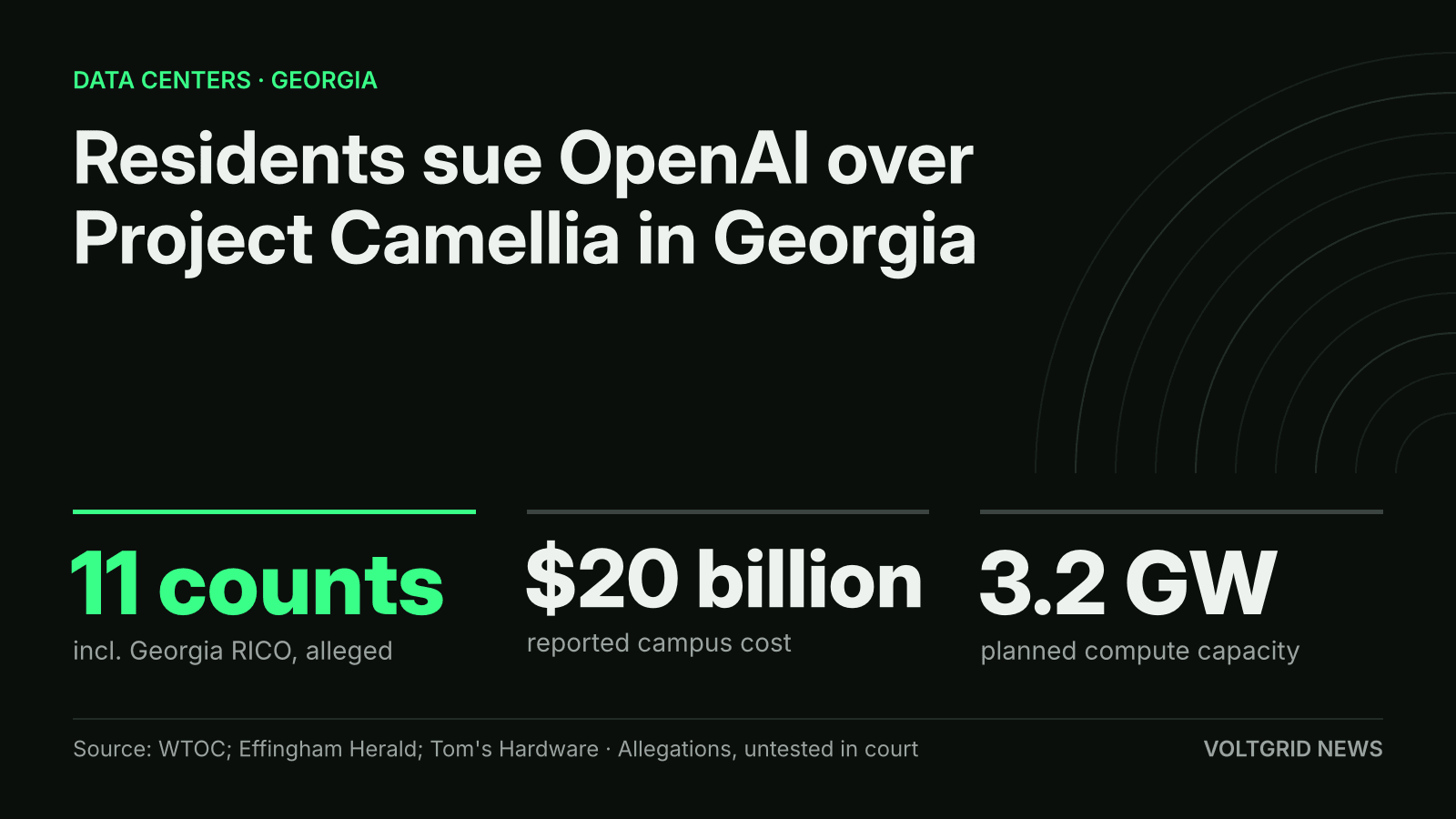
In Effingham County, Georgia, three residents filed the third Project Camellia suit on Nov. 6, alleging fraud and racketeering over OpenAI's roughly $20 billion campus, WTOC reported. They seek damages, not a halt. In Minnesota, two groups appealed Hermantown's second environmental review on Nov. 4, KAXE reported; MPR News counted three suits pending against the project on Oct. 31, before that filing. A week earlier Google settled over its Pine Island site by agreeing to a state-run review; that settlement, outside this ledger, is the only court-linked outcome here that changes how a project is reviewed. In Southaven, Mississippi, a noise suit over xAI's 69 turbines continues, and a reported buyout of 418 homes is unconfirmed by xAI.
The cross-reading is that none of the four legal cases has produced an order halting construction. Camellia seeks damages, Botetourt an undone agreement, Hermantown a new environmental review and Southaven noise relief. One Michigan case sits outside the count: Attorney General Dana Nessel's appeal, briefed on Aug. 6, 2026, challenges a state commission's approval of DTE contracts for what her release calls a 1.4 GW hyperscale AI data center in Washtenaw County. It is a utility-contract case with no event since Oct. 1, and no ruling has been reported.
Data Centers Moving Ahead Despite Opposition
Hermantown's council unanimously passed six resolutions on Oct. 30, including the special-use permit, Northern News Now reported; the approval still needs a Minnesota Public Utilities Commission vote on the power contract. Botetourt is grading. Effingham staff recommended approving the Camellia site plan, which commissioners tabled to Nov. 17.
For engineers and investors, the pattern is that local instruments act on applications not yet filed, while approved sites reach grading. Boise, Romulus and Mountain Home have nothing on file, Trident was accepted before any pause, and NAVWAR is federal land. The larger constraint is the grid. Texas has paused new grid connections for data centers since Aug. 3 until ERCOT and the Public Utility Commission of Texas finish an audit, per Houston Public Media; ERCOT then counted 474 GW of large-load requests, about 90% from data centers. The law firm Bracewell expects the pause to last to mid-December, Tom's Hardware reported. Governor-elect Gina Hinojosa has pledged a moratorium.
What to Watch: Hearing and Vote Dates
Nov. 16: the next Botetourt hearing; the county's plea on remedies is still open. Nov. 17: Effingham commissioners are due to take up the Camellia site plan they tabled on Nov. 3. Nov. 23: Aurora's council is due to take up a new moratorium that needs six votes, Sentinel Colorado reported. About Dec. 11: San Diego's 45-day pause ends unless renewed, counting from the Oct. 27 ratification. Mid-December: when Bracewell expects the Texas audit to end and the pause to lift. About March 4, 2027: Memphis's 135 days end, counting from Oct. 20. About May 8, 2027: Romulus's 180 days end, counting from Nov. 9. Up to May 10, 2027: Boise's pause ends. Oct. 5, 2027: Oakland's extended pause ends, unless the council adopts rules sooner. Not dated: the Minnesota commission's vote on Hermantown's power contract, Senate amendments and a final vote on the permitting bill, and the certified Sunbury result.
Sources
- 01AG Nessel briefs appeal over MPSC approval of DTE Saline contractsMichigan Attorney General · michigan.gov
- 02Mayor Gloria statement on council ratifying moratoriumCity of San Diego · sandiego.gov
- 03Environmental groups sue Hermantown, GoogleKAXE · kaxe.org
- 04Senate roll call list (vote 258)U.S. Senate · senate.gov
- 05Congressional Record, Senate, Nov 10 (SA 6883)U.S. Senate · govinfo.gov
- 06S. 5653 as introducedU.S. Government Publishing Office · govinfo.gov