Huang's Reported $2,000 GPU Fee Hints at an Agent Software Subscription
Jensen Huang reportedly put NVIDIA agent software at about $2,000 per GPU a year at GTC Berlin, below the $4,500 one-year AI Enterprise list. NVIDIA has published no such price.
5 min readAI-assisted

Press image from NVIDIA's OpenShell Reference Architecture release; it shows the launch hardware, not the software fee.
Image: NVIDIA
Source · Press image from the NVIDIA newsroom, used for news reporting.
NVIDIA chief executive Jensen Huang put the cost of running NVIDIA agent software at about $2,000 per GPU per year at GTC Berlin on Oct. 22, according to The Register and Tom's Hardware. If the figure holds, it would point to a plan for AI agents: give the security runtime away, then charge a yearly fee on every GPU that runs agents in production.
That reading rests on one reported remark, and NVIDIA has not published the price. Its licensing FAQ lists no dollar figures, and no transcript of the remark was found for this piece. The $2,000 is a remark attributed to Huang by The Register and, citing it, Tom's Hardware. The Register paraphrases, only Tom's prints a direct quote, and the two are not independent. It is not an NVIDIA price list.
What Huang Said at GTC Berlin
The Register first reported the figure on Oct. 22 in its account of Huang's appearance in Berlin. It wrote that he priced a licence for NVIDIA's software stack at roughly $2,000 per GPU a year. Tom's Hardware followed on Oct. 25, citing The Register. It quoted Huang saying that software licensing will become a growing part of NVIDIA's business, and that the $2,000 covers all the NVIDIA software that runs agents in what he calls AI factories. The two framings differ: "software stack" is broader than "software that runs agents", and neither outlet says which products are included.
The remark came one day after NVIDIA launched its OpenShell Reference Architecture on Oct. 21, as Voltgrid reported. In NVIDIA's release, the design runs model inference on Vera Rubin systems and agent harnesses on Vera CPUs. BlueField-4 data processing units (DPUs) run NVIDIA Sentry, which watches agent behaviour out of band and enforces policy in hardware. NVIDIA says the design is available now, with Dell, Cisco, HPE, Lenovo and Supermicro building systems around it.
Why a Free Runtime Feeds a Per-GPU Fee
The first step is what NVIDIA gives away. Its licensing FAQ lists OpenShell as free, open-source software alongside Triton, Dynamo, NeMo and RAPIDS. The paid tier is a set of Enterprise Products, such as NVIDIA AI Enterprise and Mission Control, sold with support. The runtime that keeps agents inside their boundaries therefore costs nothing to adopt.
The second step is how NVIDIA charges for the paid tier. The same FAQ says the company typically licenses enterprise software per GPU, as annual subscriptions priced per seat or per GPU-year, typically on 1, 3 or 5-year terms, or per GPU-hour on cloud marketplaces. A per-GPU licence means NVIDIA's software income grows with every accelerator in an agent rack, not with the number of users or agents.
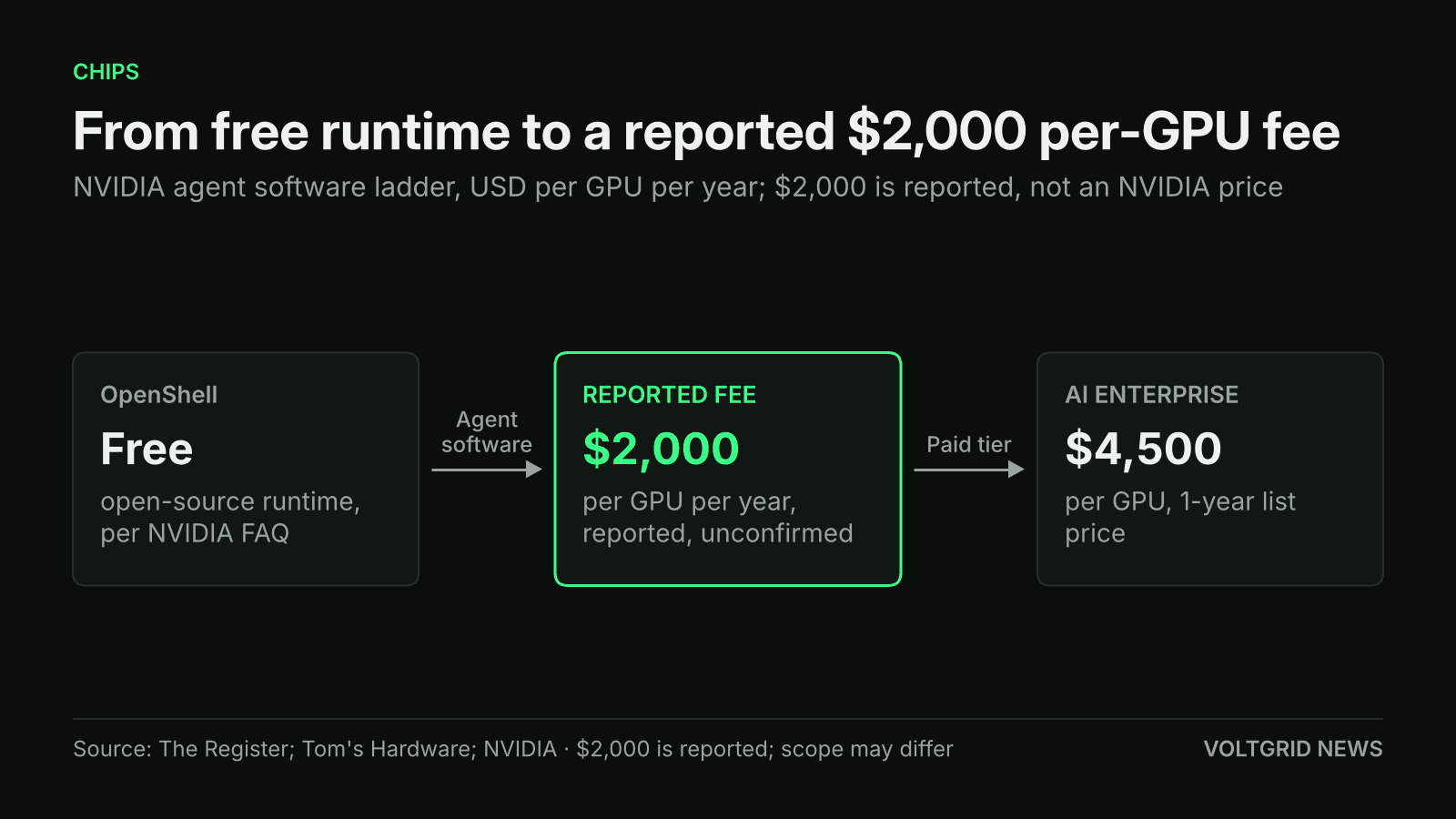
The $2,000 is a reported remark, not an NVIDIA price, and NVIDIA has not said it covers the same products as the $4,500 list.
Illustration (AI-generated)
The third step is the price. NVIDIA's own AI Enterprise pricing page lists a one-year subscription at $4,500 per GPU for self-managed systems, $13,500 for three years and $18,000 for five years, which NVIDIA describes as five years for the price of four. On cloud marketplaces it lists $1 per GPU per hour on top of the instance cost. Huang's reported $2,000 sits well under the one-year list price. One possible reading is an agent-focused bundle priced to raise the share of GPUs that carry any paid NVIDIA software at all. Tom's Hardware cautions that NVIDIA has not confirmed the two prices cover the same products or terms, and that the figure should not be treated as a confirmed price cut.
Put together, the argument is that agent security gives NVIDIA a reason to sell software on GPUs it already sold. If enterprises want a supported, accountable stack before letting agents act on their systems, a free runtime brings them in and a per-GPU subscription collects the revenue.
Why the $2,000 Figure Is Thin Evidence
The evidence is thin. One reported sentence, with no transcript and no NVIDIA document behind it, cannot establish a price, a product or a scope. NVIDIA's FAQ also says customers agree price, quantity and payment terms with channel partners, resellers, OEMs and cloud marketplaces, not with NVIDIA. Street prices may therefore differ from any figure Huang names.
Paid attach is also not guaranteed. NVIDIA's pricing page says the five-year AI Enterprise subscription comes included with H100, H200 NVL and A800 PCIe GPUs, so a share of the installed base already carries the software without a separate purchase. Much of the agent stack, OpenShell included, is free, and the large clouds meter NVIDIA software by the hour. A buyer can run agents on NVIDIA hardware without a yearly NVIDIA licence.
What counts as a GPU has changed before. The Register reported in April 2025 that NVIDIA began counting each die as a GPU on HGX B300 NVL16 systems, which could double licence counts per box. At the time NVIDIA told the outlet that AI Enterprise pricing for B300 and Rubin was not final. A per-GPU fee is only as clear as the GPU definition behind it.
What a Per-GPU Fee Means for Buyers
For operators, the unit of cost is the accelerator. NVIDIA describes Vera Rubin NVL72 as a rack of 72 Rubin GPUs and 36 Vera CPUs, so if each Rubin GPU package counts as one GPU, an agent deployment on that rack would carry 72 licences under a per-GPU model, on top of the hardware. NVIDIA has not said how Vera Rubin GPUs are counted. Whether Vera CPUs or BlueField-4 DPUs add separate licences has not been stated.
For investors, the revenue case so far is a third-party scenario, not guidance. Tom's Hardware cited a scenario from FourWeekMBA that assumes 10 million eligible enterprise GPUs shipped in a year and a 50% paid attach rate. At $2,000 each, that third-party scenario reaches $10 billion a year, or $50 billion over five years if every subscription renews. The Register put NVIDIA's fiscal 2026 revenue at $215.9 billion. NVIDIA has not said how many GPUs carry paid software today.
For partners, the release names security vendors CrowdStrike, Palo Alto Networks, Zscaler and Okta as integrating OpenShell support, and ServiceNow as enforcing its Arc agent through OpenShell. If NVIDIA prices a supported agent layer per GPU, those vendors sell into racks where NVIDIA already collects a software fee.
What to Watch in NVIDIA's Pricing
The first test is documentation. A line for agent software, Sentry or OpenShell support on NVIDIA's pricing page would confirm the $2,000 figure and its scope; its absence keeps it a remark. The second is NVIDIA's next quarterly report, for any software or subscription revenue figure. The third is how NVIDIA counts GPUs in Vera Rubin licences, which sets the bill per rack.