India Bans Lithium-Ion Black Mass Exports in DGFT Notice 49/2026-27
India's DGFT moved black mass (HS 85491400) from Free to Prohibited on Nov. 10, with no volume data yet, to feed recyclers backed by the ₹1,500 crore critical-minerals scheme.
Policy & Economics DeskEdited by Ege Erten
3 min readAI-assisted
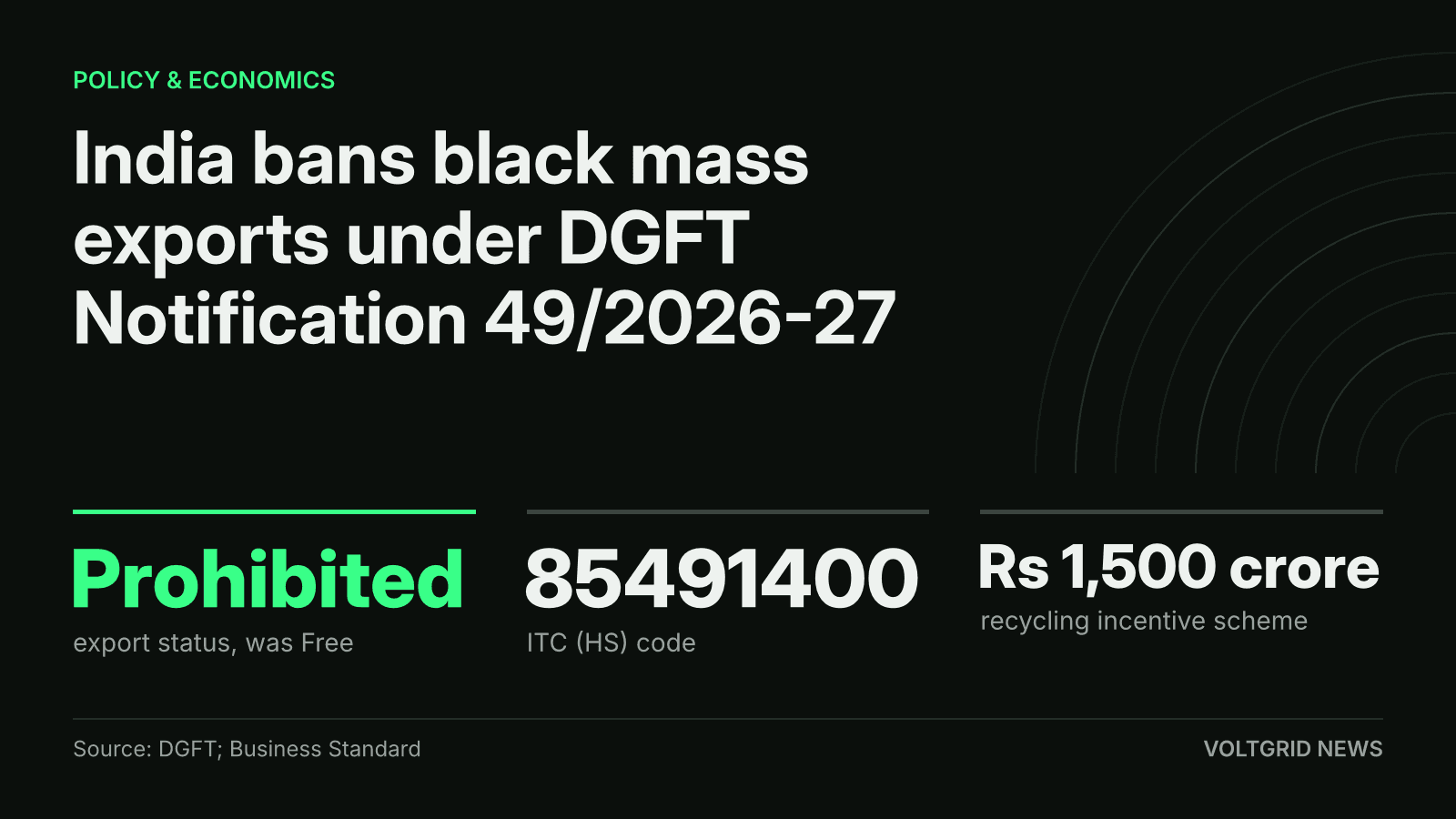
DGFT Notification 49/2026-27 moves ITC (HS) 85491400, which names black mass, from Free to Prohibited.
Illustration (AI-generated)
India's Directorate General of Foreign Trade (DGFT) moved lithium-ion battery black mass from "Free" to "Prohibited" exports in Notification No. 49/2026-27, dated Nov. 10, 2026, with immediate effect and "until further orders".
The notification, signed by Director General Lav Agarwal under the Foreign Trade (Development & Regulation) Act, 1992, amends ITC (HS) code 85491400: unsorted waste and scrap of primary cells, batteries and accumulators that contains no lead, cadmium or mercury. The notification text puts black mass in that line in brackets. It also says the transitional arrangement in Para 1.05 of the Foreign Trade Policy 2023 applies. Business Standard and ANI reported the order on Nov. 11, and Mercom India carried it too.
What the order changes
Black mass is the powder left when end-of-life lithium-ion batteries and battery-factory scrap are shredded. According to the Department of Commerce's release, as quoted by Business Standard, it holds recoverable lithium, cobalt, nickel and manganese. Until Nov. 10 the entry sat in the "Free" export category. Now exports are barred unless the DGFT amends the entry again.
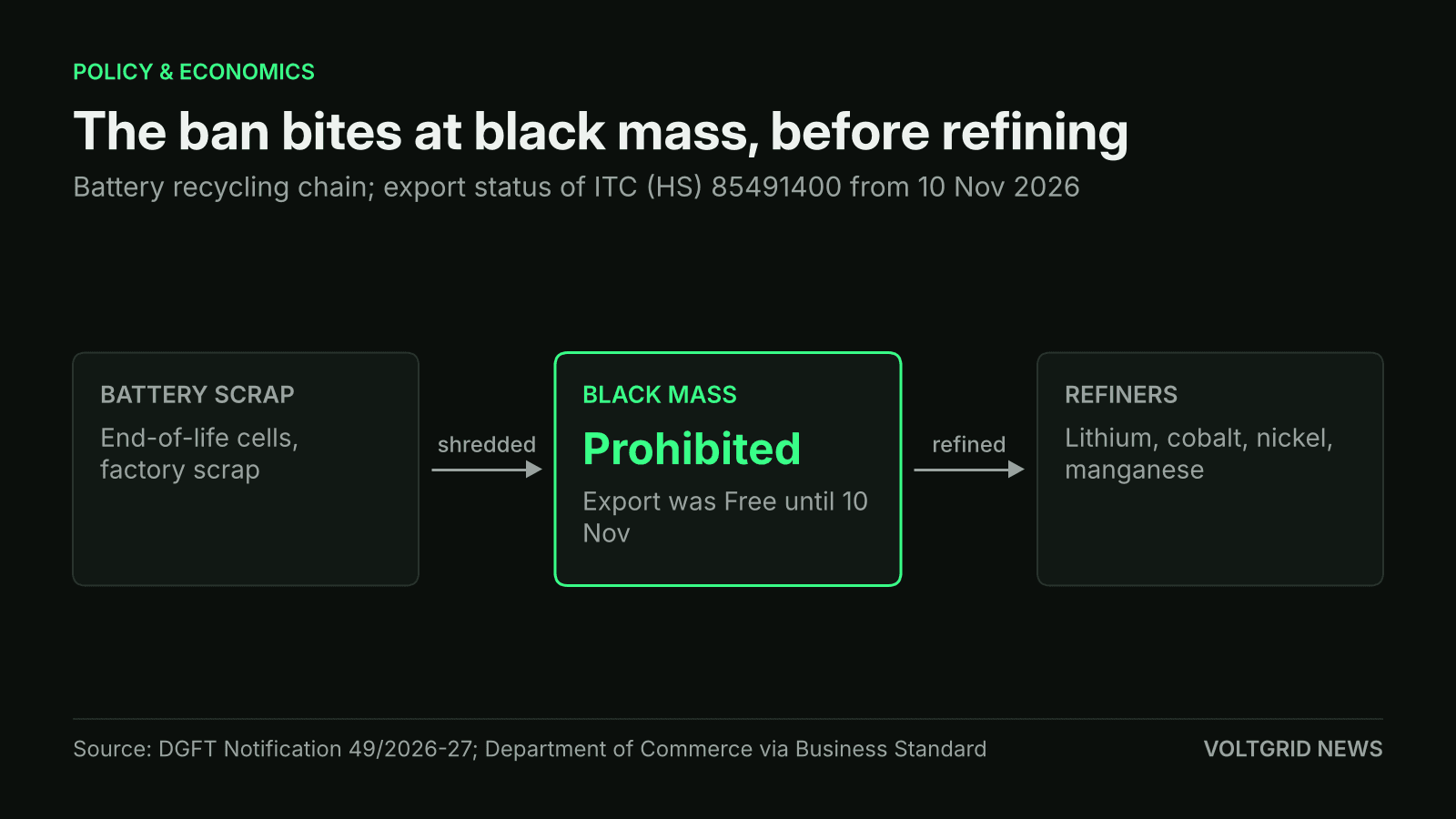
The export ban sits at the black mass step: the category was Free until 10 Nov and is now Prohibited.
Illustration (AI-generated)
The order is narrow. ANI's report notes that it is not a blanket ban on every battery or battery-related material, only on the unsorted category the notification names.
The Commerce release says India's capacity to recycle battery waste and recover critical minerals has grown but is under-used because feedstock is short. It adds that some domestic recyclers have had to import material while Indian-generated black mass went overseas. Keeping the powder at home, the ministry argues, raises capacity utilisation at recycling and refining units and could draw fresh investment.
The ministry ties the order to the National Critical Mineral Mission and its ₹1,500 crore incentive scheme for recycling, approved by the Union Cabinet in September 2025. The release says retaining black mass will give the recycling capacity built under that scheme adequate domestic feedstock.
Who gains, and what is not yet visible
Refiners that separate and produce critical minerals gain first, because the domestic supply of black mass can no longer leak out. Cell makers and EV and storage manufacturers gain only indirectly: the government expects stronger supply chains for batteries, electric vehicles and energy storage, but the notification gives no volume, price or tonnage. Voltgrid has not found a published figure for how much black mass India produces or recovers.
One number puts the immediate effect in proportion. Ajay Srivastava, founder of the Global Trade Research Initiative, told Business Standard that India recorded zero exports of the product in 2025-26. On that account the ban closes a door that was not yet in use, rather than cutting an existing trade. That figure is Srivastava's, not the DGFT's.
Srivastava also flagged an enforcement gap. Hazardous-waste rules already require prior permission for such shipments, he said, but exporters can declare black mass as cobalt powder, a nickel intermediate or another industrial product. Customs, in his view, will have to check how material was produced as well as how it was declared.
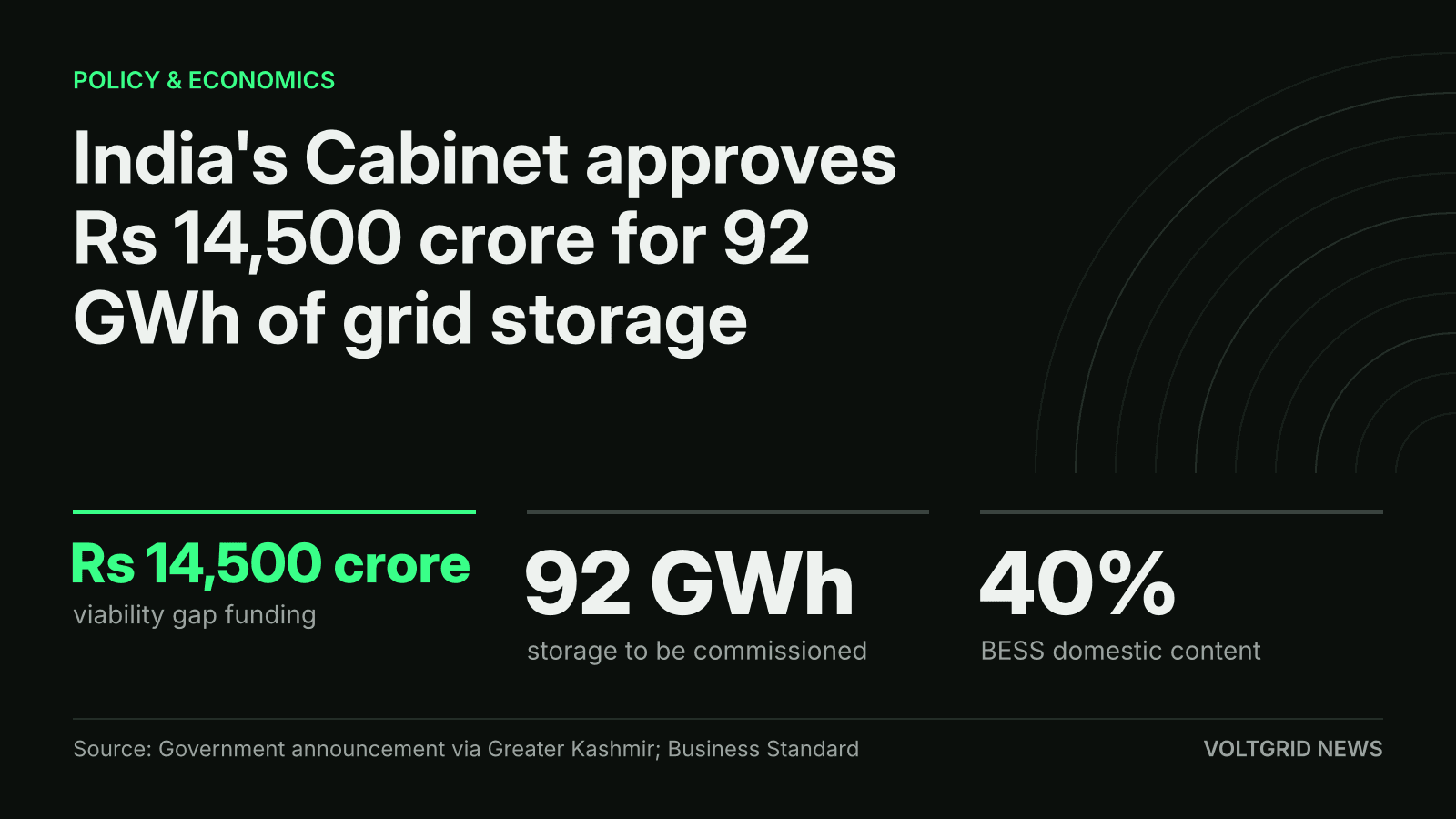
India is also funding battery demand: Voltgrid reported earlier on the ₹14,500 crore viability-gap funding for 92 GWh of grid storage. The two policies sit on opposite ends of the same battery supply chain.
What is not confirmed yet
The notification says it is to be published in the Gazette of India, Extraordinary; Voltgrid read the DGFT's posted PDF, not the Gazette copy. The text does not say how Para 1.05 will treat contracts signed before Nov. 10, and no customs circular on enforcement has been seen. Mercom India's full report was behind a registration wall, so Voltgrid relied on its opening paragraph only. Which recyclers hold spare capacity, and whether the ban changes what they pay for feedstock, has not been reported.
Sources
- 01India Prohibits Export of Lithium-Ion Battery Black MassMercom India · mercomindia.com
- 02DGFT Notification No. 49/2026-27: black mass export policy amended to ProhibitedDGFT (Ministry of Commerce) · dgft.gov.in
- 03Govt bans lithium-ion battery black mass exports to aid domestic recyclersBusiness Standard · business-standard.com