NTT Docomo Business, 3 Partners Trial Data Center Heat for Shrimp
NTT Docomo Business, IMT Engineering, Hibiya Sogo Setsubi and NTT Green & Food will recover heat from a Tokyo-area data center in FY2026 and raise shrimp on it in FY2027.
3 min read
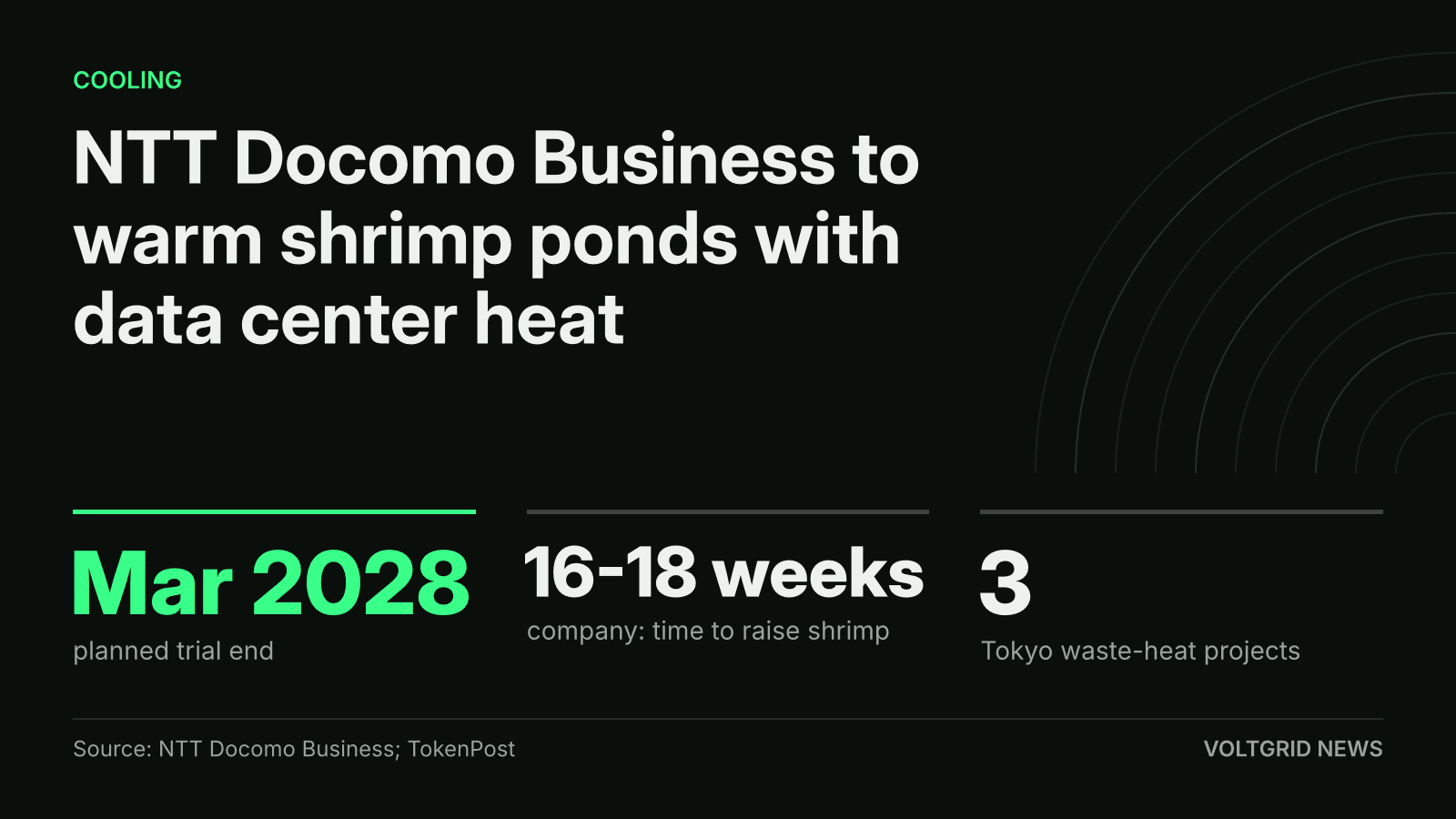
Planned trial end, the company's 16-18 week rearing time and the three Tokyo data center waste-heat projects.
Graphic: Voltgrid News
NTT Docomo Business and three partners said on Nov. 13 that they will recover heat from a data center cooling system near Tokyo and use it to warm ponds for whiteleg shrimp, in a trial that runs to March 2028.
The four companies are NTT Docomo Business, IMT Engineering, Hibiya Sogo Setsubi and NTT Green & Food. According to their joint release, heat recovery at the NTT Docomo Business data center starts within the current fiscal year, and shrimp farming on that heat follows in fiscal 2027. The release gives the site only as a data center in the Tokyo suburbs and names no facility.
The project is one of three data center waste-heat experiments chosen under the Tokyo Metropolitan Government's program for startups and data center operators, according to TokenPost. It reports that startups in the selected projects may receive up to ¥20 million each, tax included, for fiscal 2026 experiment costs. Voltgrid News reported earlier on Google and ENGIE's Châteauroux heat-reuse memorandum, another plan that so far only studies reuse.
Why Low-Grade Heat Is the Problem
The release says most data center power ends up as heat released to the air, and that the heat is relatively low in temperature, which has limited what it can be used for. Land-based aquaculture is attractive because output does not depend on weather or sea conditions, but holding pond water at a set temperature takes heating energy, which the release calls a major obstacle to running such farms as a business. The partners want one cost to offset the other.
For cooling engineers the useful output is not the shrimp but the sizing rule. In fiscal 2027 the partners also aim to build a design method that derives the right farm size from a data center's cooling method and heat conditions, which differ from site to site. Such a rule, if the trial yields one, would let an operator judge a site's potential before building anything.
What Each Partner Does
IMT Engineering designs the aquaculture system and runs the rearing trial. NTT Docomo Business supplies the data center and assesses the effect on its facility equipment. Hibiya Sogo Setsubi designs and builds the heat-recovery and heat-supply equipment. NTT Green & Food handles sensing and monitoring of the rearing environment and evaluates production-cost savings and business viability.
In fiscal 2026 the partners will take heat from the cooling equipment, record its quantity and temperature, and judge which recovery method suits aquaculture. In fiscal 2027 they will check that the heat holds the water temperature, how much heating energy it saves and that data center operations are unaffected, according to the release. TokenPost quotes an NTT Docomo Business representative saying land-based methods can raise whiteleg shrimp in 16 to 18 weeks, and that the company may consider shipping the shrimp if they are suitable, with no recipient or timing decided.
The partners plan to recover heat in FY2026 and rear shrimp on it in FY2027, with the trial running to March 2028; NTT Green & Food monitors and evaluates cost.
Graphic: Voltgrid News
What Is Not Confirmed Yet
The release states no heat temperature, no heat quantity in kW or MW, no pond or tank size, no heating-energy saving and no investment figure, and XenoSpectrum notes the same gap. Those are the numbers the fiscal 2026 measurements are meant to produce. The release also describes its work plan as a draft. The partners have not said which cooling method the host site uses, so it is unclear whether the heat comes from air-cooled or liquid-cooled equipment. The trial is scheduled to run to March 2028, and no interim results date has been given.
Sources
- 01Joint release: data center waste heat to be used for land-based aquaculture (NTT Docomo Business)NTT Docomo Businessntt.com
- 02Data center waste heat to raise shrimp: four companies start a land-based aquaculture trialXenoSpectrumxenospectrum.com
- 03NTT docomo business Plans Data Center Heat Test for Shrimp FarmingTokenPosttokenpost.com
- Published
- Sources
- 3 cited