First published Changes log
Trane CDU Rated Up to 2.5 MW: 11 Vera Rubin Racks at 227 kW, by Our Math
By our math, a coolant distribution unit Trane rates at up to 2.5 MW at a 4°C approach covers 11 Vera Rubin NVL72 racks at 227 kW. CoolIT and Supermicro name fewer racks for their own units than the same math gives.
9 min read
- Vera Rubin NVL72 at 227 kW per Trane CDU rated up to 2.5 MW
- 11.0racksby Voltgrid's arithmetic
- GB300 NVL72 at 142 kW per Trane CDU rated up to 2.5 MW
- 17.6racksby Voltgrid's arithmetic
- GB300 NVL72 per CHx2000, up to: CoolIT's own claim
- 12racks2,000 kW at 5°C ATD
- Coolant inlet NVIDIA lists for Vera Rubin NVL72
- 45°C
As ofSourceNVIDIA, Vera Rubin datasheet, Trane, LiquidStack CDU-2.X, Schneider Electric, GB300 NVL72 design, CoolIT, CHx2000Racks per CDU is Trane's rating of up to 2.5 MW at 4°C ATD divided by the rack's published power, with all rack power counted as heat to the liquid; redundancy, flow and pressure limits are left out, and they lower it.
A coolant distribution unit (CDU) Trane rates at up to 2.5 MW covers 11 NVIDIA Vera Rubin NVL72 racks at 227 kW each by Voltgrid's arithmetic, or 17.6 GB300 NVL72 racks at 142 kW.
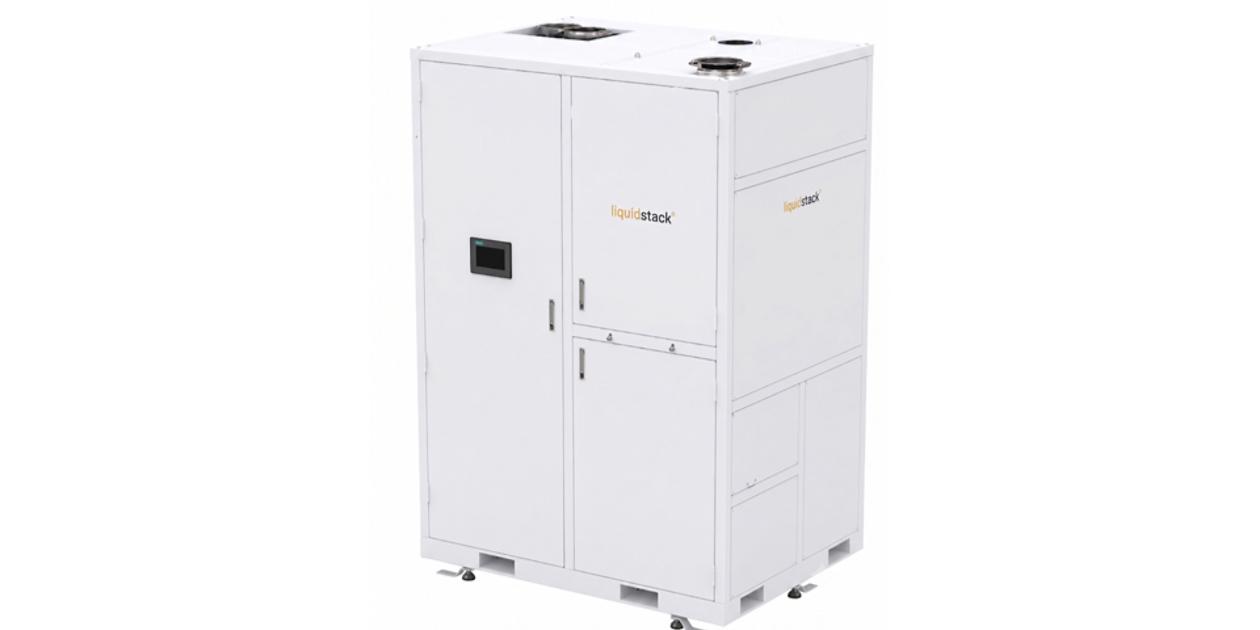
The LiquidStack CDU-2.X, which Trane rates at up to 2.5 MW of cooling at a 4°C approach. By our math, one unit covers 11 Vera Rubin NVL72 racks at 227 kW.
Image: Trane Technologies
Source · Official product image from Trane's CDU-2.X product page, used for news reporting.
The inputs are the companies' own published figures. NVIDIA's Vera Rubin datasheet lists 227 kW per rack at MaxP, its highest power setting, with a 45°C coolant inlet. Trane rates its LiquidStack CDU-2.X at up to 2.5 MW at a 4°C approach (ATD), meaning the coolant it sends to the racks runs 4°C above the facility water coming in. Schneider Electric's GB300 NVL72 reference design plans for racks of up to 142 kW. CoolIT, which publishes its own count, says its CHx2000, rated 2,000 kW at a 5°C approach, cools up to 12 GB300 NVL72 racks, where Voltgrid's division at 142 kW a rack gives 14.1.
The count is moving from data sheets into designs and factories. Daikin Applied's D60-W design for NVIDIA's DSX platform, released on Nov. 10, puts seven 2.3 MW CDUs in each block of its 60 MW plan, as Voltgrid reported. Modine began making 2 MW and 3 MW Airedale chillers in Texas a day later (our report), and Vertiv says its new PowerStation panel can cut power to a single rack when a coolant leak is detected (our report).
How much heat does one AI rack send into the liquid?
NVIDIA gives three power figures for a Vera Rubin NVL72 rack of 72 Rubin GPUs and 36 Vera CPUs: 227 kW at MaxP, 187 kW at MaxQ and 156 kW under MaxLPS, the power-management suite of its DSX platform. NVIDIA says Vera Rubin infrastructure supports 100% liquid cooling with coolant at up to 45°C, so the count here treats the whole rack power as heat that the coolant carries to the CDU.
For the GB300 NVL72, the figures come from partners. Supermicro's rack specification lists total power of 132 kW for its power shelves, and Schneider Electric's reference design for GB300 NVL72 clusters, published in September 2025, sets a maximum rack density of 142 kW. NVIDIA describes its DGX GB200 racks as cooled by both liquid and air; where part of a rack's heat leaves by air, a count against full rack power understates what a CDU can carry. Lenovo's guide to its GB300 NVL72, updated on Aug. 30, 2026, puts the rack at 135 kW of thermal design power and up to 155 kW at peak, with about 90% of the heat going to liquid.
The step between generations is large. A Vera Rubin rack at MaxP draws 1.6 times the 142 kW maximum of Schneider Electric's GB300 NVL72 design, by our arithmetic. NVIDIA's answer is power management: it claims DSX MaxLPS can produce the same number of tokens with up to 30% less power.
How many racks can one 2.5 MW CDU carry?
Divide the rating by the rack and the count falls as racks get denser. With Trane's 2.5 MW rating at a 4°C approach, Voltgrid's arithmetic gives 18.9 GB300 NVL72 racks at Supermicro's 132 kW and 17.6 at Schneider's 142 kW maximum. For Vera Rubin NVL72 it gives 16.0 racks at 156 kW under MaxLPS, 13.4 at 187 kW under MaxQ and 11.0 at 227 kW under MaxP.
A 2.5 MW-rated CDU covers 18.9 GB300 racks at 132 kW but 11.0 Vera Rubin racks at MaxP
Racks per CDU by Voltgrid's arithmetic: Trane's 2.5 MW rating at 4°C ATD divided by each rack's published power
NoteAll rack power is counted as heat to the liquid loop. Not a design count: redundancy, flow and pressure limits are left out, and they lower it.
SourceNVIDIA, Vera Rubin datasheet, Trane, LiquidStack CDU-2.X, Supermicro, SRS-GB300-NVL72, Schneider Electric, GB300 NVL72 design
As of
Data table
| Category | Racks per 2.5 MW CDU (racks) |
|---|---|
| GB300 NVL72 at 132 kW (Supermicro) | 18.9 |
| GB300 NVL72 at 142 kW (Schneider max) | 17.6 |
| Vera Rubin NVL72 at 156 kW (MaxLPS) | 16.0 |
| Vera Rubin NVL72 at 187 kW (MaxQ) | 13.4 |
| Vera Rubin NVL72 at 227 kW (MaxP) | 11.0 |
Not every rack needs a row-level unit. Supermicro also lists an in-rack CDU of up to 250 kW for its GB300 NVL72 rack, which serves one rack at a time. The large units are built to serve a row or a hall, and they are where the count of racks per CDU decides how many units, pipes and floor positions a hall needs.
What do the makers' ratings promise, and under what conditions?
Voltgrid's table takes eight CDUs in the 1.8 MW to 2.5 MW class with a published rating, each on its maker's own terms; the list is not complete, and Delta, for one, lists an in-row CDU of up to 2.4 MW. Trane rates the LiquidStack CDU-2.X at 2.5 MW at a 4°C approach and 2.0 MW at 3°C; Network World reported that it takes pre-orders and ships from the second quarter of 2027. Cooler Master rates its in-row unit at 2,500 kW at 5°C and 1,500 kW at 4°C, and Data Center Frontier reported mass production due in the fourth quarter of 2026. Motivair, Schneider Electric's liquid-cooling arm, lists CDUs of up to 2.5 MW per unit, and FläktGroup has built its first 2.5 MW refrigerant-based DX CDU; neither states an approach.
Vertiv gives its CoolChip CDU 2300kW a nominal 2,300 kW at 4°C in its data sheet, and NVIDIA lists it as DSX Ready, meaning qualified for its DSX platform. Daikin Applied gives 2.3 MW at a 4°C approach for the CDU in its design, from a CDU line that its page puts at 1 MW to 3.5 MW and that is in development for the second half of 2027. CoolIT rates the CHx2000 at 2,000 kW at 5°C, and Supermicro lists an in-row CDU of up to 1.8 MW; both are in their makers' product lines. By our arithmetic, the eight headline ratings cover 12.7 to 17.6 GB300 racks at 142 kW, and 7.9 to 11.0 Vera Rubin racks at 227 kW.
| CDU | Maker's rating and condition | GB300 NVL72 at 142 kW | Vera Rubin NVL72 at 227 kW | Status |
|---|---|---|---|---|
| Trane LiquidStack CDU-2.X | 2.5 MW at 4°C ATD; 2.0 MW at 3°C | 17.6 | 11.0 | Pre-orders; ships Q2 2027 |
| Cooler Master in-row CDU | 2,500 kW max at 5°C ATD; 1,500 kW nominal at 4°C | 17.6 | 11.0 | Mass production due Q4 2026 |
| Motivair (Schneider Electric) CDU | Up to 2.5 MW per unit; no condition stated | 17.6 | 11.0 | In product line |
| FläktGroup DX CDU | 2.5 MW, refrigerant-based; no condition stated | 17.6 | 11.0 | First unit built |
| Vertiv CoolChip CDU 2300kW | 2,300 kW nominal at 4°C ATD | 16.2 | 10.1 | In product line; DSX Ready |
| Daikin Applied CDU (D60-W) | 2.3 MW at 4°C approach | 16.2 | 10.1 | In development; H2 2027 |
| CoolIT CHx2000 | 2,000 kW at 5°C ATD | 14.1 | 8.8 | In product line |
| Supermicro in-row CDU | Up to 1.8 MW; no condition stated | 12.7 | 7.9 | In product line |
NoteRack counts divide each maker's headline rating by the rack's power. Three makers state no condition: Motivair, FläktGroup and Supermicro. Shipping dates for Trane and Cooler Master are as reported by Network World and Data Center Frontier.
SourceTrane, Cooler Master, Motivair product pages, FläktGroup, release of Oct. 14, 2026, Vertiv data sheet; Daikin Applied D60-W page, CoolIT and Supermicro product pages
As of
The condition moves the answer. On Cooler Master's own page, the same unit has a maximum rating of 2,500 kW at a 5°C approach with 3,750 LPM of flow, and a nominal 1,500 kW at 4°C with 2,250 LPM; at the 4°C figure, our division gives 6.6 Vera Rubin racks at MaxP rather than 11.0. The approach is the gap between the facility water entering a CDU and the coolant it sends to the racks. A smaller gap lets the facility water run warmer while the racks still get coolant at the temperature they need. Besides Vertiv's unit, NVIDIA's DSX Ready list includes LiquidStack's GigaModular CDU.
Why do makers count fewer racks than the arithmetic?
Two of the eight, CoolIT and Supermicro, give a rack count on their product pages, and both land below the division. CoolIT says one CHx2000, rated 2,000 kW at a 5°C approach with 2,125 LPM of flow, cools up to 12 GB300 NVL72 racks; at 142 kW a rack, the rating covers 14.1 by our arithmetic. Supermicro says its in-row CDU of up to 1.8 MW supports up to 8 of its GB300 NVL72 racks, which the same page lists at 132 kW of total power; our division gives 13.6.
| Measure | CoolIT CHx2000 | Supermicro in-row CDU |
|---|---|---|
| Maker's rating | 2,000 kW at 5°C ATD | Up to 1.8 MW |
| Rack power used | 142 kW (Schneider maximum) | 132 kW (Supermicro total) |
| Racks by Voltgrid's arithmetic | 14.1 | 13.6 |
| Racks the maker names | Up to 12 | Up to 8 |
NoteBoth counts are for GB300 NVL72 racks. Neither maker shows the working behind its count.
SourceCoolIT, CHx2000, Supermicro, SRS-GB300-NVL72, Schneider Electric, GB300 NVL72 design
As of
Trane's product page points to the likely limit: as racks get denser, the flow they need per kW and the pressure drop across them both rise, and a megawatt figure alone does not show whether a CDU can push that flow at a usable pressure. Trane quotes its own unit at up to 3,750 lpm with 3.5 bar of head pressure.
Spares lower the count per installed unit. Daikin Applied's D60-W installs seven 2.3 MW CDUs in each block, six on duty and one on standby. Each block carries 9.2 MW of liquid load, the rating of 4.0 such units by our arithmetic, while its six duty units add up to 13.8 MW, the block's reference capacity, so by the same arithmetic the liquid load uses 66.7% of that nameplate. Daikin's page lists 128 racks per block but no load per rack, so the design does not give a racks-per-CDU figure.
Where does the heat go after the CDU?
Daikin's design gives the clearest map of the rest of the chain. Rack coolant leaves its CDUs at 41°C and comes back at 51°C. The CDUs pass that heat to facility water, which arrives at 37°C and leaves at 47°C; the 4°C gap between the 37°C facility supply and the 41°C rack supply matches the 4°C approach Daikin gives for its CDU. Liquid carries 92% of the 60 MW design load, and rack-level air units take the other 8% on a separate water loop at 22°C.
The facility water then goes outdoors. The plant has 27 dry coolers of 3.0 MW nominal each, 21 of them on duty for the liquid loop, and Magnitude WME magnetic-bearing chillers of up to 10 MW. When the dry coolers' leaving fluid plus the heat-exchanger approach is 41°C or below, the chiller compressors stay off, and facility water can rise to 41°C, giving racks coolant at 45°C rather than 41°C. Between 41°C and 47°C the plant runs both; at 47°C and above the chillers hold the supply temperature. Daikin's design weather is Ashburn, Virginia, with a 39.8°C summer dry bulb.
The equipment for that chain is being built now. Modine said on Nov. 11 it had started making Airedale chillers with free cooling, in 2 MW and 3 MW sizes, at a 682,000 sq ft plant in Grand Prairie, Texas, and that it targets four 2 MW lines by the end of its fiscal year (our report). Daikin says its own CDU and data center dry cooler are under development for the second half of 2027 (our report).
The heat path, from chip to outside air
Chip to cold plate
Coolant enters a Vera Rubin NVL72 rack at up to 45°C. NVIDIA lists the rack at 227 kW at MaxP and describes it as 100% liquid-cooled.
Rack loop
In Daikin's D60-W design, rack coolant leaves the CDU at 41°C and returns from the racks at 51°C.
Across the CDU
A heat exchanger hands the heat to facility water. Vertiv and Trane quote ratings of 2.3 MW and 2.5 MW at a 4°C approach.
Facility water loop
Facility water arrives at 37°C and leaves at 47°C. Liquid carries 92% of the D60-W design load of 60 MW.
Dry coolers and chillers
Dry coolers work alone while their leaving fluid plus approach stays at 41°C or below. Chillers, Daikin's of up to 10 MW and Modine's of 2 MW and 3 MW, cover the hottest days.
Outside air, or reuse
Dry coolers warm the air without evaporating water; NVIDIA claims near-zero facility cooling water. A few projects plan or study reusing the heat first.
Does the chain still need water?
Dry coolers shed heat by warming air rather than by evaporating water. Daikin says D60-W needs no cooling-tower make-up water, but it publishes no water usage effectiveness (WUE) or power usage effectiveness (PUE) figure. NVIDIA says dry-cooler designs for its DSX platform can cut facility cooling water to near zero, and that a 2 GW deployment could save 54 million liters a day against cooling-tower designs, which it equates to the daily use of 180,000 households. Those are NVIDIA's estimates, and the company says local climate decides whether mechanical cooling is needed in the hottest periods (our report).
Reuse comes last in the chain, and so far mostly as plans. NTT Docomo Business and three partners plan to recover heat from a Tokyo-area data center and raise shrimp on it (our report), while ENGIE's agreement with Google for a data center at Châteauroux only studies a supply of waste heat (our report).
Terms in this story
- coolant distribution unit
- Pumps, controls and a heat exchanger that move heat from the racks' coolant loop to the building's facility water; CDU for short.
- approach
- The gap between facility water entering a CDU and the coolant it sends to the racks. Makers quote capacity at a stated gap, such as 4°C (ATD).
- facility water
- The building loop that carries heat from the CDUs to dry coolers or chillers outdoors.
- dry coolers
- Outdoor coils and fans that shed heat into the air without evaporating water.
- MaxP
- The highest of the power settings NVIDIA lists for a Vera Rubin NVL72 rack; MaxQ and MaxLPS are lower settings.
- free cooling
- Cooling water with outside air while chiller compressors stay off, possible when the air is cool enough.
How we counted
Racks per CDU is each maker's headline rating divided by the rack's published power, worked out by Voltgrid. All rack power is counted as heat to the liquid loop: NVIDIA says Vera Rubin supports 100% liquid cooling, and for GB300 racks any heat that leaves by air leaves the CDU more room. Redundancy, flow and pressure limits are not modeled. The table takes eight CDUs in the 1.8 MW to 2.5 MW class from makers' pages and releases; it leaves out others, such as Delta's 2.4 MW in-row unit. Ratings and specifications as read on Nov. 16, 2026; Schneider's 142 kW design dates from Sept. 30, 2025.
What to watch
Cooler Master's 2,500 kW CDU targets mass production
Data Center Frontier reported the fourth-quarter target for volume output.
Modine targets four 2 MW Airedale chiller lines in Texas
The goal is for the end of its fiscal year, subject to commissioning and staffing, Modine said.
Trane's LiquidStack CDU-2.X starts shipping
Pre-orders are open, Network World reported; the 2.5 MW rating is at a 4°C approach.
Daikin Applied's own CDU and dry cooler become available
Both are under development for the D60-W design, Daikin says.
Changes
First published.
Sources
- 01Daikin Applied Introduces 60 MW AI Factory Cooling Reference ArchitectureDaikin Applied (PR Newswire)prnewswire.com
- 02SuperServer SRS-GB300-NVL72 rack specificationSupermicrosupermicro.comas read on Nov 16, 2026
- 03LiquidStack CDU-2.X product pageTrane Technologiestrane.com
- 04CHx2000 row-based CDU for AICoolIT Systemscoolitsystems.comas read on Nov 16, 2026
- 05NVIDIA Vera Rubin datasheetNVIDIAdam-cdn.nvd.orangelogic.comas read on Nov 16, 2026
- 06Schneider Electric announces new reference designs, including NVIDIA GB300 NVL72Schneider Electric (Motivair)motivaircorp.com
- Published
- Sources
- 6 cited