ZutaCore Z2O Models 1.03 pPUE With No CDU, Cooling Tower or Water
ZutaCore and Munters unveiled Z2O at SC26 on Nov. 16, a waterless two-phase design. The 1.03 pPUE is vendor-modeled; the first install is one HGX B300 server and no operating data exists.
2 min read
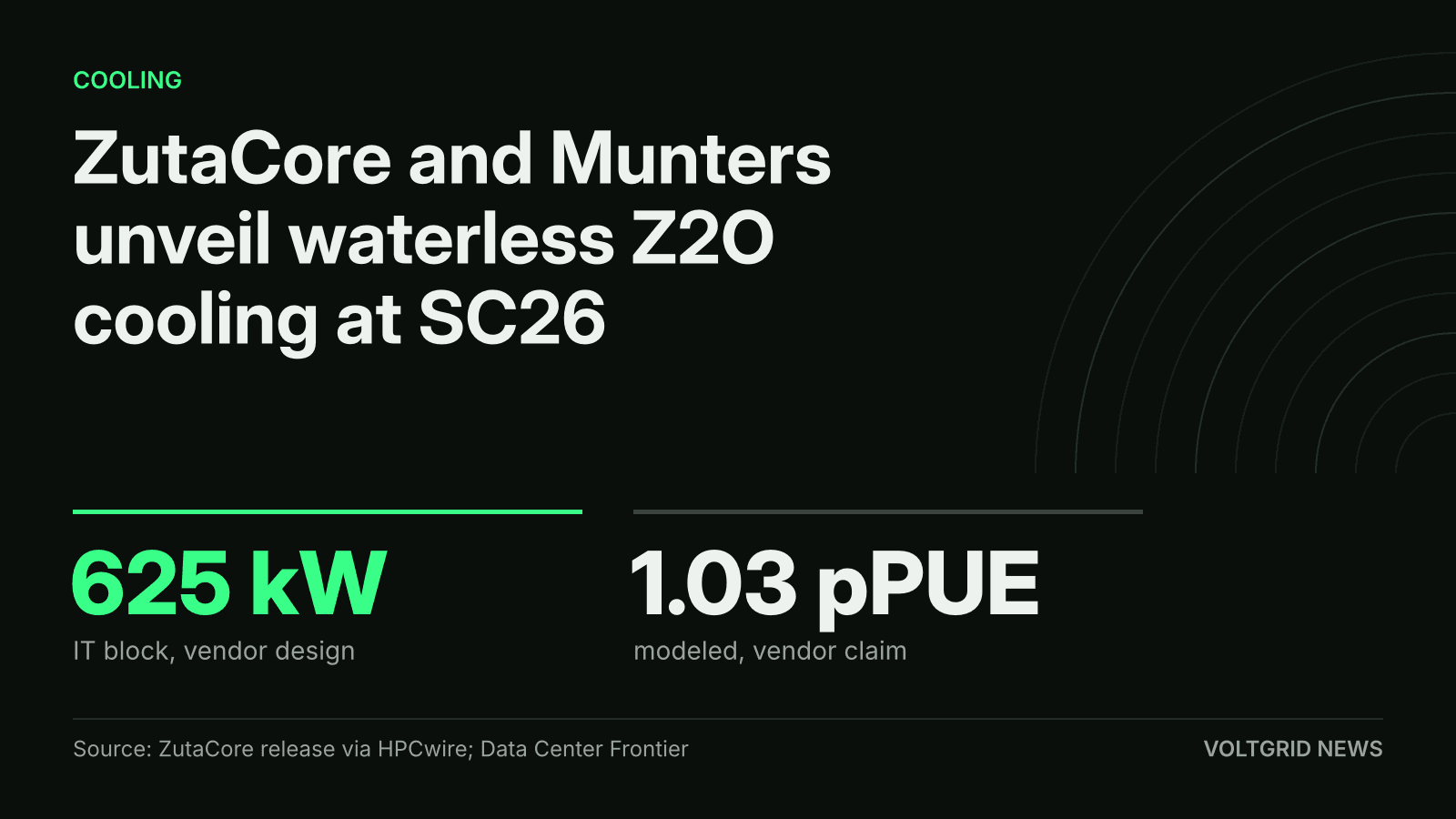
ZutaCore says Z2O is built from 625 kW IT blocks and models 1.03 pPUE; both are vendor figures.
Graphic: Voltgrid News
ZutaCore unveiled Z2O, a waterless two-phase cooling architecture, with launch partner Munters at Supercomputing 2026 (SC26) in Chicago on Nov. 16, and says its reference design reaches a modeled annualized partial power usage effectiveness (pPUE) of 1.03 with zero water.
The design runs one sealed loop of dielectric fluid from the cold plate on the chip to rooftop heat rejection, where Munters SyCool equipment passes the heat to outdoor air, according to ZutaCore's release as carried by HPCwire. The company says the loop needs no coolant distribution unit (CDU), no liquid-to-liquid heat exchanger, no facility water loop and no water-based cooling tower. Data Center Frontier, which reported the launch the same day, put the modeled comparison at 1.03 against 1.115 for a high-efficiency chilled-water system.
ZutaCore models 1.03 pPUE for Z2O against 1.115 for chilled water, per its release and Data Center Frontier; no operating data exists.
Graphic: Voltgrid News
By Voltgrid's arithmetic on those two figures, the modeled cooling overhead falls from 0.115 to 0.03 of IT power, a cut of about 74%, the same figure Data Center Frontier cites. In one 625 kW IT block that is roughly 19 kW of cooling overhead against about 72 kW. For an operator with a fixed grid connection, ZutaCore's argument is that more of the secured power reaches the servers: at 1.03, about 97% of IT-plus-cooling power goes to IT.
How the 625 kW block is built
ZutaCore says Z2O is assembled from repeatable 625 kW IT blocks, each with 500 kW taken by two-phase liquid cooling and 125 kW by air, an 80/20 split. The design adds N+1 spare heat-rejection capacity and redundant pumps fed from a UPS, and ZutaCore's HyperCool Cloud software monitors the loop. The company says it works with its HyperCool cold plates and with the OmniTherm cold plates it introduced at the OCP Global Summit in October 2026, so a customer can change cold plates without changing the facility loop.
Munters and ZutaCore first announced their alliance in September 2024. What is new is the rooftop-to-chip design with figures attached, not the partnership. Munters' Keith Dunnavant said in the release that Z2O lets outdoor air do the work for most of the year.
What is modeled, and what is not confirmed yet
Every efficiency figure is a modeled one from the vendors. Data Center Frontier reports that the pPUE comparison uses hourly weather data for Dulles, Virginia, a constant 100% IT load and the 80/20 liquid-to-air split, and that it is not independently verified operating data. A pPUE also counts only the cooling overhead, not the whole facility's PUE.
The first installation, ZutaCore says, runs on an ASRock Rack server built on NVIDIA's HGX B300 platform. No site, customer or measured result has been published, and the release says more partner instantiations will follow in 2027. Whether 1.03 holds in a hot, humid climate, where dry coolers work harder than they do in Virginia weather, is the open question.
Where it sits against other CDU designs
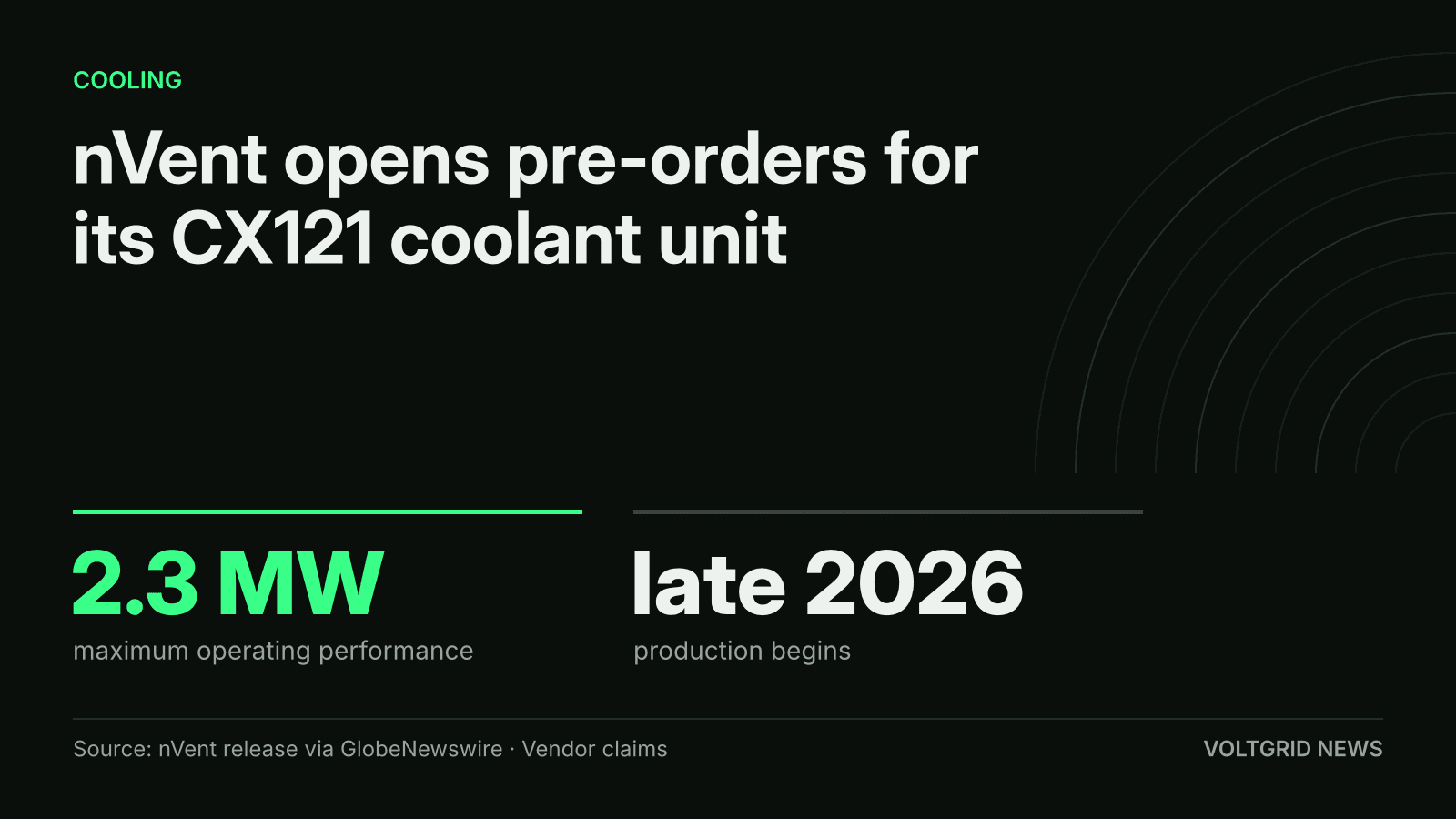
Most liquid-cooling launches Voltgrid has covered keep the CDU and scale it up, such as nVent's CX121 CDU rated 2.3 MW and Trane's CDU for Vera Rubin racks. Z2O instead removes that layer. Munters also took a 45% stake in a Texas coil venture, as Voltgrid reported.
Sources
- Published
- Sources
- 2 cited