Poland's PEJ Seeks Permit for Deep Excavations at 3,750 MWe Nuclear Site
Poland's PEJ filed on Oct. 30 for a permit to start deep reactor excavations at Lubiatowo-Kopalino, ahead of a 2027 construction-permit filing. The voivode has set no decision date.
Chips & Power DeskEdited by Ege Erten
2 min readAI-assisted

A Westinghouse AP1000 reactor building. Westinghouse supplies the AP1000 design planned for Poland's Lubiatowo-Kopalino plant; this is a file image of the design, not the Polish site.
Image: Westinghouse Electric Company
Source · Press image from the Westinghouse newsroom, used for news reporting.
Polskie Elektrownie Jądrowe (PEJ) applied on Oct. 30 to the Pomeranian voivode for a permit for preliminary construction works at Poland's first nuclear plant, a three-unit, 3,750 MWe Westinghouse AP1000 project at Lubiatowo-Kopalino.
PEJ said the application covers deep excavations at the spots where the three reactors will stand, support for the excavation walls and protection against groundwater inflow. World Nuclear News, reporting on Nov. 2, calls the same step an early-works permit. The Polish term is Wstępne Roboty Budowlane, or WRB.
The step matters for schedule, not for megawatts. PEJ president Marek Woszczyk said the application lets the company start basic work not directly tied to the nuclear part of the plant without waiting for further administrative approvals. If the voivode grants it, the deep excavations can begin before the main construction permit, which PEJ plans to apply for in 2027.
What the permit covers
The WRB route exists because of a law of July 3, 2026, which amended Poland's nuclear special act. Under it, defined works can proceed without a separate licence from the National Atomic Energy Agency (PAA). Energy Minister Miłosz Motyka called the filing a practical use of the changed rules.
The scope also takes in the sea-water cooling system. The PAA earlier classed that system as not safety-related, so its onshore part can be built as non-nuclear work. PEJ plans to lay the intake and discharge pipelines under the beach and the Baltic seabed with a trenchless method, according to the company.
Where the project stands
Site preparation is already under way. The second phase of preparatory works, building infrastructure for the future construction site, is running, and the general contractor Bechtel is carrying out deeper onshore and offshore geological surveys, World Nuclear News reported. PEJ's August 2024 application for preparatory works covered about 300 hectares in two phases, the first on about 45% of the site.
On equipment, Westinghouse placed conditional purchase orders in October with four Polish companies for safety-related modules, a week after PEJ cleared it to order long-lead items for the first unit. PEJ said the order for the first unit covers six key nuclear-island components, including the reactor containment vessel. Voltgrid News reported separately on Westinghouse's AP1000 study in Slovakia.
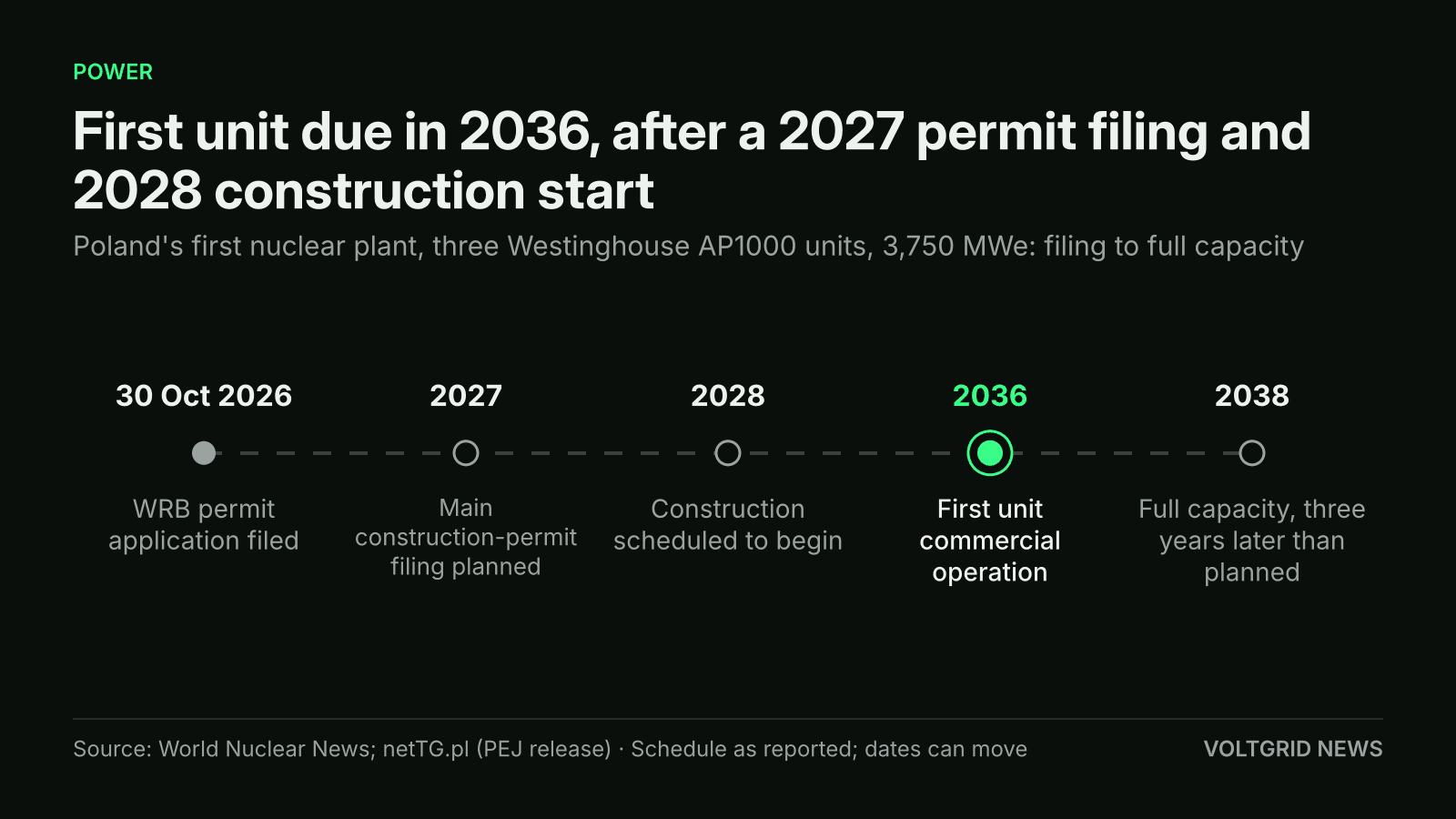
PEJ's schedule as reported puts first-unit commercial operation in 2036 and full capacity in 2038.
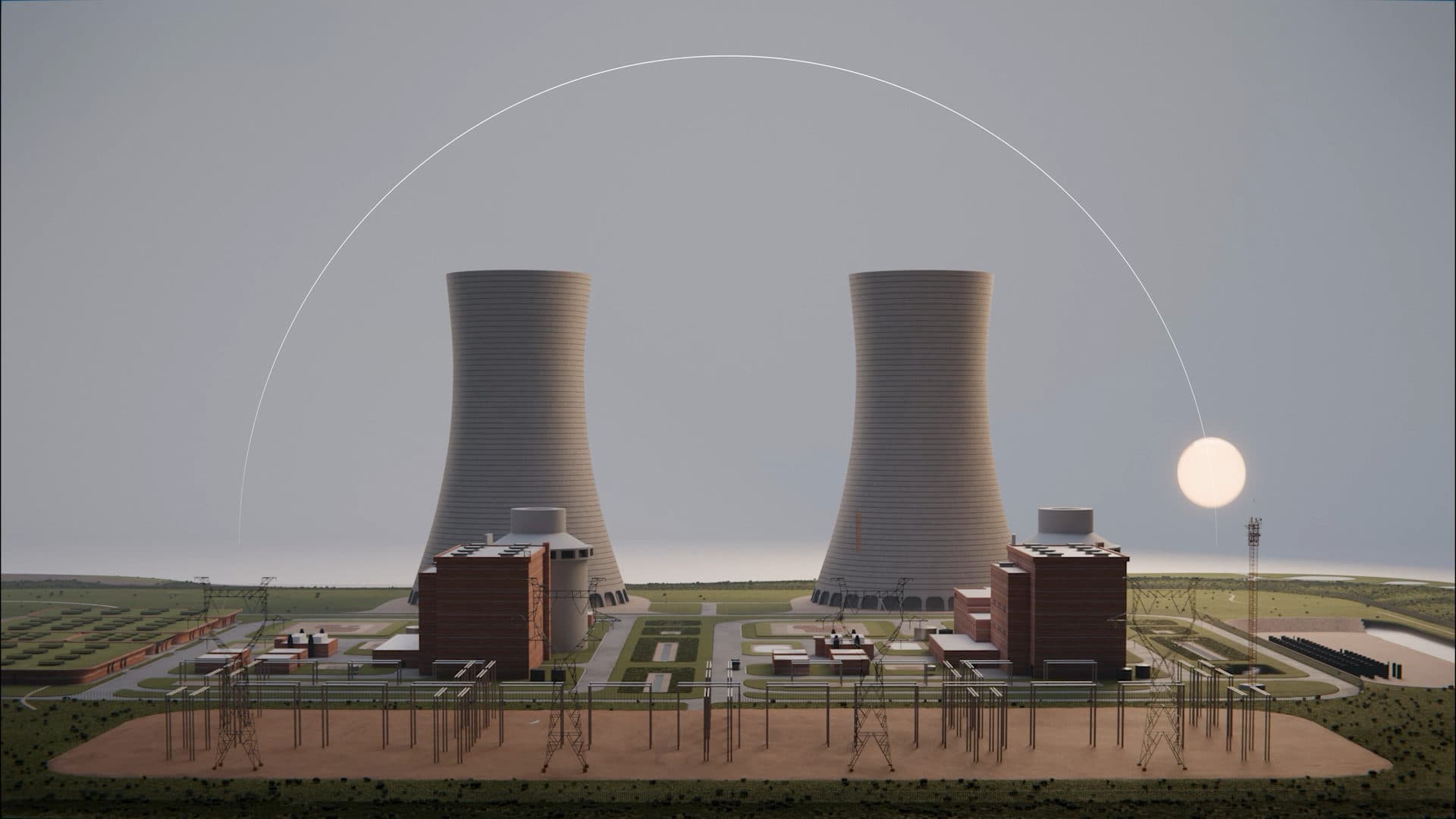
Illustration (AI-generated)
Construction of the plant is scheduled to begin in 2028, according to World Nuclear News. Under the latest update to Poland's nuclear programme, the first unit is due to enter commercial operation in 2036 and the plant to reach full capacity in 2038, three years later than planned. The 3,750 MWe is the plant's total installed capacity as PEJ states it, so it is a design-stage figure, not output.
What is not confirmed yet
The voivode has not ruled on the application, and neither PEJ nor the ministry has given a decision date. The sources do not say how long the excavations would run once permitted, or how much of the 2028 construction start depends on this approval. Neither source links the plant's output to data-center demand. For another AP1000 plan, see the six-reactor Kentucky campus.