Alliant's 3.4 GW Data-Center Build Is Gas, Storage and Renewables
Alliant Energy has 3.4 GW of contracted data-center demand and a $15.9 billion 2027-2030 capital plan in which gas is the largest generation line in three of four years, with up to $5.1 billion of DOE loans. Siting and contract conversion are the risks.
Nuclear & Microgrids DeskEdited by Ege Erten
5 min readAI-assisted
Follows our story: Alliant Energy Expects 1 GW More Data Center Contracts in Six Months
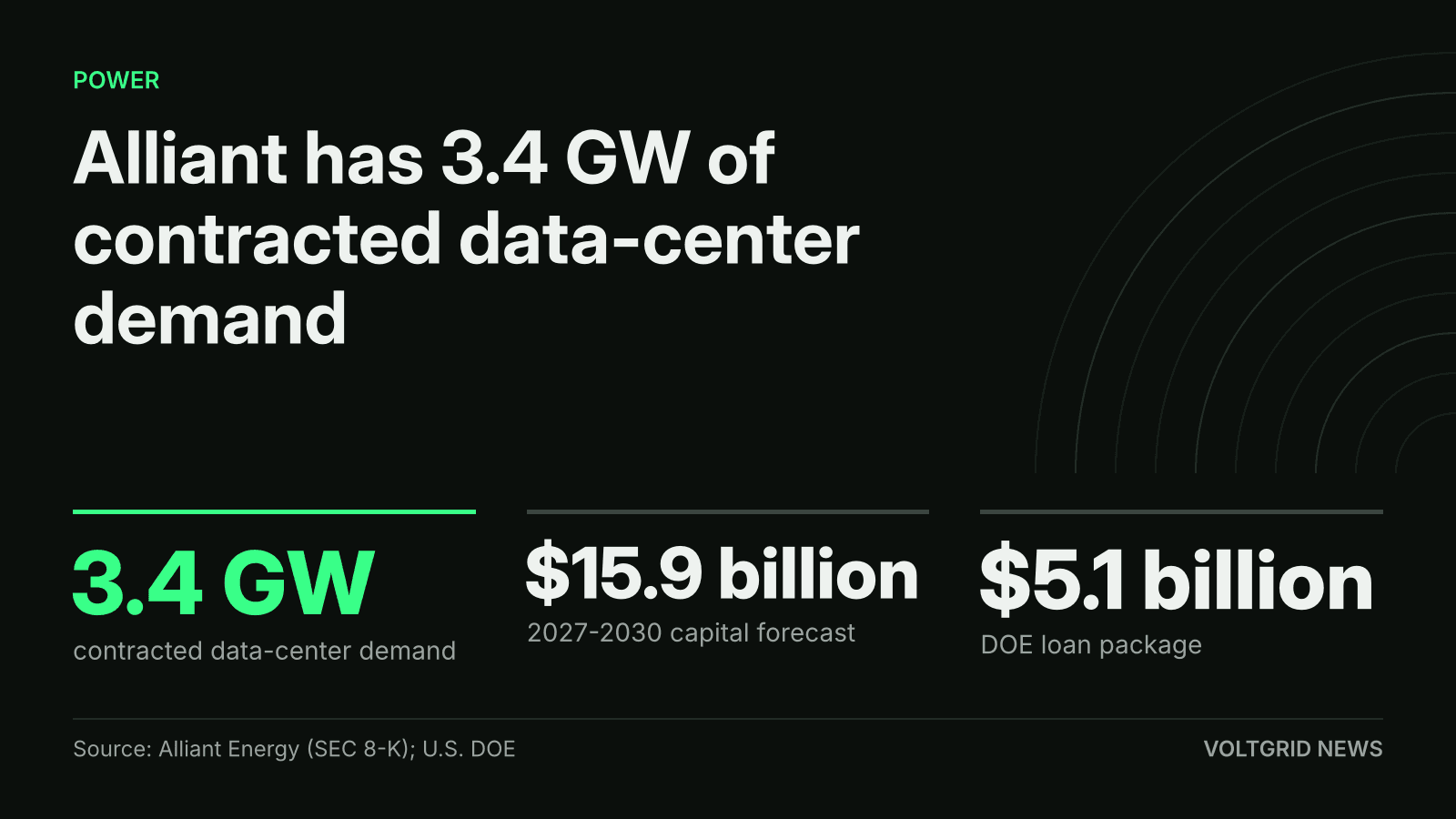
Alliant Energy's contracted data-center demand, capital forecast and DOE loan package, per its Oct. 29 results and DOE's Oct. 28 announcement.
Illustration (AI-generated)
Alliant Energy is meeting its data-center boom with utility-built gas plants, batteries and renewables, not reactors: its Oct. 29 results put contracted data-center demand at 3.4 GW and lifted its 2027-2030 capital plan 19% to $15.9 billion. The argument here is that the plan's weak points are local siting and turning prospects into signed contracts, not technology.
What happened
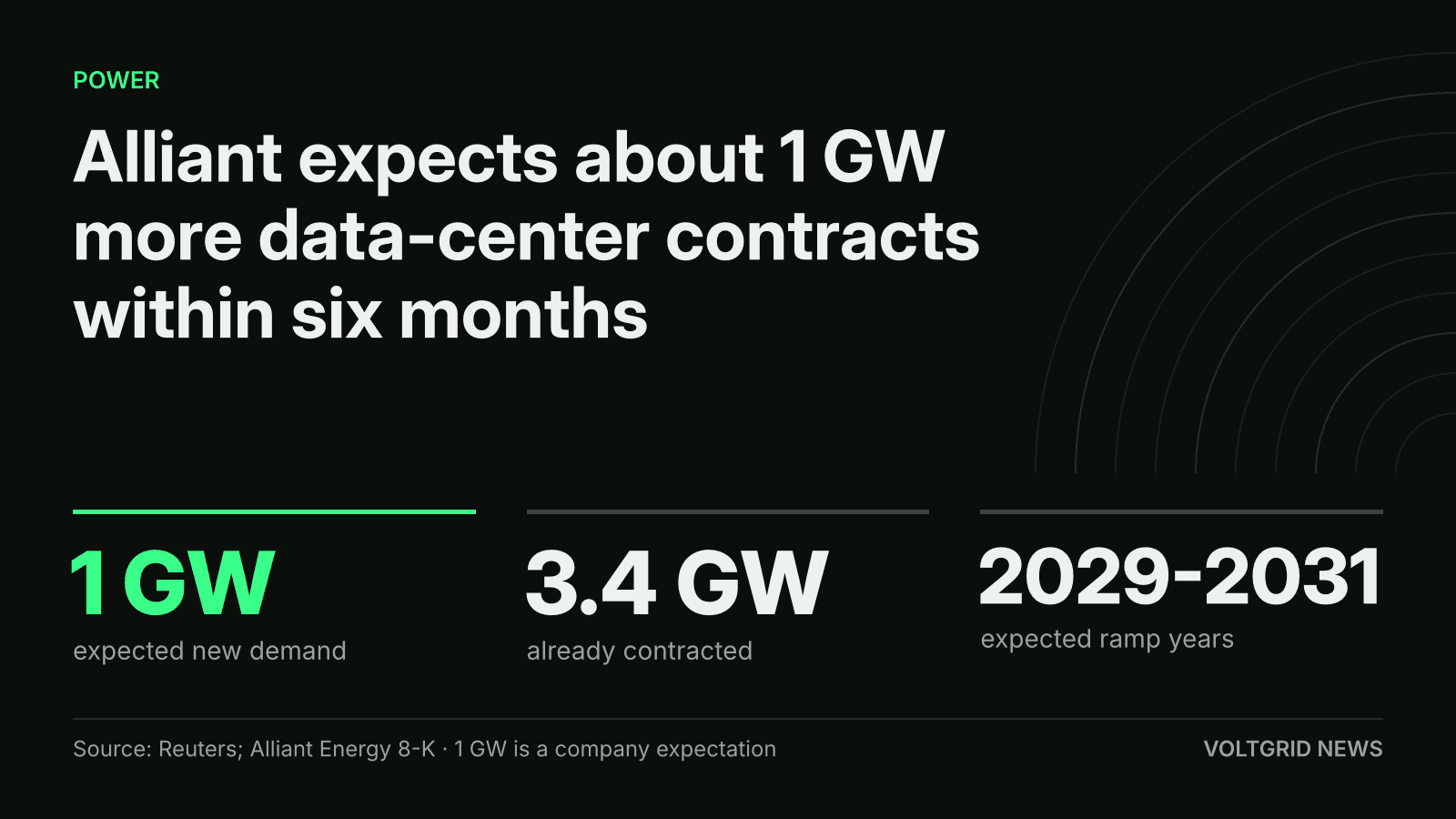
In its third-quarter release, filed with the SEC on Oct. 29, Alliant said its two utilities, Interstate Power and Light (IPL) in Iowa and Wisconsin Power and Light (WPL), have 3.4 GW of contracted demand from data centers. The company expects its peak demand to rise by approximately 60% by 2031, and it tied the higher four-year capital forecast to the resources needed to serve that load. Reuters reported that the 3.4 GW is contracted with Alphabet's Google, Meta Platforms and Blackstone-backed QTS Data Centers.
On the Oct. 30 earnings call, chief financial officer Robert Durian said Alliant expects to sign contracts for about 1 GW of additional data-center demand within six months, according to Reuters. That load would begin ramping between 2029 and 2031, he said. It is an expectation; no customer or site has been named for it.
Two days earlier, on Oct. 28, the US Department of Energy's Office of Energy Dominance Financing closed a $5.1 billion loan package to Alliant. DOE said it backs new gas-fired plants, energy storage and upgrades to existing generation, adding more than 2.6 GW of new or upgraded capacity, as Voltgrid reported that day. Our first read of the call is in our Oct. 31 brief.
Why it matters: the build is gas first, with renewables and storage close behind
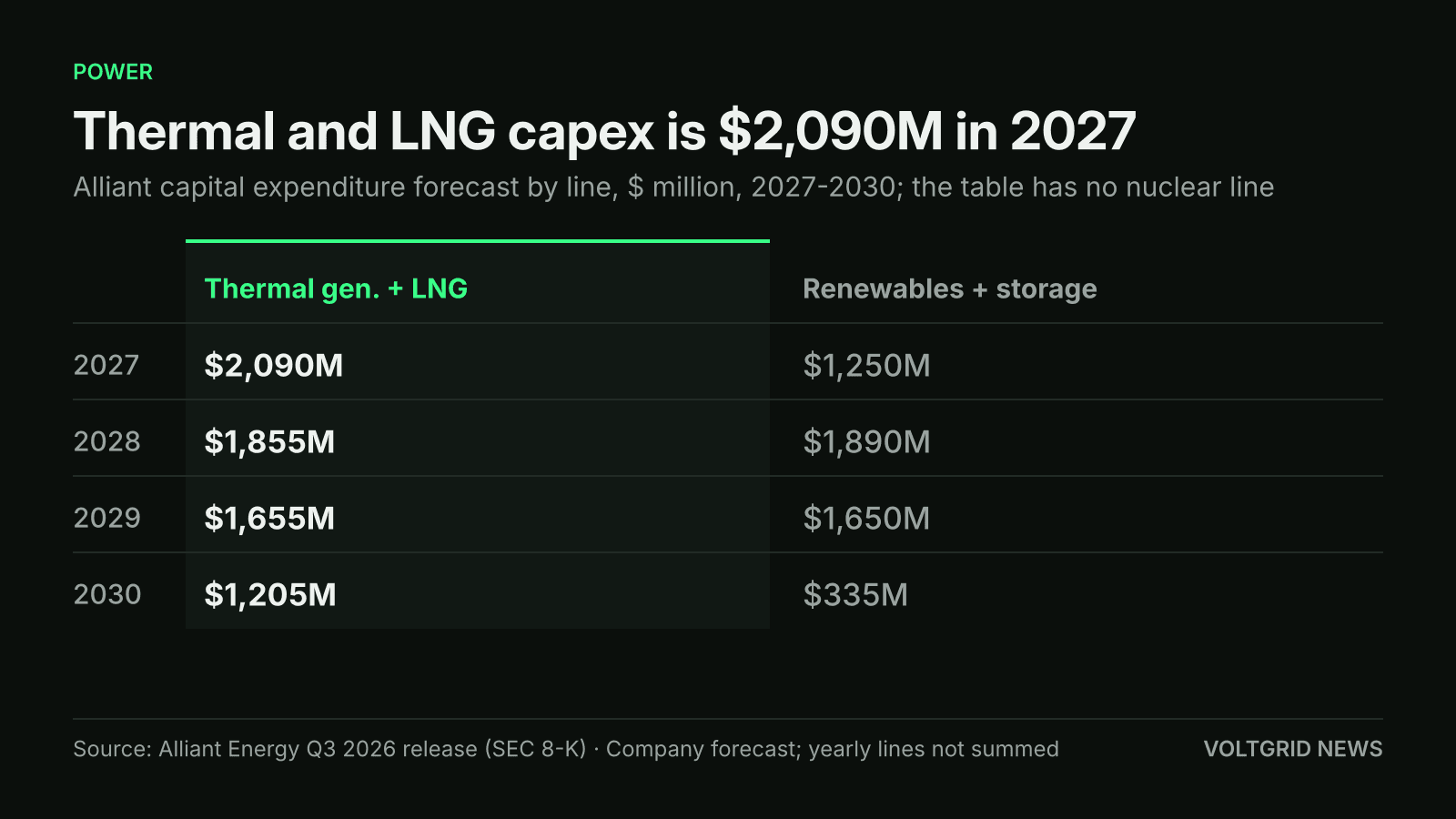
Alliant's capital table has a thermal generation and LNG line and a renewables and storage line, and no nuclear line; the yearly figures are not summed.
Illustration (AI-generated)
The capital table in the release shows where the money goes. The line for thermal generation and liquefied natural gas is $2,090 million in 2027, $1,855 million in 2028, $1,655 million in 2029 and $1,205 million in 2030. The line for renewables and energy storage is $1,250 million, $1,890 million, $1,650 million and $335 million in the same years. The table has no nuclear line at all.
The loan points the same way. In its own Oct. 28 release, Alliant said the DOE financing may support, among other projects, 1.6 GW of new natural gas generation, 240 MW of added capacity at existing gas plants, 1 GW of energy storage and 2 BCF (billion cubic feet) of liquefied natural gas storage. The company said the money is available subject to project advancement, qualification and financing terms, and that every project still goes through a regulatory process.
Put together, this suggests that for hyperscalers in Iowa and Wisconsin, firm supply in this decade will come from regulated gas plants, batteries and renewables on Alliant's system, front of the meter, rather than from a nuclear supply deal. If that holds, the speed of these campuses depends on how fast a utility can site and permit gas plants, not on a licence from the Nuclear Regulatory Commission.
How a Utility Builds Power for Data Centers
A regulated utility such as Alliant builds and owns the generation for its data-center customers, instead of each customer building its own. IPL and WPL sign the large-load customers, then need regulatory approval for each construction project, and Alliant earns an authorized return on what it builds. That is why Alliant says every project on its DOE-financed list still goes through a regulatory process.
The $5.1 billion DOE package lowers the cost of that capital. Alliant says it gives access to lower-cost loans, subject to project advancement, qualification and financing terms, for projects that may include 1.6 GW of new gas generation and 1 GW of energy storage. Gas supplies firm capacity; a peaker such as Morgan Valley is designed to run no more than 40% of the time, according to Alliant.
The case against
The gas reading can be overstated. In 2028 the renewables and storage line, at $1,890 million, is larger than the thermal line, at $1,855 million, so the plan is a mix rather than a pure gas bet. Gas peakers are also not baseload: Alliant has said its proposed Morgan Valley plant would run no more than 40% of the time, as Voltgrid reported on Oct. 22.
The contracted load is also concrete. Three named buyers stand behind the 3.4 GW, and Reuters reported that Meta is expected to begin taking transmission service in Wisconsin in the first quarter of 2027. On that view, the risk is execution, not demand.
Alliant's own risk factors cut both ways. They name the chance that policy changes let large customers buy behind-the-meter power from third parties, own on-site generation or join co-located arrangements. A data center that builds its own supply would bypass the utility build that this plan depends on.
What it means for Alliant and its data-center customers
Siting is the first test. On Oct. 20 the Linn County Board of Supervisors voted 3-0 to deny the rezoning IPL needs for the 720-MW Morgan Valley gas plant, as we reported; the Iowa Utilities Commission can still issue a generating certificate that overrides the county. The release lists zoning, siting, permitting and community opposition among the factors that could delay large-load customers' own facilities.
Contract conversion is the second. Alliant's 2027 earnings guidance, $3.63 to $3.73 per share, assumes it realizes the revenue it expects from new data-center demand. The release also warns that customers could alter, delay or cancel planned facilities, which could leave generation, storage or transmission overbuilt or under-used. Durian said on the call, as reported by Reuters, that earnings growth could exceed the company's 8% target if capital spending rises further for load growth and other opportunities, which suggests the next gigawatt would bring more capital on top of the $15.9 billion.
For Iowa retail customers, Alliant said it will extend IPL's base rate stability plan through 2030, so the cost of this build will be watched closely at the state commission.
What to watch
The Iowa Utilities Commission is scheduled to begin considering the Morgan Valley application on Dec. 7, 2026, according to local reports we cited on Oct. 22. Meta's Wisconsin transmission service is expected in the first quarter of 2027. The six-month window Durian gave for about 1 GW of new contracts runs to around the end of April 2027; a signed contract with a named buyer would support the thesis, and a slip would point to the conversion risk. That added load is expected to ramp from 2029 to 2031.
Sources
- 01Energy Department Closes $5.1 Billion Loan to Lower Electricity Costs and Strengthen Grid Reliability in Iowa and WisconsinU.S. Department of Energy · energy.gov
- 02Alliant targets 1 GW of new data-center contracts in six months as power demand surgesReuters (via WSAU) · wsau.com
- 03Alliant Energy announces third quarter 2026 results and 2027 guidanceAlliant Energy (SEC 8-K) · sec.gov