Amazon's Xe-100 Bet: NRC Review Lowers Design Risk, Not Project Risk
The NRC's Long Mott safety review, finished Oct. 30 per X-energy, is the Xe-100's first. It eases design risk for Amazon's X-energy plan, but Cascade and Indiana still lack NRC filings, priced contracts and secured fuel.
Nuclear & Microgrids DeskEdited by Ege Erten
6 min readAI-assisted
Follows our story: Long Mott: X-energy Says NRC Issued Final Safety Evaluation, 320 MWe
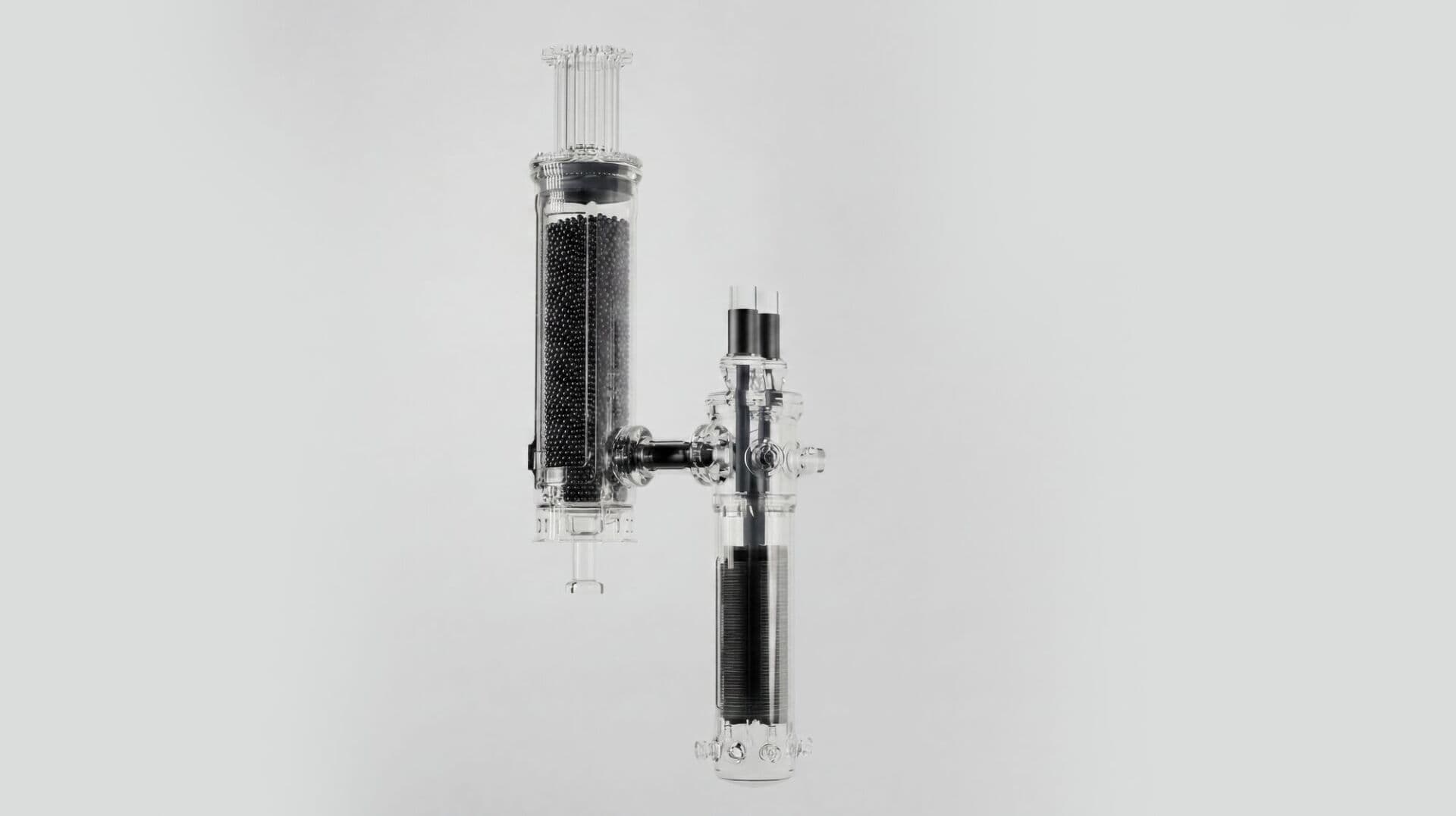
Rendering of the Xe-100 with fuel pebbles, as published by Amazon on its X-energy program page. It is an illustration, not a photo of Long Mott.
Image: Amazon
Source · Press image from the Amazon newsroom (aboutamazon.com), used for news reporting.
The Nuclear Regulatory Commission's first completed safety review of X-energy's Xe-100, which X-energy announced on Oct. 30 for Dow's Long Mott plant in Texas, takes the biggest design question off Amazon's X-energy program. It does not touch the questions that now set Amazon's schedule: neither of its two Xe-100 projects has applied to the NRC, neither has a priced power purchase agreement, and the fuel plant X-energy is building is still not producing.
What the Long Mott Safety Review Found
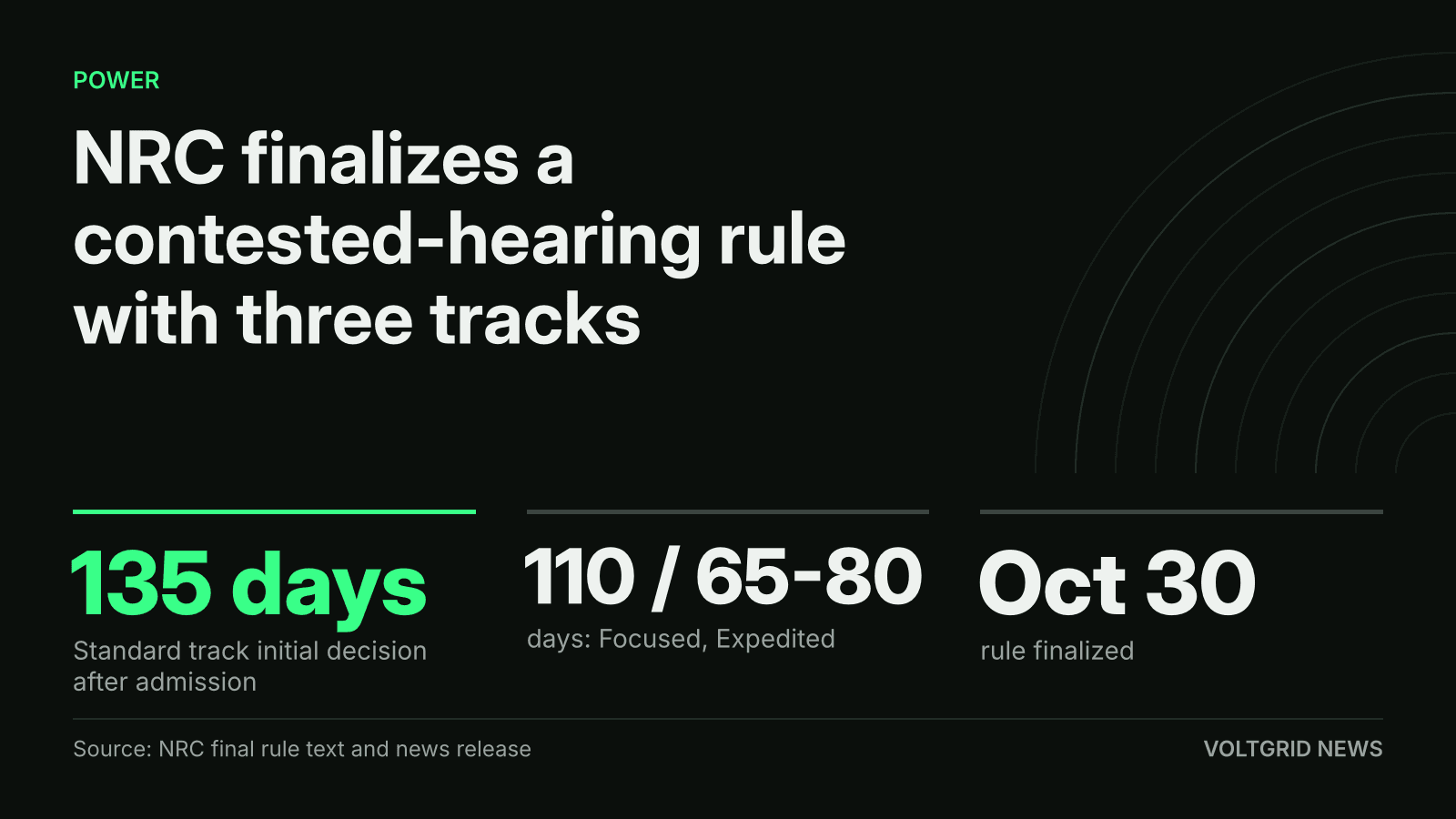
X-energy said the NRC staff's Final Safety Evaluation Report examined the plant's design criteria, its preliminary design, its safety and probabilistic risk analyses and its research programs. The staff concluded that the plant and site offer a safety basis for starting construction under the NRC's Part 50 rules, and the Commission's outside advisers on reactor safeguards separately back issuing the construction permit, the company said. As of Nov. 1, the NRC's Long Mott project page, last updated Sept. 14, still listed the final safety evaluation as a November 2026 target, and the agency's October news releases did not mention it, so the finding rests on X-energy's statement until the NRC posts it. Voltgrid reported the step on Oct. 30; the environmental assessment and finding of no significant impact came on May 18, and the hearing and permit decision are still listed as TBD.
Long Mott is four Xe-100 modules, 320 MWe and 800 MWt in all according to the NRC, for Dow subsidiary Long Mott Energy. A construction permit would let it build, not operate; an operating licence is a later, separate step.
Why the Review Matters for Amazon's X-energy Bet
Amazon's X-energy program is a bet on one design. Amazon says it led X-energy's 2024 Series C-1 round to fund completion of the reactor's design and licensing and the first phase of the TRISO-X fuel plant in Oak Ridge, Tennessee. It pairs that equity stake with a goal of more than 5 GW of new US nuclear capacity by 2039, built with regional utilities, which is a target rather than capacity under contract. Both projects named so far, Energy Northwest's Cascade facility in Washington and the Indiana plant studied with AEP, use the Xe-100.
Before Oct. 30, the NRC staff had not finished a safety review of any Xe-100, a pebble-bed, helium-cooled reactor seeking a licence under the agency's newer risk-informed approach. X-energy says the Xe-100 is the first high-temperature gas-cooled reactor permit application to use that framework, and X-energy says the design supports a 400-meter emergency planning zone against 10 miles for conventional light-water plants. A staff finding that the safety case holds for a first site suggests the design question has largely moved from whether to how fast. X-energy says the review sets precedents for every later Xe-100 project, though each will be reviewed on its own.
The pace from here is also more legible. At TVA's Clinch River project, a different design (GE Vernova Hitachi's BWRX-300), the NRC's page lists a final safety evaluation on June 25, 2026 and a construction permit decision date of Sept. 28, 2026, which makes the pace a rough comparison only. X-energy's quarterly filing expects Long Mott's permit in the first quarter of 2027, and chief executive Clay Sell put the decision in the first half of 2027 on the company's August call, ANS Nuclear Newswire reported. If Long Mott follows that path, the first Xe-100 permit lands before Cascade has even filed.
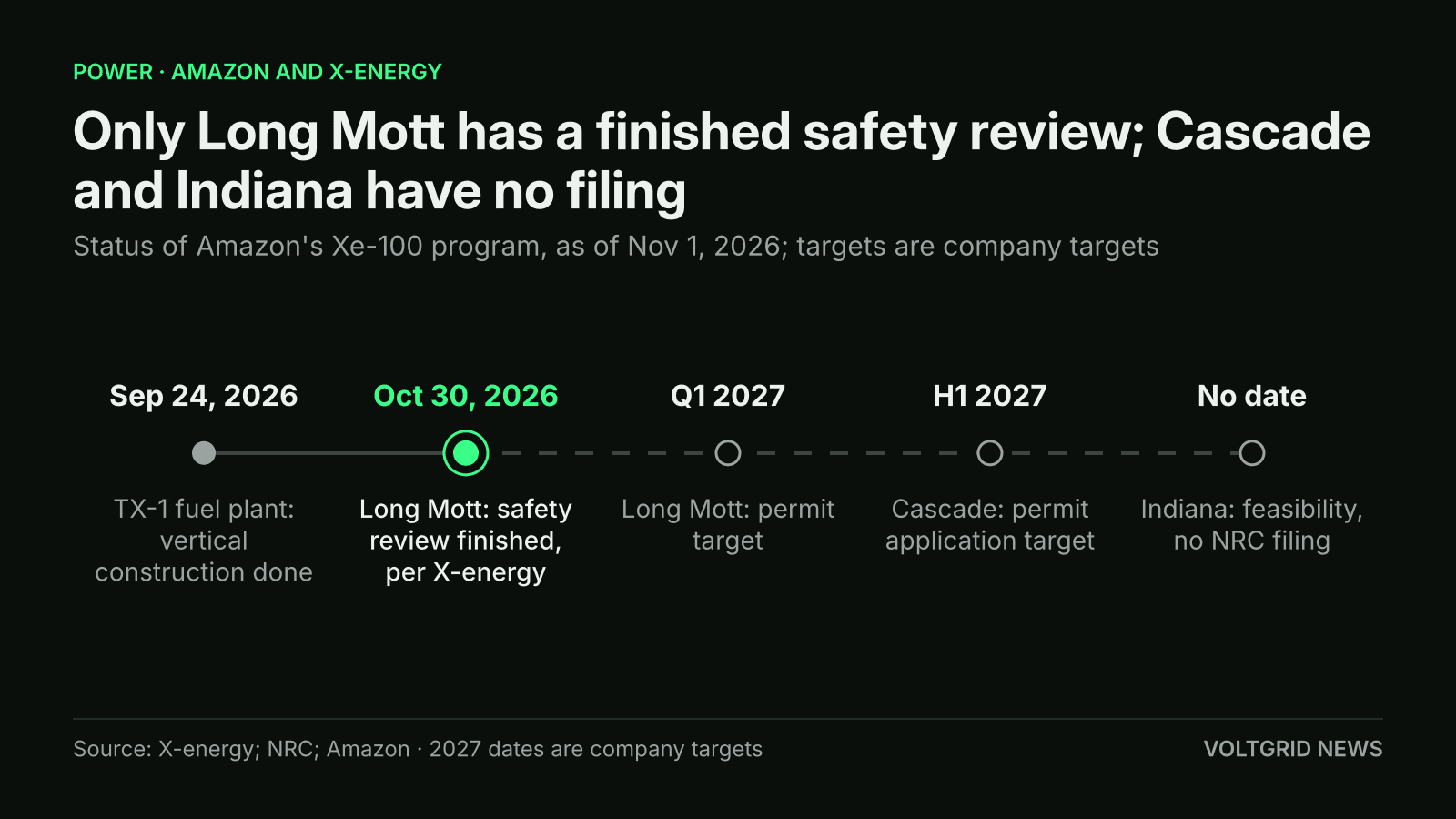
Only Long Mott has a finished safety review, per X-energy; the 2027 dates are company targets, and Indiana has no NRC filing.
Illustration (AI-generated)
The Xe-100 is a high-temperature gas-cooled reactor: helium gas, not water, carries heat out of a core of graphite pebbles packed with TRISO fuel, uranium particles wrapped in ceramic layers that trap fission products at high temperature. The NRC lists each module at 80 MWe of electricity, or about 200 MWt of steam, and the four-module Long Mott plant at 320 MWe and 800 MWt in all.
X-energy says that design supports a 400-meter emergency planning zone, against 10 miles for conventional light-water reactors, so a plant could sit inside an industrial site such as Dow's. The constraint is fuel: the pebbles use HALEU enriched to 15.5%, to be made at TX-1, which X-energy says could supply up to 11 reactors once it runs.
Why the Review Settles Less Than It Seems
The strongest objection is that the review settles less than it seems. A final safety evaluation is a staff finding on one site's construction permit, built on a preliminary design; it is not a design certification, and the final design is examined again before any operating licence. X-energy's own release lists among its risks that the review may not make later licensing more efficient, that later sites may not win a similar emergency planning zone or the same short environmental review, and that design changes after the permit would need more NRC review. Long Mott's permit is also not yet issued: no Commission ruling had been found, as of Oct. 31, on a local group's July 20 request for review of the dismissed hearing claims, as Voltgrid reported.
The second objection is that Long Mott's economics do not transfer. It is a project under the Department of Energy's Advanced Reactor Demonstration Program, and Sell put the cost-shared funding at roughly $2.15 billion in all, ANS reported. X-energy's filing warns that construction after about 2030 would not qualify for that reimbursement without a contract change. Cascade and Indiana have no such award, and no cost, price or financing has been disclosed for either.
Third, fuel may set the pace more than the licence. The Xe-100 burns TRISO-X pebbles made from high-assay low-enriched uranium (HALEU) enriched to 15.5% in steady-state reactor operation, X-energy's filing says. Its TX-1 plant, licensed by the NRC in February, finished its building shell on Sept. 24 and is now in interior buildout; once operating it would make about 700,000 pebbles a year, with capacity to provide fuel for up to 11 Xe-100 reactors, X-energy said, while the Indiana plan counts 12 units. X-energy does not say whether that means first cores or annual refuelling, and TX-1 is being developed first for Dow's Long Mott. A second plant, TX-2, is planned on the same site but not built, and X-energy's enrichment supply rests on agreements with Centrus Energy and, its chief executive said, General Matter; Centrus's new Piketon capacity is a 2029 target.
Finally, nuclear is not Amazon's only firm supply. Its signed contracts, such as Talen's Susquehanna supply of up to 1,920 MW and Constellation's Calvert Cliffs deal, are tied to plants that already run.
What It Means for Amazon, Energy Northwest and AEP
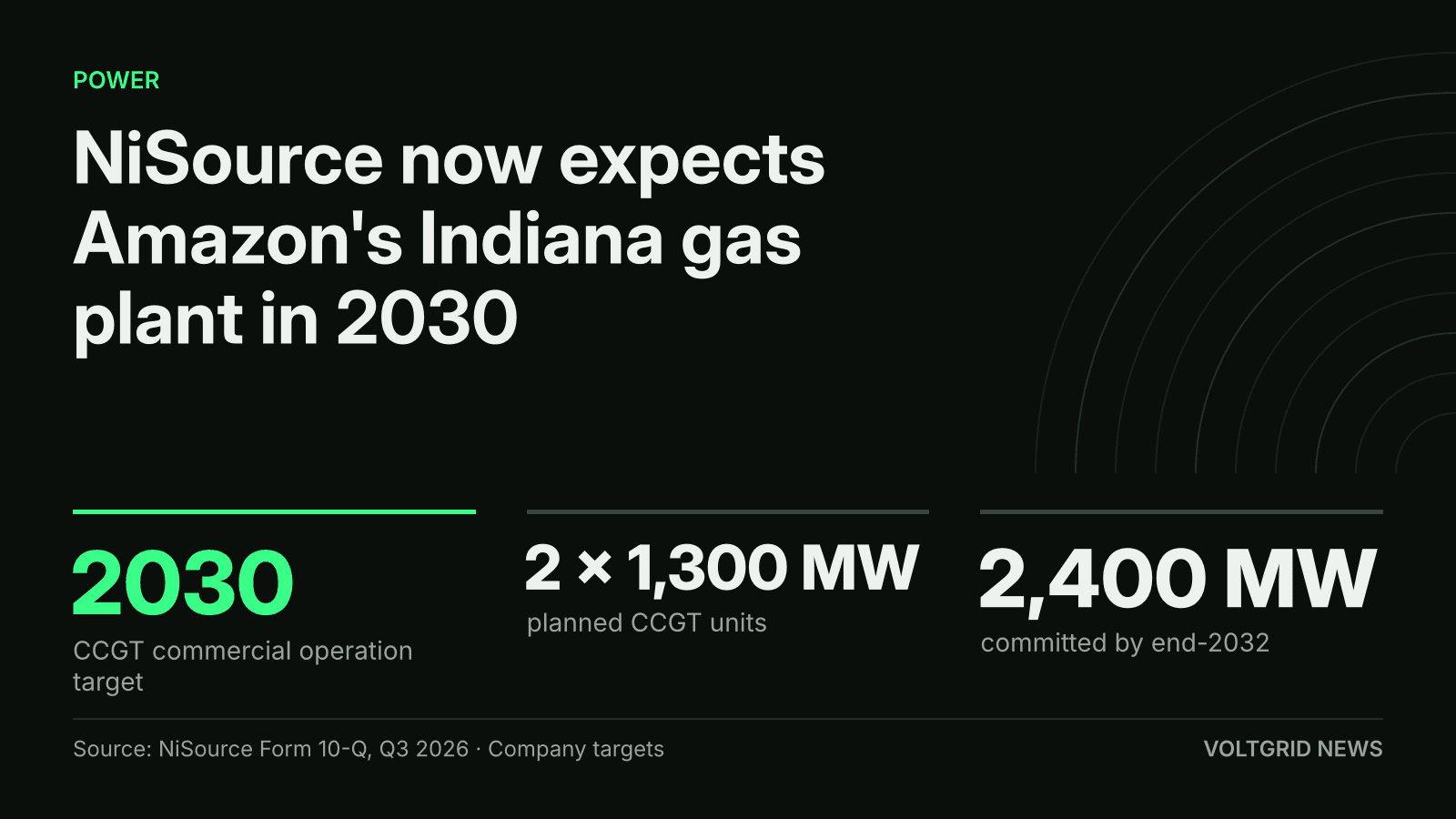
For Amazon, the equity stake looks safer than the power. What it holds at Cascade is a development and funding agreement with Energy Northwest for four reactors, 320 MWe, with the potential to grow to 960 MWe, and X-energy expects them to begin operating in the early 2030s. In Indiana it funds a feasibility study of 12 units, 960 MW in AEP's count, and says it would be the first customer once the plant runs; no power purchase agreement is signed. X-energy has also given Amazon first-priority allocation of its Xe-100 manufacturing slots from 2031 to 2039, to hand to utilities and independent producers that would own the plants, but its filing states that Amazon is not obligated to buy.
For Energy Northwest, the review means a Cascade application could build on a safety case the NRC staff has already accepted once, instead of breaking new ground. Its filing target has already slipped once, from end-2026 to the first half of 2027, when X-energy now expects to submit it. Filed after the NRC's new hearing rule takes effect, a first Cascade permit would likely sit on the standard track, in Voltgrid's reading. For AEP, the precedent helps only once it decides to apply, which it has not announced.
What to Watch Through 2027
November 2026: the NRC's own posting of the Long Mott final safety evaluation, which would confirm X-energy's account. Early December: the contested hearing rule takes effect if the Federal Register publishes it in the first week of November, as the NRC expects. First quarter of 2027: X-energy's target for receiving the Long Mott construction permit, the first real test of the thesis. First half of 2027: the Cascade construction permit application X-energy expects to submit; a filing that cites the Long Mott review and keeps its date would support the argument, another slip would weaken it. Still undated: TX-1's start of production, a signed Cascade or Indiana power contract, and Indiana's feasibility results.
Sources
- 01X-Energy, Inc. Form 10-Q for the quarter ended June 30, 2026X-energy (SEC filing) · sec.gov
- 02Long Mott Energy, LLC - Long Mott Generating Station Xe-100 Power Reactor ApplicationU.S. NRC · nrc.gov
- 03TRISO-X Completes Vertical Construction of TX-1 Fuel Fabrication FacilityX-energy · x-energy.com
- 04X-energy, TerraPower share updates on advanced reactor projectsANS Nuclear Newswire · ans.org
- 05Amazon invests in nuclear energy project targeting nearly 1 gigawatt of carbon-free energy for IndianaAmazon · aboutamazon.com
- 06NRC Completes Landmark Safety Review of X-energy's Xe-100 SMRX-energy · x-energy.com