SK hynix SC26: MARS Rack Pools KV Caches Over CXL, Shows 256GB RDIMM
SK hynix's SC26 MARS rack demos pooled memory over CXL to share KV caches, with no capacity figure; its only HBM4E specs remain June's 12-high, 48GB, 16Gbps-per-pin samples.
3 min read
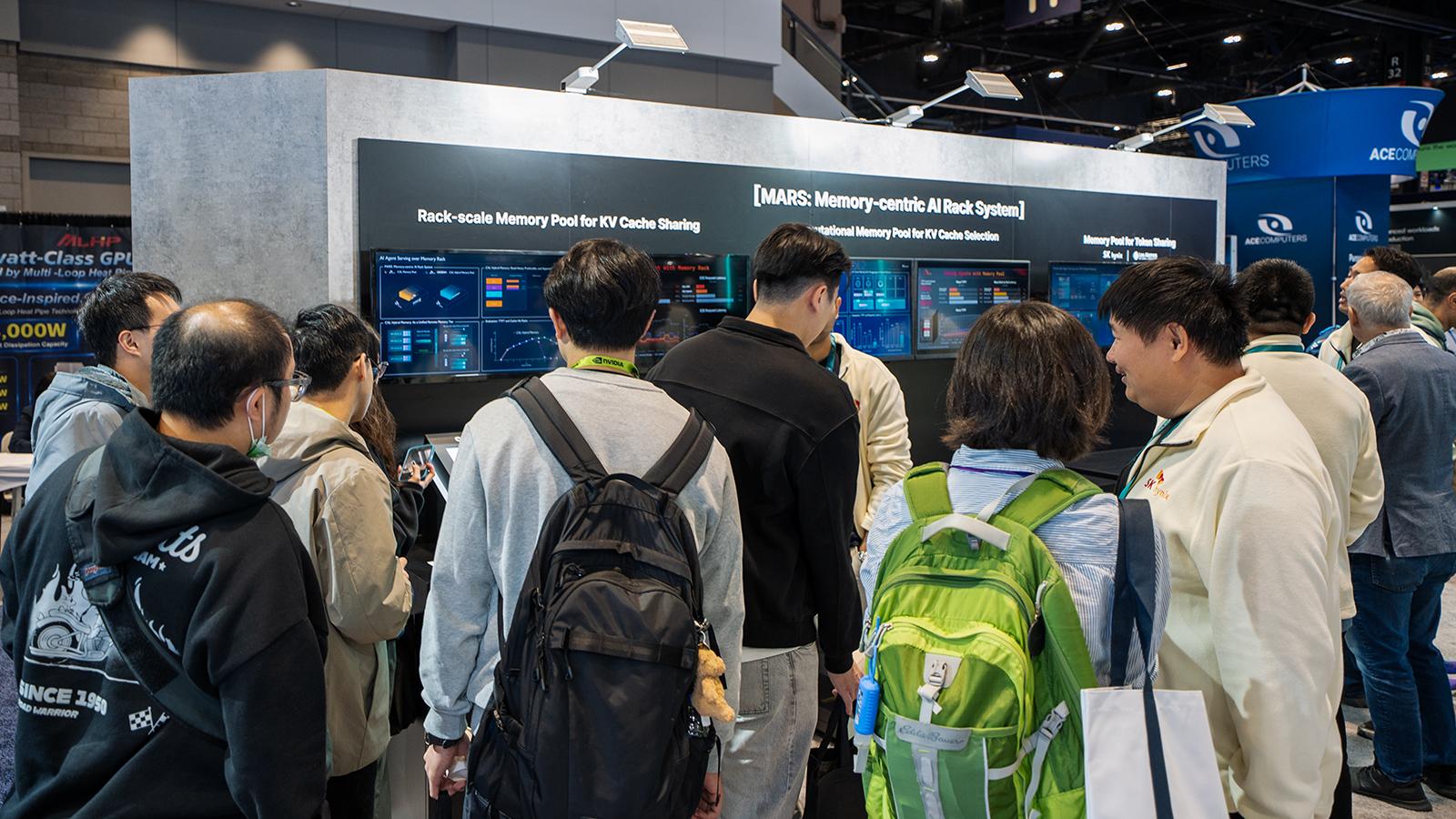
SK hynix's MARS section at its Supercomputing 2026 booth, where visitors watched the rack-level KV cache pooling demo (SK hynix).
Image: SK hynix
Source · Press image from the SK hynix newsroom, used for news reporting.
SK hynix showed MARS, a memory-centric AI rack that integrates partners' solutions with memory at its core, at Supercomputing 2026 in Chicago, which ran Nov. 15 to 20. Its demos pooled memory over CXL (Compute Express Link) so servers share KV caches.
The company's release, dated Nov. 20 and carried by HPCwire, describes MARS (Memory-centric AI Rack System) as a rack that integrates partners' solutions with memory at its core. It gives no rack-level memory capacity, bandwidth or power figure, and JKN's report of the booth carries none either. The HBM4E (a next-generation high-bandwidth memory) on the booth floor also came without new specifications.
SK hynix's own HBM4E numbers date from its June 18 sampling release: a 12-high stack of 48GB, a maximum of 16Gbps per pin, and power efficiency up more than 20 percent over earlier models.
What MARS demonstrated
The company ran three demos in the MARS section. In the first, CXL memory and CXL hybrid memory formed a rack-level pool that shares KV caches, the stored attention state an AI model reuses across turns of a conversation. Large caches sit on the SSD inside the hybrid memory, and the system predicts which ones a session will need and loads them into DRAM.
The second demo served AI agents across several servers and GPUs through a computational memory pool. SK hynix said selectively moving or reusing a KV cache this way "can significantly improve" system performance compared with methods that rely on network communication, without giving a measurement. The third had CPU servers share tokens through CXL pooled memory, which the company said shortens GPU idle time in multimodal serving.
A presentation by Younghoon Min, a technical leader in SK hynix's AI System Infra group, was titled "Enabling Agentic AI Serving with Disaggregated Memory Pools." He said these methods raise GPU and CPU utilization over conventional approaches. SK hynix also said that, together with SK Telecom, it completed verification of KV cache offloading over CXL in a real LLM inference environment.
What else was on the booth
A system demo wall added Compute-using-DRAM, which runs bit-level logic and arithmetic inside commercial DRAM using charge sharing across rows, and Custom HBM Array, which links several custom HBM units that carry compute functions. The product zone showed HBM4E and HBM4 beside HBM3E, plus a 256GB 3DS DDR5 RDIMM, a 128GB DDR5 MRDIMM, a 96GB DDR5 RDIMM and a 192GB SOCAMM2 module. SK hynix said about 10,000 people visited the show and some 500 companies took part.
How a CXL Memory Pool Holds KV Caches
An AI model keeps the attention data of a conversation, its KV cache, so it need not recompute earlier turns. The cache grows with every user and turn, and it normally sits in HBM or server DRAM. JEDEC's HBM4 standard allows up to 2 TB/s per stack but only up to 64GB per cube, so for long agent sessions capacity runs out before speed does.
CXL (Compute Express Link) adds a larger, slower tier. In SK hynix's first demo, hot caches stay in HBM and DRAM, cold ones sit on SSD inside a CXL pool, and the system loads them back when it predicts reuse. Several servers share the pool, so capacity is bought once for the rack rather than per host. SK hynix gave no latency or bandwidth figure for the pool.
In SK hynix's first MARS demo, a shared CXL pool sits between SSD-held caches and DRAM, per the company; it gave no latency or bandwidth figure.
Graphic: Voltgrid News
Why it matters
The pitch targets a cost that grows with every long agent session: KV cache held in scarce HBM and server DRAM. In Voltgrid's reading, moving cold caches into a shared CXL pool adds a slower tier in exchange for capacity, and it lets several hosts draw on one memory resource instead of each buying its own. For data-center planners the open question is power and floor space per rack, and SK hynix gave neither for MARS.
It also fits the company's wider push on HBM. Voltgrid reported on Nov. 20 that SK hynix reportedly plans Besi hybrid bonders for 16-high HBM, and on Nov. 9 that HBM chief Ahn Hyun was named to lead a new Americas unit, the executive who said on June 18, as President and Chief Development Officer, that SK hynix "has laid the foundation to strengthen its AI leadership with HBM4E."
What is not confirmed yet
SK hynix has not published a MARS memory capacity, a partner list, a price or a shipping date, and SK hynix gave no benchmark figures for any demo. For HBM4E, the SC26 release adds no specifications; SK hynix's June 18 release gave 12-high, 48GB and up to 16Gbps per pin, and no bandwidth, interface width or mass-production date.
Sources
- Published
- Sources
- 3 cited