JEDEC DDR6 Preview Points at AI Servers: 12.8 GT/s, 96-Bit Bus
The JEDEC DDR6 preview plans 12.8 GT/s server RDIMMs, a 96-bit bus and a 74 mm module, but it is not a finished standard, and industry sources put launch at 2028-2029 or later. DDR5 MRDIMMs and CXL carry the load until then.
5 min read
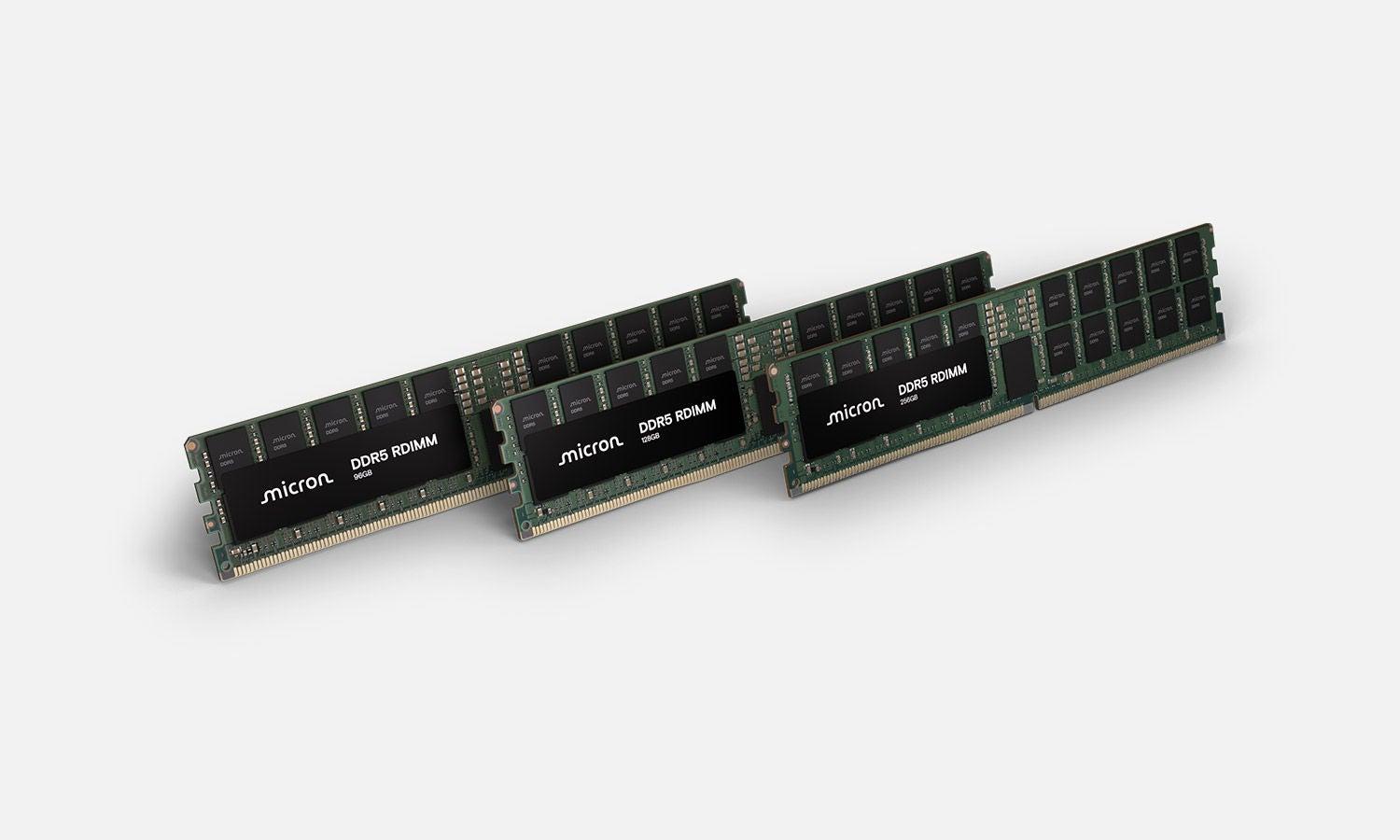
Micron DDR5 RDIMMs, the server module type that JEDEC's DDR6 preview would succeed. The photo shows DDR5, not DDR6 hardware.
Image: Micron
Source · Press image from the Micron website, used for news reporting.
JEDEC previewed DDR6 on Nov. 18, 2026, and the plan reads as a server memory first: registered modules starting at 12.8 GT/s, a 96-bit data bus and a 74 mm module, against 133 mm for DDR5. Until it ships, which industry sources put at 2028-2029 or later, servers will have to close the CPU memory gap with DDR5 MRDIMMs and CXL.
DDR6 Specs: 12.8 GT/s, 96-Bit Bus, 74 mm Module
The standards body behind DRAM said the features reflect its current development plans, not a finished standard, and may still change before approval. Registered DIMMs (RDIMMs, the server modules) would start at 12.8 GT/s, up from DDR5's 9.2 GT/s, with a roadmap to 14.4 GT/s and beyond. The data bus widens from 64 to 96 DQ lines, a 50% increase. JEDEC says the two together lift bandwidth by more than 50% at introduction, and it warns that this target is not a claim of an equal gain in application performance.
JEDEC's DDR6 preview, dated Nov 18, 2026, is not a finished standard, and its plans may change.
Graphic: Voltgrid News
The rest of the list is about capacity and power. Die density rises to up to 128Gb (gigabits) per die, from 64Gb on DDR5 as ServeTheHome tabulates it, and the bank count doubles. JEDEC also plans pseudo-channels, several system ECC schemes, VSS-terminated IO and low-power modes built for data centers. Form factors may include RDIMM, UDIMM and CAMM. In JEDEC's own words, the interface is tuned for high-capacity modules for general compute and for AI inference and agentic AI, which need more capacity and performance close to the CPU.
ServeTheHome, writing on Nov. 20, ran its own numbers on the top of that roadmap. By its calculation a DDR6-14400 module would move 172.8 GB/s, 2.35 times a DDR5-9200 module. That figure is a different comparison from JEDEC's: it sets the highest planned DDR6 speed against today's fastest DDR5, while JEDEC's "more than 50%" describes the first DDR6 parts. The two numbers measure different things and should not be mixed. ServeTheHome also noted that the preview leaves the channel count, burst length and voltages open, and does not mention SO-DIMMs.
TrendForce, on Nov. 19, cited a May report by The Elec saying that Samsung, SK hynix and Micron had asked substrate suppliers to start early development work. Industry sources expect DDR6 to reach the market in 2028-2029 or later, depending on customer demand. That timing is a reported expectation, not a JEDEC date.
Why JEDEC Is Defining DDR6 for AI Servers
Bandwidth is the width of the bus times its data rate, and DDR6 moves both numbers at once. That is the main idea of the preview. Moving the bus from 64 to 96 bits would end a module width that, ServeTheHome points out, has held for almost three decades. A faster data rate alone was not enough: by ServeTheHome's arithmetic, even 14.4 GT/s is only 57% above DDR5's 9.2 GT/s per pin.
The shorter module points at the same customer. JEDEC says the 74 mm length is meant to allow higher memory density per system. ServeTheHome describes the problem: 16 channels of DDR5 modules, each 133 mm long, take up a great deal of board space, and there is no real way around it. ServeTheHome puts the new module at 44% narrower, a change that looks aimed more at crowded server boards than at desktops.
Read together, the choices suggest DDR6 is being defined for the CPU side of AI servers. That is an inference from JEDEC's list, not a statement from JEDEC. JEDEC names inference and agentic AI as the workloads that need more memory near the CPU, and memory makers are already showing key-value (KV) caches, the stored state a model reuses across a conversation, held in memory outside the GPU. If that demand keeps growing, capacity and bandwidth per socket become the limit DDR6 is designed around, and data-center power modes and ECC options matter more than desktop overclocking.
The Case Against: DDR6 Timing and DDR5 MRDIMMs
The strongest objection is timing. DDR6 has no finished standard, no CPU platform has been announced for it, and the reported market window is 2028-2029 or later. Servers that ship in the meantime already have a bandwidth path. JEDEC is finalizing second-generation DDR5 multiplexed-rank modules (MRDIMMs) aimed at 12,800 MT/s, about 45% faster than first-generation parts near 8,800 MT/s, TrendForce reported in May, citing ZDNet. Micron has said its MRDIMMs give up to 39% more effective bandwidth than standard RDIMMs. Intel's Xeon 6 is among the few processors that support them so far.
On the reported numbers, that target matches DDR6's planned starting speed, though on a 64-bit module, and Gen2 MRDIMM is still a target rather than a finished standard. If it lands there, DDR6's advantage at introduction would rest on the wider bus, the power changes and capacity, rather than on speed. Capacity is also being added outside the DIMM slot. At Supercomputing 2026, SK hynix showed racks that pool memory over CXL (Compute Express Link) to share KV caches, alongside a 128GB DDR5 MRDIMM and a 256GB DDR5 RDIMM, as Voltgrid reported. SK hynix gave no latency or bandwidth figure for the pool, so it adds capacity rather than proven bandwidth. AMD, for its part, is trying to need less DRAM per server by moving cold pages to flash, a claim no independent lab has tested yet.
There is a second caution in the preview itself. JEDEC standards can change during development and can be rejected by its board of directors, so the 74 mm module and the 96-bit bus are plans. ServeTheHome suggests the compact module may become a premium RDIMM option rather than the only one, which would weaken the density argument for mainstream servers.
What DDR6 Means for Memory Makers and Server Buyers
For Samsung, SK hynix and Micron, DDR6 adds a new product line on top of HBM, DDR5 and MRDIMM. The early substrate work The Elec reported means suppliers are already designing for its signal and power demands. For server buyers the near-term choice does not change: the platforms of the next two years run DDR5 RDIMMs, MRDIMMs and CXL expanders. ServeTheHome notes that today's latest server platforms support DDR5-8000, below the 9.2 GT/s top of the DDR5 standard. That suggests a buyer planning a 2027 cluster should size it on DDR5 bandwidth and treat DDR6 as a later upgrade.
What to Watch Before DDR6 Ships
The first date is JEDEC's JC-42 memory committee meeting in Hawaii at the end of November, its last quarterly meeting of 2026, according to ServeTheHome. It may settle the open items: channel count, burst length and voltages. After that comes the completion of the MRDIMM Gen2 standard, which sets the bandwidth DDR6 has to beat, and the first CPU makers to name DDR6 on a roadmap. The test of the thesis is whether the first DDR6 platforms are servers. If client CAMM modules come first, the server-first reading is wrong. The reported 2028-2029 window is the date to hold the industry to.
Sources
- 01JEDEC Nears 2nd-Gen MRDIMM as CPUs Demand More Bandwidth; Samsung, SK hynix Reportedly Accelerate PushTrendForcetrendforce.com
- 02JEDEC Previews Next-Generation DDR6 DRAM: Higher Performance, Greater Capacity, Improved Power Efficiency and Data-Center-Class ReliabilityJEDECjedec.org
- 03JEDEC Previews DDR6 Memory Standard: 2.35x More Bandwidth, 44% Narrower DIMMsServeTheHomeservethehome.com
- 04JEDEC Previews Preliminary DDR6 Specs, Targeting Over 50% Higher Bandwidth and 12.8 GT/s SpeedsTrendForcetrendforce.com
- Published
- Sources
- 4 cited