AMD FSR 4.1 on RX 6000 Costs RX 6950 XT 19% at 4K, ComputerBase Finds
ComputerBase measured AMD's FSR 4.1 upscaler on Radeon RX 6000 at a 10% to 19% frame-rate cost on the RX 6950 XT against FSR 3.1, less than RDNA 3 pays; PCGH found smaller losses.
3 min readAI-assisted
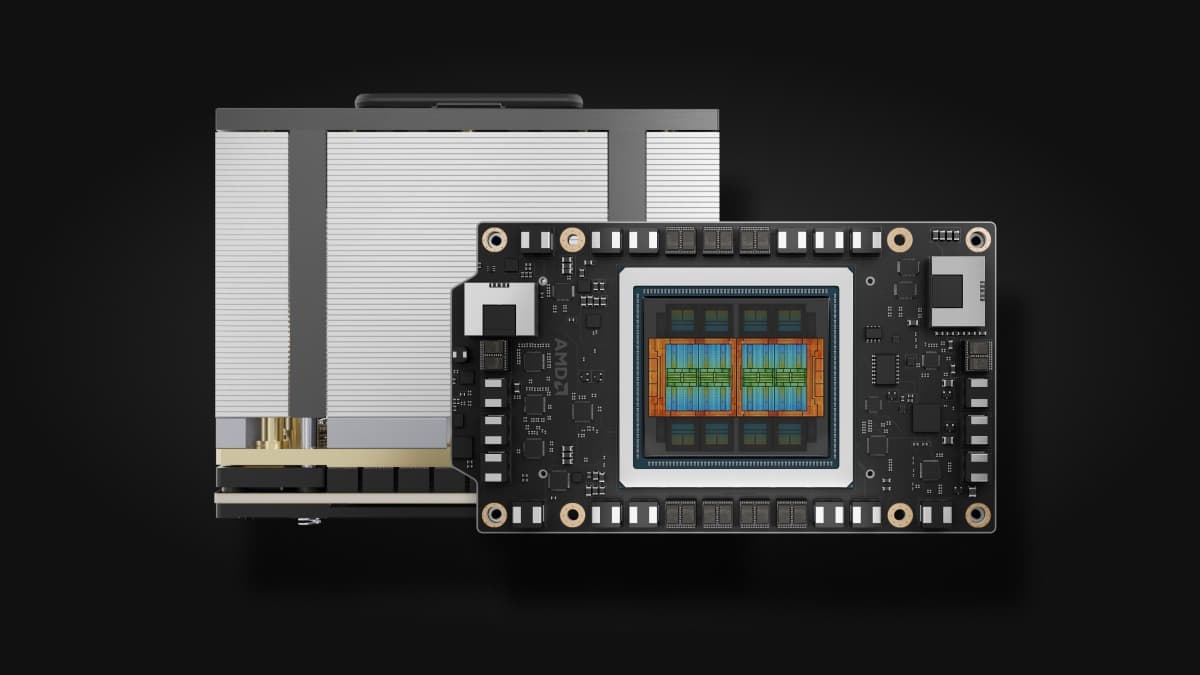
AMD's title graphic for its Oct 20 FSR announcement. It is a company slide, not a photo of an RX 6000 card or of the tested hardware.
Image: AMD
Source · Press image from the AMD newsroom, used for news reporting.
AMD's FSR Upscaling 4.1 on Radeon RX 6000 cost the RX 6950 XT 19% of its average frame rate at 4K against FSR 3.1, a 13-game average ComputerBase measured on Oct 23 in Performance mode, in return for a clearly sharper image.
AMD brought its machine-learning upscaler to the 2020-era Radeon RX 6000 series on Oct 20 with the Adrenalin Edition 26.10.1 driver, using an optimized version of the INT8 model it first built for the RX 7000. AMD's release gave no frame-rate figures, so the German labs supplied them. ComputerBase took a geometric mean of average frame rates over 13 games, with other settings at maximum and ray tracing off because RDNA 2 would otherwise fall behind: the RX 6950 XT fell from 82.3 to 74.4 fps at 1440p in Quality mode, a 10% loss, and from 68.0 to 54.9 fps at 4K in Performance mode.
The same test put the older card ahead of a newer one. ComputerBase measured the RDNA 3 Radeon RX 7900 GRE losing 13% and 24% in the same two scenarios, while the RDNA 4 Radeon RX 9070 GRE lost 3% and 10%. ComputerBase's worst case for the RX 6950 XT was Call of Duty: Modern Warfare 4 at 4K, where it lost 26%; in the same game the RX 7900 GRE lost 28% and the RX 9070 GRE 11%. ComputerBase suggests the further slimmed network AMD ships for RDNA 2 is the reason it beats RDNA 3 here.
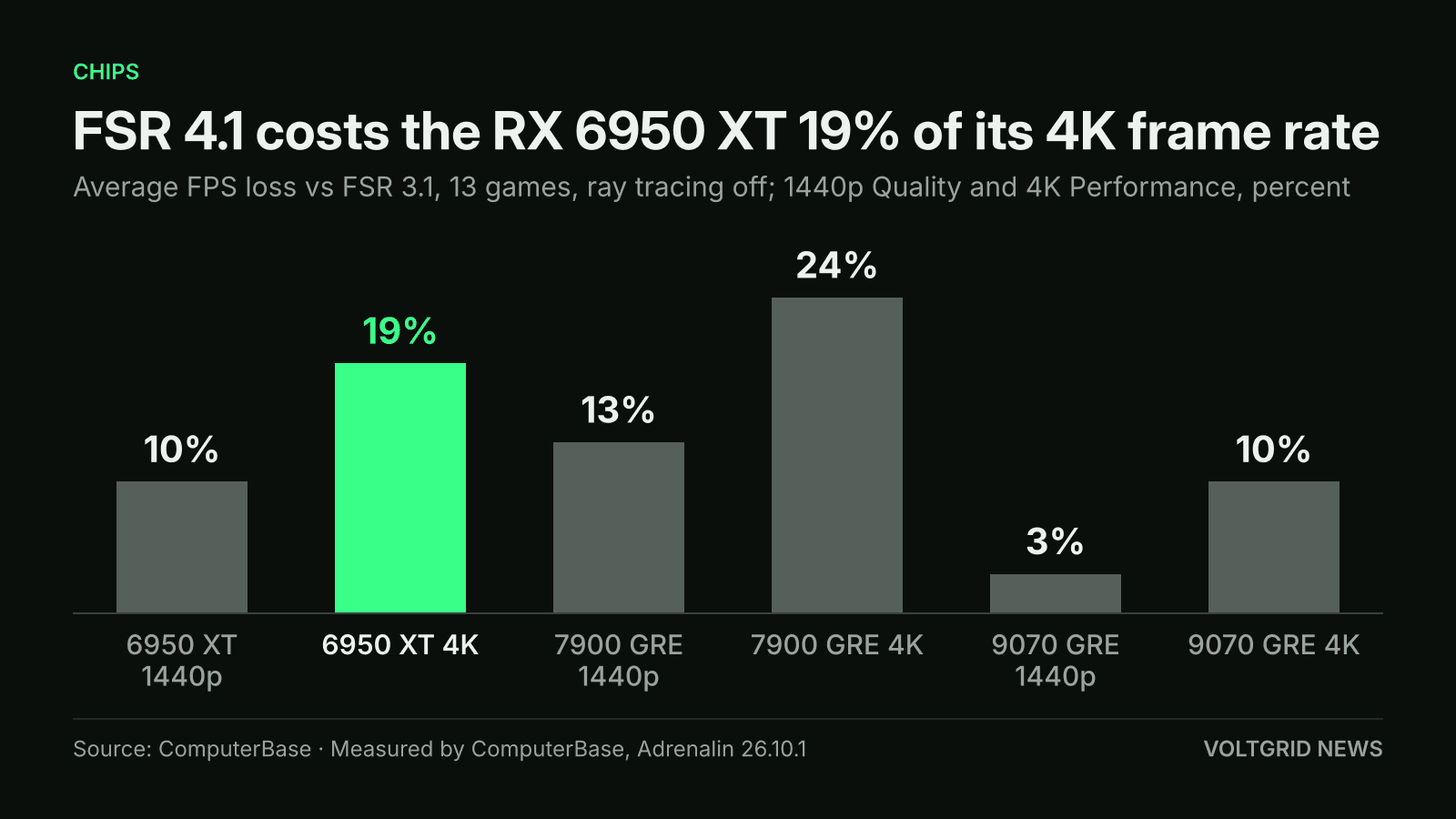
ComputerBase measured the RX 6950 XT losing 19% at 4K Performance, less than the RDNA 3 RX 7900 GRE's 24% and more than the RDNA 4 RX 9070 GRE's 10%.
Illustration (AI-generated)
Why FSR 4.1 Costs Older Radeons Frame Rate
FSR 4.1 renders a game at a lower resolution, then a trained neural network rebuilds the full frame. On RX 9000 cards the network runs in FP8 on dedicated matrix units, which ComputerBase says accelerate it far better than older shader units can. RX 6000 GPUs have no AI accelerators but can do INT8 math, PCGH notes, so the network shares the same shader units that draw the game. Every millisecond spent on inference is taken from rendering, and the bill rises with output resolution: at 4K, ComputerBase measured a 19% loss on the RX 6950 XT against 10% on the RX 9070 GRE. That suggests a general rule for AI features on older silicon: they can be ported to chips without matrix engines, but the price is paid in throughput.
PC Games Hardware measured the same driver on three RDNA 2 cards in three games; it labels its baseline FSR 3, where ComputerBase's is FSR 3.1. Its RX 6950 XT, at maximum overclock and 4K, lost 11.1% in Modern Warfare 4, 10.4% in Forza Horizon 6 and 12.5% in 007 First Light in Performance mode, up to 15.2% in Ultra Performance and 7.7% to 8.8% in Quality. An RX 6800 XT at 1440p lost 5.3% to 8.4% in Performance mode. On an RX 6600 at 1080p, Forza Horizon 6 ran 4.2% faster with FSR 4, while Modern Warfare 4 lost 7.1%.
ComputerBase and PCGH FSR 4.1 Results Differ
PCGH's 4K Performance losses on the RX 6950 XT sit well below ComputerBase's 19% average, and in Modern Warfare 4 the gap is 11.1% against 26%. The tests differ in game count, test scenes and clocks, since PCGH ran its card overclocked and published percentages only; neither lab explains the gap, and the figures should not be averaged. ComputerBase's conclusion also puts the RX 6950 XT's 4K gap at 24%, without naming the direction. That matches the same 68.0 and 54.9 fps measured against the FSR 4.1 result instead of FSR 3.1, so it is one result on a different base, not a second measurement. The RX 7900 GRE's 24% loss in the page-3 table is a separate figure. Both labs advise moving from FSR 3.1 Quality to FSR 4.1 Performance, which ComputerBase says usually still gives slightly higher frame rates with a much better image.
What Is Not Confirmed Yet for FSR 4.1
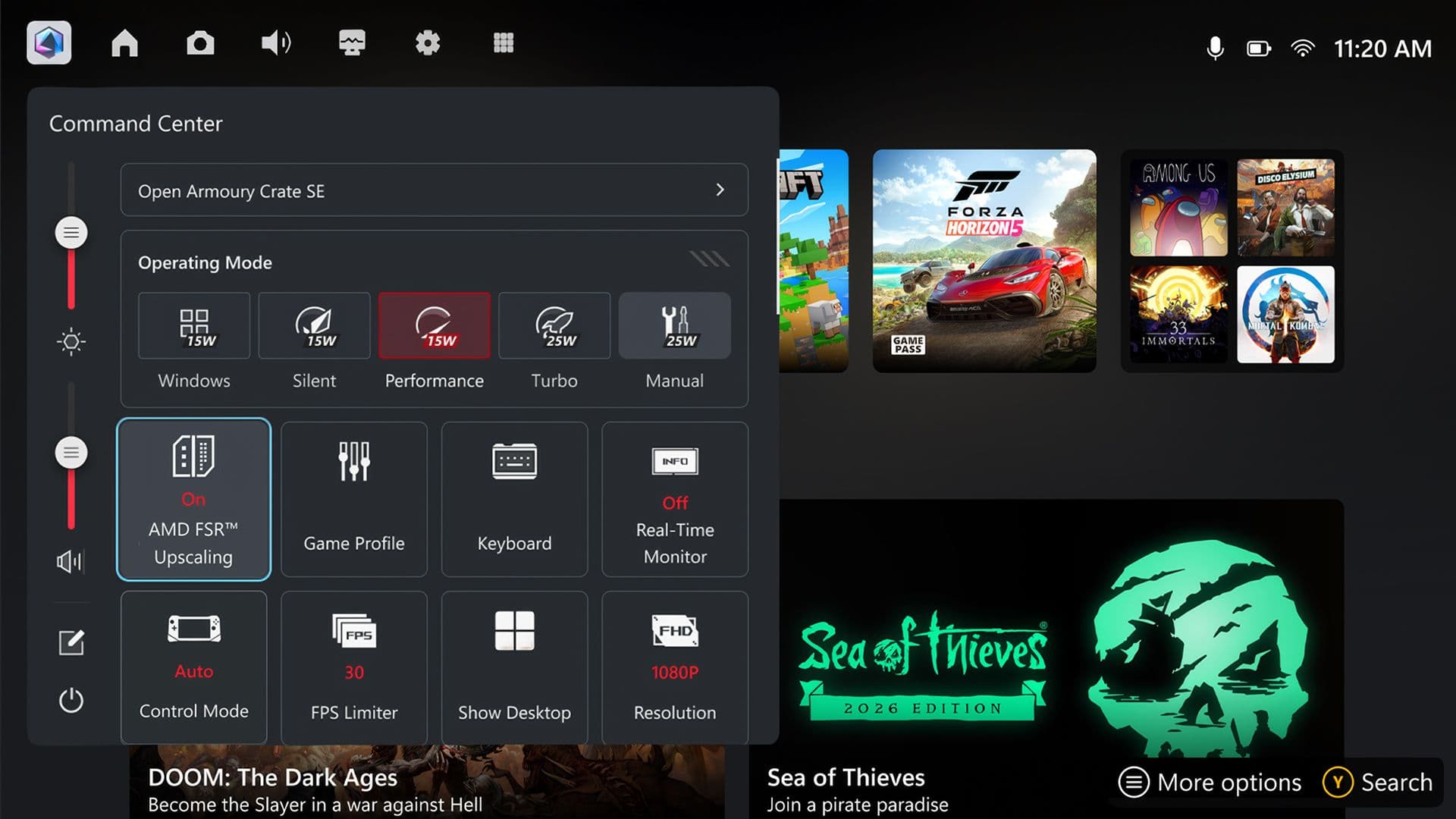
RX 6000 gets only the upscaler; AI frame generation and Ray Regeneration stay on RX 9000, and FSR 4 remains DirectX 12 only until Vulkan support arrives with FSR SDK 2.4, PCGH reports. AMD says it built a new, more efficient version of FSR Upscaling 4.1 for Ryzen AI 9 laptops and Ryzen Z2-class handhelds, with availability set by each device maker, but gives no size or cost figure. ASUS has put it in a preview driver for the ROG Xbox Ally X and X20, as Voltgrid reported, yet ComputerBase and PCGH tested desktop Radeons only, and no lab measurement of the handheld version's frame-rate cost has surfaced; AMD publishes none either. Xbox CTO Scott Van Vliet said in an AMD video that Xbox Series X and S support is coming soon, without a date.
Sources
- 01AMD FSR Upscaling 4.1 Boosts Frames and Image QualityAMD · newsroom.amd.com
- 02FSR 4.1.2 für Radeon RX 6000 im Test: Deutlich besseres Bild, moderate KostenPC Games Hardware · pcgameshardware.de
- 03FSR Upscaling 4.1 auf Radeon RX 6000 im Test: Performance: RDNA 2 vs. RDNA 3 vs. RDNA 4ComputerBase · computerbase.de
- 04Xbox Series X/S and Xbox ROG Ally X are getting AMD FSR 4.1 upscaling to improve performanceVideo Games Chronicle · videogameschronicle.com