ASUS Ships AMD FSR 4.1 Preview Driver for ROG Xbox Ally X, X20
FSR 4.1 reaches the ROG Xbox Ally X and X20 in an ASUS preview driver dated Oct 23, covering 400-plus games, but no independent frame-rate tests exist yet.
2 min readAI-assisted
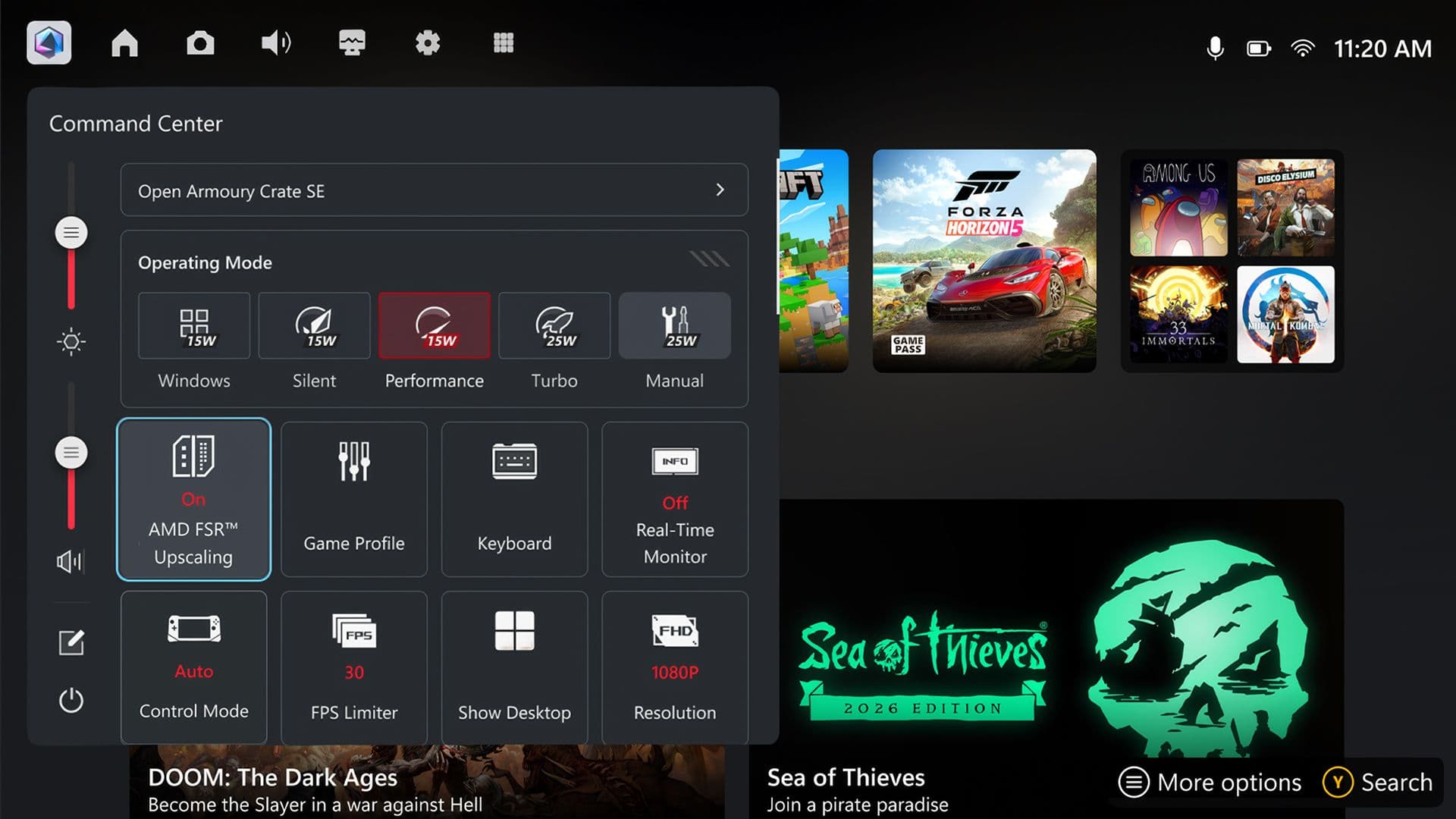
The Command Center tile that switches FSR on, as shown in ASUS's preview announcement. The image is a software screenshot, not a photo of the handheld.
Image: ASUS ROG
Source · Press image from the ASUS ROG newsroom, used for news reporting.
ASUS began distributing a preview GPU driver on Oct 23 that brings AMD FSR Upscaling 4.1 (FSR 4.1) to the ROG Xbox Ally X and ROG Xbox Ally X20 handhelds, which run the Ryzen AI Z2 Extreme processor, according to ASUS's ROG site.
Owners open Armoury Crate SE, go to Update Center, then Preview Updates, and install the latest GPU driver. ASUS said the build may still contain bugs or instability and will roll out automatically once it leaves preview. Players then add an FSR tile in the Command Center, switch it on, and enable FSR in each game's graphics settings.
The release follows AMD's Oct 20 announcement that FSR Upscaling 4.1 now officially covers Radeon RX 6000 graphics cards, Ryzen AI Max and Ryzen AI 9 processors, and handhelds built on the Ryzen AI Z2 Extreme, Ryzen Z2 Extreme and Ryzen Z2 A. Notebookcheck reported that the Adrenalin 26.10.1 driver carries the desktop and laptop support, while AMD's release notes direct handheld owners to their device maker for drivers. Tech Times reported that handhelds do not receive AMD's Adrenalin driver directly, so Ally owners depend on ASUS's driver timeline.
How FSR 4.1 Fits on a Handheld
FSR 4.1 renders a game at a lower resolution, then a trained neural network rebuilds the frame at the screen's resolution. The network runs on the same graphics hardware that draws the game, so a smaller network leaves more of each frame's time for the game. ASUS said the handheld build uses a new model less than half the size of the original INT8 model, tuned for Ryzen AI Z2 Extreme devices; that is a vendor claim, and ASUS gives no figure for the size. Tech Times reported that the Ryzen AI Z2 Extreme lacks the FP8 acceleration found on AMD's RDNA 4 desktop cards, and that running the model on shader cores carries a performance cost.
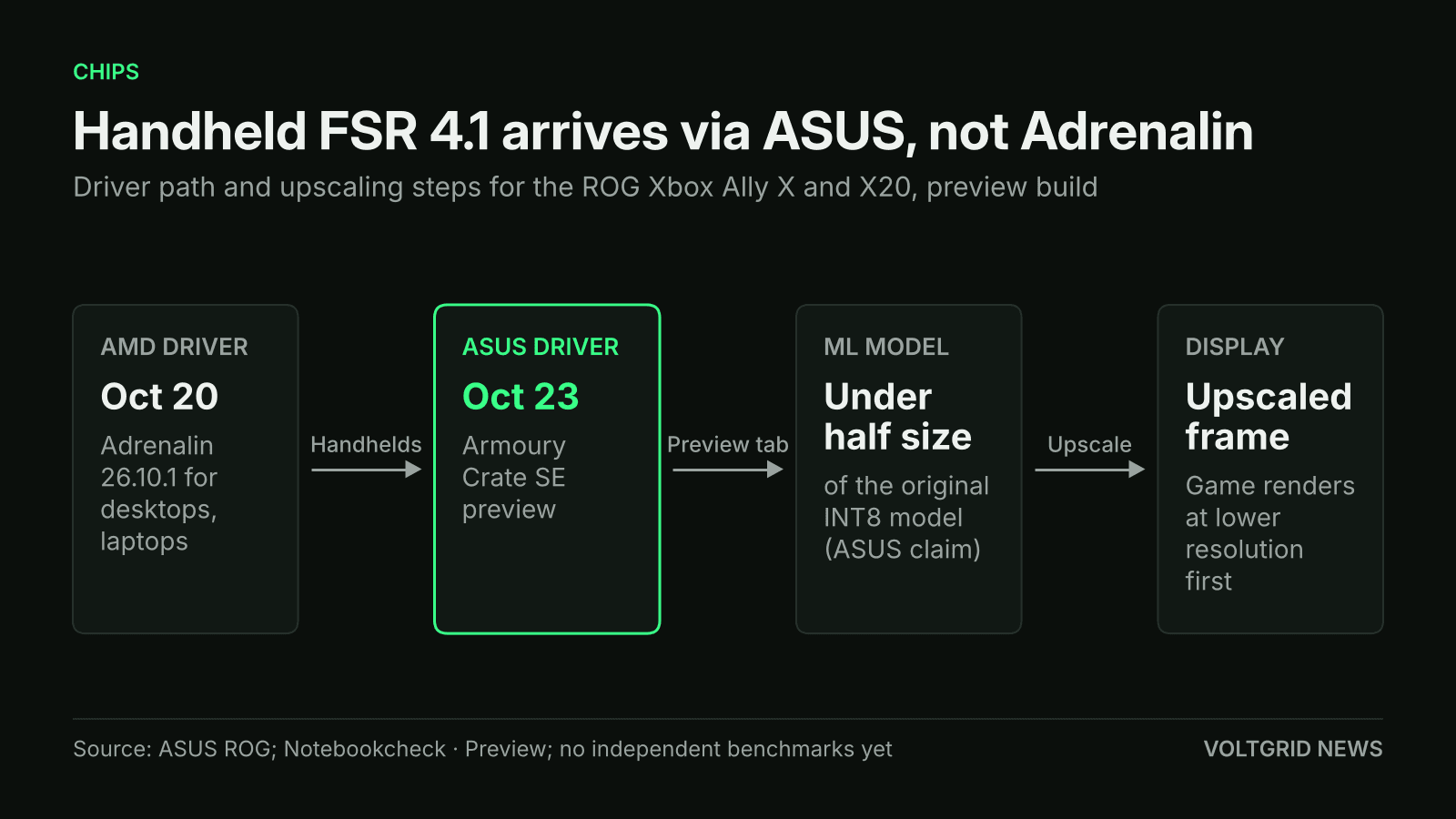
Handheld owners get FSR 4.1 through ASUS's preview driver, not AMD's Adrenalin; the model-size figure is an ASUS claim and no independent benchmarks exist yet.
Illustration (AI-generated)
Notebookcheck reported that AMD had said it was developing lightweight machine-learning models for APUs, and Tech Times quoted an AMD executive calling the Ally model purpose-built rather than a port of the desktop version. ASUS said the preview covers more than 400 games that support FSR 3.1 or newer, and Tech Times reported that no per-game patches are needed.
The consequence is a trade between image quality and the power a handheld can spare. AMD has not published benchmarks for this model on handhelds, and ASUS gives no figures for its cost, so the claim stays a vendor claim until reviewers measure frame rate and battery draw.
What Is Not Confirmed Yet
No independent frame-rate or image-quality measurements on these handhelds have been published. Tech Times cited a demonstration by AMD in which a game rose from roughly 54 fps under FSR 3.1 to about 63 fps under FSR 4.1; that is a vendor demonstration, not a test. ASUS's page is unclear on the base ROG Xbox Ally: it says a driver update is coming soon, with no date. Xbox Series X and Series S support is listed by AMD as coming soon, also without a date.
The next thing to watch is whether ASUS moves the driver from the Preview Updates tab to Official Updates. Tech Times headlined that Performance mode in FSR 4.1 now beats FSR 3.1 Quality, but that rests on RDNA 3 desktop results, not handheld tests.