Boom Supersonic Runs Sprint Core of Its 42 MW Superpower Gas Turbine
Boom Supersonic ran the Sprint Core of its 42 MW Superpower turbine for AI data centers on Nov. 21, Aviation Week reported. A short test, with a full-engine run and first deliveries both targeted for mid-2027.
3 min read
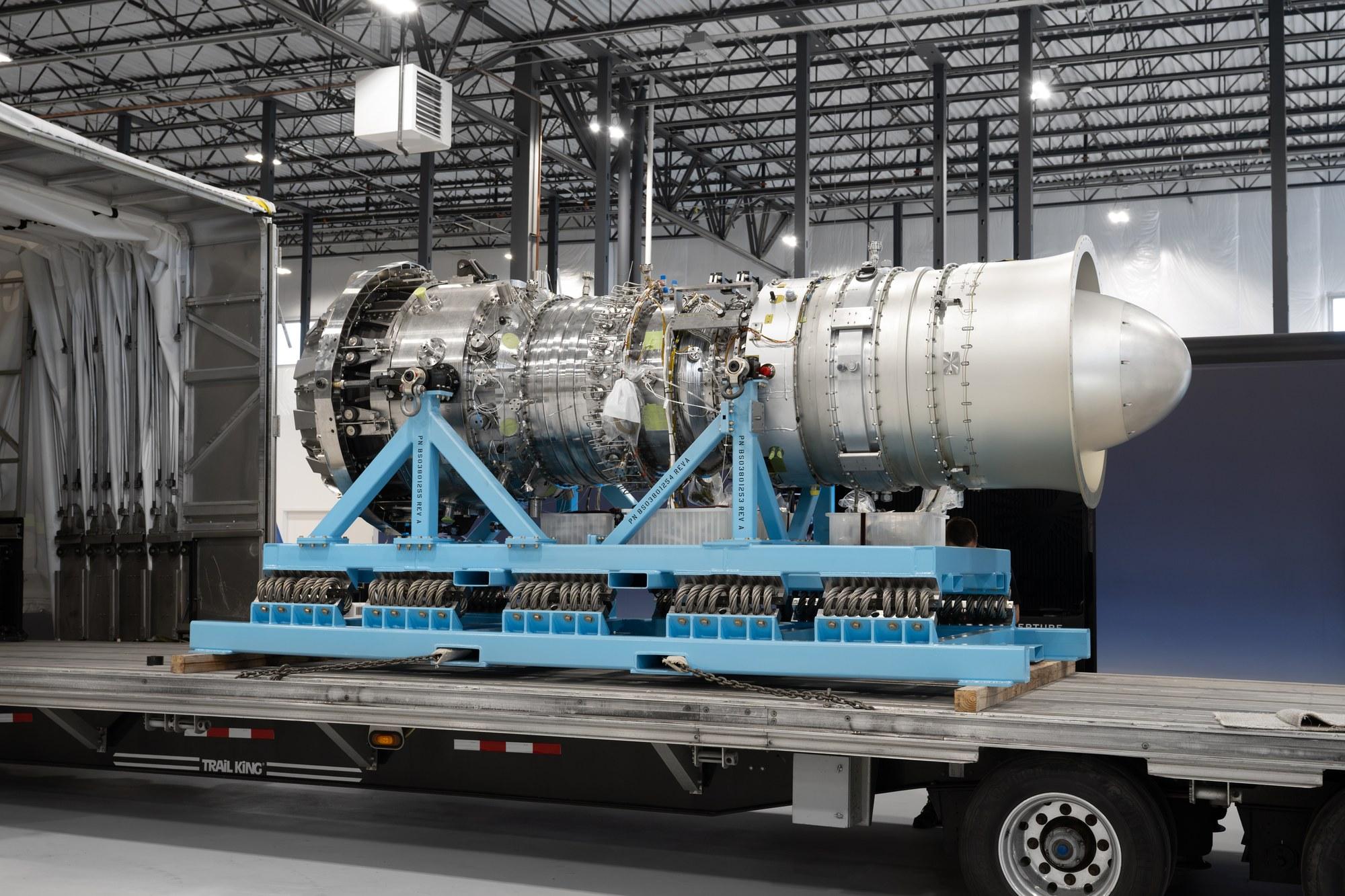
Boom's Sprint Core, the compressor, combustor and high-pressure turbine at the heart of the Superpower gas turbine, in a Boom press photo.
Image: Boom Supersonic
Source · Press image from the Boom Supersonic newsroom, used for news reporting.
Boom Supersonic ran the prototype Sprint Core of its 42 MW Superpower gas turbine for the first time on Nov. 21, Aviation Week reported, with light-off on the second attempt.
Boom founder and CEO Blake Scholl told Aviation Week on Nov. 21 that the core was run up to 6,500 rpm, with nearly 2,000 real-time sensors across the test setup recording data. He said the first run was deliberately short, and that Boom expects to widen the core's test envelope over the next two months. The test took place at Boom's site at the Colorado Air and Space Port in Watkins, east of Denver. According to Aviation Week, the core is a six-stage high-pressure compressor and a single-stage high-pressure turbine, shared by Superpower and by Symphony, the engine planned for Boom's Overture airliner.
Boom's own Oct. 22 release described the Sprint Core as the compressor, combustor and high-pressure turbine, with more than 1,000 sensors on the core itself, and said first firing was expected before Thanksgiving. The Nov. 21 run came ahead of that target. The core is a part of a turbine, not a turbine: Aviation Week says the twin-shaft Superpower will add a low-pressure spool and a free power turbine to the core, and no electrical output has been reported.
What a turbine core is and is not
A gas turbine's core is the part that makes the hot gas: a compressor, a combustor and a high-pressure turbine. Turning a generator takes more, which is why the missing low-pressure spool and power turbine matter. Compressor mapping at Watkins uses a vacuum pump and a variable exhaust nozzle to stand in for the missing low-pressure turbine and bypass duct, according to Aviation Week.
So the 42 MW is Boom's stated design rating, with net or gross not stated. The run shows that the hardest hardware turns; it does not show when megawatts arrive. Boom's mid-2027 delivery target depends on an integrated engine test it also places around the middle of next year.
Why a 42 MW turbine matters for data centers
Superpower is aimed at on-site power for AI data centers, where new gas turbines are scarce. Reuters reported on Nov. 9 that Wood Mackenzie sees US delivery talks focused on 2030 to 2031, with a new gas turbine taking about six years to arrive on average, as Voltgrid reported. That is a market average, not a figure for Boom's size class. Boom's target of first customer deliveries in mid-2027 is a company claim, and it sits in the same window as the full-engine test Scholl is "tracking toward."
For scale, GE Vernova rates its LM2500XPRESS aeroderivative package at 35 MW per unit, and 29 of them are expected to provide nearly 1 GW for Crusoe, according to GE Vernova's July 2025 release; Voltgrid has covered GE Vernova's hydrogen tests on the same model. ProEnergy says each PE6000 set is capable of 50 MW, and Crusoe's 13 sets make up a 650 MW package due by summer 2027. Boom's 42 MW falls between the two, though each rating is the maker's own and the bases differ: GE's is net, ProEnergy's spec page gives 50.2 MW gross, and Boom's basis is unstated.
Boom's 42 MW sits between GE's 35 MW and ProEnergy's 50 MW; each is the maker's own rating, and the bases differ.
Graphic: Voltgrid News
For a sense of campus size, the Kraft Group's tentative proposal in Sutton, Massachusetts, which Voltgrid covered, puts that data center at about 900 MW, a developer estimate. The Sutton plan names no Boom equipment and no on-site generation.
Boom's timeline and targets
Boom says its Superpower Superfactory in Centennial, Colorado, is a $150 million investment of nearly 200,000 square feet. Its release says the plant is already making turbine parts and targets full operation by early 2027. Boom pairs 1 GW of annual output with 25 turbines by 2028 and 2 GW with 50 turbines by 2029, with first single-crystal blades and vanes expected to ship in 2027. These are the company's targets, not delivered capacity.
Scholl told Aviation Week that single-crystal blades cannot be bought on the market, and Aviation Week says Boom is setting up its own tool-free foundry for them; Boom's release says it plans to develop an all-digital foundry. Aviation Week also reports more than 75% commonality between Superpower and Symphony.
What is not confirmed yet
Aviation Week is the only report of the run we found, and the figures above come from Scholl's account to it. No power output, efficiency or emissions data has been published, and the sources we read name no customer for Superpower. Whether an integrated engine runs by mid-2027, and whether first deliveries follow in the same window, is not shown by a short core run.
Sources
- Published
- Sources
- 2 cited