Destin Power Adds ESS, Electrolysis PCS; Doosan Fuel Cell Is 80%+ of Sales
Korean converter maker Destin Power, over 80% reliant on Doosan Fuel Cell, is moving into immersion-cooled ESS and electrolysis PCS ahead of a Kosdaq listing, TheElec reported on Nov. 22.
3 min read
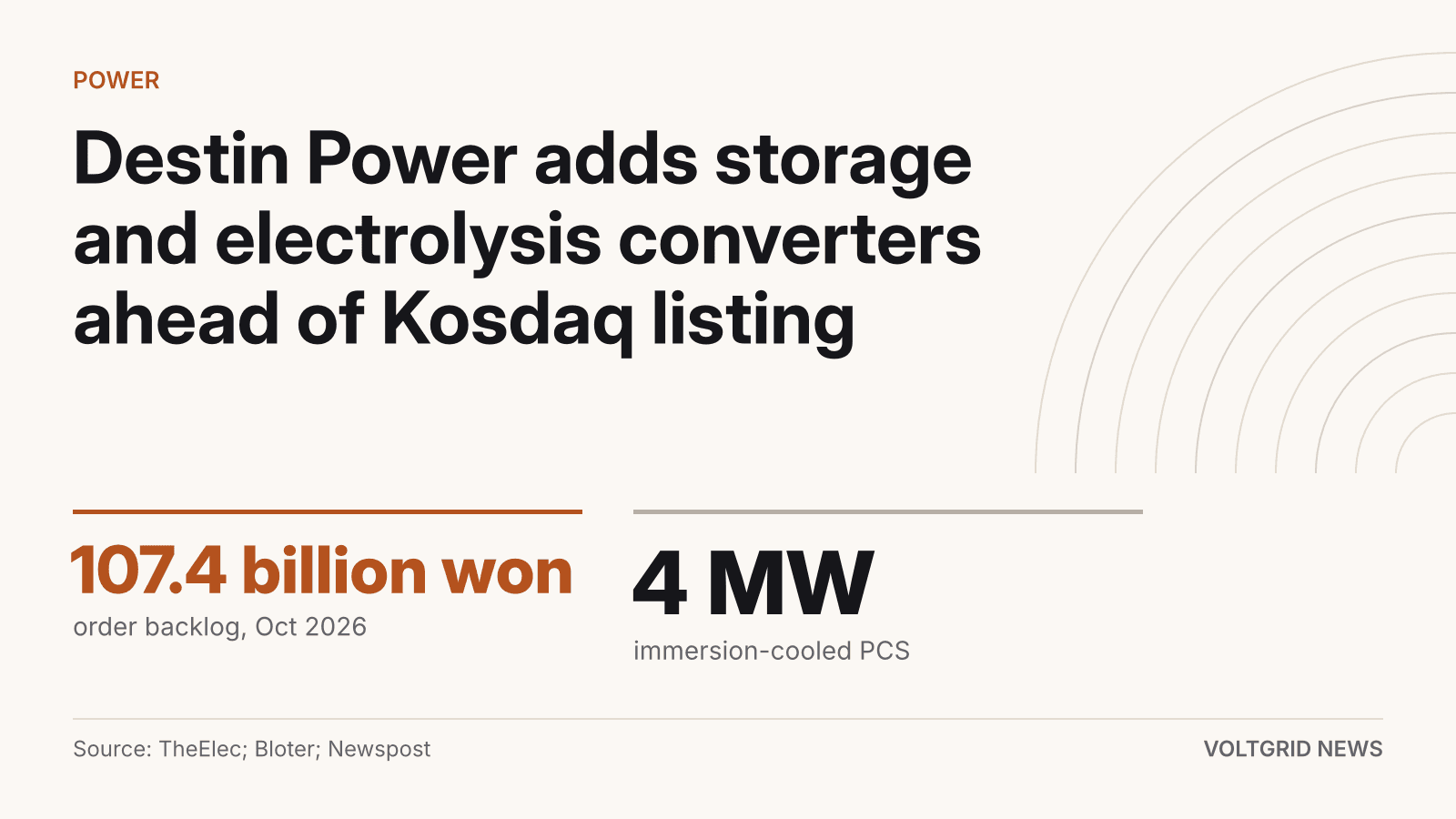
Destin Power key facts as reported by TheElec, Bloter and Newspost; the 4 MW PCS is the company's own claim.
Graphic: Voltgrid News
Destin Power, the South Korean power-conversion maker that has sold only to Doosan Fuel Cell since 2024, is adding energy-storage and electrolysis converters, TheElec reported on Nov. 22, ahead of a Kosdaq listing.
Destin Power will keep fuel cell inverters as its cash cow, according to TheElec, while expanding power conversion systems (PCS) for energy storage systems (ESS) and rectifiers for water electrolysis. Sales to Doosan Fuel Cell were 24 billion won in 2025 and 18.5 billion won through the third quarter of 2026, and the customer has made up more than 80% of revenue since 2024. Its order backlog stood at 107.4 billion won in October 2026.
Bloter, reading the company's securities registration statement filed with Korea's electronic disclosure system, added that Destin Power signed a 107.5 billion won supply contract with Doosan Fuel Cell in October, of which 587 inverters are for US data centers. Bloter said 453 of them are due in 2027, with the company projecting 65.7 billion won in revenue from that delivery.
Why 4 MW and 8 MW PCS Units Matter for Data Centers
TheElec said individual PCS units for ESS are growing from 2 megawatts (MW) to 4 MW and 8 MW as data-center capacity expands, and that larger units shed more heat. Destin Power is applying its own immersion cooling to its high-capacity PCS products, the outlet reported.
Newspost, carrying the company's statement of Oct. 29, named the product: a 4 MW immersion-cooled PCS developed jointly with SK On, which submerges the heat-producing parts in insulating coolant oil. The company says this improves cooling performance and power density compared with air cooling and addresses fire-safety concerns. Cumulative ESS PCS supply exceeds 600 MW, it said, against 552 MW of fuel cell inverters.
The demand signal runs through the converter, not only the cell or the battery. Newspost said the company links its US push to on-site generation at data centers, a theme Voltgrid News covered in its on-site AI power count, because grid expansion takes time. A fuel cell inverter supplier is therefore adding storage converters to its range.
Revenue Targets and Offering Terms
Destin Power expects 7.8 billion won of new revenue by 2028 from PCS for domestic long-duration ESS and 4.1 billion won from electrolysis PCS, TheElec reported. Together that is 11.9 billion won, and the company said the two lines could reach 50% to 60% of the revenue from ESM products sold to Doosan Fuel Cell. An ESM (Electrical System Module) is the unit that combines power conversion and electrical control inside a fuel cell system. Cumulative revenue through the third quarter of 2026 was 21.5 billion won, or 72% of full-year 2025.
Doosan Fuel Cell sales of 24 billion won in 2025 are far larger than the 7.8 and 4.1 billion won of new revenue Destin Power targets by 2028.
Graphic: Voltgrid News
The company plans to offer 2.2 million shares at 8,000 to 11,000 won each, with Korea Investment & Securities as lead underwriter, and to put 15.6 billion won of the proceeds into a new factory in Iksan, North Jeolla Province, for fuel cell ESMs and PCS for ESS and electrolysis, TheElec said. Bloter put the implied market value at 116.5 billion to 160.2 billion won and noted that the range rests on 2028 estimates rather than current results, with 98.4 billion won of 2028 standalone revenue forecast against 28.9 billion won in 2025.
What is not confirmed yet
The sources give different bookbuilding timing. TheElec wrote that institutional bookbuilding takes place in November, while Bloter, citing the registration statement, gave Dec. 2 to Dec. 8, with the final price on Dec. 10 and retail subscription on Dec. 14 and 15. Neither reported a result.
The revenue targets are company projections. Bloter noted that the Doosan Fuel Cell supply contracts run to the first quarter of 2028 and that none yet covers the period after. The sources name no customer for the ESS or electrolysis products, and TheElec describes the 4 MW and 8 MW sizes as a market trend rather than shipping Destin Power products; only the 4 MW unit is named, by Newspost. Voltgrid News did not read the registration statement itself.
Sources
- Published
- Sources
- 3 cited