Diamond Foundry Says It Grew First 200 mm Single-Crystal Diamond
Diamond Foundry says its 200 mm single-crystal diamond, shown unpolished on Nov. 6, could spread heat inside AI chips, but it gave no yield, cost or thermal data.
Energy & Cooling DeskEdited by Ege Erten
3 min readAI-assisted

Diamond Foundry's D200, the 200 mm single-crystal diamond the company announced on Nov. 6.
Image: Diamond Foundry
Source · Press image from the Diamond Foundry website, used for news reporting.
Diamond Foundry said on Nov. 6, 2026 that it has grown the first 200 mm (about 8 inches) single-crystal diamond, a disc it pitches as heat-spreading material for AI chips.
The San Francisco company made the announcement in a press release and a video keynote by chief executive Martin Roscheisen at the CarbonSemi 2026 conference in Ningbo, China. Diamond Foundry says the disc is one continuous crystal, not an assembly of smaller pieces and not polycrystalline diamond. "World's first" is the company's claim, and Tom's Hardware repeats it without independent verification. Roscheisen said in the release that the result "makes D300mm predictable as well"; the release does not say a 300 mm crystal exists. Tom's Hardware reads a company graph as putting that size before 2030.
What a diamond spreader changes for AI chip cooling
Today the limit on an AI accelerator is often local: power concentrates in small hot spots on the silicon, and the cold plate sitting on top can only remove heat as fast as it leaves those spots. Diamond Foundry's release says diamond combines the highest thermal conductivity with exceptional mechanical strength, so it can spread heat at the material level. Tom's Hardware estimates diamond conducts heat at least five times better than copper. That is an outlet estimate, not a measurement on this crystal.
In practice, a diamond layer bonded behind a die would flatten hot spots before heat reaches the cold plate. For a fixed temperature limit, that could allow more watts per chip or a lower peak temperature at the same power. The company's website claims up to 10 times the power and up to 10 times the lifetime for hot-spot-free AI chips, up to 100 times the capacity for advanced cooling and up to 7 times the FLOPS per kWh for 3D chip packaging. Those are marketing figures from Diamond Foundry, published without a stated test basis, and none appears in the Nov. 6 release.
How a diamond spreader moves chip heat
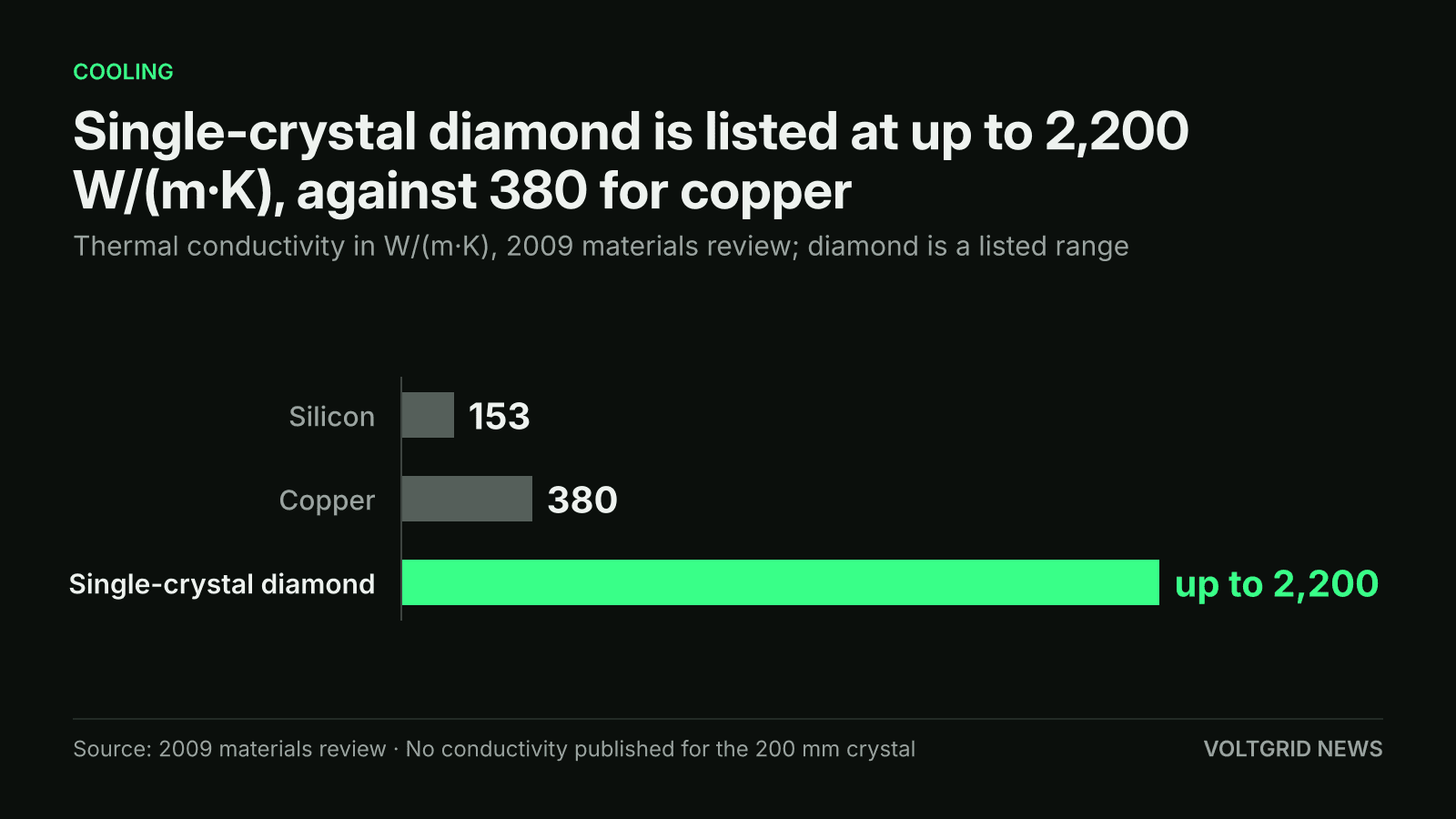
A 2009 materials review lists single-crystal diamond at up to 2,200 W/(m·K), against 380 for copper and 153 for silicon; no figure has been published for the 200 mm crystal.
Illustration (AI-generated)
A heat spreader is a layer that carries heat sideways, away from a hot spot, before it reaches the cold plate. What counts is thermal conductivity, the watts that flow through a metre of material for each kelvin of temperature difference. A 2009 materials review lists copper at 380 W/(m·K), silicon at 153, and natural single-crystal diamond as high as 2,200. Diamond Foundry's website charts diamond at 3,000, with no units or test basis.
That gap is why diamond is pitched for the package: it can even out temperatures across a die, so peak temperature falls or power can rise. It does not change the rack's heat load. The same watts still leave through cold plates, the coolant distribution unit and facility water. No conductivity has been published for the new 200 mm crystal.
What it does not change at rack level
A spreader moves heat within the package. It does not remove it from the rack. Heat still has to travel through cold plates, a coolant distribution unit (CDU) and facility water to heat rejection, the chain that liquid-cooling systems such as the Vertiv SmartIT bundle for NVIDIA GB300 and Rubin are built around. Voltgrid's reading is that better spreading would show up first as a lower chip-to-coolant temperature drop, which in principle lets operators hold power density or run warmer coolant, not as smaller coolant loops. No source quantifies that effect for this crystal.
Competing approaches already target the same thermal path. Tom's Hardware, whose rival details are its own, lists Akash Systems, which won $18.2 million in CHIPS Act funding in 2024 for gallium nitride on synthetic diamond that it says cuts temperatures by 20 degrees C, De Beers' copper-plated diamond composite, and Frore Systems' diamond-infused cold plates for NVIDIA's next-generation GPUs. Chemours' two-phase fluids work at the coolant end of that chain.
What is not confirmed yet
The crystal is shown as grown and unpolished, and the release says nothing about yield, cost, defect density or a date for commercial 200 mm wafers. It also gives no thermal measurement for this disc. Tom's Hardware notes that the sample still needs processing before chipmakers can use it. The outlet also notes that 200 mm matches the wafers fabs use for older processes, not the 300 mm wafers of leading-node lines.
The company says it is scaling volume production of chip substrates through a $2.77 billion EU Chips Act project in Spain. Watch for polished wafers, third-party thermal data, and a customer that names diamond in a shipping accelerator package.