DirectX Raytracing Preview Hits 66x in RX 9070 Sample, 89.7% Less Memory
Microsoft's Oct. 28 DXR preview ran 66x faster in its own RX 9070 sample and cut acceleration-structure memory 89.7%. Scratch memory trims the net saving to about 80%, and it is not yet in games.
Chips & Power DeskEdited by Ege Erten
4 min readAI-assisted
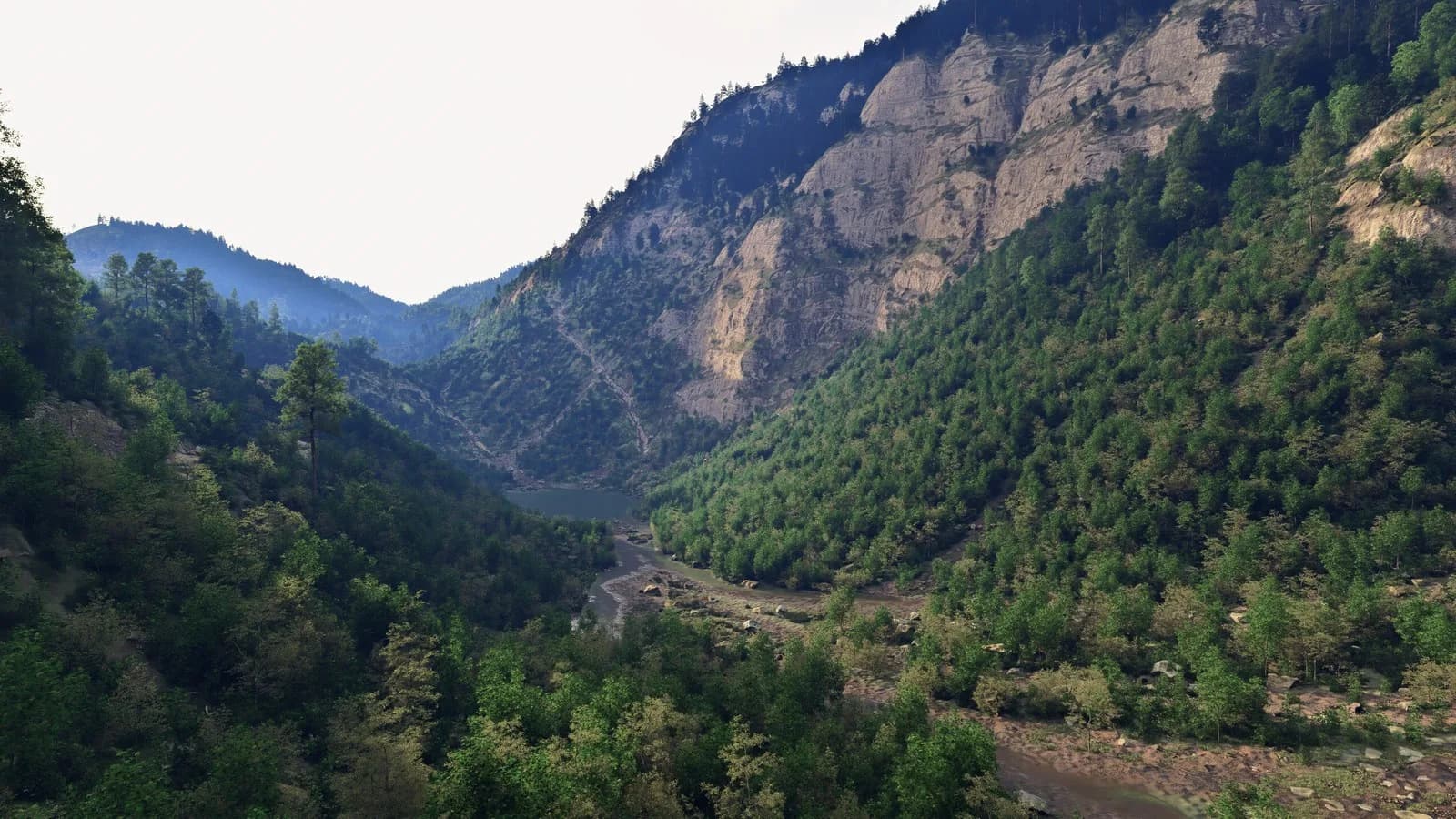
A sample scene from Microsoft's DirectX Raytracing preview post, rendered with clustered geometry and PTLAS. It is not an RX 9070 product photo and not a game.
Image: Microsoft DirectX Developer Blog
Source · Press image from the Microsoft DirectX Developer Blog, used for news reporting.
Microsoft previewed Clustered Geometry and Partitioned Top-Level Acceleration Structures (PTLAS) for DirectX Raytracing on Oct. 28, and its own sample on a Radeon RX 9070 went from 1.2 to 79 frames per second, about 66 times faster than rebuilding every bottom-level structure each frame, while total acceleration-structure memory, before scratch buffers, fell from 7,519 MiB to 774 MiB.
The figures come from Microsoft's DirectX Developer Blog, where engineer Amar Patel calls the update the most significant for DirectX Raytracing since its 2018 debut. The numbers are Microsoft's own, from a test sample, not an independent benchmark. The post says the sample is "just one configuration" and warns in capitals that games should not be expected to see this magnitude of wins. The comparison pits clustered geometry against a full rebuild of every bottom-level acceleration structure (BLAS, the data structure that lets rays find triangles) each frame, which PC Games Hardware (PCGH) calls a particularly unfavourable baseline for animated geometry.
What Microsoft measured on the RX 9070
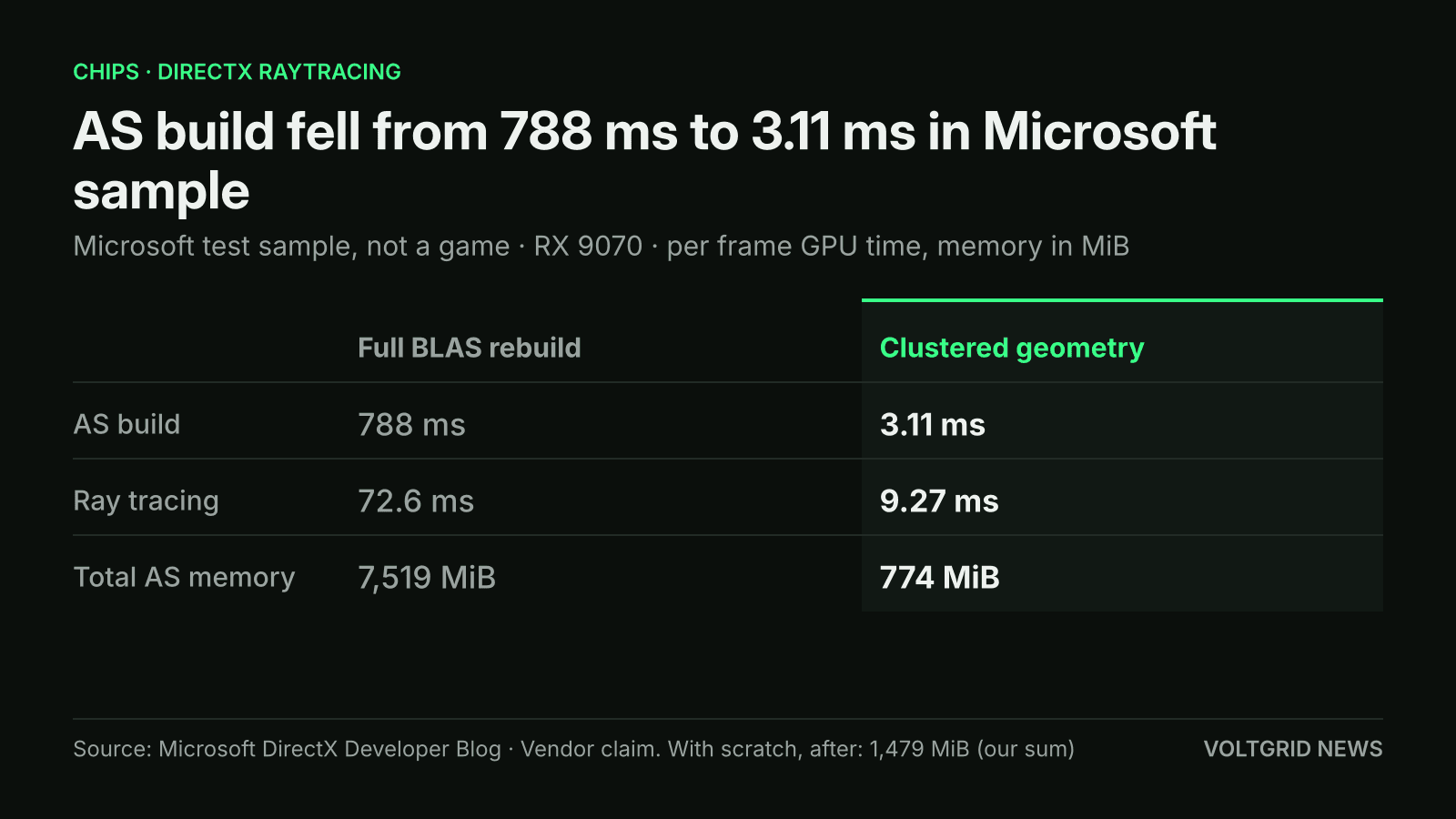
Microsoft test sample, not a game: a vendor claim on one configuration. With scratch memory, the after figure is 1,479 MiB (Voltgrid sum).
Illustration (AI-generated)
Per frame, GPU acceleration-structure preparation fell from 788 ms to 3.11 ms and GPU ray tracing from 72.6 ms to 9.27 ms, Microsoft's table shows. Memory for the animated objects dropped from 6,794 MiB to 244 MiB, 96.4% less, and the static objects from 723 MiB to 527 MiB. Total acceleration-structure memory, including the top-level structure, fell 89.7%.
Our arithmetic from those figures: the old path spent about 91.6% of its build and trace time on rebuilding (788 of 860.6 ms; that sum runs a little over the roughly 833 ms frame that 1.2 fps implies), so most of the 66x comes from build cost, not faster ray tracing. Tracing alone gains 7.8x (72.6 divided by 9.27). The memory saving is 6,745 MiB, about 6.6 GiB. At 1.2 fps a frame takes about 833 ms, against about 12.7 ms at 79 fps.
Scratch memory narrows the saving
PCGH notes the 89.7% excludes scratch memory, the temporary working buffer the GPU needs during a build. Microsoft's table shows it rising from 1.83 MiB to 526 MiB for static builds and from 8.25 MiB to 179 MiB for animated ones. PCGH adds it up to 10 MiB before and 705 MiB after and puts the net saving at roughly 80%, or just under 6 GiB. Our sum agrees: 7,529 MiB before, 1,479 MiB after, a saving of 6,050 MiB, or 80.4%. A second sample in Microsoft's repository, contributed by NVIDIA, a domino scene using PTLAS, cut the update from 2.88 ms for a full top-level rebuild to 0.79 ms with 4,702 localized writes, with slightly slower tracing.
How Clustered Geometry Cuts Rebuild Work
A ray tracer finds triangles through an acceleration structure, and the old route rebuilds each animated object's bottom-level structure (BLAS) every frame. Clustered geometry splits a mesh into small cluster structures (CLAS) of up to 256 triangles and 256 vertices, Microsoft says, and builds a BLAS from references to them, so cluster work can be reused.
Partitioned TLAS applies the same idea to the whole scene and updates only the regions that changed. In Microsoft's RX 9070 sample, per-frame build time fell from 788 ms to 3.11 ms against a full rebuild, and its domino sample cut a scene update from 2.88 ms to 0.79 ms. Microsoft warns games will not see this magnitude; the saving is build time and memory, offset by a larger scratch buffer.
Why memory savings matter for pricier VRAM
Graphics memory is getting dearer. As we reported on Oct. 29, Tom's Hardware found the cheapest in-stock RTX 5080 at $1,999 as of that date, double its launch price, and our reading was that memory makers' focus on AI is setting GeForce prices. On Oct. 31 we covered the report that AMD plans a second Radeon price increase, with GDDR6 up 8% to 10% in the third quarter, a cost our story read as mainly touching the Radeon RX 9000 series. If a game could keep ray-tracing structures in a fraction of the VRAM, that would ease pressure on cards whose memory is the costly part. The sample's 6.6 GiB is a test scene's structure footprint, not a game's VRAM use. That is a developer decision, and nothing here shows a shipping game doing it.
Hardware, drivers and status
This is a preview. It needs the Agility SDK 1.722 preview, a supporting driver and Windows Developer Mode, and Microsoft says it needs no hardware capabilities beyond existing ray tracing, though support for some older ray-tracing GPUs is still to be determined. NVIDIA says it supports all RTX GPUs. AMD lists Radeon RX 9000 series cards with a developer-preview driver, and Intel lists Arc B-Series and some Core Ultra processors with a beta driver. Qualcomm targets driver support on Snapdragon X2 in the first half of 2027. PCGH reports no commitment for Radeon RX 6000 and RX 7000 or Intel's Arc A-Series. Microsoft names Gears of War: E-Day as an early adopter of clustered geometry, through NVIDIA's vendor-specific RTX Mega Geometry interface, not the DirectX one.
What is not confirmed yet
Microsoft has given no date for a final release. Its Agility SDK post says Shader Model 6.10 should reach retail in version 1.621 in early December, and PCGH says it is open whether these ray-tracing features ship with it. We found no newer driver, game patch or Khronos Group announcement for the Vulkan side since the Oct. 28 post and PCGH's Oct. 30 report. On Vulkan, PCGH says only NVIDIA-specific extensions exist so far for cluster structures.
Sources
- 01Announcing Agility SDK 1.620 Retail and 1.722 Preview: DirectX Dump Files, Partial Graphics Programs, and So Much More!Microsoft DirectX Developer Blog · devblogs.microsoft.com
- 02[PREVIEW] Raytracing: Clustered Geometry, Partitioned TLAS, Indirect Acceleration Structure BuildsMicrosoft DirectX Developer Blog · devblogs.microsoft.com
- 03DirectX Raytracing: Neue Vorschau senkt Speicherbedarf um bis zu 90 ProzentPC Games Hardware · pcgameshardware.de