Gujarat Adds Rs 1,000 Crore PM Surya Ghar Subsidy for Rooftop Solar
Gujarat's cabinet added Rs 1,000 crore to the PM Surya Ghar subsidy on 22 October 2026; households with systems up to 2.18 kWp pay 5% to 10% of the benchmark cost.
3 min readAI-assisted
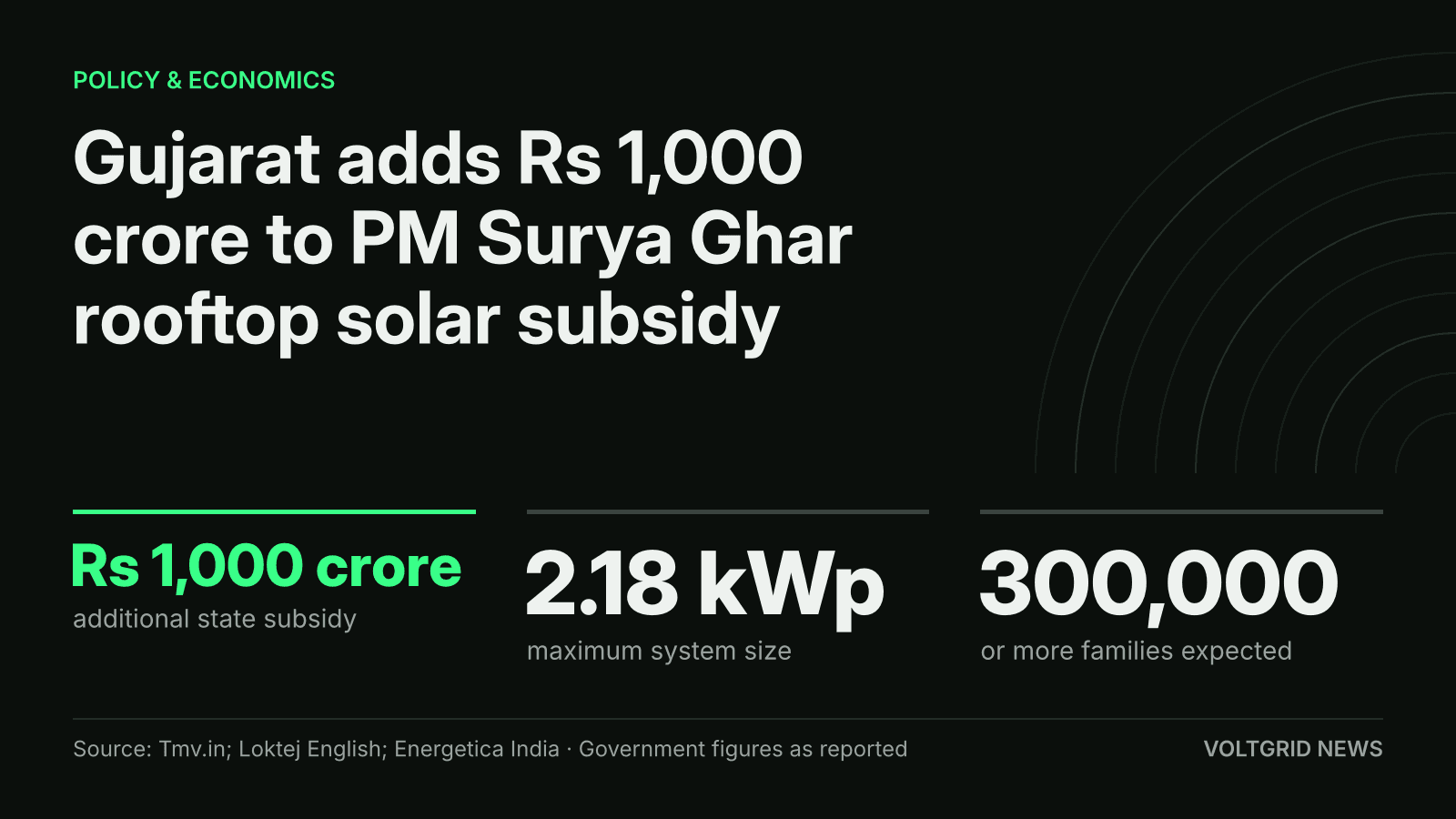
Gujarat's cabinet approved an additional Rs 1,000 crore for rooftop solar systems up to 2.18 kWp under PM Surya Ghar, as reported.
Illustration (AI-generated)
Gujarat's state cabinet approved an additional Rs 1,000 crore subsidy on 22 October 2026 for rooftop solar systems of up to 2.18 kWp under the central PM Surya Ghar: Muft Bijli Yojana, cutting the household's own share to 10% of the benchmark cost, or 5% for Scheduled Caste and Scheduled Tribe (SC/ST) households.
The decision was taken at a cabinet meeting chaired by Chief Minister Bhupendra Patel, according to Loktej and The Morning Voice. State spokesperson Jitu Vaghani said it is expected to directly benefit more than three lakh (300,000) families. The state pays whatever remains of the cost after the central financial assistance (CFA) and the household's share are deducted, Energetica India reported from the government notification.
How Much Households Pay Under the Top-Up
Loktej gives two worked examples from the state's release. A 1 kW system costs Rs 54,000, of which the Centre pays Rs 32,400. A general-category household then pays Rs 5,400 and the state adds Rs 16,200; an SC/ST household pays Rs 2,700 and the state adds Rs 18,900.
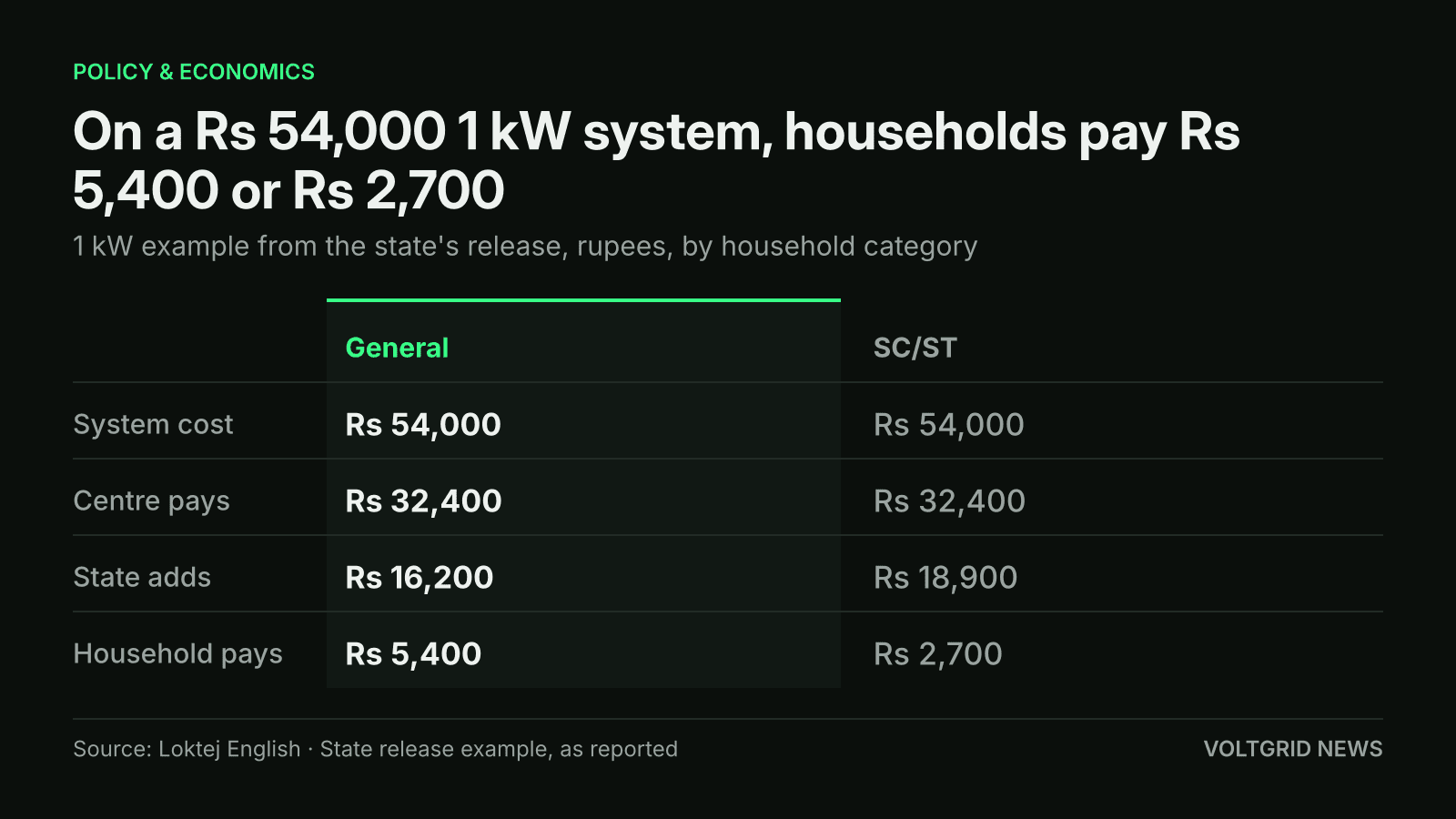
In the state's 1 kW example, a general household pays Rs 5,400 and an SC/ST household Rs 2,700, according to Loktej English.
Illustration (AI-generated)
For a 2 kW system the reported cost is Rs 1,07,200 (Rs 107,200) with Rs 62,800 of central assistance. The household pays Rs 10,720, or Rs 5,360 for SC/ST consumers. The reports do not state the state's rupee amount for 2 kW. Subtracting the published figures gives about Rs 33,680 for general households and Rs 39,040 for SC/ST households; that is Voltgrid's arithmetic, not a government figure.
Who Pays the Gujarat Rooftop Solar Subsidy
Money flows from the state budget to the distribution companies and then to households. Energetica India says Gujarat Urja Vikas Nigam (GUVNL) is the nodal agency that allocates the funds to the four state distribution companies (DGVCL, MGVCL, PGVCL, UGVCL) and to private licensee Torrent Power, which pay the subsidy by Direct Benefit Transfer into bank accounts.
Spread across the three lakh families the government expects to reach, Rs 1,000 crore (Rs 10 billion) works out to roughly Rs 33,000 per family. That is Voltgrid's division of two official numbers; the government has not said what system sizes the budget assumes.
For a household the effect is on the upfront bill. On the 1 kW example the own contribution falls to 10% of Rs 54,000, and for SC/ST households to 5%. Gujarat says more than 14 lakh households already have rooftop solar, over 8.5 lakh of them under PM Surya Ghar, the highest of any state in the programme by the government's count.
Eligibility Conditions and Open Points
The top-up applies only to systems commissioned on or after 22 October 2026, with installed DC capacity no higher than 2.18 kWp. Beneficiaries may not add rooftop capacity for three years from installation. Households with earlier, smaller systems can apply for the top-up on added capacity if the cumulative total stays within 2.18 kWp, according to Energetica India.
Sources differ on the benchmark. Energetica India quotes a benchmark of Rs 50,000 per kW for the first 2 kW and Rs 45,000 per kW beyond that, while the cabinet examples use Rs 54,000 for 1 kW and Rs 1,07,200 for 2 kW. Voltgrid has not seen the government resolution and has not merged the two bases.
The next steps are the first DBT payouts through the distribution companies and the uptake figures for systems commissioned after 22 October. The state has not said how quickly the Rs 1,000 crore will be drawn down or whether the cap will be revised. Voltgrid News reported separately on Vietnam's order for provinces to set rooftop solar incentives.