IEA: Data Center Electricity Use Doubles to 1,000 TWh by 2030
The IEA's World Energy Outlook 2026 puts data center demand at 1,000 TWh in 2030 and 1,500 TWh in 2035, with emissions up 70% by 2030 as coal and gas supply about 60% of the power.
2 min read
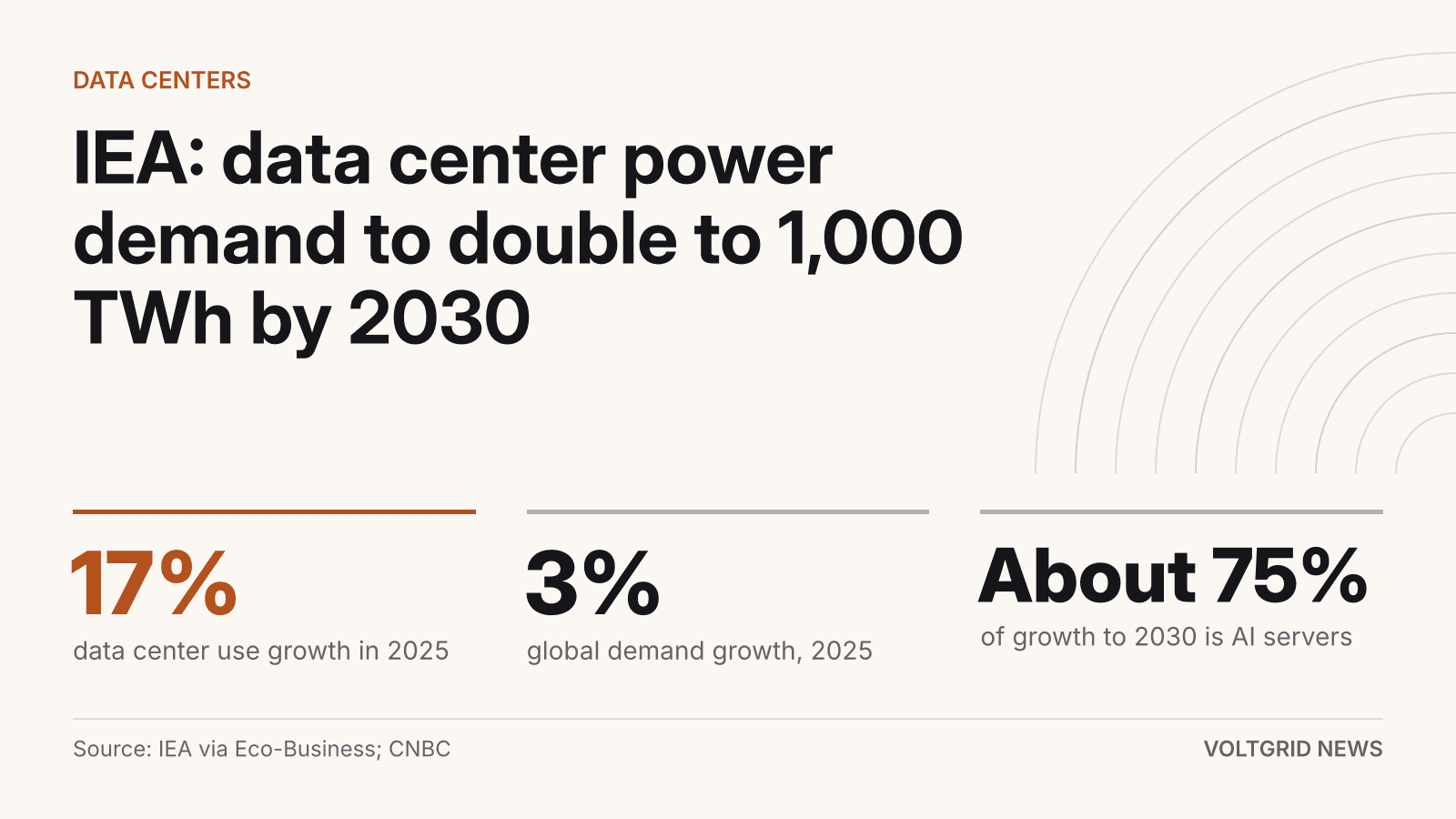
IEA World Energy Outlook 2026 on data center electricity demand. Figures as reported by Eco-Business and CNBC.
Graphic: Voltgrid News
The International Energy Agency (IEA) said on 19 November 2026 that global data center electricity use will double from about 500 terawatt-hours (TWh) today to 1,000 TWh by 2030, and reach 1,500 TWh by 2035, in its World Energy Outlook 2026.
The figures come from the outlook's main scenario, which is built on policies already in force plus those governments have formally proposed, according to Eco-Business. CNBC, which cites the IEA's Stated Policies Scenario, wrote that use "could roughly double" to about 1,000 TWh a year by 2030. Servers built for AI account for about three-quarters of the growth to 2030, Eco-Business reported, and data center electricity use rose 17% in 2025 while global electricity demand rose 3%, CNBC reported.
Emissions and Where the Power Comes From
Coal and gas supply about 60% of the electricity data centers use today, and emissions linked to the sector are on track to rise 70% by 2030, the IEA said, as Eco-Business reported. Data centers are still about 1.7% of global electricity demand. By 2035 they add less new demand than electric vehicles or factories making batteries and solar panels, the agency's projections show. The concentration is the issue: China, the European Union and the United States together hold more than 80% of the sector's projected 2035 demand.
Against the April 2025 Projection
The IEA's April 2025 Energy and AI report put data center demand at around 945 TWh by 2030, according to the American Public Power Association. The new 1,000 TWh figure is about 55 TWh, or roughly 6%, higher. Eco-Business describes the agency as having raised its data center outlook, with more data centers expected than before, particularly in the United States. The two reports may use different scenarios and baselines, and the IEA's own comparison was not available to us, so treat the gap as indicative.
The IEA's main scenario puts data center demand at 1,000 TWh in 2030, above the 945 TWh projected in April 2025.
Graphic: Voltgrid News
What It Means for Grids
Interconnection is where this bites. CNBC reported that in several regions, including Texas, Virginia, Finland and the United Kingdom, data centers waiting to connect have combined capacity above current peak demand. Tight supply chains, local opposition and limited grid capacity could slow construction, the IEA said. Over the next 10 years the world needs at least 25 million kilometres of new power lines and 15 million kilometres of replacements or upgrades, the agency's executive summary states, and supplies of copper, transformers and cables are currently tight.
Some governments are already acting on that. Thailand paused 49 data center projects under construction and 117 awaiting approval in September while it drafts rules on electricity, water use, siting and community impacts, Eco-Business reported, citing the IEA. In the US, PJM Interconnection proposed to halve data center studies to one year on 17 November.
The IEA's total is global. A study of US hyperscale data centers, as Voltgrid reported on 16 November, covered a narrower set of sites, so the two figures should not be compared directly.
What Is Not Confirmed Yet
The IEA's online chapters were only partly readable for this report. The executive summary confirms the outlook and its grid-build figures, but the data center figures here are the IEA's as carried by Eco-Business and CNBC, and we could not check them against the chapter text. The IEA's scenario definitions and any country split of the 1,000 TWh were not available, so how much of the 2030 total falls in the US is not stated here.
Sources
- Published
- Sources
- 3 cited